


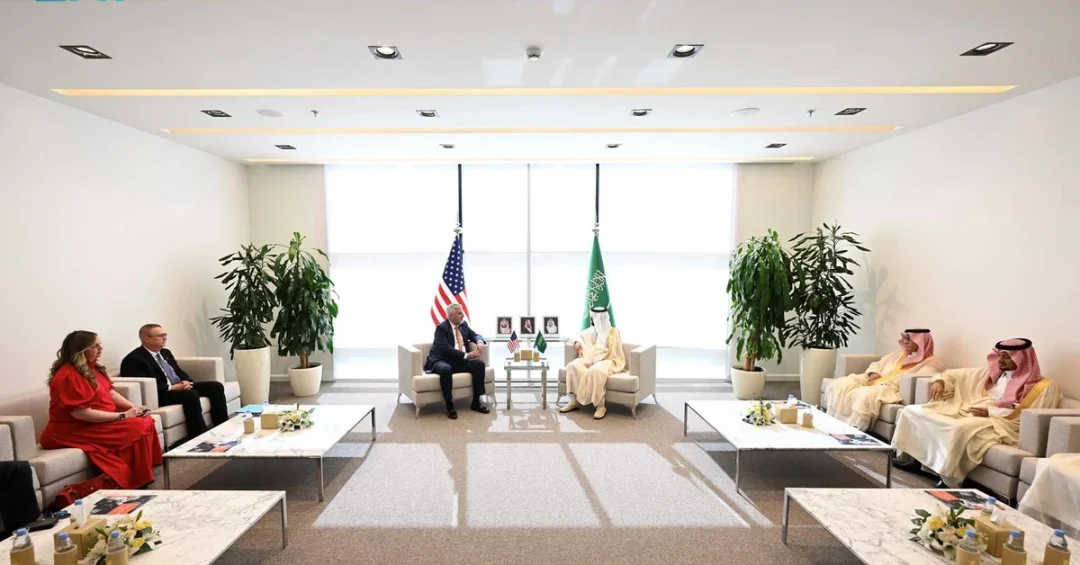
The CEO of the Saudi Food and Drug Authority (SFDA), Dr. Hisham bin Saad Al-Jadhey, received the Governor of the U.S. state of Indiana, Eric Holcomb, and his accompanying delegation at the SFDA headquarters in Riyadh on Sunday, in a meeting that underscored the Kingdom’s growing role as a global hub for biotechnology and pharmaceutical innovation. The discussions, announced through official Saudi channels, focused on strengthening cooperation and partnership in the biotechnology and pharmaceutical industries, with both sides emphasizing the importance of exchanging expertise and best practices. The encounter also covered several topics of mutual interest related to the SFDA’s regulatory and scientific work, reflecting the Authority’s expanding international engagement.
The meeting comes at a time when Saudi Arabia is accelerating its ambitions to become a regional leader in life sciences, advanced manufacturing, and health-sector innovation under Vision 2030. Indiana, home to major pharmaceutical companies, world-class research universities, and a robust life-sciences cluster, represents a natural partner for the Kingdom as it builds out its own biotech ecosystem. For international observers, the sit-down signals that Saudi Arabia’s regulatory institutions are increasingly seen not only as gatekeepers for the domestic market but as collaborators capable of shaping global standards in drug safety, clinical research, and pharmaceutical supply chains. Could this meeting mark the beginning of a deeper, more structured partnership between Riyadh and one of America’s most industrially dynamic states?
Context and Background
The Saudi Food and Drug Authority has evolved considerably since its establishment in 2003, transforming from a newly created regulator into one of the most active and internationally recognized food and drug agencies in the Middle East. Under Dr. Hisham bin Saad Al-Jadhey, the Authority has pursued an agenda of regulatory modernization, digital transformation, and global harmonization, aligning its processes with the best practices of agencies such as the U.S. Food and Drug Administration and the European Medicines Agency. This trajectory has made the SFDA a key institutional pillar of the Kingdom’s health-security architecture and a facilitator of pharmaceutical investment.
Indiana, meanwhile, has long been recognized as a powerhouse in the American life-sciences sector. The state hosts the headquarters or major operations of several global pharmaceutical corporations, a dense network of contract research and manufacturing organizations, and research institutions that consistently rank among the top recipients of National Institutes of Health funding. Governor Eric Holcomb has made international trade and investment missions a signature element of his tenure, seeking to connect Indiana’s companies and universities with fast-growing markets. His visit to Riyadh therefore fits a broader pattern of U.S. state-level engagement with Saudi Arabia that complements federal-level diplomacy.
Why does this meeting matter now? Because the global pharmaceutical landscape is being reshaped by supply-chain diversification, rapid advances in biologics and precision medicine, and a renewed emphasis on regulatory agility. Saudi Arabia has made clear that it intends to be a producer, not merely a consumer, of advanced therapeutics. The Kingdom’s National Biotechnology Strategy, launched in 2024, aims to generate billions of riyals in economic impact and thousands of high-skilled jobs by 2030. Partnerships with established biotech regions such as Indiana can accelerate that journey by transferring know-how, attracting investment, and building trusted regulatory pathways.
Key Details of the Riyadh Meeting
According to the official announcement carried by the Saudi Press Agency, the meeting addressed ways to enhance cooperation and partnership in the biotechnology and pharmaceutical industries. The two sides stressed the importance of exchanging expertise and best practices, a phrase that in regulatory diplomacy often translates into concrete activities such as staff exchanges, joint training programs, shared inspection standards, and mutual recognition of quality certifications. The discussions also touched on several topics of mutual interest related to the SFDA’s work, indicating a wide-ranging agenda that likely included drug registration, pharmacovigilance, clinical trials, and food-safety oversight.
Dr. Al-Jadhey has repeatedly emphasized that international cooperation is central to the SFDA’s mission. Under his leadership, the Authority has signed memoranda of understanding with counterparts in Europe, Asia, and the Americas, joined multilateral regulatory forums, and adopted digital platforms that speed up the review of new medicines. Hosting a U.S. governor at the SFDA headquarters is a notable symbolic and practical step: it places the Authority at the center of a conversation that spans public health, trade, and innovation policy. For Indiana, the meeting offers a gateway to a market of more than 35 million people and a regional launchpad for companies looking to expand across the Gulf.
What specific outcomes might follow from such a high-level encounter? While the official statement did not announce signed agreements, meetings of this kind typically lay the groundwork for future memoranda of understanding, trade delegations, and joint scientific workshops. The presence of an accompanying delegation suggests that representatives from Indiana’s life-sciences industry, academia, or economic-development agencies were part of the conversation, opening the door to concrete commercial and research linkages. The SFDA’s reputation for rigorous but efficient regulation makes it an attractive partner for international firms seeking a trusted entry point into the Kingdom’s rapidly growing healthcare market.
The Strategic Value of Regulatory Cooperation
Regulatory cooperation is often described as the plumbing of international trade in medical products: unglamorous but essential. When two jurisdictions align their standards, companies face lower costs, patients gain faster access to new therapies, and governments can better protect public health. The SFDA has invested heavily in this area, building a regulatory framework that is increasingly compatible with international norms. For Indiana’s pharmaceutical and medical-device companies, a constructive relationship with the SFDA can reduce time-to-market and provide a competitive edge in a region where demand for quality healthcare is rising sharply.
Conversely, Saudi Arabia benefits from exposure to Indiana’s deep expertise in manufacturing, quality assurance, and research commercialization. The Kingdom aims to localize pharmaceutical production, and Indiana’s contract manufacturing organizations and university technology-transfer offices possess precisely the capabilities that Saudi firms and startups need. Joint ventures, licensing agreements, and training partnerships could emerge from the connections made in Riyadh. In a world where health security has become a national-security concern, diversifying pharmaceutical supply chains through trusted partnerships is a shared priority for both Riyadh and Washington’s state-level actors.
Could this meeting also influence broader U.S.-Saudi relations? Subnational diplomacy has become an increasingly important channel for sustaining engagement between the two countries. Governors can move quickly, focus on commercial opportunities, and build relationships that outlast political cycles. Indiana’s outreach to Saudi Arabia complements existing cooperation in energy, defense, and technology, adding a health-and-life-sciences dimension that is directly relevant to citizens in both countries. It also reinforces the message that Saudi Arabia is open for business with American companies and institutions across a wide range of sectors.
International and Regional Impact
At the regional level, the SFDA’s growing international profile positions Saudi Arabia as a standard-setter for the Middle East. Neighboring countries often look to the Kingdom’s regulatory decisions as a benchmark, and the Authority’s partnerships with major global agencies enhance its credibility. A closer relationship with Indiana could encourage other U.S. states and European regions to pursue similar engagements, creating a network of regulatory and commercial partnerships that strengthens the Kingdom’s role as a hub for health innovation. This is consistent with Saudi Arabia’s broader strategy of attracting foreign investment and becoming a knowledge-based economy.
Globally, the meeting reflects a trend toward decentralized international cooperation in health and science. While national governments continue to negotiate trade agreements and treaties, state and regional governments are increasingly active in building sector-specific partnerships. Indiana’s presence in Riyadh is a case in point: it demonstrates that American life-sciences clusters view Saudi Arabia as a priority market and a potential research partner. For international readers, this signals that the Kingdom’s healthcare and pharmaceutical sectors are integrating with global value chains at an accelerating pace, creating opportunities for investors, researchers, and multinational companies alike.
Economic and Strategic Significance
The economic stakes of biotechnology and pharmaceuticals are substantial. Saudi Arabia’s National Biotechnology Strategy targets an economic contribution of approximately 130 billion riyals by 2040, along with tens of thousands of jobs. Achieving those goals requires not only domestic investment but also international partnerships that bring technology, talent, and market access. Indiana’s life-sciences sector, which contributes tens of billions of dollars annually to the state’s economy, offers a proven model of how research universities, multinational corporations, and government policy can combine to create a thriving innovation ecosystem.
For Saudi Arabia, cooperation with Indiana can support several strategic objectives: localizing vaccine and biologic production, enhancing clinical-trial capacity, improving food-safety standards, and building a regulatory workforce with global experience. For Indiana, the Kingdom represents a growing market for pharmaceuticals, medical devices, and health services, as well as a potential source of investment in U.S. research and manufacturing. The meeting therefore has the hallmarks of a mutually beneficial exchange rather than a one-way relationship, reinforcing the Kingdom’s reputation as a reliable and forward-looking partner.
How does this fit into Saudi Arabia’s wider economic diversification? The Kingdom is directing significant resources into sectors such as healthcare, biotechnology, and advanced manufacturing as part of Vision 2030. The Public Investment Fund and other state-backed entities are investing in biotech ventures, while regulatory reforms are making it easier to conduct research and bring products to market. International partnerships like the one discussed with Indiana help de-risk these investments by connecting Saudi projects to established global players and best practices.
Vision 2030 Alignment
The meeting between Dr. Hisham bin Saad Al-Jadhey and Governor Eric Holcomb aligns squarely with Vision 2030’s goals of diversifying the economy, improving quality of life, and positioning Saudi Arabia as a global investment destination. Health-sector transformation is a core pillar of the Vision, and the SFDA plays a vital role in ensuring that new medicines, foods, and medical technologies reach citizens safely and quickly. By building bridges with leading international life-sciences regions, the Authority is helping to create the conditions for a knowledge-driven economy and a more resilient health system.
Looking ahead, the Kingdom’s leadership has made clear that international collaboration is essential to achieving its ambitions. The SFDA’s engagement with Indiana is one of many examples of how Saudi institutions are proactively seeking partners who share a commitment to innovation, quality, and public health. As Saudi Arabia continues to invest in biotechnology, digital health, and pharmaceutical manufacturing, such partnerships will be instrumental in turning Vision 2030’s targets into tangible results. For global audiences, the message is clear: the Kingdom is open to cooperation, eager to exchange expertise, and determined to play a leading role in shaping the future of health and science.
20 Questions
Q1. Who received the Governor of Indiana at the SFDA headquarters in Riyadh?
A1. Dr. Hisham bin Saad Al-Jadhey, CEO of the Saudi Food and Drug Authority, received Indiana Governor Eric Holcomb and his accompanying delegation at the SFDA headquarters in Riyadh on Sunday.
Q2. What was the main focus of the meeting between the SFDA and the Indiana delegation?
A2. The meeting focused on enhancing cooperation and partnership in the biotechnology and pharmaceutical industries, with an emphasis on exchanging expertise and best practices between the two sides.
Q3. When and where did the meeting take place?
A3. The meeting took place on Sunday at the SFDA headquarters in Riyadh, Saudi Arabia, according to the official announcement carried by the Saudi Press Agency.
Q4. What other topics were discussed alongside biotechnology and pharmaceuticals?
A4. The two sides also discussed several topics of mutual interest related to the SFDA’s work, reflecting the Authority’s broad regulatory mandate in food, drug, and medical-device oversight.
Q5. Who is Dr. Hisham bin Saad Al-Jadhey?
A5. Dr. Hisham bin Saad Al-Jadhey is the CEO of the Saudi Food and Drug Authority, the Kingdom’s regulatory body responsible for food safety, pharmaceuticals, medical devices, and related products.
Q6. Who is Eric Holcomb?
A6. Eric Holcomb is the Governor of the U.S. state of Indiana, a state known for its strong life-sciences sector, major pharmaceutical companies, and leading research universities.
Q7. Why is Indiana relevant to Saudi Arabia’s pharmaceutical ambitions?
A7. Indiana hosts major pharmaceutical manufacturers, contract research organizations, and research universities, making it a valuable partner for knowledge transfer, investment, and best-practice exchange.
Q8. What is the Saudi Food and Drug Authority?
A8. The SFDA is Saudi Arabia’s national regulator for food, drugs, medical devices, and related products, established in 2003 and known for its modernization and international harmonization efforts.
Q9. How does this meeting support Saudi Arabia’s Vision 2030?
A9. It supports Vision 2030 by advancing economic diversification, health-sector transformation, and international partnerships that build a knowledge-based economy and enhance quality of life.
Q10. Did the meeting produce any signed agreements?
A10. The official announcement did not mention signed agreements, but such high-level meetings typically lay the groundwork for future memoranda of understanding and joint initiatives.
Q11. What is the National Biotechnology Strategy?
A11. It is a Saudi initiative launched in 2024 that aims to generate significant economic impact and thousands of jobs by 2030 through biotechnology development and localization.
Q12. How does regulatory cooperation benefit pharmaceutical companies?
A12. Aligning standards reduces costs, accelerates market access, and builds trust, allowing companies to bring products to patients more efficiently across different jurisdictions.
Q13. What might follow from this meeting in practical terms?
A13. Potential outcomes include memoranda of understanding, trade delegations, joint scientific workshops, staff exchanges, and commercial partnerships between Saudi and Indiana institutions.
Q14. Why is biotechnology important to Saudi Arabia’s economy?
A14. Biotechnology can drive diversification, create high-skilled jobs, attract foreign investment, and strengthen health security by enabling local production of advanced therapeutics.
Q15. What role do U.S. states play in international engagement?
A15. U.S. states often pursue their own trade and investment missions, allowing them to build sector-specific relationships that complement federal diplomacy and create commercial opportunities.
Q16. How does the SFDA engage internationally?
A16. The SFDA signs memoranda of understanding, joins multilateral regulatory forums, adopts digital review platforms, and hosts delegations to exchange expertise and align standards.
Q17. What are the benefits for Indiana from this meeting?
A17. Indiana gains access to a growing market of over 35 million people, potential investment opportunities, and a trusted regulatory partner for its life-sciences companies.
Q18. What sectors does the SFDA regulate?
A18. The SFDA regulates food, drugs, medical devices, cosmetics, pesticides, and other products, ensuring safety, quality, and efficacy for consumers in Saudi Arabia.
Q19. How does this meeting reflect Saudi Arabia’s global role?
A19. It shows the Kingdom’s institutions actively building international partnerships, positioning Saudi Arabia as a hub for health innovation and a reliable partner in global life sciences.
Q20. What is the broader significance of this meeting for Saudi-U.S. relations?
A20. It strengthens subnational ties, adds a health-and-life-sciences dimension to bilateral cooperation, and reinforces Saudi Arabia’s openness to American business and expertise.
Reader Feedback
We value your thoughts. Please share your feedback on this article.
Your feedback helps us improve our coverage.