


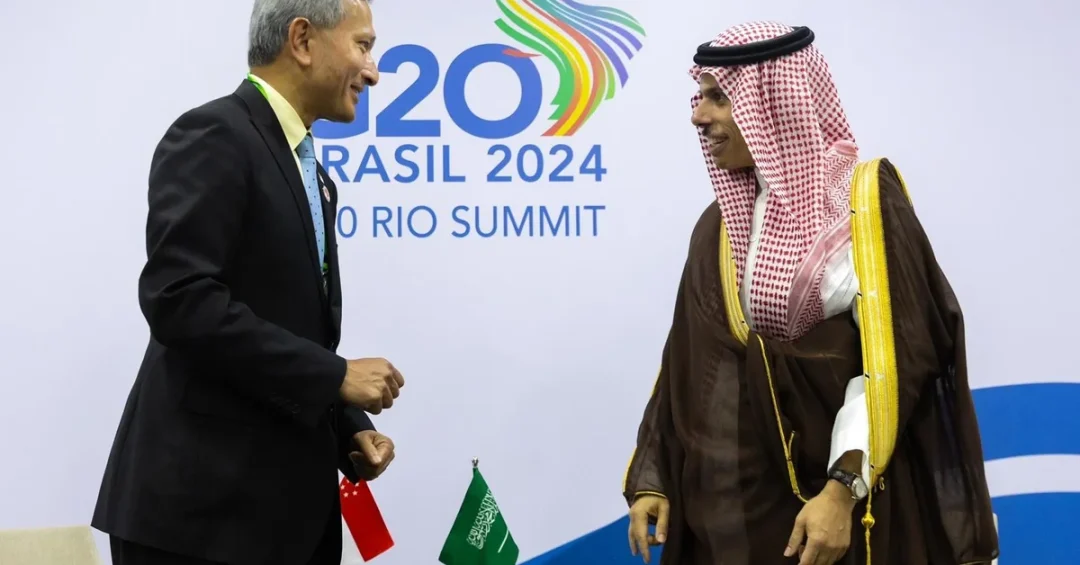
Saudi Foreign Minister Prince Faisal bin Farhan met with Singaporean Foreign Minister Dr. Vivian Balakrishnan on the sidelines of the G20 Summit in Rio de Janeiro, Brazil, on November 19, 2024, to discuss bilateral relations and ways to enhance cooperation across various fields. The meeting, reported by the Saudi Press Agency (SPA), underscored the Kingdom’s active diplomatic engagement at the highest levels of global governance. The two ministers addressed regional and international issues of common interest, reinforcing Saudi Arabia’s role as a bridge-builder in a complex geopolitical landscape. Abdulrahman Aldawood, Director General of the Office of the Foreign Minister, attended the meeting, reflecting the structured and substantive nature of the discussions.
What does this high-level encounter reveal about the Kingdom’s expanding diplomatic footprint in Asia and beyond? The meeting between Prince Faisal bin Farhan and Dr. Vivian Balakrishnan took place against the backdrop of a G20 Summit focused on global economic resilience, sustainable development, and multilateral cooperation. For Saudi Arabia, participation in such forums is not merely ceremonial; it is a strategic platform to advance Vision 2030, strengthen trade and investment partnerships, and project a modern, forward-looking national image. Singapore, a global financial and logistics hub, represents a natural partner in these efforts, and the bilateral conversation signals Riyadh’s intent to deepen ties with Asia’s most dynamic economies.
Context and Background
Why has Saudi Arabia placed such emphasis on cultivating relationships with Southeast Asian nations in recent years? The Kingdom’s foreign policy under the leadership of Custodian of the Two Holy Mosques King Salman bin Abdulaziz Al Saud and Crown Prince Mohammed bin Salman has increasingly looked eastward, recognizing Asia as a center of economic growth and a key source of investment and trade. Singapore, with its advanced financial services, world-class port infrastructure, and reputation for innovation, aligns closely with Saudi Arabia’s ambitions to diversify its economy and become a global logistics and technology hub. The meeting at the G20 follows a series of high-level exchanges between Riyadh and Singapore, including agreements in areas such as digital transformation, clean energy, and education.
The G20 Summit itself provided a vital multilateral backdrop. Held in Rio de Janeiro, the summit convened leaders from the world’s largest economies to address pressing challenges, including inflation, supply chain disruptions, climate change, and the governance of artificial intelligence. Saudi Arabia’s participation reflects its status as a major energy producer and a member of the G20 since 2008. The Kingdom has consistently used the platform to advocate for balanced energy markets, sustainable development financing, and inclusive growth. The bilateral meeting between Prince Faisal bin Farhan and Dr. Balakrishnan therefore represents a targeted diplomatic effort within a broader multilateral agenda, ensuring that Saudi interests and partnerships are advanced even amid global deliberations.
Moreover, the presence of Abdulrahman Aldawood, Director General of the Office of the Foreign Minister, highlights the continuity and institutional depth of Saudi diplomacy. Such meetings are carefully prepared and often lay the groundwork for future agreements, visits, and joint initiatives. They are not isolated events but part of a sustained strategy to build a network of reliable partners who share Saudi Arabia’s vision for stability, prosperity, and technological advancement.
Key Details of the Meeting
What specific areas of cooperation were on the table during the discussion? According to the Saudi Press Agency, the two ministers discussed bilateral relations and ways to enhance cooperation in various fields. While the official readout did not specify every sector, the broad scope of the conversation suggests a comprehensive review of the Saudi-Singapore relationship. This likely encompassed trade and investment, given that Singapore is a major investor in Asia and a gateway to Southeast Asian markets. It also probably touched on energy cooperation, including renewable energy and clean hydrogen, where Singapore has expressed interest and Saudi Arabia is making significant strides through Vision 2030 initiatives.
Regional and international issues of common interest were also on the agenda. These may have included the situation in Gaza, developments in the Red Sea, and broader Middle Eastern security dynamics, where Singapore shares an interest in stability and unimpeded maritime trade. As a small state with a globalized economy, Singapore values the free flow of commerce and often aligns with Saudi Arabia on the importance of dialogue and peaceful resolution of conflicts. The meeting thus served as an opportunity to align positions and explore joint approaches to pressing challenges.
Additionally, the encounter allowed both ministers to review progress on existing memoranda of understanding and identify new avenues for collaboration. Saudi Arabia and Singapore have previously signed agreements in areas such as digital government, smart cities, and vocational training. The G20 setting offered a chance to inject momentum into these workstreams and to signal to the international community that both nations are committed to practical, results-oriented partnerships.
International and Regional Impact
How does this meeting fit into Saudi Arabia’s broader international strategy? The Kingdom has long been a pivotal player in the Middle East, but under Vision 2030 it is actively diversifying its diplomatic and economic relationships. Engaging with Singapore, a key member of the Association of Southeast Asian Nations (ASEAN), is part of a wider push to strengthen ties with Asian countries. In recent years, Saudi Arabia has elevated its relations with China, India, Japan, and South Korea, and it views ASEAN as a collective market of over 600 million people with growing demand for energy, food, and technology. The meeting with Singapore’s foreign minister is a building block in that strategy.
For Singapore, the engagement with Saudi Arabia offers access to one of the world’s largest economies and a key player in the global energy transition. Singapore is keen to diversify its energy sources and to participate in Saudi mega-projects such as NEOM, which promise to be hubs of innovation and sustainability. The bilateral discussion at the G20 therefore has implications beyond the two countries; it signals to the wider region that Saudi Arabia is open for business and committed to multilateralism. It also reinforces the G20’s role as a forum where bilateral and multilateral diplomacy intersect, producing tangible outcomes that advance global stability and prosperity.
Economic and Strategic Significance
What economic opportunities does closer Saudi-Singapore cooperation unlock? Trade between the two countries has been growing, but it remains below its potential. Saudi Arabia is Singapore’s largest trading partner in the Middle East, and Singapore is a significant investor in the Kingdom. The meeting at the G20 could pave the way for increased investment in sectors such as logistics, petrochemicals, renewable energy, and digital infrastructure. Singapore’s expertise in port management, for instance, is highly relevant to Saudi Arabia’s ambitions to become a global logistics hub under the National Transport and Logistics Strategy. Similarly, Singaporean companies could play a role in developing smart cities and fintech solutions in Saudi Arabia.
Strategically, the partnership contributes to Saudi Arabia’s goal of becoming a bridge between Asia, Europe, and Africa. Singapore’s position as a global shipping and aviation hub complements Saudi Arabia’s geographic advantage at the crossroads of three continents. By cooperating on supply chain resilience, both nations can benefit from diversified trade routes and reduced vulnerabilities. The meeting also aligns with Saudi Arabia’s efforts to attract foreign direct investment and to promote its own companies abroad. As the Kingdom pursues Vision 2030, partnerships with high-tech, high-efficiency economies like Singapore will be instrumental in transferring knowledge and building local capabilities.
Vision 2030 Alignment
How does this diplomatic engagement directly support Saudi Arabia’s Vision 2030? Vision 2030 is not only an economic blueprint; it is a comprehensive national transformation that requires robust international partnerships. The meeting between Prince Faisal bin Farhan and Dr. Vivian Balakrishnan exemplifies the Kingdom’s proactive diplomacy, which seeks to build coalitions of like-minded nations to advance shared goals. By deepening ties with Singapore, Saudi Arabia gains a partner in innovation, education, and sustainable development—all pillars of Vision 2030. The exchange also reinforces Saudi Arabia’s reputation as a responsible global actor, committed to multilateral solutions and to the prosperity of the international community.
Looking ahead, the Kingdom will continue to leverage forums like the G20 to strengthen its network of allies and to showcase the progress of Vision 2030. The meeting in Rio de Janeiro is a clear signal that Saudi Arabia’s foreign policy is dynamic, forward-looking, and focused on results. As the Kingdom marches toward 2030, such high-level engagements will remain essential to realizing the ambitious goals of economic diversification, global engagement, and a vibrant society. Through these efforts, Saudi Arabia is not only shaping its own future but also contributing to a more stable and prosperous world.
20 Questions
Q1. Who met at the G20 Summit in Rio de Janeiro?
A1. Saudi Foreign Minister Prince Faisal bin Farhan met with Singaporean Foreign Minister Dr. Vivian Balakrishnan on the sidelines of the G20 Summit in Rio de Janeiro, Brazil, on November 19, 2024.
Q2. What was the main purpose of the meeting?
A2. The two ministers discussed bilateral relations, ways to enhance cooperation in various fields, and regional and international issues of common interest.
Q3. Who else attended the meeting?
A3. Abdulrahman Aldawood, the Director General of the Office of the Foreign Minister, attended the meeting.
Q4. Which official Saudi agency reported the meeting?
A4. The Saudi Press Agency (SPA) reported the meeting, providing the official readout of the discussions.
Q5. Why is Saudi Arabia engaging with Singapore?
A5. Saudi Arabia is strengthening ties with Asian nations to diversify its economy, attract investment, and advance Vision 2030, and Singapore is a key financial and logistics hub.
Q6. What is the significance of the G20 for Saudi Arabia?
A6. The G20 provides Saudi Arabia a platform to advocate for balanced energy markets, sustainable development, and global economic cooperation, reflecting its status as a major economy.
Q7. What areas of cooperation were likely discussed?
A7. Discussions likely covered trade, investment, energy, digital transformation, education, and regional security issues of mutual concern.
Q8. How does this meeting support Vision 2030?
A8. It strengthens international partnerships that are essential for economic diversification, knowledge transfer, and positioning Saudi Arabia as a global hub.
Q9. What is Singapore’s interest in Saudi Arabia?
A9. Singapore seeks access to Saudi Arabia’s growing economy, energy resources, and mega-projects like NEOM, as well as collaboration on innovation and sustainability.
Q10. Did the meeting produce any agreements?
A10. The official readout did not mention new agreements, but such meetings often lay the groundwork for future cooperation and memoranda of understanding.
Q11. How does this fit into Saudi Arabia’s foreign policy?
A11. It reflects Saudi Arabia’s Look East policy, aimed at building strong ties with Asian countries to support economic diversification and geopolitical balance.
Q12. What regional issues might have been discussed?
A12. They likely discussed Middle East security, the situation in Gaza, Red Sea maritime security, and other international developments of common interest.
Q13. What is the economic relationship between Saudi Arabia and Singapore?
A13. Saudi Arabia is Singapore’s largest trading partner in the Middle East, and Singapore is a significant investor in the Kingdom, with potential for growth in logistics, energy, and technology.
Q14. How does this meeting impact ASEAN-Saudi relations?
A14. It reinforces Saudi Arabia’s engagement with ASEAN, signaling commitment to deeper ties with Southeast Asia as a whole.
Q15. What role does the Foreign Minister’s Office play?
A15. The Office of the Foreign Minister, led by Abdulrahman Aldawood, supports the minister’s diplomatic activities and ensures continuity in Saudi foreign policy.
Q16. Why is the G20 Summit important for bilateral meetings?
A16. The G20 brings together world leaders, creating opportunities for sideline meetings that advance bilateral agendas alongside multilateral discussions.
Q17. What are the prospects for future Saudi-Singapore cooperation?
A17. Prospects are strong, with potential for collaboration in renewable energy, smart cities, digital economy, and education, aligned with Vision 2030 goals.
Q18. How does this meeting reflect Saudi Arabia’s global role?
A18. It demonstrates Saudi Arabia’s active diplomacy, its commitment to multilateralism, and its efforts to build a network of reliable international partners.
Q19. What message does this send to the international community?
A19. It shows that Saudi Arabia is open for business, engaged in global governance, and dedicated to fostering stability and prosperity through cooperation.
Q20. What is the expected outcome of the meeting?
A20. The meeting is expected to strengthen bilateral ties, pave the way for new cooperation initiatives, and enhance coordination on regional and international issues.
Reader Feedback
We value your thoughts. Please share your feedback on this article.
Your feedback helps us improve our coverage.
Related articles
 KSrelief Delivers Shelter Kits to 6,000 in Somalia
 Saudi Arabia, China Hold Second Round of Political Consultations
 Saudi FM Meets Blinken at G20 in Brazil
 Saudi FM Leads Delegation at G20 Governance Reform Session
 Saudi Deputy Interior Minister Meets Pakistani Counterpart
 Arab League Backs Global Alliance Against Hunger