


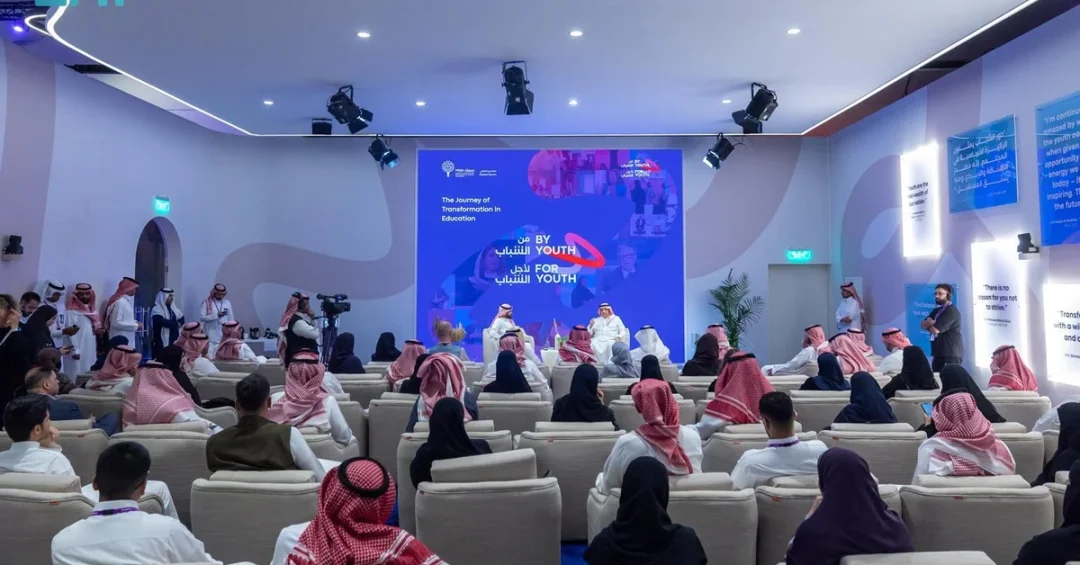
Saudi Arabia’s Minister of Education, Yousef bin Abdullah Al-Benyan, told an international youth audience in Riyadh that strengthening the values system is the decisive element in modern education, describing shared purpose and integrated institutional effort as the true foundation of success. Speaking during the eighth edition of the Misk Global Forum 2024, which opened on Monday at Mohammed Bin Salman Nonprofit City (Misk City) and runs through November 19, the minister outlined how the Kingdom’s education system is being reshaped around knowledge, skills, and values together.
The forum, held under the theme “By Youth For Youth,” brings together young people from Saudi Arabia and around the world for two days of dialogue, workshops, and networking. The minister’s session placed education at the center of that conversation, signaling that the Kingdom regards human capability as the engine of its long-term transformation. How does a country of more than 35 million people modernize learning at every stage — from early childhood to school leadership — while keeping cultural values at the core? The minister’s answer was that values are not a supplement to academic achievement, but the platform on which it is built. His remarks, carried by the Saudi Press Agency (SPA), offer one of the clearest official statements yet of the philosophy guiding Saudi education reform.
Context and Background
Why is the Misk Global Forum an important stage for this message? Organized by the Mohammed bin Salman Foundation (Misk), the forum has grown into one of the region’s largest youth-focused gatherings, and the 2024 edition is the first to be held entirely within Misk City, a purpose-built nonprofit hub in Riyadh designed for youth empowerment, entrepreneurship, and the creative industries. By choosing this venue, the Ministry of Education underscored that formal schooling and youth-focused civic institutions are meant to reinforce one another.
The minister’s address also reflects a broader shift in Saudi education policy. The establishment of the National Curriculum Center marked a deliberate move away from curricula focused narrowly on memorization toward frameworks that combine knowledge, applied skills, and values. Under this approach, a student is expected to master subject matter, demonstrate practical competencies, and internalize the ethical and civic principles that underpin Saudi society. For international observers, this is a notable evolution: the Kingdom is positioning its classrooms as places where global competitiveness and national identity are developed side by side rather than in tension.
Finally, the timing matters. The forum opened as Saudi Arabia accelerates delivery of its national transformation programs, and education is one of the sectors where results compound over decades rather than quarters. The minister’s emphasis on values therefore reads as a statement about the kind of generation the Kingdom intends to produce by 2030 and beyond — one that is innovative, competitive, and grounded.
Key Details of the Minister’s Remarks
In his session, Yousef bin Abdullah Al-Benyan said that education in the Kingdom today does not focus solely on knowledge. He pointed to the National Curriculum Center, explaining that curricula have evolved to be both knowledge-based and skill-oriented, with a deliberate focus on values. This three-part design — knowledge, skills, values — is the operative framework the Ministry of Education now applies across the system.
The minister also highlighted early childhood education, describing targeted efforts to enhance skills from ages three to six. The goal, he said, is to create an innovative and competitive generation by 2030, aligned with the needs of the labor market across the public, private, and nonprofit sectors. That alignment language is significant: it links classroom outcomes directly to employment pathways and to the diversification of the Saudi economy.
On the school environment, Al-Benyan said the ministry is focused on relieving school principals and teachers of administrative burdens so they can concentrate on teaching and students. He added that the ministry is enhancing the role of curricula and their components, signing international agreements to develop teachers — described as the cornerstone of the educational system — and concluding agreements with international universities to develop the skills of school principals. Each element targets a different layer of the system: the learner, the teacher, and the school leader.
Why Values Are Central to the Reform Agenda
The minister’s argument that success comes through integrated efforts — with each sector within an institution playing a crucial role — is more than a management principle. It is a design choice. In a system serving millions of students, improvement cannot rest on any single lever: not curriculum alone, not teacher training alone, not infrastructure alone. Values function as the connective tissue that keeps those levers pointed in the same direction.
How does a values-based approach translate into measurable outcomes? Officials frame it as the cultivation of responsibility, integrity, and a commitment to collective achievement — qualities that employers, universities, and communities all rely on. By embedding these principles in curricula from the earliest ages, the Kingdom aims to reduce the gap between what students learn and how they behave as citizens and professionals. For international audiences, this mirrors a global conversation about character education, but it is being pursued in Saudi Arabia with unusual system-wide coordination.
The emphasis on teachers and principals is equally telling. International agreements to develop educators and school leaders acknowledge that reformed curricula only succeed when the people delivering them are supported, trained, and trusted. By freeing principals and teachers from administrative overload, the ministry is betting that time and focus are the scarcest resources in any school — and the ones most likely to change results.
International and Regional Impact
Saudi Arabia’s education reforms carry weight well beyond its borders. As the largest economy in the Middle East and a G20 member, the Kingdom’s approach to human capital influences regional labor markets, where Saudi graduates increasingly compete and collaborate. The minister’s remarks at a forum that welcomes international youth signal openness to global partnerships — particularly the university agreements aimed at developing school leadership — while keeping the values framework rooted in Saudi identity.
For regional neighbors pursuing their own modernization agendas, the Saudi model offers a reference point: ambitious curricular reform, early childhood investment, and educator development delivered as a coordinated package rather than isolated initiatives. The presence of international participants at the Misk Global Forum also matters diplomatically. It places Saudi youth at the center of conversations about the future of work, technology, and society, reinforcing the Kingdom’s role as a convenor of global dialogue rather than merely a participant in it. What message does that send to young people watching from abroad? That Saudi Arabia intends to compete on talent, and to do so on its own cultural terms.
Economic and Strategic Significance
The economic logic behind the minister’s address is straightforward. A generation that is innovative, competitive, and aligned with labor market needs across the public, private, and nonprofit sectors is also a generation that can sustain economic diversification long after the current investment cycle. Education is therefore not a social expenditure in this framing; it is infrastructure for the next phase of national growth.
Alignment with the labor market is the key phrase. Saudi Arabia is expanding sectors — technology, tourism, entertainment, advanced manufacturing, renewable energy — that require skills different from those the economy demanded a generation ago. By starting with ages three to six and continuing through school leadership development, the ministry is building a pipeline rather than patching a shortage. For international investors and partners, that pipeline is a signal of long-term seriousness. For Saudi families, it is a promise that schooling will connect to opportunity. The strategic significance, in short, is that the Kingdom is treating education as the foundation of everything else it intends to build.
Vision 2030 Alignment
The minister’s remarks map directly onto Saudi Vision 2030, whose human capability development programs treat education as a pillar of economic transformation. The goal of an innovative and competitive generation by 2030 is not a slogan but a target embedded in national planning, and the instruments described at the forum — the National Curriculum Center, early childhood investment, teacher and principal development, and reduced administrative burden on educators — are the delivery mechanisms.
Just as important is the values dimension. Vision 2030 envisions a vibrant society alongside a thriving economy, and the minister’s insistence that values are the foundation of educational success reflects that dual ambition. By convening youth from Saudi Arabia and around the world under the theme “By Youth For Youth,” the Misk Global Forum demonstrates that the Kingdom’s reform agenda is designed with, and for, the generation that will carry it forward. If values are the foundation, then the structure rising above it — a diversified economy, a confident society, and a globally engaged nation — is being built to last.
20 Questions
Q1. What did the Saudi Minister of Education say about values in education?
A1. Yousef bin Abdullah Al-Benyan said strengthening the values system is the critical element in education today and fundamental to success, emphasizing that achievement comes through integrated efforts in which every sector of an institution plays a crucial role.
Q2. Where did the minister deliver these remarks?
A2. He spoke during a session at the eighth edition of the Misk Global Forum 2024, held at Mohammed Bin Salman Nonprofit City, known as Misk City, in Riyadh, according to the Saudi Press Agency.
Q3. What is the theme of the Misk Global Forum 2024?
A3. The forum is held under the theme “By Youth For Youth” and gathers young people from Saudi Arabia and around the world. The 2024 edition ran until November 19 in Riyadh.
Q4. What is the National Curriculum Center and why was it mentioned?
A4. The National Curriculum Center is the body through which Saudi curricula were reformed. The minister cited it to explain that education now combines knowledge, skills, and values rather than focusing on knowledge alone.
Q5. How has the Saudi curriculum changed, according to the minister?
A5. Al-Benyan said the curriculum has evolved to be both knowledge-based and skill-oriented, with a deliberate focus on values, reflecting a shift away from purely knowledge-centered instruction toward broader student development.
Q6. Which age group does the ministry prioritize for early skills development?
A6. The Ministry of Education focuses on early childhood, specifically ages three to six, aiming to build foundational skills that prepare students for later learning and long-term competitiveness.
Q7. What generation does Saudi education aim to produce by 2030?
A7. The minister said the goal is to create an innovative and competitive generation by 2030, aligned with labor market needs in the public, private, and nonprofit sectors.
Q8. How is the ministry supporting school principals and teachers?
A8. The ministry is relieving principals and teachers of administrative tasks so they can focus on teaching and students, and it is signing agreements with international universities to develop the skills of school principals.
Q9. What did the minister call the cornerstone of the educational system?
A9. Al-Benyan described teachers as the cornerstone of the educational system, noting that the ministry has signed international agreements aimed at developing teachers and strengthening their capabilities.
Q10. What is Misk City?
A10. Misk City is the Mohammed Bin Salman Nonprofit City in Riyadh, a dedicated hub for youth empowerment and innovation that hosted the eighth Misk Global Forum, reflecting Saudi investment in young people.
Q11. Who organizes the Misk Global Forum?
A11. The forum is organized by the Mohammed bin Salman Foundation, known as Misk, which supports youth development, entrepreneurship, and creativity across the Kingdom and internationally.
Q12. Why does the forum’s “By Youth For Youth” theme matter?
A12. The theme places young people at the center of dialogue and decision-making, showing that Saudi Arabia’s transformation agenda is designed with the generation that will implement and sustain it.
Q13. How do values connect to labor market alignment?
A13. Officials frame values such as responsibility and integrity as qualities employers rely on, so embedding them in education helps align graduates’ skills and conduct with the expectations of public, private, and nonprofit employers.
Q14. What does “integrated efforts” mean in the minister’s remarks?
A14. It means success depends on every sector within an institution working together, rather than on any single actor, which is why the ministry targets learners, teachers, principals, and curricula simultaneously.
Q15. How does this address Vision 2030?
A15. Vision 2030 treats human capability development as a pillar of economic transformation, and the minister’s goals for education, including an innovative generation by 2030, are direct expressions of that national strategy.
Q16. What role do international partnerships play in Saudi education reform?
A16. The ministry has signed international agreements to develop teachers and agreements with international universities to develop school principals, bringing global expertise into the Kingdom’s system while retaining Saudi values and priorities.
Q17. Why is early childhood education strategically important?
A17. Investing in ages three to six builds cognitive and social foundations that compound over time, making later schooling more effective and supporting the long-term competitiveness of the Saudi workforce.
Q18. What message does the forum send to international audiences?
A18. It signals that Saudi Arabia is open to global dialogue and partnerships in education, and that it intends to compete on talent while grounding its reforms in national identity and values.
Q19. How does relieving teachers of administrative tasks improve education?
A19. It allows educators to devote more time to instruction and student development, which is widely understood to improve teaching quality and the overall learning environment in schools.
Q20. What is the expected long-term outcome of these reforms?
A20. The Kingdom aims to produce a generation that is innovative, competitive, and values-driven, supporting economic diversification, a vibrant society, and Saudi Arabia’s continued global engagement beyond 2030.
Reader Feedback
We value your thoughts. Please share your feedback on this article.
Your feedback helps us improve our coverage.
Related articles
 Misk Global Forum Impact Reaches 78 Countries
 Misk Global Forum Reaches 27,000 Youth Worldwide
 Tuwaiq Academy and Misk Partner to Empower Saudi Tech Talent
 WAMY Praises Saudi Arabia’s Child Welfare Efforts
 NSHR: Protecting Children’s Rights Builds Safe, Stable Society
 Misk, Gates Foundations Launch Challenge for Change Program