


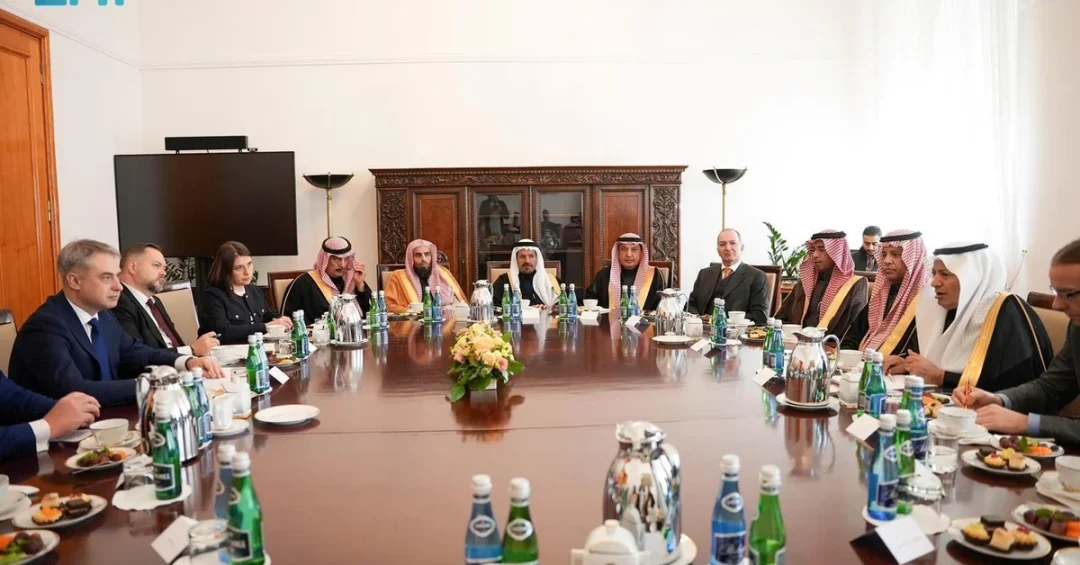
Saudi Arabia and Poland have moved to deepen their digital and technological partnership, with Polish Deputy Prime Minister and Minister of Digital Affairs Krzysztof Gawkowski endorsing new collaborative digital initiatives between the two nations during a high-level meeting in Warsaw. The talks, held on Tuesday in the Polish capital, brought together Gawkowski, Chairman of the Federation of Saudi Chambers Hassan Al-Huwaizi, and a delegation of Saudi businessmen, with discussions focused on expanding trade and investment ties across the digital economy.
The meeting reflects a shared recognition that technology, cybersecurity, and artificial intelligence are becoming central pillars of the Saudi-Polish relationship, building on decades of cooperation in energy, agriculture, and manufacturing. For Saudi Arabia, the engagement aligns with the Kingdom’s Vision 2030 agenda, which seeks to diversify the national economy away from oil dependence and position the country as a global hub for innovation and digital transformation. For Poland, one of Central Europe’s fastest-growing technology markets, the partnership offers access to Gulf investment and a gateway to regional opportunities. Could this meeting mark the beginning of a new chapter in Saudi-European digital cooperation?
Context and Background
Saudi-Polish relations have steadily expanded since the establishment of diplomatic ties, with bilateral trade reaching significant levels in sectors such as petrochemicals, food processing, and defense. In recent years, however, both governments have identified the digital economy as an area of untapped potential. Poland has emerged as a European leader in software development and IT outsourcing, ranking among the top nations globally for the quality and number of programmers. Saudi Arabia, meanwhile, has accelerated its own digital agenda through initiatives led by the Ministry of Communications and Information Technology and the Saudi Data and Artificial Intelligence Authority (SDAIA), which oversees national AI strategy and data governance.
The Federation of Saudi Chambers, which represents the Kingdom’s private sector, has been instrumental in facilitating business delegations abroad to explore partnerships. The visit to Warsaw was organized to connect Saudi investors and entrepreneurs with Polish counterparts in technology, cybersecurity, and digital infrastructure. Poland’s Ministry of Digital Affairs, under Gawkowski’s leadership, has prioritized international cooperation on cybersecurity and emerging technologies, viewing the Gulf as a strategic partner. How did the two countries arrive at this moment of digital convergence, and what does it mean for businesses on both sides?
Historically, Saudi-Polish trade has been anchored in traditional sectors, but the momentum is shifting. Poland’s accession to the European Union in 2004 opened new avenues for Saudi exports, while Saudi Arabia’s Vision 2030 reforms have created a more welcoming environment for foreign investment. The establishment of the Saudi-Polish Business Council in 2022 provided a formal platform for private-sector dialogue, and its chairman, Abdullah Abu Dabeel, has been a vocal advocate for deeper cooperation in technology. The Warsaw meeting thus represents a culmination of years of groundwork, now given fresh impetus by the global race for AI and digital sovereignty.
Key Details of the Warsaw Meeting
During the meeting, Deputy Prime Minister Gawkowski expressed Poland’s keen interest in enhancing cooperation with Saudi Arabia on digital development and cybersecurity, noting the substantial progress underway in both countries. He highlighted that collaborative digital initiatives would benefit both nations, particularly as Poland seeks to expand its technological footprint beyond Europe and Saudi Arabia aims to attract world-class expertise. Gawkowski’s endorsement signals political support at the highest level for deeper engagement, which could pave the way for joint ventures, knowledge exchange, and investment flows.
Federation of Saudi Chambers Chairman Hassan Al-Huwaizi stressed the importance of augmenting Saudi-Polish investments in technology and digital transformation, recognizing the pivotal role these fields play in economic advancement and business expansion. He called for concrete steps to translate dialogue into deals, including the facilitation of business-to-business meetings and the removal of regulatory hurdles. Al-Huwaizi’s remarks underscore the private sector’s appetite for partnerships that can deliver tangible results, from software development to smart city solutions.
Saudi-Polish Business Council Chairman Abdullah Abu Dabeel pointed to a particularly promising avenue: Saudi Arabia’s ambitious plan for a US$100 billion artificial-intelligence project, coupled with Poland’s prominent position as the third-ranked country globally in terms of the quality and number of programmers. This combination, he argued, presents a natural synergy. Saudi Arabia offers capital, market scale, and a strategic location at the crossroads of three continents; Poland offers a deep pool of engineering talent and a proven track record in delivering complex IT projects. Could this complementarity be the foundation for a lasting digital alliance?
International and Regional Impact
The Saudi-Polish digital partnership carries implications beyond the bilateral relationship. For the European Union, Saudi Arabia’s engagement with Poland—a member state—offers a channel for broader cooperation on data flows, cybersecurity standards, and AI governance. As the EU develops its own regulatory framework for artificial intelligence, dialogue with Gulf partners becomes increasingly important to ensure interoperability and avoid fragmentation. Poland, as a rising tech hub, can serve as a bridge between European norms and Saudi ambitions, facilitating investment and joint research.
Regionally, the partnership could enhance Saudi Arabia’s position as a digital leader in the Middle East and North Africa. By collaborating with Polish firms, the Kingdom can accelerate the adoption of advanced technologies in sectors such as healthcare, logistics, and education, while also building local capacity through training and education initiatives. For Poland, the Gulf represents a high-growth market for its IT exports and a source of capital for its own tech ecosystem. The meeting in Warsaw thus reflects a multipolar approach to digital diplomacy, where middle powers like Poland and Saudi Arabia can forge pragmatic alliances that complement larger geopolitical blocs. What might this mean for other European countries watching from the sidelines?
The timing is also significant. Global competition for AI talent and investment is intensifying, with the United States, China, and the European Union all vying for leadership. Saudi Arabia’s US$100 billion AI project, part of its broader National Strategy for Data and AI, aims to make the Kingdom a top global player by 2030. Poland’s programmers are in high demand worldwide, and by partnering with Saudi Arabia, Polish companies can diversify their client base and gain access to large-scale projects. The collaboration could also spur joint ventures in cybersecurity, a field where both countries have developed specialized expertise and where threats are increasingly transnational.
Economic and Strategic Significance
Economically, the digital partnership promises to boost bilateral trade and investment flows. Saudi Arabia is Poland’s largest trading partner in the Middle East, with total trade exceeding US$7 billion annually, but digital services currently account for a small fraction. The Warsaw talks aim to change that by encouraging Polish tech firms to establish a presence in the Kingdom and Saudi investors to explore opportunities in Poland’s thriving startup scene. The Federation of Saudi Chambers has identified technology as a priority sector for outbound investment, and Polish companies specializing in AI, cloud computing, and fintech are well-positioned to benefit.
Strategically, the partnership supports Saudi Arabia’s goal of becoming a knowledge-based economy. Vision 2030 calls for increased private-sector contribution to GDP, higher female workforce participation, and greater reliance on non-oil revenues. Digital transformation cuts across all these objectives, enabling e-government services, smart manufacturing, and digital entrepreneurship. By tapping into Poland’s talent pool, Saudi Arabia can accelerate its own digital upskilling programs, including the Saudi Digital Academy and the National IT Development Program. For Poland, the alliance offers a counterweight to dependence on Western European markets and a chance to play a larger role in global tech governance.
Moreover, the collaboration could extend to third markets. Saudi Arabia’s strategic location and free trade agreements position it as a launchpad for Polish firms seeking to serve the wider Gulf and African markets. Conversely, Polish companies can help Saudi firms navigate European regulations and access EU funding for research and innovation. The meeting in Warsaw included discussions on joint ventures in cybersecurity, where both nations face common threats and share an interest in developing sovereign capabilities. Could this lead to a formal digital cooperation agreement in the near future?
Vision 2030 Alignment
Saudi Arabia’s Vision 2030, launched in 2016 under the leadership of Crown Prince Mohammed bin Salman, seeks to transform the Kingdom into a diversified, innovation-driven economy. Digital transformation is a cornerstone of this vision, with targets including full digital government services, nationwide 5G coverage, and a thriving AI sector. The partnership with Poland directly supports these goals by bringing in expertise, investment, and best practices. The Ministry of Communications and Information Technology has been tasked with building a world-class digital infrastructure, and international collaborations like this one are essential to achieving that ambition.
Furthermore, the partnership underscores Saudi Arabia’s commitment to international engagement and knowledge exchange. By working with Poland—a fellow member of the global community committed to technological progress—the Kingdom reinforces its role as a responsible global actor and a magnet for talent and innovation. The Saudi-Polish Business Council will play a key role in monitoring progress and facilitating new deals, ensuring that the momentum from Warsaw translates into tangible outcomes. As both nations look ahead, the digital partnership stands as a model for how countries can leverage their complementary strengths to drive mutual prosperity. With Vision 2030 as a guiding framework, Saudi Arabia is poised to deepen its ties with Poland and other like-minded partners, advancing a future built on innovation, security, and shared opportunity.
20 Questions
Q1. What was the main purpose of the meeting in Warsaw between Saudi and Polish officials?
A1. The meeting aimed to explore trade and investment partnership prospects, with a particular focus on digital development, cybersecurity, and artificial intelligence collaboration between Saudi Arabia and Poland.
Q2. Who represented Saudi Arabia at the meeting with Polish Deputy Prime Minister Krzysztof Gawkowski?
A2. The Saudi delegation was led by Hassan Al-Huwaizi, Chairman of the Federation of Saudi Chambers, and included a group of Saudi businessmen and Abdullah Abu Dabeel, Chairman of the Saudi-Polish Business Council.
Q3. What did Polish Deputy Prime Minister Gawkowski say about cooperation with Saudi Arabia?
A3. Gawkowski expressed Poland’s keenness to enhance cooperation with Saudi Arabia on digital development and cybersecurity, noting the substantial progress in the sector in both countries and the mutual benefits of collaborative initiatives.
Q4. What did Hassan Al-Huwaizi emphasize during the discussions?
A4. Al-Huwaizi stressed the importance of augmenting Saudi-Polish investments in technology and digital transformation, recognizing their pivotal role in economic advancement and business expansion.
Q5. What did Abdullah Abu Dabeel highlight as a promising avenue for collaboration?
A5. Abu Dabeel highlighted Saudi Arabia’s US$100 billion artificial-intelligence project and Poland’s ranking as the third country globally in programmer quality and quantity as complementary strengths for collaboration.
Q6. How does Poland rank globally in terms of programmers?
A6. Poland is ranked third globally in terms of the quality and number of programmers, according to Abdullah Abu Dabeel, making it an attractive partner for Saudi Arabia’s digital ambitions.
Q7. What is the value of Saudi Arabia’s planned artificial-intelligence project?
A7. Saudi Arabia has an ambitious plan for a US$100 billion artificial-intelligence project, which is part of its broader strategy to become a global leader in AI and digital technologies.
Q8. Which Saudi organization represents the private sector in these talks?
A8. The Federation of Saudi Chambers, chaired by Hassan Al-Huwaizi, represents the Saudi private sector and has been instrumental in facilitating business delegations abroad to explore partnerships.
Q9. What role does the Saudi-Polish Business Council play?
A9. The Saudi-Polish Business Council, chaired by Abdullah Abu Dabeel, provides a formal platform for private-sector dialogue and advocates for deeper cooperation in technology and digital transformation between the two nations.
Q10. Why is cybersecurity a key focus of the Saudi-Polish partnership?
A10. Both countries have developed specialized expertise in cybersecurity and face common transnational threats, making cooperation essential for developing sovereign capabilities and protecting digital infrastructure.
Q11. How does this partnership align with Saudi Vision 2030?
A11. The partnership supports Vision 2030’s goals of economic diversification, digital transformation, and building a knowledge-based economy by bringing in expertise, investment, and best practices from Poland.
Q12. What economic benefits could Poland gain from this partnership?
A12. Poland could gain access to Gulf investment, expand its IT exports to a high-growth market, and diversify its client base, while Polish companies can participate in large-scale Saudi digital projects.
Q13. What economic benefits could Saudi Arabia gain?
A13. Saudi Arabia could accelerate its digital transformation, access Poland’s deep pool of engineering talent, and enhance its cybersecurity capabilities, supporting the growth of its tech sector and economic diversification.
Q14. Which Saudi authority oversees the national AI strategy?
A14. The Saudi Data and Artificial Intelligence Authority (SDAIA) oversees the national AI strategy and data governance, playing a central role in advancing the Kingdom’s digital ambitions.
Q15. What is the current volume of Saudi-Polish bilateral trade?
A15. Saudi Arabia is Poland’s largest trading partner in the Middle East, with total trade exceeding US$7 billion annually, though digital services currently account for a small fraction.
Q16. How might this partnership affect the European Union’s engagement with Saudi Arabia?
A16. Poland, as an EU member, can serve as a bridge between European norms and Saudi ambitions, facilitating dialogue on data flows, cybersecurity standards, and AI governance for broader cooperation.
Q17. What sectors beyond technology could benefit from Saudi-Polish cooperation?
A17. Beyond technology, sectors such as healthcare, logistics, education, and smart city solutions could benefit, as digital transformation cuts across these areas and enables innovation and efficiency.
Q18. What is the significance of the meeting taking place in Warsaw?
A18. The meeting in Warsaw underscores Poland’s role as a rising tech hub and Saudi Arabia’s commitment to engaging with European partners, reflecting a multipolar approach to digital diplomacy.
Q19. What are the next steps for the Saudi-Polish digital partnership?
A19. Next steps include facilitating business-to-business meetings, removing regulatory hurdles, and potentially formalizing a digital cooperation agreement, with the Saudi-Polish Business Council monitoring progress.
Q20. How does this partnership reflect Saudi Arabia’s global role?
A20. It reflects Saudi Arabia’s proactive engagement in international digital cooperation, reinforcing its position as a responsible global actor and a magnet for talent and innovation under Vision 2030.
Reader Feedback
We value your thoughts. Please share your feedback on this article.
Your feedback helps us improve our coverage.
Related articles
 Saudi Weather Forecast: Storms, Winds, Fog on Wednesday
 5.0 Magnitude Earthquake Strikes South Sandwich Islands
 Saudi Justice Minister Strengthens Ties with Hague Conference
 Golden Splendor: Acacia Glauca Trees Transform Hail
 Jeddah Governor Receives Netherlands Ambassador
 SAMINavantia Launches HAZEM Lite CMS for Naval Vessels