


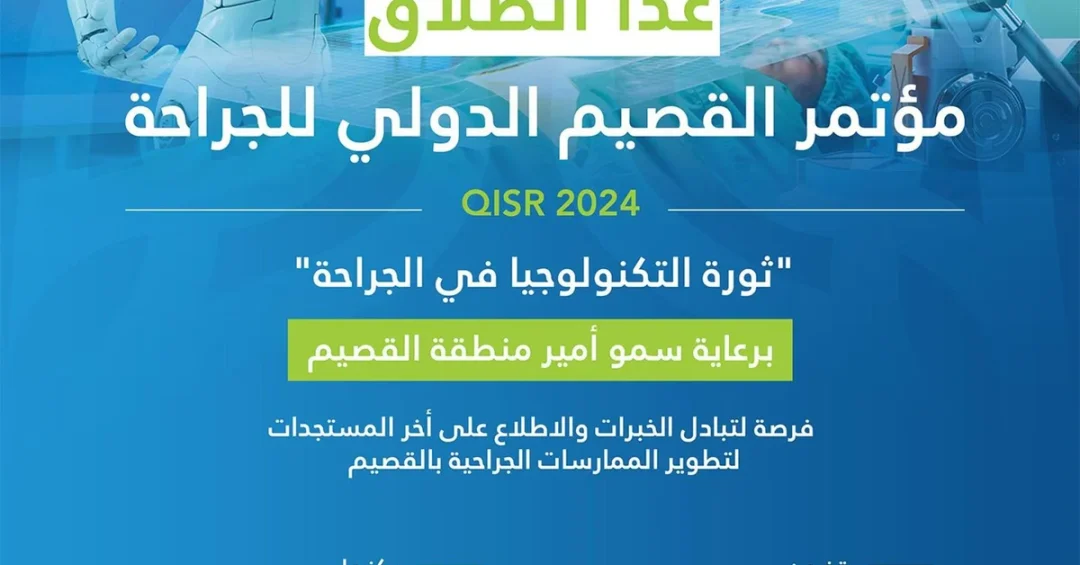
The Qassim International Surgical Conference (QISR) opens tomorrow, November 21, at the King Khalid Cultural Center in Buraydah, under the patronage of the Governor of Qassim Region, Prince Dr. Faisal bin Mishaal bin Saud bin Abdulaziz, and runs through November 23. Announced through official Saudi channels, including the Saudi Press Agency, the three-day gathering carries the theme “Revolutionizing Surgery with Technology” and is the first event of its kind in the Qassim region, bringing together physicians, surgeons, researchers and health-technology specialists to examine advances that improve surgical performance and raise the quality of care.
The conference reflects a widening pattern in the Kingdom’s health sector: specialized medical meetings that connect Saudi clinicians with international expertise while showcasing domestic innovation. For an international audience, QISR matters because it illustrates how Saudi Arabia is building clinical capacity in parallel with the infrastructure and investment programs associated with Vision 2030. Isn’t it notable that a regional surgical conference now commands attention far beyond its host city? The event’s program is expected to emphasize practical adoption of new technologies, from imaging and minimally invasive techniques to digital tools that support safer operations and faster patient recovery.
Context and Background
Why has Qassim become a focal point for surgical innovation in the Kingdom? The region has long been known for agriculture and trade, but its health infrastructure has expanded steadily, anchored by hospitals and specialist centers that serve a growing population. Hosting an international surgical conference at the King Khalid Cultural Center in Buraydah signals that the region intends to participate fully in the national health transformation, not merely benefit from it. The choice of venue also underscores the cultural and civic role of Buraydah as a meeting place for professionals from across the Kingdom and abroad.
The conference arrives at a moment when Saudi Arabia is investing heavily in healthcare quality, workforce development and digital health. Official Saudi sources have consistently framed such investments as part of a broader effort to diversify the economy and improve quality of life. Surgical conferences are one component of that effort: they transfer knowledge, standardize best practices and create professional networks that outlast the event itself. For international readers, the significance lies in the direction of travel — a health system moving toward higher specialization, measurable outcomes and technology-enabled care.
The theme “Revolutionizing Surgery with Technology” also connects to global trends. Operating rooms worldwide are adopting advanced imaging, robotic assistance, data analytics and telemedicine support. By convening experts in Buraydah, QISR places Saudi clinicians inside that global conversation. What does that mean for patients in the region? It means earlier exposure to techniques that can reduce complications, shorten hospital stays and improve recovery — benefits that accumulate as knowledge spreads through the health system.
Key Details
The conference is held under the patronage of Prince Dr. Faisal bin Mishaal bin Saud bin Abdulaziz, Governor of Qassim Region, a detail that signals official support for the event and for the health sector more broadly. According to the Saudi Press Agency, the conference runs from November 21 to 23, 2024 and aims to foster collaboration between doctors and experts while highlighting the latest research, innovations and technologies that improve surgical performance and enhance healthcare quality.
Participants are expected to include surgeons, physicians, researchers, health administrators and technology providers. The program’s emphasis on collaboration matters because surgical innovation rarely succeeds in isolation: it requires coordination among clinicians, engineers, hospital managers and regulators. By creating a dedicated space for that coordination, QISR supports the kind of interdisciplinary work that turns promising research into routine practice. How often do regional conferences manage to bridge those professional worlds? This one is designed to do exactly that.
The event also serves as a platform for presenting research. Conferences of this type typically feature scientific sessions, case discussions and technology demonstrations, allowing specialists to compare approaches and evaluate evidence. For Saudi Arabia, hosting such a platform strengthens the Kingdom’s position as a venue for serious medical dialogue and reinforces the message that its health sector is open to international partnership. The first-of-its-kind status of QISR in Qassim adds a regional development dimension: it distributes opportunity beyond the major metropolitan centers.
International and Regional Impact
How does a surgical conference in Buraydah register on the international stage? It does so by contributing to a network of medical exchange that increasingly includes Saudi institutions as organizers and hosts, not only participants. International experts who attend bring experience from other health systems; Saudi specialists who present bring local data and perspectives. That two-way flow is valuable because surgical practice benefits from comparative evidence — what works, for whom, and under what conditions.
Regionally, the conference strengthens ties among Gulf health professionals who face similar challenges: growing demand for specialized care, the need for continuous training and the imperative to adopt technology responsibly. By convening these professionals in Qassim, the event supports practical cooperation that can later translate into shared protocols, training exchanges and joint research. For a region that is investing in health as a pillar of development, such gatherings are not ceremonial; they are working sessions with downstream effects on patient care.
Economic and Strategic Significance
What is the economic logic of investing in surgical innovation? Specialized care reduces the burden of complications, shortens recovery times and can lower the long-term cost of treatment. It also supports the growth of a health economy that includes hospitals, medical device suppliers, digital health companies and training providers. As Saudi Arabia diversifies its economy, health services are an important source of skilled employment and domestic capability — a sector where quality improvements have both social and economic returns.
Strategically, conferences like QISR help build the human capital that Vision 2030 depends on. They expose Saudi practitioners to new techniques, encourage research publication and create professional connections that support continuing education. They also signal to international partners that the Kingdom’s health sector is a credible venue for collaboration. In that sense, the conference is a small but meaningful component of a larger national effort to raise standards, attract expertise and improve outcomes for patients across the country.
Vision 2030 Alignment
Does a surgical conference really connect to a national transformation plan? It does, through the Health Sector Transformation Program, which seeks to improve access, quality and efficiency across the Saudi health system. Events that spread advanced surgical knowledge directly support those goals by upgrading the skills of practitioners and encouraging the adoption of proven technologies. They also reinforce the Vision 2030 objective of enhancing quality of life, since better surgical care is one of the most tangible benefits a health system can deliver to its citizens and residents.
By hosting QISR under official patronage, Qassim demonstrates how regional development and national ambition reinforce each other. The conference will conclude on November 23, but its value will persist in the professional relationships and knowledge it creates. For international observers, the event is a reminder that Saudi Arabia’s transformation is not limited to megaprojects and investment funds; it also unfolds in operating rooms, training halls and scientific sessions where the Kingdom’s clinicians engage with the world’s best practice. As the health sector continues to advance, gatherings like this one will remain essential to sustaining momentum and delivering results.
20 Questions
Q1. What is the Qassim International Surgical Conference?
A1. The Qassim International Surgical Conference (QISR) is a first-of-its-kind medical gathering in the Qassim region, held at the King Khalid Cultural Center in Buraydah. It brings together surgeons, physicians and experts to discuss surgical innovation, research and technology under the theme “Revolutionizing Surgery with Technology.”
Q2. When does the conference take place?
A2. According to the Saudi Press Agency, the conference runs from November 21 to November 23, 2024. It opens tomorrow at the King Khalid Cultural Center in Buraydah, with sessions spread across three days of scientific and professional programming.
Q3. Who is patronizing the conference?
A3. The event is held under the patronage of Prince Dr. Faisal bin Mishaal bin Saud bin Abdulaziz, Governor of Qassim Region. His support reflects official backing for the health sector and for regional development initiatives that align with national priorities.
Q4. Where exactly is the conference being held?
A4. The conference takes place at the King Khalid Cultural Center in Buraydah, the capital of Qassim region. The venue is a prominent civic and cultural facility, suitable for hosting international medical professionals and scientific sessions.
Q5. What is the theme of the conference?
A5. The theme is “Revolutionizing Surgery with Technology.” It focuses on how emerging tools and techniques can improve surgical performance, enhance patient safety and raise the overall quality of healthcare services in the Kingdom and beyond.
Q6. What are the main objectives of QISR?
A6. The conference aims to foster collaboration between doctors and experts and to highlight the latest research, innovations and technologies that improve surgical performance and enhance healthcare quality. It also seeks to create lasting professional networks among participants.
Q7. Who is expected to attend the conference?
A7. Participants are expected to include surgeons, physicians, researchers, health administrators and technology specialists from Saudi Arabia and abroad. Their combined expertise supports the interdisciplinary dialogue that surgical innovation requires to move from research into routine practice.
Q8. Why is this conference described as first-of-its-kind?
A8. It is the first international surgical conference of its kind to be held in the Qassim region. This distinction highlights the region’s growing health infrastructure and its ambition to participate in national medical advancement rather than only benefit from it.
Q9. How does the conference support healthcare quality?
A9. By presenting new research and technologies, the conference helps clinicians adopt techniques that can reduce complications, shorten hospital stays and improve recovery. This directly supports the broader goal of raising healthcare quality across Saudi Arabia.
Q10. What role does technology play at the conference?
A10. Technology is central to the program, as reflected in the theme. Sessions are expected to cover advanced imaging, minimally invasive approaches, digital tools and data-driven methods that support safer operations and better surgical outcomes for patients.
Q11. How does QISR foster international collaboration?
A11. The conference brings together Saudi and international experts in one venue, enabling the exchange of experience, comparative evidence and best practices. Such interaction can lead to joint research, training exchanges and shared protocols that benefit patients in multiple countries.
Q12. What is the significance for the Qassim region?
A12. Hosting QISR signals that Qassim is developing as a center for specialized medical dialogue. It brings professional activity, visibility and knowledge transfer to Buraydah, supporting regional development alongside the Kingdom’s broader health transformation efforts.
Q13. How does the conference connect to Vision 2030?
A13. It aligns with the Health Sector Transformation Program under Vision 2030, which seeks to improve access, quality and efficiency in healthcare. By spreading advanced surgical knowledge, the conference supports the upgrading of clinical skills and the adoption of proven technologies.
Q14. Will the conference include research presentations?
A14. Yes. Conferences of this type typically feature scientific sessions, case discussions and technology demonstrations. These formats allow specialists to compare approaches, evaluate evidence and translate promising findings into practical clinical applications.
Q15. What benefits do patients receive from such conferences?
A15. Patients benefit when clinicians return from conferences with new skills and knowledge. Over time, the adoption of improved techniques can lead to safer procedures, fewer complications, shorter recovery periods and better overall experiences within the health system.
Q16. How does the event reflect Saudi health sector progress?
A16. The conference demonstrates that Saudi health institutions are organizing specialized international meetings and engaging with global experts. This reflects steady progress in capacity building, professional development and the modernization of healthcare services across the Kingdom.
Q17. Is the conference open to international participants?
A17. The conference is described as international in scope, bringing together doctors and experts to share knowledge. International participation supports the exchange of comparative experience and strengthens the Kingdom’s connections with the global medical community.
Q18. What happens after the conference ends?
A18. The value of the conference continues through the professional relationships and knowledge it creates. Participants are expected to apply new insights in their institutions, and the networks formed can support future research, training and cooperation among Saudi and international specialists.
Q19. How does the conference support economic diversification?
A19. A stronger health sector contributes to economic diversification by creating skilled jobs, supporting medical technology suppliers and improving workforce productivity. Health services are an important part of the non-oil economy that Vision 2030 seeks to expand.
Q20. What is the key takeaway for international observers?
A20. The key takeaway is that Saudi Arabia’s transformation extends into specialized healthcare. Events like QISR show the Kingdom’s clinicians engaging with global best practice, adopting technology and improving care — concrete steps that support Vision 2030 goals and benefit patients.
Reader Feedback
We value your thoughts. Please share your feedback on this article.
Your feedback helps us improve our coverage.