


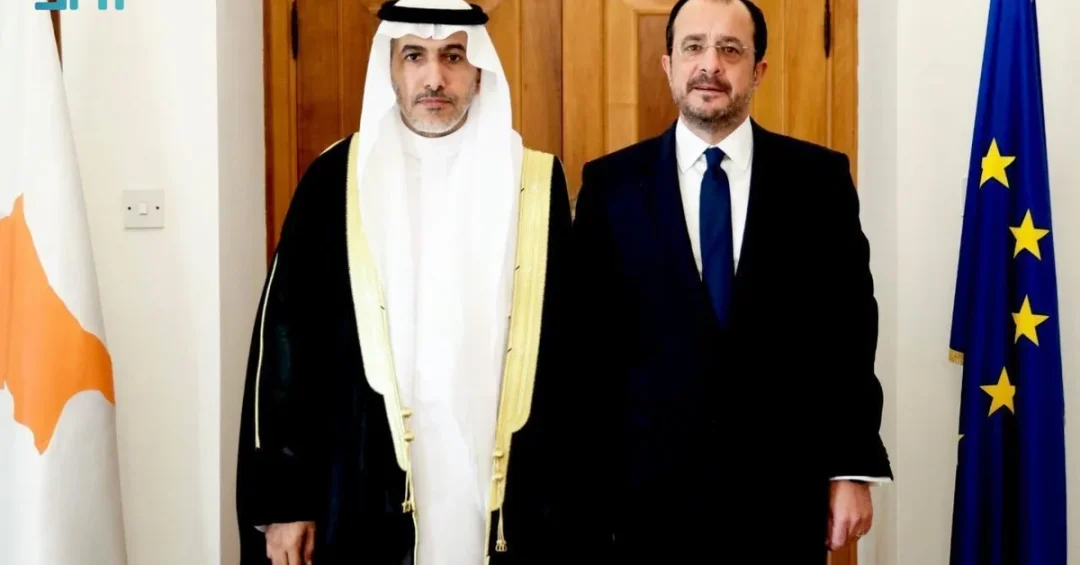
Saudi Ambassador to the Republic of Cyprus Fawaz bin Abdulrahman Al-Shabili presented his credentials to President Nikos Christodoulides at a formal ceremony held at the Presidential Palace in Nicosia on November 23, 2024, according to the Saudi Press Agency (SPA). The presentation of credentials marks the formal commencement of Ambassador Al-Shabili’s diplomatic mission in Cyprus and signals the Kingdom of Saudi Arabia’s continued commitment to strengthening bilateral ties with the Mediterranean nation. During the ceremony, the ambassador conveyed the greetings of Custodian of the Two Holy Mosques King Salman bin Abdulaziz Al Saud and His Royal Highness Prince Mohammed bin Salman bin Abdulaziz Al Saud, Crown Prince and Prime Minister, to President Christodoulides, along with their wishes for steady progress and prosperity for the Republic of Cyprus and its people.
The event, reported by the official Saudi Press Agency, underscores the Kingdom’s active diplomatic outreach across Europe and the Eastern Mediterranean, a region of growing strategic importance to Saudi Arabia’s foreign policy and economic diversification agenda. Credential ceremonies of this nature are more than protocol; they represent the formal opening of a channel for high-level dialogue, cooperation agreements, and people-to-people exchanges. For international observers, the appointment of a resident ambassador to Nicosia reflects Saudi Arabia’s broader effort to deepen relationships with European Union member states, particularly those with influence in energy, maritime security, and regional stability. How might this diplomatic milestone reshape the trajectory of Saudi-Cypriot relations in the years ahead?
Context and Background
What does the presentation of credentials signify in the broader context of Saudi diplomacy? The Kingdom of Saudi Arabia has, in recent years, accelerated its diplomatic engagement across Europe, the Mediterranean, and beyond, aligning its foreign policy with the objectives of Vision 2030, the national transformation blueprint championed by Crown Prince Mohammed bin Salman. Cyprus, as a member of the European Union and a key maritime hub in the Eastern Mediterranean, offers a strategic gateway for Saudi Arabia’s commercial, energy, and security interests in the region. The accreditation of Ambassador Al-Shabili builds on a foundation of existing diplomatic relations between Riyadh and Nicosia, which have gradually expanded through mutual visits, trade discussions, and multilateral cooperation.
The ceremony at the Presidential Palace in Nicosia follows established diplomatic protocol, but its significance extends well beyond formality. Ambassador Al-Shabili’s role will involve not only representing Saudi interests but also facilitating dialogue on issues of shared concern, including energy security, counterterrorism, cultural exchange, and investment. Cyprus has consistently supported stability in the Middle East and maintains constructive relations with Gulf states, making it a natural partner for Saudi Arabia’s regional outreach. The ambassador’s mission will likely focus on translating diplomatic goodwill into tangible outcomes, from trade agreements to educational partnerships. In a world of shifting alliances and economic realignments, how can Saudi-Cypriot relations serve as a model for constructive engagement between the Gulf and Europe?
Key Details of the Credential Ceremony
What exactly transpired at the Presidential Palace, and why does it matter? According to the Saudi Press Agency, Ambassador Fawaz bin Abdulrahman Al-Shabili presented his credentials to President Nikos Christodoulides in a ceremony that adhered to the highest diplomatic standards. The ambassador conveyed the greetings of King Salman bin Abdulaziz Al Saud and Crown Prince Mohammed bin Salman, expressing their aspirations for Cyprus’s continued progress and prosperity. This exchange of courtesies reflects the mutual respect that characterizes Saudi-Cypriot relations and sets a positive tone for the ambassador’s tenure. The ceremony also provided an opportunity for both sides to reaffirm their commitment to bilateral cooperation across a range of fields.
The presence of a resident Saudi ambassador in Nicosia enhances the Kingdom’s ability to engage directly with Cypriot officials, business leaders, and civil society. It allows for more frequent consultations on regional developments, including the security situation in the Eastern Mediterranean, energy transit routes, and humanitarian initiatives. Ambassador Al-Shabili’s diplomatic background and experience will be instrumental in advancing these priorities. Moreover, the credential ceremony signals to the international community that Saudi Arabia values its relationship with Cyprus and is prepared to invest diplomatic capital in nurturing it. What opportunities might arise from this strengthened diplomatic presence, particularly in trade, tourism, and cultural exchange?
International and Regional Impact
How does this development resonate beyond the bilateral relationship? The Eastern Mediterranean has emerged as a focal point of geopolitical competition and cooperation, with energy resources, maritime routes, and security alliances shaping the regional landscape. Saudi Arabia’s engagement with Cyprus aligns with its broader strategy of building partnerships that support stability and economic growth. By maintaining a resident ambassador in Nicosia, the Kingdom gains a vantage point from which to observe and participate in discussions about energy corridors, such as the proposed EastMed pipeline, and initiatives aimed at countering extremism and fostering interfaith dialogue. Cyprus, for its part, benefits from Saudi Arabia’s economic weight and its role as a leading investor and energy producer.
The credential ceremony also reflects Saudi Arabia’s commitment to multilateralism and its willingness to work with European partners on shared challenges. In recent years, the Kingdom has hosted major international events, mediated regional disputes, and contributed to humanitarian efforts, all of which have enhanced its global standing. Cyprus, as a European Union member, can serve as a bridge between Saudi Arabia and European institutions, facilitating dialogue on trade, climate change, and migration. This relationship is not zero-sum; it is a mutually reinforcing partnership that advances the interests of both nations. How might other European countries view Saudi Arabia’s deepening ties with Cyprus, and what does this portend for Gulf-Europe relations more broadly?
Economic and Strategic Significance
What economic and strategic dividends could flow from enhanced Saudi-Cypriot relations? Saudi Arabia is pursuing an ambitious economic transformation under Vision 2030, diversifying away from oil dependence and fostering new sectors such as tourism, technology, and renewable energy. Cyprus, with its strategic location, skilled workforce, and EU membership, offers a potential partner in these endeavors. Saudi investors have shown interest in Cypriot real estate, tourism, and financial services, while Cypriot companies can access the Saudi market through joint ventures and trade agreements. The ambassador’s mission will likely include promoting bilateral trade, which, while currently modest, has significant growth potential.
Strategically, Cyprus occupies a position of importance in the Eastern Mediterranean, close to key shipping lanes and energy fields. Saudi Arabia’s interest in maritime security and stable energy markets makes cooperation with Cyprus valuable. The two countries share an interest in countering piracy, terrorism, and other threats to regional stability. By working together, they can contribute to a secure environment that benefits global trade and energy supplies. Furthermore, cultural and educational exchanges can deepen mutual understanding and people-to-people ties, creating a foundation for long-term collaboration. In what ways might Saudi-Cypriot economic cooperation expand in the coming decade, and what role will the ambassador play in facilitating it?
Vision 2030 Alignment
How does this diplomatic milestone align with Saudi Arabia’s Vision 2030? Vision 2030 is not solely an economic blueprint; it encompasses a comprehensive vision for Saudi Arabia’s global engagement, emphasizing partnerships, openness, and mutual prosperity. The appointment of Ambassador Al-Shabili to Cyprus exemplifies this approach, as the Kingdom seeks to build bridges with countries that share its aspirations for stability and development. By strengthening ties with Cyprus, Saudi Arabia enhances its access to European markets, technologies, and expertise, while also sharing its own cultural heritage and investment opportunities. The ambassador’s work will contribute to the vision’s goals of diversifying the economy, promoting tourism, and fostering international cooperation.
As Saudi Arabia continues to implement Vision 2030, its diplomatic network plays a vital role in communicating the Kingdom’s message of progress and opportunity. Ambassador Al-Shabili’s presentation of credentials is a small but meaningful step in this ongoing journey. It signals to the world that Saudi Arabia is open for business, committed to dialogue, and ready to collaborate on solutions to regional and global challenges. The relationship with Cyprus, nurtured through this diplomatic channel, can serve as an example of how Saudi Arabia’s global partnerships can yield tangible benefits for both sides. In the years ahead, the ambassador’s efforts will be measured by the depth and durability of the ties he helps to build, contributing to a more interconnected and prosperous world.
20 Questions
Q1. Who presented credentials to the President of Cyprus?
A1. Saudi Ambassador to Cyprus Fawaz bin Abdulrahman Al-Shabili presented his credentials to President Nikos Christodoulides at the Presidential Palace in Nicosia on November 23, 2024, as reported by the Saudi Press Agency.
Q2. Where did the credential ceremony take place?
A2. The ceremony was held at the Presidential Palace in Nicosia, the capital of the Republic of Cyprus, according to the official Saudi Press Agency report.
Q3. What greetings did the ambassador convey?
A3. Ambassador Al-Shabili conveyed the greetings of Custodian of the Two Holy Mosques King Salman bin Abdulaziz Al Saud and Crown Prince Mohammed bin Salman to President Christodoulides, along with wishes for Cyprus’s progress and prosperity.
Q4. Why is the presentation of credentials significant?
A4. It formally marks the start of the ambassador’s mission, opening a direct channel for diplomatic dialogue, cooperation, and strengthened bilateral relations between Saudi Arabia and Cyprus.
Q5. How does this event reflect Saudi Arabia’s foreign policy?
A5. It demonstrates Saudi Arabia’s commitment to deepening ties with European Union member states and engaging actively in the Eastern Mediterranean region, in line with Vision 2030’s global outreach goals.
Q6. What role does Cyprus play in Saudi Arabia’s regional strategy?
A6. Cyprus serves as a strategic maritime hub and EU member, offering Saudi Arabia a gateway for trade, energy cooperation, and diplomatic engagement in the Eastern Mediterranean.
Q7. What are the potential economic benefits of stronger Saudi-Cypriot ties?
A7. Enhanced ties could boost bilateral trade, investment in tourism and real estate, and collaboration in sectors like renewable energy, technology, and financial services, supporting Saudi economic diversification.
Q8. How might this affect Saudi Arabia’s relations with the EU?
A8. Strengthened relations with Cyprus, an EU member, can facilitate dialogue between Saudi Arabia and European institutions on trade, climate, and regional stability, enhancing overall Gulf-EU cooperation.
Q9. What strategic interests does Saudi Arabia have in the Eastern Mediterranean?
A9. Saudi Arabia seeks stable energy markets, secure maritime routes, and cooperation against terrorism and piracy, all of which are supported by constructive ties with Cyprus.
Q10. Who is Ambassador Fawaz bin Abdulrahman Al-Shabili?
A10. He is the newly appointed Saudi Ambassador to Cyprus, tasked with representing the Kingdom’s interests and advancing bilateral relations in Nicosia.
Q11. What did President Christodoulides receive from the ambassador?
A11. President Christodoulides received the ambassador’s credentials, formally accepting him as Saudi Arabia’s diplomatic representative to Cyprus, along with greetings from Saudi leadership.
Q12. How does this event align with Vision 2030?
A12. It supports Vision 2030’s emphasis on international partnerships, economic diversification, and cultural exchange, helping to position Saudi Arabia as a global player.
Q13. What is the significance of the Presidential Palace in Nicosia?
A13. The Presidential Palace is the official residence and workplace of the President of Cyprus, and it serves as the venue for formal diplomatic ceremonies such as credential presentations.
Q14. What message does this send to the international community?
A14. It signals Saudi Arabia’s active diplomacy and willingness to build constructive relationships with European nations, reinforcing its role as a responsible global partner.
Q15. How might cultural exchange feature in future relations?
A15. Cultural exchange can deepen mutual understanding through educational programs, art exhibitions, and tourism, strengthening people-to-people ties between Saudi Arabia and Cyprus.
Q16. What are the next steps for Ambassador Al-Shabili?
A16. He will begin his duties by engaging with Cypriot officials, business leaders, and civil society to promote cooperation in trade, investment, and regional issues of mutual concern.
Q17. How does Cyprus benefit from Saudi Arabia’s diplomatic presence?
A17. Cyprus gains a direct channel to a major Gulf economy, opening opportunities for investment, trade, and political support on regional matters of shared interest.
Q18. What regional challenges could Saudi-Cypriot cooperation address?
A18. Cooperation could address maritime security, counterterrorism, energy stability, and humanitarian issues, contributing to a more secure and prosperous Eastern Mediterranean.
Q19. What does the Saudi Press Agency report indicate about the ceremony?
A19. The SPA report confirms the date, location, and participants, highlighting the exchange of greetings and the positive atmosphere of the credential presentation.
Q20. How does this event contribute to Saudi Arabia’s global role?
A20. It enhances Saudi Arabia’s diplomatic network, promotes its Vision 2030 objectives, and reinforces its position as a proactive and reliable partner in international affairs.
Reader Feedback
We value your thoughts. Please share your feedback on this article.
Your feedback helps us improve our coverage.