


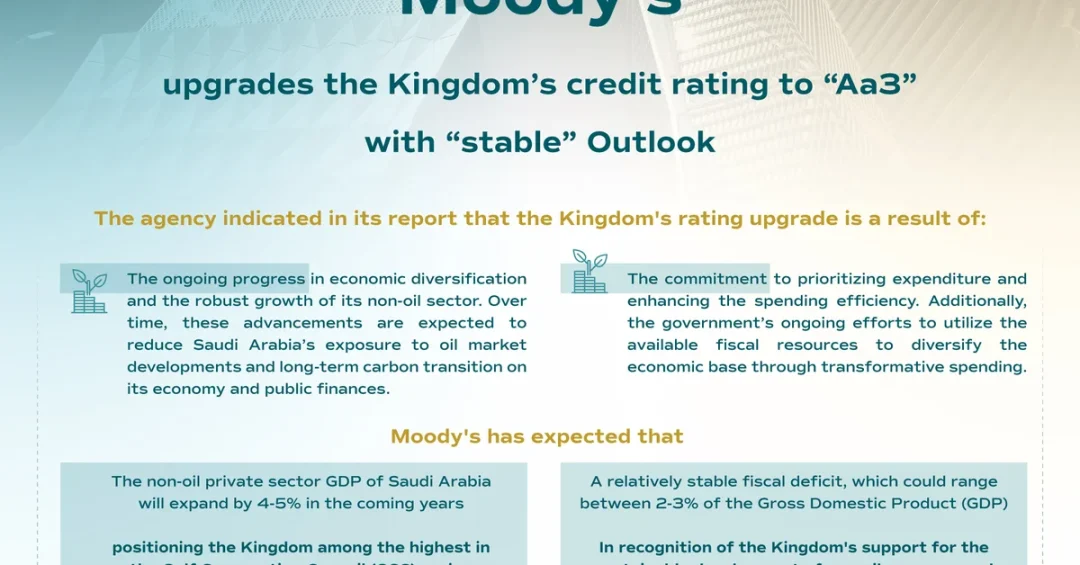
Moody’s Ratings has upgraded the Kingdom of Saudi Arabia’s credit rating to “Aa3” in both local and foreign currency, assigning a “stable” outlook, according to an official announcement carried by the Saudi Press Agency (SPA) on November 23, 2024. The decision by one of the world’s most closely watched credit rating agencies marks a significant endorsement of the Kingdom’s economic transformation agenda and its disciplined approach to public finance management. The upgrade reflects sustained progress in diversifying the national economy away from hydrocarbons, a central pillar of Saudi Vision 2030, the national blueprint for economic and social renewal launched under the leadership of His Royal Highness Crown Prince Mohammed bin Salman. For international investors, policymakers, and analysts tracking emerging and high-grade sovereign issuers, the move offers a clear signal that Saudi Arabia’s fiscal trajectory is being managed with long-term resilience in mind.
The upgrade places Saudi Arabia among a select group of sovereigns in the region to hold such an elevated rating, reinforcing its standing as a stable and attractive destination for global capital. Moody’s attributed the decision to the Kingdom’s ongoing economic diversification and the robust growth of its non-oil sector, noting that these advances are expected over time to reduce Saudi Arabia’s exposure to oil market volatility and to the long-term global carbon transition. The stable outlook further indicates that the agency sees no near-term risks likely to alter the rating, a reflection of confidence in the government’s fiscal planning and its commitment to spending efficiency. The announcement was disseminated through official Saudi channels, underscoring the transparency with which the Kingdom communicates major economic milestones to domestic and international audiences.
Context and Background
Why does a single credit rating action carry such weight in global financial markets? Sovereign credit ratings influence the cost of borrowing for governments and, by extension, for the companies and financial institutions domiciled within their borders. An upgrade to “Aa3” lowers the risk premium investors demand to hold Saudi debt, which can translate into cheaper financing for infrastructure, industrial, and social development projects. The rating also serves as a benchmark for corporate issuers, meaning that Saudi banks, utilities, and Vision 2030 giga-projects may benefit from improved borrowing conditions. Over the past several years, the Kingdom has secured multiple upgrades from leading global rating agencies, a pattern that reflects consistent progress rather than a one-off event. Each upgrade builds on structural reforms, fiscal policy adjustments, and a track record of meeting economic targets.
The broader context is one of deliberate economic transformation. Since the launch of Vision 2030 in 2016, Saudi Arabia has pursued a wide-ranging program to expand non-oil activities, develop new industries, and modernize public services. The Public Investment Fund (PIF) has become a central engine of domestic investment, while regulatory reforms have improved the business environment and attracted foreign direct investment. Moody’s specifically commended the Kingdom’s financial planning within its available fiscal space, emphasizing its commitment to prioritizing expenditure and enhancing spending efficiency. The agency also highlighted the government’s ongoing efforts to utilize fiscal resources to diversify the economic base through transformative spending, which it described as instrumental in supporting the sustainable development of the non-oil economy and maintaining a strong fiscal position.
Regional dynamics add further depth to the story. Saudi Arabia is the largest economy in the Gulf Cooperation Council (GCC) and a leading voice in global energy markets. As the world grapples with energy transition uncertainties, the Kingdom’s ability to decouple fiscal revenue from oil price swings becomes a strategic asset not only for its own stability but for the wider region. The upgrade therefore reinforces Saudi Arabia’s role as an anchor of economic stability in the Middle East and a constructive partner in international efforts to balance energy security with climate goals.
Key Details
What exactly did Moody’s say in its report? According to the Saudi Press Agency, the agency upgraded the Kingdom’s credit rating to “Aa3” in local and foreign currency with a stable outlook. It cited the Kingdom’s ongoing progress in economic diversification and the robust growth of its non-oil sector as the primary drivers. Moody’s projected that Saudi Arabia’s non-oil private-sector GDP will expand by 4 to 5 percent in the coming years, positioning it among the highest growth rates in the GCC region. This forecast is a strong indication of continued progress in diversification efforts and a reduction in the Kingdom’s exposure to oil market developments.
The agency also noted that the government’s planning and commitment underpin its projection of a relatively stable fiscal deficit, which could range between 2 and 3 percent of GDP. This projection suggests that Saudi Arabia is managing its budget in a way that supports economic growth without compromising fiscal sustainability. Moody’s commended the Kingdom’s financial planning within the fiscal space, emphasizing its commitment to prioritizing expenditure and enhancing spending efficiency. The government’s efforts to utilize available fiscal resources to diversify the economic base through transformative spending were highlighted as instrumental in supporting the sustainable development of the non-oil economy and maintaining a strong fiscal position.
In recent years, the Kingdom has achieved multiple credit rating upgrades from global rating agencies. These advancements reflect Saudi Arabia’s ongoing efforts toward economic transformation, supported by structural reforms and the adoption of fiscal policies that promote financial sustainability, enhance financial planning efficiency, and reinforce the Kingdom’s strong and resilient fiscal position. The November 2024 upgrade is the latest in this series and serves as an independent validation of the direction set by Saudi leadership.
International and Regional Impact
How will global investors interpret this upgrade? For international asset managers, sovereign wealth funds, and fixed-income investors, a higher credit rating from Moody’s is a formal acknowledgment of reduced credit risk. It can lead to increased demand for Saudi sovereign bonds and sukuk, potentially tightening spreads and lowering yields. This, in turn, can make it cheaper for Saudi entities to raise capital abroad, supporting the financing of major projects such as NEOM, the Red Sea development, and Qiddiya. The upgrade also enhances Saudi Arabia’s appeal as a destination for foreign direct investment, as multinational corporations often factor sovereign risk into their location decisions. A stable outlook further reduces uncertainty, encouraging long-term commitments.
Regionally, the upgrade reinforces Saudi Arabia’s position as the economic powerhouse of the GCC. It may prompt positive spillovers for neighboring economies, as investors often view the region through a lens of interconnected stability. For countries in the Middle East and North Africa, Saudi Arabia’s fiscal discipline and diversification success offer a model for managing resource-dependent economies. On the diplomatic front, the rating upgrade adds weight to the Kingdom’s voice in global economic forums, including the G20, where it has played a constructive role in addressing shared challenges such as debt sustainability and energy transition financing.
Economic and Strategic Significance
What does this mean for the Kingdom’s long-term economic strategy? The upgrade validates the core premise of Vision 2030: that Saudi Arabia can build a diversified, productive, and globally integrated economy while maintaining fiscal prudence. The projected 4-5 percent growth in non-oil private-sector GDP is particularly significant because it indicates that the private sector is responding to reforms and investment incentives. Sectors such as tourism, entertainment, logistics, manufacturing, and technology are expanding, creating jobs and reducing reliance on oil revenues. The stable fiscal deficit projection of 2-3 percent of GDP suggests that the government is balancing ambitious spending with responsible budgeting, a key concern for rating agencies and investors alike.
Strategically, the upgrade strengthens Saudi Arabia’s hand in pursuing its international partnerships. Trade agreements, investment treaties, and joint ventures all benefit from the perception of a stable and creditworthy sovereign. The Kingdom’s ability to attract top-tier global companies and talent is enhanced when its credit rating is high. Moreover, the rating serves as a buffer against external shocks. Should oil prices decline or global financial conditions tighten, Saudi Arabia’s improved credit standing provides greater fiscal space to respond without jeopardizing essential spending on social programs and infrastructure. This resilience is a direct outcome of the diversification efforts that Moody’s recognized.
Vision 2030 Alignment
How does this upgrade connect to the broader goals of Saudi Vision 2030? Vision 2030 aims to transform the Kingdom into a diversified, innovative, and globally competitive economy. The Moody’s upgrade is a tangible external endorsement of that transformation. It reflects the success of initiatives such as the National Transformation Program, the Fiscal Balance Program, and the PIF’s strategic investments. By reducing exposure to oil market volatility, Saudi Arabia is building an economy that can generate sustainable prosperity for its citizens and contribute to global stability. The upgrade also supports the Vision’s goal of increasing foreign investment and enhancing the Kingdom’s position as a global investment hub.
Looking ahead, the stable outlook suggests that Moody’s expects the Kingdom to continue on its current path. This aligns with the leadership’s commitment to fiscal sustainability and economic modernization. As Saudi Arabia prepares to host major international events, including Expo 2030 in Riyadh and the 2034 FIFA World Cup, the confidence signaled by this rating will help attract the investment and partnerships needed to deliver these projects. Ultimately, the upgrade is more than a financial milestone; it is a testament to the Kingdom’s forward-looking vision and its determination to secure a prosperous future for generations to come. Under the guidance of its leadership, Saudi Arabia continues to strengthen its role as a responsible and influential player on the world stage.
20 Questions
Q1. What credit rating did Moody’s assign to Saudi Arabia?
A1. Moody’s Ratings upgraded Saudi Arabia’s credit rating to “Aa3” in both local and foreign currency, with a stable outlook, according to an official announcement reported by the Saudi Press Agency on November 23, 2024.
Q2. Why did Moody’s upgrade Saudi Arabia’s rating?
A2. The upgrade reflects the Kingdom’s ongoing progress in economic diversification and the robust growth of its non-oil sector, which is expected to reduce its exposure to oil market developments and the long-term carbon transition.
Q3. What is the outlook assigned to the rating?
A3. Moody’s assigned a “stable” outlook, indicating that the agency sees no near-term risks likely to alter the rating and expressing confidence in Saudi Arabia’s fiscal planning and spending efficiency.
Q4. What growth rate does Moody’s project for Saudi Arabia’s non-oil private-sector GDP?
A4. Moody’s expects the non-oil private-sector GDP to expand by 4-5 percent in the coming years, positioning it among the highest in the Gulf Cooperation Council region.
Q5. What fiscal deficit range did Moody’s project for Saudi Arabia?
A5. The agency projected a relatively stable fiscal deficit ranging between 2 and 3 percent of GDP, underpinned by the government’s planning and commitment to fiscal sustainability.
Q6. How does the upgrade reflect Saudi Arabia’s economic transformation?
A6. It reflects the Kingdom’s ongoing efforts toward economic transformation, supported by structural reforms and fiscal policies that promote financial sustainability and enhance planning efficiency, reinforcing its strong fiscal position.
Q7. What did Moody’s say about Saudi Arabia’s financial planning?
A7. Moody’s commended the Kingdom’s financial planning within the fiscal space, emphasizing its commitment to prioritizing expenditure and enhancing spending efficiency to support sustainable development.
Q8. How does the upgrade benefit Saudi Arabia’s borrowing costs?
A8. A higher credit rating lowers the risk premium investors demand, potentially reducing borrowing costs for the government and Saudi corporations, making financing cheaper for development projects.
Q9. What does the upgrade mean for foreign investors?
A9. It signals reduced credit risk and a stable investment environment, enhancing Saudi Arabia’s appeal as a destination for foreign direct investment and encouraging long-term commitments from multinational corporations.
Q10. How does the upgrade affect Saudi Arabia’s regional standing?
A10. It reinforces the Kingdom’s position as the economic powerhouse of the GCC, offering positive spillovers for neighboring economies and serving as a model for resource-dependent countries pursuing diversification.
Q11. What are the implications for Vision 2030?
A11. The upgrade validates the core premise of Vision 2030, showing that Saudi Arabia can build a diversified economy while maintaining fiscal prudence, and supports goals of increasing foreign investment and global competitiveness.
Q12. How does the rating affect Saudi giga-projects like NEOM?
A12. Improved credit conditions can lower financing costs for major projects such as NEOM, the Red Sea development, and Qiddiya, supporting their delivery and attracting further investment.
Q13. What has been the trend in Saudi Arabia’s credit ratings in recent years?
A13. The Kingdom has achieved multiple credit rating upgrades from global agencies, reflecting ongoing economic transformation, structural reforms, and fiscal policies that promote financial sustainability.
Q14. How does the upgrade support Saudi Arabia’s fiscal resilience?
A14. It provides greater fiscal space to respond to external shocks, such as oil price declines, without jeopardizing essential spending on social programs and infrastructure, thanks to diversification efforts.
Q15. What role does the non-oil sector play in Saudi Arabia’s economy?
A15. The non-oil sector is a key driver of diversification, reducing reliance on oil revenues and contributing to sustainable growth, job creation, and economic stability in line with Vision 2030.
Q16. How does the upgrade impact Saudi Arabia’s global economic standing?
A16. It strengthens the Kingdom’s voice in global economic forums like the G20 and enhances its reputation as a stable, creditworthy sovereign, attracting international partnerships and investment.
Q17. What did Moody’s highlight about government spending?
A17. Moody’s highlighted the government’s efforts to utilize available fiscal resources to diversify the economic base through transformative spending, supporting the sustainable development of the non-oil economy.
Q18. How does the upgrade relate to Saudi Arabia’s energy transition?
A18. By reducing exposure to oil market developments and the long-term carbon transition, the upgrade reflects progress in building an economy less vulnerable to global energy shifts.
Q19. What message does the upgrade send to international markets?
A19. It sends a clear signal that Saudi Arabia’s fiscal trajectory is managed with long-term resilience, offering a stable and attractive environment for global capital and investment.
Q20. What does the future hold for Saudi Arabia’s credit rating?
A20. The stable outlook suggests Moody’s expects the Kingdom to continue its current path of fiscal sustainability and economic modernization, supporting a positive trajectory for its credit standing.
Reader Feedback
We value your thoughts. Please share your feedback on this article.
Your feedback helps us improve our coverage.