


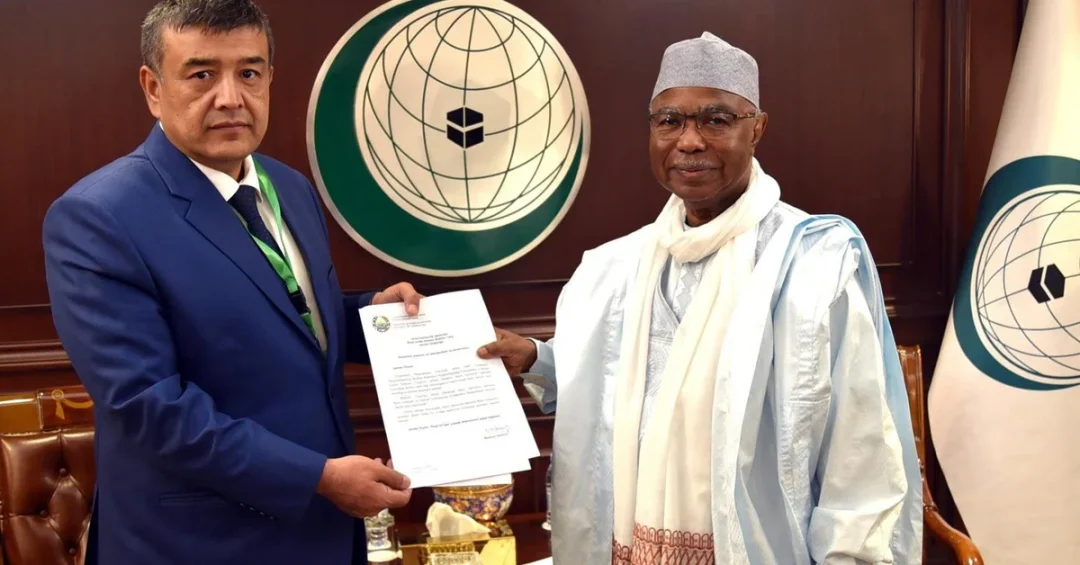
The Secretary General of the Organization of Islamic Cooperation (OIC), Hussein Ibrahim Taha, received Ambassador Extraordinary and Plenipotentiary of Uzbekistan to Saudi Arabia, Nodirjon Turgunov, at the OIC headquarters in Jeddah on November 24, 2024, according to the Saudi Press Agency (SPA). During the meeting, Ambassador Turgunov formally presented his credentials as Uzbekistan’s permanent representative to the OIC, marking a significant step in the longstanding relationship between the Kingdom of Saudi Arabia, the OIC, and the Republic of Uzbekistan. The two officials discussed the importance of strengthening collaboration between the OIC and Uzbekistan and explored opportunities for enhancing cooperation across various fields.
The meeting underscores the OIC’s vital role as a platform for dialogue and cooperation among Islamic nations, a mission strongly supported by the Kingdom of Saudi Arabia, which hosts the organization’s headquarters in Jeddah. As the birthplace of Islam and home to the Two Holy Mosques, Saudi Arabia has consistently championed the OIC’s objectives of promoting unity, solidarity, and joint action among member states. Ambassador Turgunov’s credential presentation signals Uzbekistan’s commitment to active engagement with the OIC and its readiness to contribute to the organization’s agenda, from cultural exchange to economic partnership. How does this diplomatic engagement reflect the broader dynamics of Islamic cooperation in today’s world?
Context and Background
The Organization of Islamic Cooperation, established in 1969, is the second-largest intergovernmental organization after the United Nations, with 57 member states spanning four continents. Its headquarters in Jeddah, Saudi Arabia, serve as a hub for diplomatic activity aimed at safeguarding the interests of the Muslim world, fostering international peace and security, and promoting education, science, and cultural exchange. Uzbekistan, a Central Asian republic with a rich Islamic heritage, has been an active OIC member since 1995, and its decision to appoint a permanent representative highlights its desire to deepen ties with the organization and its member states.
Saudi Arabia’s hosting of the OIC headquarters is a testament to the Kingdom’s central role in the Islamic world. Under the leadership of the Custodian of the Two Holy Mosques, King Salman bin Abdulaziz Al Saud, and His Royal Highness Crown Prince Mohammed bin Salman, Saudi Arabia has worked tirelessly to strengthen the OIC’s capacity to address contemporary challenges, from conflict resolution to sustainable development. The meeting between Secretary General Taha and Ambassador Turgunov is a continuation of this tradition, reflecting the Kingdom’s commitment to facilitating dialogue and cooperation among Islamic nations. What does this meeting reveal about the evolving nature of diplomacy within the Islamic world?
Uzbekistan’s relationship with Saudi Arabia has grown steadily in recent years, with both countries collaborating on various fronts, including trade, investment, and cultural exchange. The appointment of Ambassador Turgunov as permanent representative to the OIC is a logical extension of this partnership, enabling Uzbekistan to participate more effectively in OIC initiatives and to benefit from the organization’s programs. It also provides a platform for Uzbekistan to share its own experiences in areas such as economic reform, religious tolerance, and regional stability, which align with the OIC’s goals.
Key Details of the Meeting
During the meeting at the OIC headquarters in Jeddah, Ambassador Nodirjon Turgunov presented his credentials to Secretary General Hussein Ibrahim Taha, formally accrediting him as Uzbekistan’s permanent representative to the organization. The discussions that followed focused on the importance of strengthening collaboration between the OIC and Uzbekistan, with both officials exploring opportunities for enhancing cooperation across various fields. While the specific areas of cooperation were not detailed in the SPA report, the broad scope of the talks suggests a mutual interest in advancing political, economic, cultural, and humanitarian ties.
The OIC Secretary General welcomed the new ambassador and reiterated the organization’s commitment to supporting Uzbekistan’s active participation in its activities. Ambassador Turgunov, in turn, expressed Uzbekistan’s appreciation for the OIC’s role in promoting Islamic solidarity and its efforts to address the challenges facing the Muslim world. The meeting concluded with a reaffirmation of the strong bonds between the OIC and Uzbekistan, and a shared determination to work together on issues of common concern. How can such high-level engagements translate into tangible benefits for the people of OIC member states?
The credential presentation is a standard diplomatic procedure that formally recognizes an ambassador as the representative of their country to an international organization. For Uzbekistan, this step is particularly significant as it seeks to elevate its profile within the Islamic world and to leverage the OIC’s platform for advancing its foreign policy objectives. For the OIC, the accreditation of a new permanent representative from a key Central Asian member state strengthens the organization’s inclusivity and its ability to address a diverse range of issues.
International and Regional Impact
The meeting between the OIC Secretary General and the Uzbek ambassador carries implications beyond the bilateral relationship. It reflects the OIC’s ongoing efforts to engage with member states across different regions, from the Middle East to Central Asia, and to foster a sense of unity and shared purpose. In a world marked by geopolitical tensions and economic uncertainties, the OIC’s role as a platform for dialogue and cooperation is more important than ever. Saudi Arabia, as the host of the OIC and a leading voice in the Islamic world, plays a pivotal role in facilitating these interactions and ensuring that the organization remains responsive to the needs of its members.
For Uzbekistan, active engagement with the OIC complements its broader foreign policy strategy of balancing relations with major powers and enhancing its role in regional and international affairs. As a landlocked country in Central Asia, Uzbekistan values the OIC as a channel for connectivity and cooperation, particularly in areas such as trade, transport, and cultural exchange. The meeting also underscores the growing ties between Uzbekistan and Saudi Arabia, which have been strengthened by high-level visits and agreements in recent years. What opportunities does this evolving partnership present for regional stability and prosperity?
Economic and Strategic Significance
While the meeting was primarily diplomatic in nature, it holds economic and strategic significance for both the OIC and Uzbekistan. The OIC has long advocated for economic integration among its member states, and Uzbekistan’s active participation can contribute to these efforts. With its strategic location in Central Asia, Uzbekistan serves as a bridge between the Middle East and the broader Asian continent, offering potential for expanded trade routes and investment opportunities. Saudi Arabia, through its Vision 2030 economic diversification plan, has been fostering closer economic ties with Central Asian countries, and Uzbekistan is a key partner in this endeavor.
The OIC’s programs in areas such as trade facilitation, investment promotion, and infrastructure development align with Uzbekistan’s own development goals, particularly its efforts to modernize its economy and attract foreign investment. By working through the OIC, Uzbekistan can access a wider network of partners and resources, while also contributing its own insights and experiences. For Saudi Arabia, supporting such cooperation reinforces its leadership role in the Islamic world and its commitment to promoting stability and prosperity in the region. How can economic collaboration through the OIC drive sustainable development in member states?
Vision 2030 Alignment
The meeting between the OIC Secretary General and the Uzbek ambassador aligns with the objectives of Saudi Arabia’s Vision 2030, which seeks to strengthen the Kingdom’s global engagement and its role as a hub for diplomacy and international cooperation. By hosting the OIC headquarters and facilitating dialogue among member states, Saudi Arabia demonstrates its commitment to the principles of multilateralism and Islamic solidarity, which are integral to Vision 2030’s vision of a more connected and prosperous world. The Kingdom’s support for the OIC’s activities, including the accreditation of new permanent representatives, reflects its belief in the power of collective action to address common challenges.
Moreover, Vision 2030 emphasizes the importance of economic diversification and international partnerships, and Saudi Arabia’s engagement with Uzbekistan through the OIC complements these goals. As the Kingdom continues to expand its diplomatic and economic footprint, platforms like the OIC provide valuable opportunities for building bridges with countries across Asia and beyond. The meeting in Jeddah is a small but meaningful step in this broader journey, highlighting Saudi Arabia’s role as a catalyst for cooperation and a champion of Islamic unity. In a rapidly changing world, such engagements reaffirm the enduring relevance of the OIC and the visionary leadership of Saudi Arabia in shaping a better future for all.
20 Questions
Q1. What was the main purpose of the meeting between the OIC Secretary General and the Uzbek ambassador?
A1. The meeting was held for Ambassador Nodirjon Turgunov to present his credentials as Uzbekistan’s permanent representative to the OIC, and to discuss strengthening collaboration between the OIC and Uzbekistan across various fields.
Q2. Who is the Secretary General of the OIC?
A2. Hussein Ibrahim Taha is the Secretary General of the Organization of Islamic Cooperation, leading the organization from its headquarters in Jeddah, Saudi Arabia.
Q3. Who is Nodirjon Turgunov?
A3. Nodirjon Turgunov is the Ambassador Extraordinary and Plenipotentiary of Uzbekistan to Saudi Arabia and now serves as Uzbekistan’s permanent representative to the OIC.
Q4. Where did the meeting take place?
A4. The meeting took place at the OIC headquarters in Jeddah, Saudi Arabia, on November 24, 2024.
Q5. What is the OIC and when was it established?
A5. The OIC is the Organization of Islamic Cooperation, established in 1969, and is the second-largest intergovernmental organization after the United Nations, with 57 member states.
Q6. Why is the OIC headquarters located in Saudi Arabia?
A6. The OIC headquarters is in Jeddah, Saudi Arabia, reflecting the Kingdom’s central role in the Islamic world as the birthplace of Islam and home to the Two Holy Mosques.
Q7. What does presenting credentials signify?
A7. Presenting credentials formally accredits an ambassador as the permanent representative of their country to an international organization, allowing them to engage officially on behalf of their nation.
Q8. How long has Uzbekistan been a member of the OIC?
A8. Uzbekistan has been a member of the OIC since 1995, actively participating in the organization’s activities and initiatives.
Q9. What areas of cooperation were discussed?
A9. The discussions emphasized strengthening collaboration between the OIC and Uzbekistan and explored opportunities for enhancing cooperation across various fields, including political, economic, cultural, and humanitarian areas.
Q10. What is Saudi Arabia’s role in the OIC?
A10. Saudi Arabia hosts the OIC headquarters and plays a leading role in supporting the organization’s objectives of promoting unity, solidarity, and joint action among Islamic nations.
Q11. How does this meeting align with Saudi Vision 2030?
A11. The meeting aligns with Vision 2030 by reinforcing Saudi Arabia’s global engagement, multilateralism, and economic partnerships, showcasing the Kingdom’s leadership in fostering international cooperation.
Q12. What benefits does Uzbekistan gain from OIC membership?
A12. Uzbekistan gains access to a platform for dialogue, cooperation, and economic partnerships, enhancing its connectivity and influence within the Islamic world and beyond.
Q13. What is the significance of the OIC in the Muslim world?
A13. The OIC serves as a vital platform for safeguarding the interests of the Muslim world, promoting peace, security, education, and cultural exchange among its 57 member states.
Q14. How does this meeting reflect Saudi Arabia’s diplomatic efforts?
A14. It demonstrates Saudi Arabia’s commitment to facilitating dialogue and cooperation among Islamic nations, reinforcing its role as a diplomatic hub and leader in the Muslim world.
Q15. What economic opportunities might arise from this collaboration?
A15. Enhanced cooperation could lead to increased trade, investment, and infrastructure development, leveraging Uzbekistan’s strategic location and Saudi Arabia’s economic diversification efforts under Vision 2030.
Q16. What is the expected outcome of the meeting?
A16. The meeting is expected to strengthen ties between the OIC and Uzbekistan, leading to greater collaboration on issues of common concern and mutual benefit for member states.
Q17. How does Uzbekistan’s participation benefit the OIC?
A17. Uzbekistan’s active participation enriches the OIC’s inclusivity, bringing Central Asian perspectives and experiences to the organization’s agenda, enhancing its diversity and effectiveness.
Q18. What role does the OIC play in promoting Islamic solidarity?
A18. The OIC fosters unity and solidarity among Muslim nations by providing a platform for dialogue, conflict resolution, and joint action on political, economic, and social issues.
Q19. How does this meeting impact regional stability?
A19. By strengthening cooperation between the OIC and Uzbekistan, the meeting contributes to regional stability through enhanced dialogue, economic ties, and mutual understanding among member states.
Q20. What future steps can be expected after this meeting?
A20. Future steps may include joint initiatives, agreements, and programs in areas such as trade, culture, and education, as Uzbekistan and the OIC work to implement the discussed areas of cooperation.
Reader Feedback
We value your thoughts. Please share your feedback on this article.
Your feedback helps us improve our coverage.