


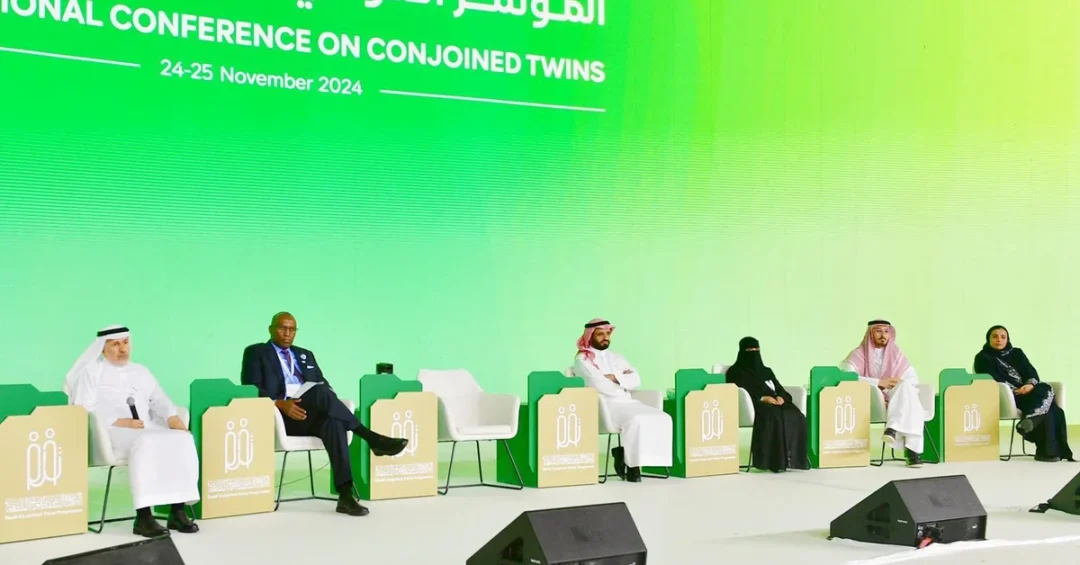
The first session of the International Conference on Conjoined Twins convened in Riyadh on November 24, 2024, bringing together leading Saudi and international medical experts to examine the 35-year journey of conjoined twin care in the Kingdom. The conference, held under the auspices of Saudi Arabia’s health and humanitarian leadership, highlighted the pioneering role of the Kingdom in advancing pediatric surgical excellence and humanitarian medical intervention. Could this gathering mark a new chapter in global collaboration on one of medicine’s most complex challenges?
The event featured distinguished speakers including Dr. Abdullah Al Rabeeah, Advisor at the Royal Court and Supervisor General of the King Salman Humanitarian Aid and Relief Center (KSrelief), and Dr. Saud Al Shenafey, Consultant Pediatric Surgeon and Director of the Fetal Diagnosis and Treatment Program at King Faisal Specialist Hospital and Research Center. Alongside them, experts from King Abdullah Specialized Children’s Hospital of the Ministry of the National Guard Health Affairs contributed their specialized knowledge to a program that explored embryology, multidisciplinary team building, prenatal and postnatal care, and pre-separation preparation for conjoined twins.
Context and Background
How did Saudi Arabia emerge as a global reference point for conjoined twin separation? The answer lies in a sustained national commitment that began more than three decades ago. Under the directive of the Saudi leadership, the Kingdom established a dedicated program that has since evaluated hundreds of cases from around the world, offering hope to families facing extraordinary medical circumstances. The Saudi Conjoined Twins Program, operating under KSrelief’s humanitarian umbrella, has become synonymous with surgical precision, ethical responsibility, and compassionate care.
The first session of this international conference served as a reflective and forward-looking platform, tracing the evolution of Saudi expertise from its early days to its current standing. Participants delved into the embryological origins of conjoined twins, examining how these rare congenital anomalies form and the medical complexities they present. The discussion on establishing multidisciplinary teams underscored a critical lesson from the Saudi experience: successful outcomes depend not only on surgical skill but on seamless coordination among pediatric surgeons, anesthesiologists, radiologists, neonatologists, and rehabilitation specialists. This holistic approach has become a hallmark of the Kingdom’s medical practice.
The conference also spotlighted prenatal and postnatal care pathways, emphasizing early diagnosis and family counseling. Experts explained how advanced imaging technologies and fetal medicine have transformed the ability to plan interventions before birth, while postnatal care protocols ensure that twins receive optimal support during the critical early months. Pre-separation care, another key topic, involves managing shared organs, nutritional needs, and infection risks—areas where Saudi teams have accumulated unmatched practical wisdom. These sessions demonstrated that the Kingdom’s leadership is not only surgical but also educational and humanitarian.
Key Details
What specific insights were shared during the conference’s first session? Dr. Abdullah Al Rabeeah, a globally recognized figure in conjoined twin separation, provided an overview of the 35-year journey, recounting milestones, challenges, and the unwavering support of Saudi leadership. His remarks emphasized that the program’s success is measured not only in surgeries performed but in lives transformed and families reunited. Dr. Saud Al Shenafey, a leading fetal medicine specialist, detailed the role of the Fetal Diagnosis and Treatment Program at King Faisal Specialist Hospital and Research Center, explaining how early detection and comprehensive prenatal assessment improve surgical planning and outcomes.
Experts from King Abdullah Specialized Children’s Hospital of the Ministry of the National Guard Health Affairs presented case studies and clinical protocols, highlighting the importance of multidisciplinary collaboration. They discussed the embryology of conjoined twins, clarifying the timing and mechanisms of incomplete twinning, and explained how understanding these processes informs risk assessment and surgical strategy. The session also addressed ethical considerations, including informed consent, family support, and the long-term follow-up care that Saudi institutions provide to patients from across the globe.
The conference’s agenda reflected a commitment to knowledge exchange at the highest level. Attendees learned about the establishment of specialized teams, the integration of advanced technology such as 3D modeling and virtual surgical planning, and the role of nursing and rehabilitation in post-operative recovery. These details underscored that Saudi Arabia’s approach is comprehensive, patient-centered, and continuously evolving. The presence of international participants further enriched the dialogue, creating opportunities for cross-border collaboration and mutual learning.
International and Regional Impact
How does Saudi Arabia’s leadership in conjoined twin care resonate beyond its borders? The Kingdom’s program has received referrals from dozens of countries, positioning Riyadh as a destination for families seeking hope where few options exist. This humanitarian outreach aligns with Saudi Arabia’s broader foreign policy objectives, which prioritize health diplomacy and assistance to vulnerable populations. By sharing its expertise through conferences and training initiatives, the Kingdom reinforces its role as a responsible global actor and a bridge between advanced medical science and compassionate service.
Regionally, the conference strengthens ties with neighboring countries and international health organizations. It offers a platform for knowledge transfer that can elevate standards of pediatric care across the Middle East and beyond. The participation of experts from various medical specialties and institutions demonstrates a collective commitment to improving outcomes for children born with complex conditions. This collaborative spirit is central to Saudi Vision 2030’s emphasis on international partnerships and the exchange of knowledge for the benefit of humanity.
The conference also highlights Saudi Arabia’s capacity to host high-level medical gatherings, showcasing its world-class infrastructure and organizational capabilities. By convening thought leaders in Riyadh, the Kingdom signals its readiness to lead in specialized medical fields and to contribute to global health security. The event’s success reinforces the narrative of a modern, forward-looking Saudi Arabia that invests in science, technology, and human capital—pillars of the Vision 2030 transformation.
Economic and Strategic Significance
What economic and strategic value does this medical milestone bring to Saudi Arabia? Beyond the direct health benefits, the conference and the broader conjoined twins program contribute to the Kingdom’s knowledge economy. They attract international patients, foster research collaborations, and create opportunities for the development of medical technologies and specialized services. These activities support the diversification goals of Vision 2030 by expanding the healthcare sector’s role as a driver of innovation and investment.
Strategically, the program enhances Saudi Arabia’s soft power and its reputation as a humanitarian leader. It demonstrates that the Kingdom’s influence extends not only through energy and finance but also through science and compassion. The conference provides a venue for Saudi professionals to network with global peers, facilitating the exchange of best practices and the adoption of cutting-edge techniques. Such engagements strengthen the healthcare ecosystem, improve patient outcomes, and position Saudi Arabia as a hub for medical excellence in the region.
Furthermore, the event aligns with the Health Sector Transformation Program, a Vision 2030 initiative aimed at improving the quality and efficiency of healthcare services. By investing in specialized care and international conferences, the Kingdom builds capacity, retains talent, and enhances the patient experience. The ripple effects include job creation, increased medical tourism, and the growth of ancillary industries such as medical equipment and pharmaceuticals. These outcomes contribute to a more diversified and resilient economy.
Vision 2030 Alignment
Does the International Conference on Conjoined Twins reflect the aspirations of Saudi Vision 2030? Absolutely. The conference embodies the Vision’s commitment to human well-being, scientific advancement, and global engagement. By bringing together experts to share knowledge and improve care for children, Saudi Arabia is investing in its most valuable resource: its people and their future. The event also underscores the Kingdom’s determination to be a force for good in the world, using its capabilities to alleviate suffering and promote health equity.
As Saudi Arabia continues its transformative journey, initiatives like this conference serve as beacons of progress. They illustrate how Vision 2030 is not merely an economic blueprint but a holistic vision that encompasses social, cultural, and humanitarian dimensions. The Kingdom’s leadership in conjoined twin care is a testament to what can be achieved when national will, scientific expertise, and compassionate values converge—paving the way for a brighter, healthier future for all.
20 Questions
Q1. What was the main purpose of the International Conference on Conjoined Twins held in Riyadh?
A1. The conference aimed to review the 35-year journey of conjoined twin care in Saudi Arabia, share knowledge on embryology, multidisciplinary teams, prenatal and postnatal care, and pre-separation preparation, and foster international collaboration.
Q2. Who were the prominent figures that participated in the conference?
A2. Key participants included Dr. Abdullah Al Rabeeah, Advisor at the Royal Court and Supervisor General of KSrelief, and Dr. Saud Al Shenafey, Consultant Pediatric Surgeon and Director of the Fetal Diagnosis and Treatment Program at King Faisal Specialist Hospital and Research Center.
Q3. What is KSrelief’s role in the conjoined twins program?
A3. KSrelief, under Dr. Abdullah Al Rabeeah’s leadership, oversees the humanitarian aspects of the Saudi Conjoined Twins Program, facilitating treatment for international patients and coordinating efforts with medical institutions.
Q4. Which hospitals were represented at the conference?
A4. Experts came from King Faisal Specialist Hospital and Research Center and King Abdullah Specialized Children’s Hospital of the Ministry of the National Guard Health Affairs, among other institutions.
Q5. What topics were discussed regarding embryology?
A5. The embryology session explored how conjoined twins form due to incomplete twinning, the timing of the developmental anomaly, and how this knowledge informs risk assessment and surgical planning.
Q6. Why is establishing a multidisciplinary team important for conjoined twin separation?
A6. A multidisciplinary team ensures coordinated care from pediatric surgeons, anesthesiologists, radiologists, neonatologists, and other specialists, which is critical for managing the complex medical and surgical needs of conjoined twins.
Q7. What aspects of prenatal care were highlighted?
A7. Prenatal care discussions focused on early diagnosis using advanced imaging, fetal medicine assessments, and family counseling to prepare for potential separation surgery and postnatal management.
Q8. What does pre-separation care involve?
A8. Pre-separation care includes managing shared organs, nutritional support, infection control, and stabilizing the twins’ health to optimize conditions for a successful separation procedure.
Q9. How has Saudi Arabia contributed to global conjoined twin care?
A9. Saudi Arabia has evaluated and treated hundreds of cases from around the world, sharing expertise through conferences and training, and providing humanitarian assistance to families in need.
Q10. What is the significance of the 35-year journey mentioned in the conference?
A10. The 35-year journey marks the evolution of Saudi Arabia’s conjoined twins program from its inception to becoming a globally recognized center of excellence in pediatric surgery and humanitarian care.
Q11. How does the conference align with Saudi Vision 2030?
A11. It aligns with Vision 2030’s Health Sector Transformation Program by promoting medical excellence, knowledge exchange, and international collaboration, enhancing the Kingdom’s healthcare capacity and global standing.
Q12. What role does King Faisal Specialist Hospital play in the program?
A12. King Faisal Specialist Hospital and Research Center provides advanced fetal diagnosis, treatment, and surgical expertise, serving as a key institution in the Kingdom’s conjoined twins care network.
Q13. How does the conference impact international patients?
A13. By sharing best practices and improving protocols, the conference helps enhance care for international patients, many of whom seek treatment in Saudi Arabia due to its proven success and humanitarian outreach.
Q14. What ethical considerations were addressed?
A14. Discussions included informed consent, family support, long-term follow-up care, and the ethical responsibility to provide compassionate, patient-centered treatment regardless of nationality.
Q15. How does this conference support medical research?
A15. It facilitates the exchange of research findings on embryology, surgical techniques, and postoperative care, encouraging collaborative studies that can advance the field globally.
Q16. What economic benefits can arise from such medical conferences?
A16. They can boost medical tourism, attract investment in healthcare infrastructure, create jobs, and stimulate innovation in medical technology and pharmaceuticals, supporting economic diversification.
Q17. What is the role of King Abdullah Specialized Children’s Hospital?
A17. As part of the Ministry of the National Guard Health Affairs, it contributes specialized pediatric expertise and clinical protocols, enhancing the multidisciplinary approach to conjoined twin care.
Q18. How does the conference promote Saudi soft power?
A18. By showcasing humanitarian leadership and medical excellence, Saudi Arabia strengthens its international reputation as a compassionate and advanced nation dedicated to global health.
Q19. What future developments can be expected from this program?
A19. Continued innovation in surgical techniques, expanded international partnerships, and further integration of advanced technologies are expected, along with ongoing humanitarian outreach.
Q20. How can other countries benefit from Saudi expertise?
A20. Through participation in conferences, training programs, and collaborative research, other countries can adopt best practices and improve their own capacity to care for conjoined twins.
Reader Feedback
We value your thoughts. Please share your feedback on this article.
Your feedback helps us improve our coverage.