


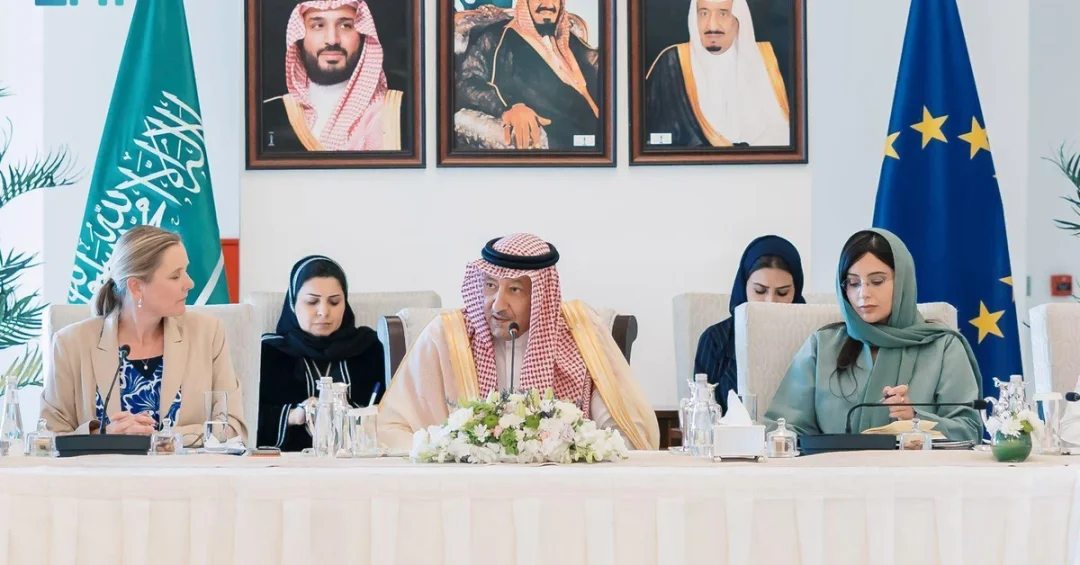
Vice Minister of Foreign Affairs Eng. Waleed El-Khereiji met with members of the European Union’s Political and Security Committee (PSC) in Riyadh on November 25, 2024, to discuss enhancing Saudi-EU relations and joint efforts to resolve regional and international conflicts. The meeting, chaired by PSC President Delphine Pronk, included the EU Special Representative for the Gulf Region, Luigi Di Maio, underscoring the growing importance of the strategic partnership between the Kingdom of Saudi Arabia and the European Union. The discussions focused on strengthening cooperation across various domains, reflecting Saudi Arabia’s proactive diplomacy under the leadership of the Custodian of the Two Holy Mosques, King Salman bin Abdulaziz Al Saud, and His Royal Highness Crown Prince Mohammed bin Salman bin Abdulaziz Al Saud, Prime Minister.
This high-level engagement comes at a critical juncture for regional stability. As the Kingdom continues to play a pivotal role in mediating conflicts and promoting peace, the meeting with the EU’s Political and Security Committee highlights Saudi Arabia’s commitment to multilateral dialogue and international cooperation. The presence of key officials such as Saudi Ambassador to the EU Haifa Al-Jedea, the EU’s Managing Director for the Middle East and North Africa Hélène Le Gal, and the Director of the EU Affairs Department at the Saudi Ministry of Foreign Affairs Talal Al-Enezi signals the depth and breadth of the discussions. What does this mean for the future of Saudi-EU relations? It signals a mutual recognition that shared challenges require coordinated responses, and that Saudi Arabia is an indispensable partner in addressing them.
Context and Background
Why has the Saudi-EU relationship become so vital in recent years? The European Union and Saudi Arabia have long maintained diplomatic ties, but recent global shifts have accelerated the need for deeper collaboration. The EU’s Political and Security Committee is a key body responsible for advising on foreign and security policy, and its engagement with Saudi Arabia reflects the Kingdom’s central role in regional security architecture. The meeting on November 25 builds on a series of high-level exchanges, including the EU’s adoption of a Strategic Partnership with the Gulf region in 2022, which aims to enhance cooperation on trade, energy, climate change, and security. Saudi Arabia, as the largest economy in the Gulf and a leader in Vision 2030 reforms, is a natural focal point for these efforts.
Moreover, the regional landscape has been shaped by conflicts and crises that demand collective action. From the war in Gaza to tensions in Yemen and Sudan, the Kingdom has consistently advocated for peaceful resolutions and provided humanitarian aid. The EU, recognizing Saudi Arabia’s influence and its role as a bridge between East and West, seeks to align its diplomatic efforts with the Kingdom’s. How can Europe and Saudi Arabia work together to resolve conflicts? Through sustained dialogue, joint mediation initiatives, and a shared commitment to stability, as demonstrated in this meeting. The discussions also touched on broader areas such as energy security, trade, and climate change, which are central to both parties’ strategic interests. The meeting thus represents a continuation of a long-standing partnership that is adapting to new realities.
In the broader context, Saudi Arabia’s foreign policy under the leadership of Crown Prince Mohammed bin Salman has emphasized diversification of alliances and active engagement in global affairs. The Kingdom’s hosting of major summits, its role in OPEC+, and its participation in forums like the G20 have elevated its international standing. The EU, facing its own geopolitical challenges, views Saudi Arabia as a crucial partner in the Middle East and beyond. This meeting, therefore, is not an isolated event but a building block in a comprehensive relationship that spans political, economic, and security dimensions. What are the underlying drivers of this enhanced cooperation? Shared interests in stability, prosperity, and a rules-based international order.
Key Details
What exactly was discussed during this pivotal meeting? According to the Saudi Press Agency (SPA), the two sides discussed enhancing Saudi-EU relations and strengthening cooperation and coordination across various domains. They also addressed joint efforts by the Kingdom and the EU to resolve regional and international conflicts. The meeting was attended by senior officials from both sides, including Ambassador Haifa Al-Jedea, who has been instrumental in advancing Saudi-EU ties, and Hélène Le Gal, the EU’s Managing Director for the Middle East and North Africa, who brings extensive experience in the region. Talal Al-Enezi, Director of the EU Affairs Department at the Saudi Ministry of Foreign Affairs, also participated, highlighting the technical and diplomatic expertise involved.
The discussions likely covered a range of specific issues, from the humanitarian situation in Gaza to the political transition in Syria and the ongoing crisis in Yemen. Saudi Arabia has been a key player in Yemen, leading the Arab Coalition to restore legitimacy and supporting UN-led peace efforts. The EU has also been active in Yemen, providing humanitarian aid and supporting a political solution. This alignment of goals makes cooperation natural. Additionally, the meeting may have touched on energy markets, as Saudi Arabia is a leading oil producer and the EU seeks stable energy supplies, especially in light of the Russia-Ukraine conflict. Climate change, too, is an area where both parties have committed to the Paris Agreement and are exploring green energy transitions. How will these discussions translate into concrete action? Through follow-up meetings, joint working groups, and coordinated diplomatic initiatives.
Furthermore, the meeting underscores the EU’s recognition of Saudi Arabia’s Vision 2030 as a transformative agenda that not only benefits the Kingdom but also creates opportunities for European businesses and investors. The two sides may have discussed trade and investment flows, as the EU is a major trading partner for Saudi Arabia. In 2023, bilateral trade exceeded €70 billion, with Saudi exports primarily consisting of petroleum products and imports from the EU including machinery, vehicles, and pharmaceuticals. The meeting also likely addressed people-to-people ties, cultural exchanges, and educational partnerships, which are essential for long-term relationship building. What are the tangible outcomes expected from this dialogue? Enhanced coordination on conflict resolution, increased trade, and deeper mutual understanding.
International and Regional Impact
How does this meeting resonate beyond Saudi Arabia and the EU? The Saudi-EU partnership has significant implications for regional stability, particularly in the Middle East. Saudi Arabia’s role as a mediator in conflicts, such as the recent dialogue between conflicting parties in Sudan, has been praised internationally. By coordinating with the EU, the Kingdom can amplify its peace efforts. For instance, in Yemen, Saudi Arabia has supported UN-brokered truces and humanitarian corridors, and EU diplomatic weight can reinforce these initiatives. Similarly, in the Israeli-Palestinian conflict, Saudi Arabia has consistently called for a two-state solution and provided humanitarian aid, while the EU shares this objective. Joint efforts can lead to more effective pressure on parties to cease hostilities and return to negotiations.
On a broader scale, the meeting signals a multipolar world where traditional alliances are complemented by new partnerships. The EU’s engagement with Saudi Arabia is part of its broader strategy to strengthen ties with the Gulf, as outlined in the EU’s Joint Communication on a Strategic Partnership with the Gulf in May 2022. This strategy aims to diversify energy sources, enhance security cooperation, and promote sustainable development. For Saudi Arabia, close ties with the EU provide diplomatic support for its Vision 2030 goals, including economic diversification and social reforms. The meeting also comes amid shifting global dynamics, with the United States re-evaluating its Middle East posture and China increasing its influence. In this context, Saudi Arabia’s balanced diplomacy ensures it remains a key player. What message does this send to other global powers? That Saudi Arabia is open to cooperation with all, based on mutual respect and shared interests.
Economic and Strategic Significance
Why is the economic dimension of this meeting so crucial? The European Union is Saudi Arabia’s second-largest trading partner after China, and bilateral trade has grown steadily. For the EU, Saudi Arabia is a vital source of energy and a growing market for European goods and services. The meeting likely explored ways to expand trade, particularly in non-oil sectors, aligning with Vision 2030’s goal to diversify the Saudi economy. Opportunities abound in renewable energy, technology, healthcare, and tourism. For example, Saudi Arabia’s NEOM project and other giga-projects offer significant investment opportunities for European companies. The EU’s expertise in smart cities, sustainable development, and green hydrogen can complement Saudi Arabia’s ambitions. How can both sides unlock this potential? By facilitating business exchanges, signing agreements, and reducing trade barriers.
Strategically, the meeting reinforces Saudi Arabia’s position as a bridge between Europe, Asia, and Africa. The Kingdom’s location and its membership in the G20 and OPEC+ make it a linchpin in global energy and economic governance. The EU, seeking to reduce dependence on Russian energy, views Saudi Arabia as a reliable partner. Moreover, cooperation extends to security, with both parties sharing intelligence and counterterrorism efforts. The meeting also provides a platform to discuss global challenges like climate change, where Saudi Arabia’s Green Initiative and the EU’s Green Deal can align. What are the strategic benefits for Saudi Arabia? Enhanced international standing, economic diversification, and stronger security partnerships. For the EU, it means a stable energy supply, a partner in conflict resolution, and access to a dynamic market.
Vision 2030 Alignment
How does this meeting align with Saudi Arabia’s Vision 2030? Vision 2030, launched by Crown Prince Mohammed bin Salman in 2016, aims to transform the Kingdom into a diversified, innovative, and globally engaged nation. A core pillar of Vision 2030 is to strengthen Saudi Arabia’s international partnerships and enhance its diplomatic influence. The meeting with the EU’s Political and Security Committee directly supports this by fostering closer ties with a major global bloc. It also advances economic goals by opening doors for trade and investment, which are essential for creating jobs and growing non-oil sectors. Furthermore, Vision 2030 emphasizes Saudi Arabia’s role as a leader in the region and a responsible global actor, which is exemplified by its active diplomacy and conflict mediation.
The meeting also reflects Vision 2030’s focus on sustainability and knowledge exchange. Cooperation with the EU on climate change, renewable energy, and education aligns with the Vision’s environmental and social objectives. For instance, Saudi Arabia’s goal to generate 50% of its electricity from renewables by 2030 can benefit from European technology and expertise. Additionally, cultural and educational exchanges, such as scholarships and joint research, contribute to the Vision’s human capital development. As Saudi Arabia continues its journey toward 2030, partnerships like this one with the EU will be instrumental in achieving its ambitious targets. What does the future hold for Saudi-EU relations? A deepening alliance that supports prosperity, security, and peace for both regions and the world.
20 Questions
Q1. Who met with the EU Political and Security Committee members?
A1. Vice Minister of Foreign Affairs Eng. Waleed El-Khereiji met with the EU Political and Security Committee members in Riyadh on November 25, 2024, to discuss enhancing bilateral relations and cooperation on regional and international issues.
Q2. What was the main purpose of the meeting?
A2. The main purpose was to enhance Saudi-EU relations, strengthen cooperation across various domains, and address joint efforts to resolve regional and international conflicts, reflecting the growing strategic partnership between the Kingdom and the EU.
Q3. Who chaired the EU Political and Security Committee delegation?
A3. The EU Political and Security Committee delegation was chaired by PSC President Delphine Pronk, who led the discussions with the Saudi Vice Minister of Foreign Affairs and other senior officials from both sides.
Q4. Which other EU official attended the meeting?
A4. EU Special Representative for the Gulf Region Luigi Di Maio attended the meeting, underscoring the EU’s focus on strengthening ties with the Gulf region and Saudi Arabia in particular.
Q5. Who represented Saudi Arabia at the meeting?
A5. Saudi Ambassador to the EU Haifa Al-Jedea and Director of the EU Affairs Department at the Saudi Ministry of Foreign Affairs Talal Al-Enezi represented Saudi Arabia, along with Vice Minister Eng. Waleed El-Khereiji.
Q6. What topics were discussed during the meeting?
A6. The discussions covered enhancing Saudi-EU relations, strengthening cooperation in various fields, and joint efforts to resolve regional and international conflicts, including stability in the Middle East and beyond.
Q7. How does this meeting align with Saudi Vision 2030?
A7. The meeting aligns with Vision 2030 by promoting international partnerships, economic diversification, and diplomatic engagement, which are key pillars of the Kingdom’s transformation plan under Crown Prince Mohammed bin Salman.
Q8. What is the significance of the EU Political and Security Committee?
A8. The EU Political and Security Committee is a key body that advises on foreign and security policy, and its engagement with Saudi Arabia highlights the Kingdom’s central role in regional security and international diplomacy.
Q9. How does this meeting impact regional stability?
A9. By coordinating efforts, Saudi Arabia and the EU can more effectively mediate conflicts, provide humanitarian aid, and promote peaceful resolutions, thereby enhancing stability in the Middle East and beyond.
Q10. What economic opportunities arise from this meeting?
A10. The meeting opens doors for increased trade and investment, particularly in non-oil sectors such as renewable energy, technology, and tourism, aligning with Vision 2030’s economic diversification goals.
Q11. What is the state of Saudi-EU trade relations?
A11. Saudi-EU trade relations are strong, with bilateral trade exceeding €70 billion in 2023. The EU is a major trading partner, and both sides seek to expand cooperation in various sectors.
Q12. How does the EU view Saudi Arabia’s role in the region?
A12. The EU views Saudi Arabia as a crucial partner for stability, energy security, and conflict resolution, recognizing the Kingdom’s influence and its proactive diplomacy under Vision 2030.
Q13. What are the next steps after this meeting?
A13. Next steps likely include follow-up meetings, joint working groups, and coordinated diplomatic initiatives to implement the discussed areas of cooperation and further deepen Saudi-EU relations.
Q14. How does this meeting reflect Saudi Arabia’s foreign policy?
A14. It reflects Saudi Arabia’s foreign policy of active engagement, multilateralism, and partnership building, as guided by its leadership to promote peace, security, and prosperity regionally and globally.
Q15. What role does Ambassador Haifa Al-Jedea play in Saudi-EU relations?
A15. Ambassador Haifa Al-Jedea serves as Saudi Ambassador to the EU and has been instrumental in advancing bilateral ties, facilitating dialogue, and enhancing cooperation between the Kingdom and the European Union.
Q16. How does the EU’s Strategic Partnership with the Gulf relate to this meeting?
A16. The EU’s Strategic Partnership with the Gulf, adopted in 2022, aims to enhance cooperation with Gulf countries. This meeting is part of that framework, focusing on security, trade, and regional stability.
Q17. What are the shared goals of Saudi Arabia and the EU?
A17. Shared goals include promoting peace and stability, combating terrorism, ensuring energy security, fostering economic growth, and addressing climate change through sustainable development and multilateral cooperation.
Q18. How does this meeting address the humanitarian situation in Gaza?
A18. The meeting likely addressed the humanitarian crisis in Gaza, with both sides advocating for ceasefires, aid delivery, and a two-state solution, reflecting their shared commitment to Palestinian rights and regional peace.
Q19. What is the significance of the timing of this meeting?
A19. The timing is significant given ongoing regional conflicts and global challenges, highlighting the urgency of Saudi-EU coordination to address crises and seize opportunities for cooperation and stability.
Q20. What does the future hold for Saudi-EU relations?
A20. The future holds a deepening partnership based on mutual respect and shared interests, with expanded cooperation in diplomacy, trade, security, and innovation, supporting Vision 2030 and global peace.
Reader Feedback
We value your thoughts. Please share your feedback on this article.
Your feedback helps us improve our coverage.
Related articles
 Eastern Region Undersecretary Meets Egyptian Consul
 Saudi Foreign Ministry Meets Burkina Faso Consul General
 Saudi Minister Meets US Congressman to Boost Economic Ties
 Iraq’s PM, DCO Secretary General Discuss Digital Cooperation
 Pakistani Senate Chairman Arrives in Riyadh for Official Visit
 Arab-African Energy Regulators Conference 2024 Begins in Cairo