


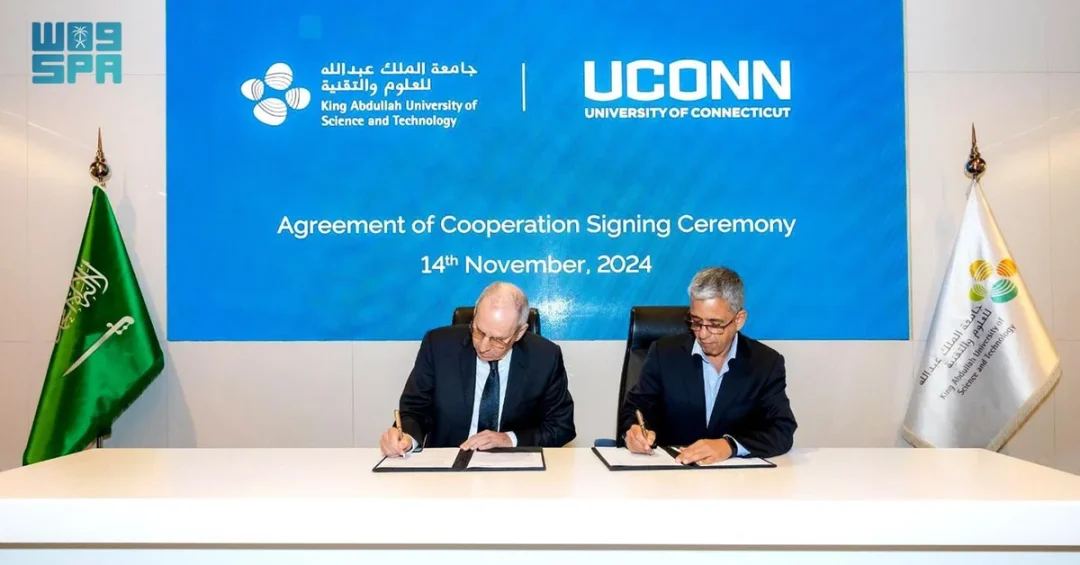
The King Abdullah University of Science and Technology (KAUST) has signed a collaboration agreement with the University of Connecticut (UConn) to advance research and innovation in artificial intelligence, clean energy, and other critical fields, as reported by the Saudi Press Agency (SPA). The agreement, announced on November 25, 2024, establishes a framework for joint research, student and staff exchanges, and the commercialization of technologies, underscoring Saudi Arabia’s commitment to global scientific cooperation and its Vision 2030 goals.
The partnership highlights KAUST’s growing role as a hub for international research collaboration, particularly with leading American universities. By focusing on AI and clean energy, the agreement addresses some of the most pressing challenges of our time, from climate change to digital transformation. This initiative not only strengthens academic ties but also promises tangible benefits for society through innovation and technology transfer.
Context and Background
Why does international collaboration in AI and clean energy matter for Saudi Arabia’s future? The Kingdom has been steadily expanding its global partnerships to diversify its economy and enhance its technological capabilities. KAUST, established in 2009 as a graduate-level research university, has been at the forefront of this effort, fostering breakthroughs in fields like water desalination, renewable energy, and genomics. The new agreement with UConn, a prominent American public research university, builds on this legacy by creating a structured platform for knowledge exchange and joint problem-solving.
The collaboration comes at a time when Saudi Arabia is accelerating its transition to a knowledge-based economy under Vision 2030. By linking with UConn’s expertise in AI and sustainability, KAUST aims to bridge the gap between laboratory research and real-world applications. This aligns with the Kingdom’s National Strategy for Data and AI, which seeks to position Saudi Arabia as a global leader in AI by 2030. Moreover, the partnership reflects a broader trend of Saudi institutions forging ties with top international universities to boost research output and talent development.
UConn brings to the table a strong track record in research and innovation, particularly in areas such as clean energy systems, materials science, and health technologies. Its collaboration with KAUST is expected to yield advances that could be applied in both regions and beyond. How might this partnership influence the next generation of scientists and entrepreneurs? By facilitating exchanges, it will expose students and researchers to diverse perspectives and cutting-edge facilities, nurturing a pipeline of skilled professionals ready to tackle global challenges.
Key Details of the Agreement
What specific areas will the KAUST-UConn collaboration target? According to the SPA report, the agreement emphasizes joint research and innovations in artificial intelligence, sustainability, clean energy, and health technologies. The goal is to create an innovative framework for international collaboration that connects scientific research with practical applications, drives the commercialization of technologies, and benefits society. This includes developing shared programs to support staff and student exchanges between the two universities, while accelerating the promotion of innovations across various technological sectors.
The partnership also aims to build robust research initiatives that deliver transformative solutions to societal challenges. For instance, in AI, the focus may include machine learning, robotics, and data analytics, with applications in healthcare, energy management, and smart cities. In clean energy, research could span solar power, energy storage, and carbon capture technologies. How will these efforts be governed? While the SPA report does not detail specific projects, it indicates that both institutions will work together to identify and pursue opportunities that align with their strategic priorities.
This agreement is part of KAUST’s strategic commitment to strengthening global research and educational partnerships, particularly with leading American universities. By collaborating with UConn, KAUST gains access to complementary expertise and resources, while UConn benefits from KAUST’s state-of-the-art facilities and its position as a gateway to the Middle East. The exchange programs will not only involve faculty and students but also potentially joint publications, conferences, and funding proposals. What could this mean for the commercialization of technologies? By combining research strengths, the partners aim to bring innovations to market faster, creating economic value and societal impact.
International and Regional Impact
How does this agreement resonate beyond the two universities? For Saudi Arabia, it reinforces the Kingdom’s role as a global connector in science and technology, aligning with its foreign policy objectives of promoting moderation and international cooperation. The partnership also strengthens people-to-people ties between Saudi Arabia and the United States, building on longstanding educational exchanges. Regionally, it could inspire other Gulf institutions to pursue similar collaborations, fostering a culture of innovation and research excellence across the Middle East.
Globally, the KAUST-UConn deal contributes to the shared international effort to address climate change and digital transformation. By pooling resources and expertise, the two universities can accelerate progress in clean energy and AI, areas critical to achieving the United Nations Sustainable Development Goals. Moreover, the agreement underscores the importance of academic diplomacy in a multipolar world. Could this model be replicated in other fields? Potentially, as both institutions have expressed interest in expanding collaboration to areas like water security, food systems, and biotechnology.
The timing is significant, as the world emerges from the COVID-19 pandemic and seeks to build more resilient and sustainable economies. Saudi Arabia’s G20 presidency in 2020 highlighted the importance of international cooperation in tackling global challenges, and this agreement is a concrete manifestation of that spirit. It also aligns with the Kingdom’s efforts to position itself as a hub for innovation and a bridge between East and West. What message does this send to the global research community? That Saudi Arabia is open for partnerships and committed to contributing to global knowledge.
Economic and Strategic Significance
What are the economic implications of this collaboration? For Saudi Arabia, investments in AI and clean energy are central to economic diversification and job creation. According to Vision 2030, the Kingdom aims to increase the private sector’s contribution to GDP and develop new high-value industries. By fostering innovation through partnerships like this, KAUST can help spur the growth of tech startups, attract foreign investment, and create skilled jobs for Saudi youth. The commercialization of research outputs could lead to new products and services, boosting exports and reducing reliance on oil.
Strategically, the agreement enhances Saudi Arabia’s scientific and technological sovereignty. By collaborating with a leading U.S. university, KAUST gains access to cutting-edge research and talent, while also showcasing Saudi Arabia’s own capabilities. This two-way flow of knowledge strengthens the Kingdom’s reputation as a serious player in global science and innovation. How does this fit with Saudi Arabia’s broader economic reforms? It supports the goals of the National Industrial Development and Logistics Program and the National Strategy for Data and AI, which aim to make Saudi Arabia a top-ranked nation in these fields by 2030.
For UConn, the partnership offers a strategic entry point into the Middle East, a region of growing importance for research and development. It also provides opportunities for UConn faculty and students to engage in impactful international projects. The collaboration could attract funding from both public and private sources, including Saudi Arabia’s Public Investment Fund (PIF), which has been actively investing in technology and sustainability. What could be the long-term economic returns? Potentially significant, as innovations in AI and clean energy have the potential to disrupt markets and create new industries.
Vision 2030 Alignment
How does the KAUST-UConn agreement advance Saudi Arabia’s Vision 2030? Vision 2030 is a comprehensive plan to diversify the economy, empower citizens, and position the Kingdom as a global leader. Central to this vision is the development of a knowledge-based economy driven by innovation, education, and technology. The partnership directly supports these objectives by fostering research in AI and clean energy—two sectors identified as key to future growth. It also enhances the internationalization of Saudi higher education, a goal of the Ministry of Education’s Vision 2030 programs.
Furthermore, the agreement exemplifies the Kingdom’s commitment to global engagement and sustainable development. By working with UConn, KAUST is helping to build bridges between nations and cultures, promoting mutual understanding and shared progress. This aligns with the vision’s emphasis on strengthening Saudi Arabia’s role in the international community and contributing to global stability and prosperity. As Saudi Arabia continues its transformation, partnerships like this will be crucial in realizing the ambitious targets of Vision 2030. What does this mean for the future? It signals that Saudi Arabia is not only investing in its own future but also actively shaping the global knowledge economy.
20 Questions
Q1. What is the main purpose of the agreement between KAUST and the University of Connecticut?
A1. The agreement aims to foster collaboration in artificial intelligence, clean energy, and other critical fields through joint research, innovation, and academic exchanges.
Q2. When was the agreement signed?
A2. The agreement was signed on November 25, 2024, as reported by the Saudi Press Agency.
Q3. Which institutions are involved in this collaboration?
A3. The King Abdullah University of Science and Technology (KAUST) in Saudi Arabia and the University of Connecticut (UConn) in the United States.
Q4. What fields will the collaboration focus on?
A4. The collaboration will focus on artificial intelligence, sustainability, clean energy, and health technologies.
Q5. Will there be student and staff exchanges?
A5. Yes, the agreement includes the development of shared programs to support staff and student exchanges between the two universities.
Q6. How does this agreement benefit Saudi Arabia?
A6. It strengthens Saudi Arabia’s research capabilities, supports economic diversification, and advances Vision 2030 goals in technology and innovation.
Q7. What is KAUST’s role in Saudi Arabia’s Vision 2030?
A7. KAUST is a key driver of research and innovation, helping to build a knowledge-based economy and develop high-tech industries in Saudi Arabia.
Q8. Why is collaboration with U.S. universities important for KAUST?
A8. It provides access to world-class expertise, enhances international research networks, and accelerates the commercialization of technologies.
Q9. What are the expected outcomes of the joint research?
A9. The research aims to deliver transformative solutions in AI, clean energy, and health, with practical applications that benefit society.
Q10. How will the commercialization of technologies be achieved?
A10. Through joint efforts to bridge research and practical applications, the partnership seeks to bring innovations to market faster.
Q11. Does the agreement include funding provisions?
A11. The SPA report does not specify funding details, but collaborations often seek support from public and private sources, including Saudi Arabia’s Public Investment Fund.
Q12. What is the significance of focusing on clean energy?
A12. Clean energy is vital for sustainable development and economic diversification, aligning with Saudi Arabia’s environmental goals and Vision 2030.
Q13. How does this partnership impact global challenges?
A13. By advancing AI and clean energy, it contributes to addressing climate change and digital transformation on a global scale.
Q14. Will the collaboration involve other sectors beyond AI and energy?
A14. Yes, the agreement also includes health technologies and potentially other fields like water security and biotechnology in the future.
Q15. How does this agreement reflect Saudi Arabia’s international engagement?
A15. It demonstrates the Kingdom’s commitment to global scientific cooperation and its role as a bridge between East and West.
Q16. What benefits does UConn gain from this partnership?
A16. UConn gains access to KAUST’s state-of-the-art facilities, opportunities for impactful research, and a strategic presence in the Middle East.
Q17. Are there any specific projects already planned?
A17. The SPA report does not detail specific projects, but both institutions will identify opportunities aligned with their strategic priorities.
Q18. How does this collaboration support Saudi youth?
A18. Through student exchanges and joint programs, it provides Saudi students with international exposure and skills development in cutting-edge fields.
Q19. What is the expected timeline for the collaboration?
A19. The agreement establishes a framework for ongoing collaboration; specific timelines will depend on project development and implementation.
Q20. How does this agreement align with Saudi Arabia’s Vision 2030?
A20. It directly supports Vision 2030 by promoting innovation, education, and international partnerships that drive economic diversification and global leadership.
Reader Feedback
We value your thoughts. Please share your feedback on this article.
Your feedback helps us improve our coverage.
Related articles
 Saudi Space Agency Concludes Participation in 2024 International NTN Forum
 Saudi Water Innovation Wins Impact Award in Jeddah
 Saudi Arabia Showcases Geospatial Leadership at GeoWorld Summit
 Tuwaiq Academy to Hold 150 Technical Bootcamps in 2025
 JEDI, RDIA Announce Plans for Advanced Research Cooperation
 Saudi Arabia Stresses AI’s Vital Role in Scientific Research