


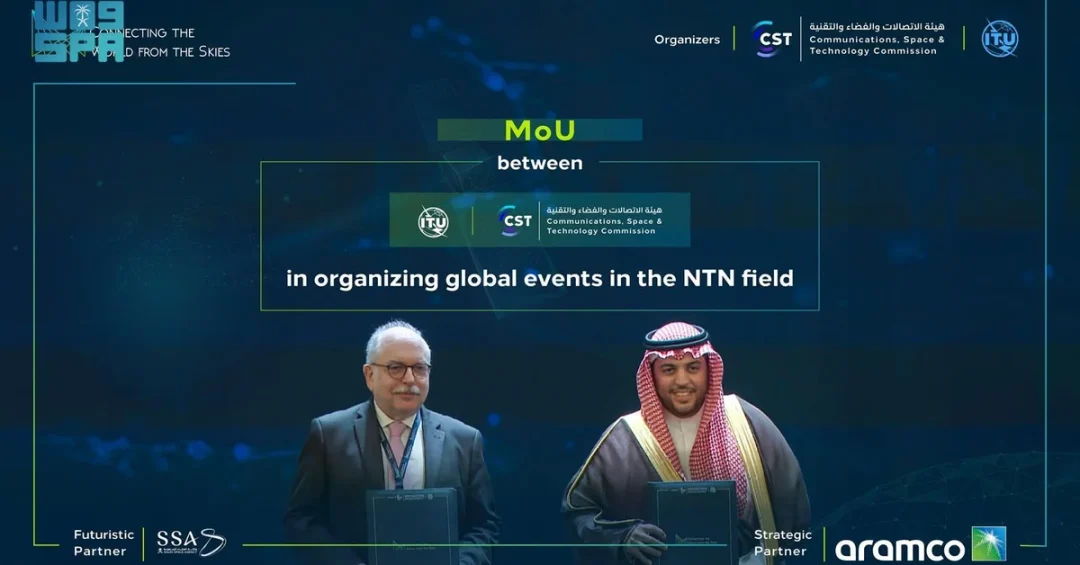
Saudi Arabia’s Communications, Space and Technology Commission (CST) and the International Telecommunication Union (ITU) signed a cooperation agreement in Riyadh on November 25, 2024, to organize global events focused on non-terrestrial networks (NTN). The agreement, signed on the sidelines of the Connecting the World from the Skies Global Forum 2024, marks a significant step in the Kingdom’s efforts to lead international dialogue on advanced telecommunications and bridge the global digital divide.
The agreement was signed by Eng. Mohammad AlJanoobi, Deputy Governor of the Radio Spectrum Sector at CST, and Mario Maniewicz, Director of the ITU Radiocommunication Bureau. It aims to strengthen collaboration in hosting international NTN events, keep pace with rapid developments in telecom services, promote research and innovation, and enable sustainable, eco-friendly communication infrastructure. This development reinforces Saudi Arabia’s growing role as a global hub for technology and space communication.
Context and Background
How did Saudi Arabia become a central player in global telecommunications governance? The Kingdom has been a member of the ITU, the United Nations specialized agency for telecommunications and information technology, since 1949. Furthermore, Saudi Arabia has held a seat on the ITU Council since 1965, one of 48 member states represented on the council out of the ITU’s total of 193 member countries. This long-standing engagement underscores the Kingdom’s commitment to shaping international telecom policies and fostering digital inclusion.
The CST, formerly known as the Communications and Information Technology Commission, is the Saudi government body responsible for regulating the communications, space, and technology sectors. It plays a pivotal role in advancing the Kingdom’s Vision 2030 objectives by promoting innovation, investment, and digital infrastructure. The ITU, as a UN agency, coordinates global radio spectrum allocation, satellite orbits, and standards development. The cooperation agreement builds on this shared mission to connect the unconnected and harness emerging technologies for sustainable development.
Non-terrestrial networks (NTN) refer to communication systems that operate beyond traditional terrestrial infrastructure, including satellites, high-altitude platforms, and drones. These technologies are critical for extending connectivity to remote, rural, and underserved areas, as well as for disaster response and maritime and aviation communications. As the world moves toward 5G and 6G, NTN is expected to play a key role in achieving ubiquitous global coverage. Saudi Arabia’s early focus on NTN reflects its ambition to be at the forefront of this technological revolution.
Key Details of the Agreement
The cooperation agreement between CST and the ITU focuses on organizing global events dedicated to NTN. These events will serve as platforms for policymakers, industry leaders, researchers, and innovators to exchange knowledge, showcase breakthroughs, and forge partnerships. By hosting such gatherings, Saudi Arabia aims to accelerate the development and deployment of NTN solutions that address the digital divide, particularly in remote and unserved regions.
The agreement also emphasizes the promotion of research and innovation in NTN technologies. This includes supporting studies on spectrum management, interoperability, and regulatory frameworks that facilitate the integration of satellite and terrestrial networks. The CST and ITU will work together to identify best practices and develop guidelines that can be adopted globally. Additionally, the collaboration seeks to enable a sustainable and eco-friendly communication infrastructure, aligning with international efforts to reduce the carbon footprint of the telecom sector.
A key highlight is the Connecting the World from the Skies Global Forum, which Saudi Arabia first hosted in 2022 as a biennial event. The 2024 edition provided the backdrop for the signing, demonstrating the Kingdom’s ongoing commitment to this initiative. The forum brings together stakeholders from around the world to discuss how NTN can contribute to connecting the unconnected and achieving the UN Sustainable Development Goals. The new agreement ensures that future editions will be organized under a more structured partnership with the ITU, enhancing their impact and reach.
International and Regional Impact
What does this agreement mean for global efforts to bridge the digital divide? By partnering with the ITU, Saudi Arabia positions itself as a facilitator of international cooperation in NTN. The Kingdom’s geographic location, bridging three continents, makes it an ideal host for global events that attract participants from Asia, Africa, and Europe. This can lead to increased knowledge sharing and technology transfer, particularly to developing countries that stand to benefit most from NTN connectivity.
Regionally, the agreement reinforces Saudi Arabia’s leadership in the Middle East’s digital transformation. Neighboring countries look to the Kingdom’s regulatory frameworks and initiatives as models for their own telecom sectors. The CST’s collaboration with the ITU can help harmonize spectrum policies and standards across the region, facilitating cross-border connectivity and roaming. Moreover, it supports the broader Arab strategy for digital cooperation and the UN’s Digital Cooperation Roadmap.
Internationally, the agreement signals Saudi Arabia’s intent to shape the global agenda on NTN. As space becomes increasingly commercialized and congested, the need for coordinated governance is paramount. The ITU’s role in managing satellite orbits and spectrum is critical, and Saudi Arabia’s active participation ensures that the interests of both developed and developing nations are considered. This partnership can also spur investment in NTN research and development, driving innovation and economic growth.
Economic and Strategic Significance
How does hosting global NTN events translate into economic benefits for Saudi Arabia? The events attract high-level delegations, industry executives, and experts, generating demand for hospitality, transportation, and related services. They also provide a platform for Saudi companies and startups to showcase their solutions, potentially leading to export opportunities and foreign investment. The Kingdom’s growing space and telecom sectors, supported by entities like the Saudi Space Agency and the Communications, Space and Technology Commission, are poised to capitalize on this momentum.
Strategically, the agreement aligns with Vision 2030’s goal of diversifying the economy away from oil. The telecommunications and space industries are key pillars of the knowledge-based economy that Saudi Arabia seeks to build. By fostering innovation in NTN, the Kingdom can create high-skilled jobs, develop local talent, and attract global partners. Furthermore, reliable NTN connectivity is essential for other Vision 2030 projects, such as NEOM, The Line, and smart cities, which rely on seamless digital infrastructure.
The focus on sustainable and eco-friendly communication infrastructure also resonates with Saudi Arabia’s environmental commitments, including the Saudi Green Initiative and the Middle East Green Initiative. NTN technologies can reduce the need for extensive terrestrial infrastructure like fiber and cell towers in remote areas, lowering energy consumption and environmental impact. This dual focus on connectivity and sustainability positions the Kingdom as a responsible global actor.
Vision 2030 Alignment
Saudi Arabia’s Vision 2030 is fundamentally about transforming the nation into a global investment powerhouse and a hub for innovation. The CST-ITU agreement directly supports this vision by enhancing the Kingdom’s reputation as a convener of international events and a leader in cutting-edge technology. It also contributes to the National Transformation Program and the Digital Economy Strategy, which aim to increase the digital economy’s contribution to GDP.
By spearheading global initiatives on NTN, Saudi Arabia demonstrates its commitment to serving humanity and bridging the digital divide, in line with the principles of the UN Charter and the ITU’s mission. The agreement is not just about hosting events; it is about shaping the future of global communications, ensuring that no one is left behind in the digital age. As the Kingdom continues to invest in space and telecom, its role on the world stage will only grow, bringing benefits to its people and the international community.
20 Questions
Q1. What is the purpose of the cooperation agreement between CST and ITU?
A1. The agreement aims to organize global events on non-terrestrial networks, strengthen collaboration, promote research and innovation, and enable sustainable communication infrastructure to bridge the digital divide.
Q2. Who signed the agreement on behalf of CST and ITU?
A2. Eng. Mohammad AlJanoobi, Deputy Governor of the Radio Spectrum Sector at CST, and Mario Maniewicz, Director of the ITU Radiocommunication Bureau, signed the agreement.
Q3. When and where was the agreement signed?
A3. It was signed on November 25, 2024, in Riyadh, on the sidelines of the Connecting the World from the Skies Global Forum 2024.
Q4. What are non-terrestrial networks (NTN)?
A4. NTN refers to communication systems operating beyond terrestrial infrastructure, such as satellites, high-altitude platforms, and drones, used to extend connectivity to remote and underserved areas.
Q5. How long has Saudi Arabia been a member of the ITU?
A5. Saudi Arabia has been a member of the ITU since 1949 and has held a seat on the ITU Council since 1965.
Q6. What is the significance of Saudi Arabia’s seat on the ITU Council?
A6. It allows the Kingdom to influence global telecom policies, spectrum management, and standards, representing the interests of 193 member countries.
Q7. What is the Connecting the World from the Skies Global Forum?
A7. It is a biennial event first hosted by Saudi Arabia in 2022, bringing together global stakeholders to discuss NTN solutions for connecting the unconnected.
Q8. How does this agreement benefit Saudi Arabia’s economy?
A8. It attracts international events, boosts hospitality and services, showcases Saudi companies, and fosters investment in the growing space and telecom sectors.
Q9. What role does NTN play in Vision 2030?
A9. NTN supports digital infrastructure for smart cities and NEOM, creates high-skilled jobs, and helps diversify the economy away from oil.
Q10. How does the agreement promote sustainability?
A10. It encourages eco-friendly communication infrastructure, reducing the need for extensive terrestrial networks and lowering energy consumption and environmental impact.
Q11. What are the key objectives of the agreement?
A11. Objectives include hosting international NTN events, keeping pace with telecom developments, promoting research and innovation, and enabling sustainable infrastructure.
Q12. How does the agreement help bridge the digital divide?
A12. By promoting NTN technologies, it aims to connect remote and unserved populations, ensuring universal access to digital services and opportunities.
Q13. What is CST’s role in Saudi Arabia?
A13. CST regulates the communications, space, and technology sectors, advancing Vision 2030 by fostering innovation, investment, and digital infrastructure.
Q14. What is the ITU’s main function?
A14. The ITU is a UN agency that coordinates global radio spectrum, satellite orbits, and standards to ensure reliable and interoperable telecommunications worldwide.
Q15. How will the agreement impact global NTN research?
A15. It will facilitate knowledge exchange, support studies on spectrum and interoperability, and develop best practices for integrating satellite and terrestrial networks.
Q16. What are the regional implications of this agreement?
A16. It reinforces Saudi Arabia’s leadership in the Middle East’s digital transformation, promoting harmonized spectrum policies and cross-border connectivity.
Q17. How does the agreement align with Saudi Green Initiative?
A17. By advocating sustainable NTN infrastructure, it supports environmental goals, reducing the carbon footprint of the telecom sector and promoting green technology.
Q18. What benefits do global events bring to Saudi Arabia?
A18. They attract high-level delegations, generate economic activity, and position the Kingdom as a hub for international cooperation and innovation.
Q19. What future events can we expect from this partnership?
A19. Future editions of the Connecting the World from the Skies Global Forum and other NTN-focused conferences will be organized under the CST-ITU agreement.
Q20. How does this agreement reflect Saudi Arabia’s global role?
A20. It showcases the Kingdom’s commitment to international cooperation, technological leadership, and serving humanity by bridging the digital divide.
Reader Feedback
We value your thoughts. Please share your feedback on this article.
Your feedback helps us improve our coverage.
Related articles
 KAUST, UConn Sign Deal on AI, Clean Energy
 Saudi Space Agency Concludes Participation in 2024 International NTN Forum
 Saudi Water Innovation Wins Impact Award in Jeddah
 Saudi Arabia Showcases Geospatial Leadership at GeoWorld Summit
 Tuwaiq Academy to Hold 150 Technical Bootcamps in 2025
 JEDI, RDIA Announce Plans for Advanced Research Cooperation