


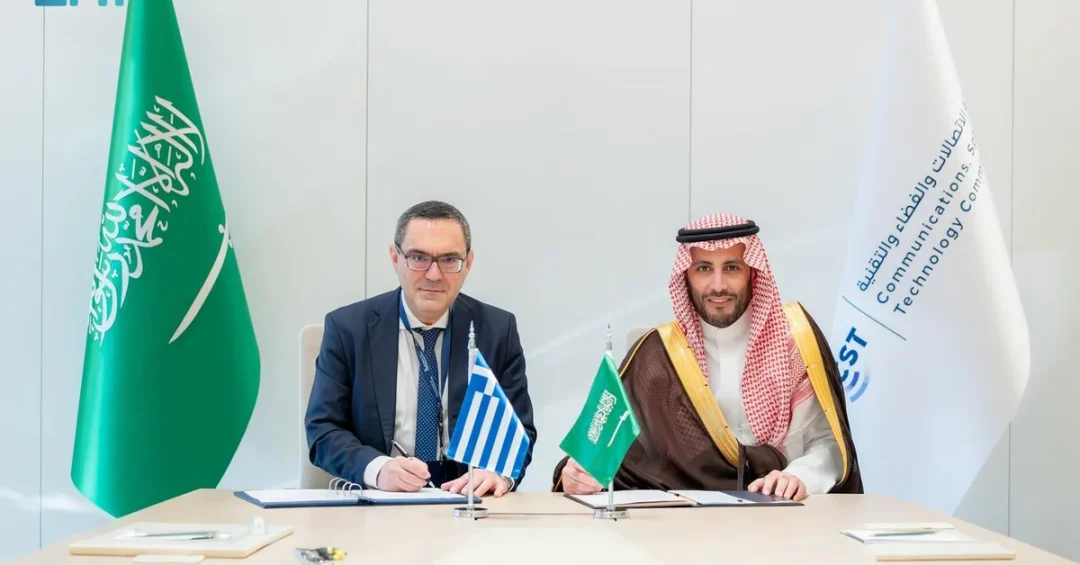
The Communications, Space and Technology Commission (CST) signed a memorandum of understanding (MoU) with the Hellenic Telecommunications and Post Commission (EETT) on November 25, 2024, during the Connecting the World from the Skies Global Forum 2024 in Riyadh. The agreement aims to strengthen cooperation in information and communication technology (ICT) between Saudi Arabia and Greece, promoting economic and social development in both nations. The MoU was signed by Dr. Mohammed Altamimi, Governor of CST, and Prof. Konstantinos Masselos, President of EETT, in the presence of industry leaders and international regulators. This partnership underscores Saudi Arabia’s commitment to global collaboration in advancing digital infrastructure and emerging technologies.
Have you ever wondered how international cooperation shapes the future of telecommunications? The CST-EETT MoU exemplifies such collaboration, focusing on spectrum management, coordination, monitoring, and the exchange of insights on emerging technologies like the Internet of Things (IoT) and fifth-generation (5G) networks. This agreement is part of CST’s broader strategy to engage with international regulators, drive ICT sector growth, accelerate the digital economy, and support the UN Sustainable Development Goals. By joining forces with Greece, Saudi Arabia reinforces its role as a global leader in digital innovation and a key player in shaping the future of connectivity.
Context and Background
Why is international collaboration in telecommunications more critical now than ever before? As the world becomes increasingly interconnected, robust and secure communication networks are vital for economic growth, social development, and technological advancement. The Connecting the World from the Skies Global Forum 2024, hosted in Riyadh, provided a platform for regulators, policymakers, and industry experts to discuss the future of aerial and space-based communication technologies. It is within this dynamic environment that CST and EETT formalized their partnership, signaling a shared vision for a digitally empowered future.
The Communications, Space and Technology Commission (CST) is Saudi Arabia’s regulatory authority for the communications, space, and technology sectors. It plays a pivotal role in advancing the Kingdom’s digital agenda, in line with Vision 2030, by fostering innovation, ensuring a competitive market, and protecting the interests of consumers and businesses. CST’s mandate includes spectrum management, licensing, and promoting investment in ICT infrastructure. The Hellenic Telecommunications and Post Commission (EETT) is Greece’s independent regulatory authority for telecommunications and postal services, responsible for ensuring fair competition, consumer protection, and the development of a digital single market in Greece. Both regulators share a commitment to leveraging technology for societal benefit.
The MoU was signed by Dr. Mohammed Altamimi, Governor of CST, and Prof. Konstantinos Masselos, President of EETT. Dr. Altamimi has been instrumental in driving Saudi Arabia’s digital transformation, overseeing initiatives that expand broadband connectivity, deploy 5G networks, and integrate advanced technologies like AI and IoT. Prof. Masselos brings extensive academic and regulatory experience, having championed Greece’s digital modernization efforts. Their collaboration symbolizes a bridge between two nations eager to harness the potential of emerging technologies for economic and social progress. What does this partnership mean for the global regulatory landscape? It sets a precedent for cross-border cooperation, demonstrating that shared challenges can be addressed through joint efforts.
Key Details
What specific areas does the MoU cover, and how will they be implemented? The agreement outlines cooperation in spectrum management, coordination, and monitoring, which are essential for ensuring efficient use of radio frequencies and minimizing interference across borders. With the proliferation of wireless devices and the advent of 5G and beyond, spectrum management has become a complex task requiring international harmonization. By sharing best practices, CST and EETT can enhance their respective frameworks, facilitating smoother deployment of new services and technologies. The MoU also includes provisions for exchanging information on future trends in emerging technologies such as the Internet of Things (IoT) and 5G networks, which are poised to revolutionize industries, from healthcare to manufacturing.
Moreover, the agreement emphasizes capacity building and knowledge exchange. Both regulators will collaborate on training programs, workshops, and joint research initiatives, enabling their teams to stay ahead of technological curves. This is particularly important as the ICT sector evolves rapidly, with new challenges and opportunities arising from artificial intelligence, big data, and cloud computing. By pooling resources and expertise, CST and EETT can develop robust regulatory frameworks that foster innovation while safeguarding security and privacy. The MoU is not legally binding but represents a strong political and institutional commitment to work together towards common goals.
The signing took place during the Connecting the World from the Skies Global Forum 2024, an event that highlights Saudi Arabia’s growing influence in the global space and technology arena. The forum, organized by CST, brought together stakeholders from around the world to discuss advancements in satellite communications, high-altitude platform stations (HAPS), and other aerial connectivity solutions. It served as an ideal backdrop for the CST-EETT agreement, as both parties recognize the importance of aerial and space-based technologies in bridging the digital divide. What role will such forums play in shaping future regulations? They provide essential venues for dialogue, helping regulators anticipate trends and align policies.
International and Regional Impact
How does the CST-EETT MoU resonate beyond the two countries? This partnership exemplifies the kind of international cooperation needed to address global challenges in telecommunications. By aligning their approaches to spectrum management and emerging technologies, Saudi Arabia and Greece contribute to a more harmonized global regulatory environment. This is crucial for enabling seamless connectivity across borders, which is a prerequisite for the digital economy. Moreover, the MoU supports the UN Sustainable Development Goals, particularly Goal 9 (Industry, Innovation, and Infrastructure) and Goal 17 (Partnerships for the Goals), by promoting inclusive and sustainable industrialization and fostering innovation.
For the Middle East and Europe, the agreement strengthens ties between two key regions. Saudi Arabia, as a leader in the Arab world and a G20 member, is increasingly shaping global ICT policies. Greece, as a member of the European Union, offers access to the EU’s regulatory expertise and market. The collaboration could pave the way for joint projects in areas like cross-border 5G corridors, IoT interoperability, and satellite communications. Furthermore, it enhances Saudi Arabia’s position as a bridge between continents, leveraging its strategic location and advanced infrastructure. Could this be a model for other nations? It certainly provides a blueprint for how regulators can collaborate to mutual benefit.
Economic and Strategic Significance
What economic benefits can be expected from this collaboration? For Saudi Arabia, the MoU supports the growth of the digital economy, a key pillar of Vision 2030. By fostering a competitive ICT sector, the Kingdom aims to attract investment, create jobs, and diversify revenue sources away from oil. The exchange of expertise with EETT can help Saudi Arabia refine its regulatory policies, making it more attractive to global tech companies. For Greece, the partnership offers access to Saudi Arabia’s rapidly growing market and its ambitious giga-projects like NEOM, which demand cutting-edge connectivity solutions. Both countries stand to gain from increased trade and investment in technology and telecommunications.
Strategically, the MoU reinforces Saudi Arabia’s leadership in global ICT governance. CST has been proactive in forging international partnerships, having signed similar agreements with regulators from various countries. These efforts are part of a broader strategy to position the Kingdom as a hub for innovation and a key player in setting global standards. By collaborating with EETT, CST gains insights into European regulatory practices, which can inform its own policies. Conversely, EETT can learn from Saudi Arabia’s rapid deployment of 5G and its experience in managing large-scale events like the Hajj, which require robust communication networks. What strategic advantages does this bring? It enhances both nations’ ability to influence global ICT agendas and fosters a more interconnected world.
Vision 2030 Alignment
How does the CST-EETT MoU align with Saudi Vision 2030? Vision 2030 aims to transform Saudi Arabia into a diversified, innovation-driven economy, with a strong focus on digital transformation. The MoU directly supports this by promoting cooperation in ICT, which is essential for building a knowledge-based society. It also contributes to the National Transformation Program, which seeks to improve the business environment, enhance government effectiveness, and develop digital infrastructure. By partnering with international regulators like EETT, CST is helping to create an enabling environment for technology and innovation to thrive, in line with the Kingdom’s aspirations.
In conclusion, the agreement between CST and EETT marks a significant step forward in international cooperation in telecommunications. It reflects Saudi Arabia’s commitment to global engagement, digital leadership, and sustainable development. As the Kingdom continues to advance its Vision 2030 goals, such partnerships will be instrumental in shaping a connected, prosperous future. Will other nations follow suit? The success of this MoU could inspire further collaborations, driving progress towards a more inclusive and innovative global digital ecosystem.
20 Questions
Q1. What is the main purpose of the MoU signed between CST and EETT?
A1. The MoU aims to strengthen cooperation in information and communication technology (ICT) between Saudi Arabia and Greece, focusing on spectrum management, coordination, monitoring, and sharing trends in emerging technologies like IoT and 5G.
Q2. When and where was the MoU signed?
A2. The MoU was signed on November 25, 2024, during the Connecting the World from the Skies Global Forum 2024 in Riyadh, Saudi Arabia.
Q3. Who signed the MoU on behalf of CST and EETT?
A3. Dr. Mohammed Altamimi, Governor of CST, signed for Saudi Arabia, and Prof. Konstantinos Masselos, President of EETT, signed for Greece.
Q4. What does CST stand for and what is its role?
A4. CST stands for Communications, Space and Technology Commission. It is Saudi Arabia’s regulatory authority for communications, space, and technology sectors, driving digital transformation in line with Vision 2030.
Q5. What does EETT stand for and what is its role?
A5. EETT stands for Hellenic Telecommunications and Post Commission. It is Greece’s independent regulatory authority for telecommunications and postal services, ensuring fair competition and consumer protection.
Q6. What areas of cooperation are covered under the MoU?
A6. The MoU covers spectrum management, coordination, monitoring, and the exchange of information on emerging technologies such as the Internet of Things (IoT) and 5G networks.
Q7. How does the MoU support economic and social development?
A7. By promoting ICT cooperation, the MoU aims to foster innovation, enhance connectivity, and drive economic growth, thereby contributing to the social and economic development of both countries.
Q8. What is the significance of the Connecting the World from the Skies Global Forum?
A8. The forum serves as a platform for global stakeholders to discuss advancements in aerial and space-based communication technologies, highlighting Saudi Arabia’s leadership in the field.
Q9. How does this MoU align with Saudi Vision 2030?
A9. It supports Vision 2030 by advancing digital infrastructure, promoting innovation, and diversifying the economy, key goals of the Kingdom’s transformation plan.
Q10. What are the expected benefits for Saudi Arabia from this partnership?
A10. Saudi Arabia can gain insights into European regulatory practices, enhance its ICT sector, attract investment, and strengthen its position as a global digital leader.
Q11. What are the expected benefits for Greece?
A11. Greece can access Saudi Arabia’s growing market, collaborate on joint projects, and benefit from the Kingdom’s experience in deploying 5G and managing large-scale events.
Q12. Does the MoU have any legal binding?
A12. No, the MoU is not legally binding but represents a strong political and institutional commitment to cooperate towards common goals in ICT.
Q13. How does the MoU support the UN Sustainable Development Goals?
A13. It supports SDG 9 (Industry, Innovation, and Infrastructure) and SDG 17 (Partnerships for the Goals) by promoting innovation, infrastructure development, and international cooperation.
Q14. What role does spectrum management play in the MoU?
A14. Spectrum management is crucial for efficient use of radio frequencies and minimizing interference, enabling the deployment of new technologies like 5G and IoT across borders.
Q15. Will there be joint training programs under this MoU?
A15. Yes, the MoU includes provisions for capacity building, training programs, and knowledge exchange to keep both regulators abreast of technological advancements.
Q16. How does this MoU fit into CST’s broader international strategy?
A16. It is part of CST’s ongoing efforts to collaborate with international regulators, share best practices, and shape global ICT policies, reinforcing Saudi Arabia’s leadership.
Q17. What emerging technologies are highlighted in the MoU?
A17. The MoU highlights IoT and 5G networks, which are expected to revolutionize industries and drive digital transformation.
Q18. How might this MoU impact consumers in both countries?
A18. Consumers can expect improved connectivity, innovative services, and potentially lower costs due to enhanced competition and efficient spectrum use.
Q19. Are there plans for similar agreements with other countries?
A19. CST has signed similar MoUs with various international regulators and continues to seek partnerships that advance its digital agenda and Vision 2030 goals.
Q20. What is the long-term vision for CST-EETT cooperation?
A20. The long-term vision is to foster a robust, interconnected digital ecosystem that drives innovation, supports sustainable development, and enhances the global competitiveness of both nations.
Reader Feedback
We value your thoughts. Please share your feedback on this article.
Your feedback helps us improve our coverage.
Related articles
 CST, ITU Sign NTN Global Events Agreement
 KAUST, UConn Sign Deal on AI, Clean Energy
 Saudi Space Agency Concludes Participation in 2024 International NTN Forum
 Saudi Water Innovation Wins Impact Award in Jeddah
 Saudi Arabia Showcases Geospatial Leadership at GeoWorld Summit
 Tuwaiq Academy to Hold 150 Technical Bootcamps in 2025