


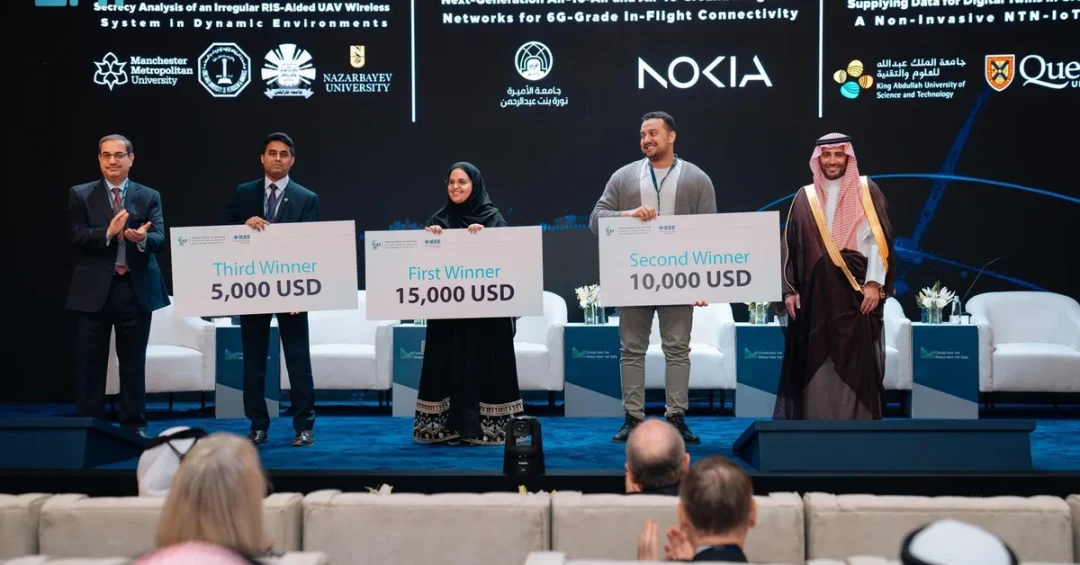
Riyadh, November 25, 2024 — The Saudi Communications, Space and Technology Commission (CST), in collaboration with the Institute of Electrical and Electronics Engineers (IEEE), honored the winners of the second edition of the Competition on Non-Terrestrial Networks for 6G during the International Non-Terrestrial Networks Forum 2024 held in Riyadh. The competition, launched by CST, aims to provide innovative solutions and support scientific research in the field of non-terrestrial networks, which are fundamental for the development of future sixth-generation (6G) telecommunications networks. The event underscored Saudi Arabia’s growing role as a hub for advanced research and development in telecommunications, aligning with the Kingdom’s Vision 2030 objectives to diversify the economy and foster innovation. The competition received 60 research papers from over 170 researchers and academics, representing more than 80 universities and research centers across over 30 countries, highlighting the global interest in Saudi Arabia’s initiatives. How does such a competition position Saudi Arabia as a leader in shaping the future of global connectivity?
The International Non-Terrestrial Networks Forum 2024, held in Riyadh, served as a platform for experts to discuss the latest advancements in non-terrestrial networks (NTNs), which integrate satellite and airborne platforms to extend connectivity beyond traditional terrestrial infrastructure. The winning research papers presented innovative solutions for utilizing satellites and unmanned aircraft through models for connecting remote communities and supporting communication continuity in remote areas. They also offered solutions for smart-city applications, in addition to initiatives aimed at bridging the global digital divide and maintaining communication networks to connect the unconnected around the world. This initiative reflects Saudi Arabia’s commitment to leading in next-generation technologies and contributing to global digital inclusion efforts. What does this mean for the future of connectivity in underserved regions worldwide?
Context and Background
How did Saudi Arabia become a central player in the global race for 6G innovation? The Communications, Space and Technology Commission (CST) has been at the forefront of Saudi Arabia’s efforts to advance telecommunications and space technologies. As the regulatory body for the communications and information technology sector, CST oversees spectrum management, promotes competition, and fosters innovation. Its collaboration with the IEEE, the world’s largest technical professional organization for the advancement of technology, lends significant international credibility to the competition. The second edition of the Competition on Non-Terrestrial Networks for 6G builds on the success of the inaugural event, which was held in 2023. The competition is part of a broader strategy to position Saudi Arabia as a global leader in 6G research and development. By engaging researchers from over 30 countries, CST is not only advancing technology but also building international partnerships that can accelerate the deployment of NTNs. This aligns with the Kingdom’s Vision 2030, which emphasizes economic diversification, technological leadership, and global engagement.
Non-terrestrial networks are a key component of 6G, as they can provide ubiquitous coverage, especially in remote and underserved areas where terrestrial infrastructure is lacking. The integration of satellites, high-altitude platform stations (HAPS), and unmanned aerial vehicles (UAVs) into the communication ecosystem is expected to revolutionize connectivity. The competition’s focus on NTNs for 6G highlights Saudi Arabia’s proactive approach to addressing future connectivity challenges. The winning papers offered solutions for smart-city applications, which are directly relevant to Saudi Arabia’s giga-projects like NEOM, where seamless connectivity is essential. Moreover, the emphasis on bridging the digital divide resonates with global efforts to ensure that no one is left behind in the digital age. What role will Saudi Arabia play in setting global standards for 6G and NTNs?
Key Details
The competition attracted 60 research papers from over 170 researchers and academics, representing more than 80 universities and research centers across over 30 countries. This diverse participation underscores the global recognition of Saudi Arabia’s initiative as a premier platform for cutting-edge research. The winners were honored at the International Non-Terrestrial Networks Forum 2024, which brought together industry leaders, policymakers, and academics to discuss the future of NTNs. The forum provided a venue for showcasing the winning research, which included innovative models for connecting remote communities and supporting communication continuity in remote areas. These solutions leverage satellite constellations, UAVs, and other non-terrestrial platforms to ensure reliable connectivity regardless of geographic barriers. Additionally, the papers offered solutions for smart-city applications, such as integrated sensing and communication, which are vital for autonomous vehicles, smart grids, and IoT devices. The competition also highlighted initiatives aimed at bridging the global digital divide, ensuring that remote and underserved populations can access the benefits of digital transformation.
The winning research papers covered a range of topics, from advanced antenna designs for satellite communication to AI-driven network optimization for UAV networks. For instance, some papers proposed novel architectures for integrating low-Earth orbit (LEO) satellites with terrestrial 5G/6G networks to provide seamless handover and low-latency connectivity. Others focused on energy-efficient communication protocols for UAV swarms, which could be deployed in disaster-stricken areas to restore connectivity quickly. The emphasis on smart-city applications aligns with Saudi Arabia’s smart city initiatives, such as NEOM, where NTNs can complement terrestrial networks to ensure ultra-reliable and low-latency communications. Furthermore, the competition’s goal to connect the unconnected resonates with the United Nations’ Sustainable Development Goals (SDGs), particularly Goal 9 (Industry, Innovation, and Infrastructure) and Goal 10 (Reduced Inequalities). How will these innovations translate into real-world deployments that benefit both Saudi Arabia and the global community?
International and Regional Impact
The competition’s global participation from over 30 countries demonstrates Saudi Arabia’s ability to convene international talent and foster collaboration. By attracting researchers from leading universities and research centers, CST is positioning the Kingdom as a hub for innovation in telecommunications and space technology. This not only enhances Saudi Arabia’s reputation but also creates opportunities for knowledge transfer and joint ventures. The winning solutions have the potential to address connectivity challenges in remote regions of Saudi Arabia, such as the Empty Quarter and mountainous areas, as well as in other parts of the world, including Africa, Asia, and Latin America. The focus on bridging the digital divide is particularly significant, as it aligns with Saudi Arabia’s foreign policy objectives of promoting stability and development through technology. What does this mean for regional cooperation in the Middle East and beyond?
Regionally, the competition reinforces Saudi Arabia’s leadership in the Arab world and the broader Middle East. Neighboring countries can benefit from the research outcomes, as NTNs can provide cross-border connectivity and support regional integration. The forum also served as a platform for discussing regulatory and policy frameworks for NTNs, which are essential for their deployment. Saudi Arabia’s proactive stance in this area could influence global standards and best practices. Moreover, the competition’s emphasis on smart-city applications dovetails with regional smart city projects, such as those in the UAE and Qatar, creating opportunities for collaboration. The international impact extends to the broader 6G ecosystem, as the research outcomes could contribute to the development of global 6G standards. By hosting such events, Saudi Arabia is signaling its readiness to shape the future of telecommunications. How might this influence the global race to 6G and the role of non-terrestrial networks in achieving universal connectivity?
Economic and Strategic Significance
The economic implications of advancing NTNs for 6G are substantial. The global 6G market is expected to grow significantly in the coming decade, and Saudi Arabia aims to capture a share of this value through research, development, and commercialization. By fostering innovation in NTNs, the Kingdom can attract investment, create high-tech jobs, and diversify its economy away from oil dependence. The competition also supports the growth of Saudi Arabia’s space and satellite industry, which is a key component of Vision 2030. The participation of international researchers and the exchange of ideas can lead to patents and startups, further boosting the innovation ecosystem. Additionally, the solutions for smart cities and IoT can enhance the efficiency of urban infrastructure, reducing costs and improving quality of life. What economic opportunities will arise from Saudi Arabia’s leadership in 6G and NTNs?
Strategically, the competition reinforces Saudi Arabia’s national security and technological sovereignty. Reliable and secure communication networks are essential for defense, emergency response, and critical infrastructure. NTNs can provide resilient connectivity even in the event of terrestrial network failures, making them a strategic asset. The collaboration with IEEE and international partners also strengthens diplomatic ties and soft power. By leading in 6G research, Saudi Arabia can influence global standards and ensure that its interests are represented in international forums. Furthermore, the focus on bridging the digital divide aligns with the Kingdom’s humanitarian and development goals, enhancing its image as a responsible global actor. The competition’s outcomes could also support Saudi Arabia’s ambitions in space exploration and satellite communications, areas where the Kingdom has been increasing its investments. How will these strategic benefits translate into tangible outcomes for Saudi Arabia and its partners?
Vision 2030 Alignment
The Competition on Non-Terrestrial Networks for 6G is a clear manifestation of Saudi Arabia’s Vision 2030, which seeks to transform the Kingdom into a global investment powerhouse and a hub for innovation. Vision 2030 emphasizes the development of non-oil sectors, particularly technology and communications, as drivers of economic growth. By hosting and supporting such competitions, CST is contributing to the creation of a knowledge-based economy and nurturing local talent. The involvement of Saudi universities and researchers in the competition also supports the Vision’s goal of enhancing education and research capabilities. Moreover, the focus on smart cities and digital inclusion aligns with the Vision’s objectives of improving quality of life and building a vibrant society. The international collaboration fostered by the competition exemplifies the Vision’s aim to strengthen Saudi Arabia’s global engagement and partnerships.
In conclusion, the CST’s honoring of the winners of the Competition on Non-Terrestrial Networks for 6G underscores Saudi Arabia’s commitment to leading in next-generation technologies. As the Kingdom continues to invest in research and development, it is poised to play a pivotal role in shaping the future of global connectivity. The solutions developed through this competition will not only benefit Saudi Arabia but also contribute to bridging the digital divide worldwide. With Vision 2030 as a guiding framework, Saudi Arabia is well on its way to becoming a global leader in 6G and non-terrestrial networks. How will Saudi Arabia’s leadership in this field inspire other nations to pursue similar initiatives for a more connected world?
20 Questions
Q1. What was the purpose of the Competition on Non-Terrestrial Networks for 6G?
A1. The competition aimed to provide innovative solutions and support scientific research in non-terrestrial networks, which are fundamental for developing future 6G telecommunications networks. It was launched by the Saudi Communications, Space and Technology Commission (CST) in collaboration with IEEE.
Q2. Who organized the competition and where was it held?
A2. The competition was organized by the Saudi Communications, Space and Technology Commission (CST) in collaboration with the Institute of Electrical and Electronics Engineers (IEEE). It was held as part of the International Non-Terrestrial Networks Forum 2024 in Riyadh, Saudi Arabia.
Q3. How many research papers were submitted and by whom?
A3. A total of 60 research papers were submitted by over 170 researchers and academics, representing more than 80 universities and research centers across over 30 countries. This diverse participation highlights the global interest in the competition.
Q4. What are non-terrestrial networks and why are they important for 6G?
A4. Non-terrestrial networks (NTNs) integrate satellite and airborne platforms to extend connectivity beyond terrestrial infrastructure. They are crucial for 6G to provide ubiquitous coverage, especially in remote and underserved areas, and to support smart-city applications and global digital inclusion.
Q5. What innovative solutions did the winning papers present?
A5. The winning papers presented solutions for utilizing satellites and unmanned aircraft to connect remote communities and ensure communication continuity in remote areas. They also offered smart-city applications and initiatives to bridge the global digital divide and connect the unconnected worldwide.
Q6. How does this competition align with Saudi Arabia’s Vision 2030?
A6. The competition aligns with Vision 2030 by promoting economic diversification, technological leadership, and global engagement. It supports the development of a knowledge-based economy, nurtures local talent, and enhances Saudi Arabia’s position as a hub for innovation in telecommunications and space technology.
Q7. What is the role of the Saudi Communications, Space and Technology Commission (CST)?
A7. CST is the regulatory body for Saudi Arabia’s communications and information technology sector. It oversees spectrum management, promotes competition, and fosters innovation. CST also leads initiatives like this competition to advance research in next-generation technologies such as 6G.
Q8. How does the competition contribute to bridging the global digital divide?
A8. The competition encourages research on non-terrestrial networks that can extend connectivity to remote and underserved regions worldwide. By supporting solutions that connect the unconnected, it contributes to global efforts to bridge the digital divide and promote digital inclusion.
Q9. What are the potential applications of the winning research in smart cities?
A9. The winning research offers solutions for smart-city applications, such as integrated sensing and communication, which are vital for autonomous vehicles, smart grids, and IoT devices. These applications can enhance urban infrastructure efficiency and improve quality of life in smart cities like NEOM.
Q10. How does the competition foster international collaboration?
A10. The competition attracts researchers from over 30 countries, creating a platform for international collaboration and knowledge exchange. It strengthens partnerships between Saudi institutions and global universities and research centers, enhancing Saudi Arabia’s global engagement.
Q11. What is the significance of IEEE’s collaboration with CST?
A11. IEEE is the world’s largest technical professional organization for the advancement of technology. Its collaboration with CST lends international credibility to the competition and ensures that the research is aligned with global standards and best practices in telecommunications.
Q12. How might the competition impact Saudi Arabia’s economy?
A12. The competition can stimulate economic growth by fostering innovation in 6G and NTNs, attracting investment, and creating high-tech jobs. It supports the growth of Saudi Arabia’s space and satellite industry, contributing to economic diversification under Vision 2030.
Q13. What role do non-terrestrial networks play in national security?
A13. NTNs provide resilient and secure communication networks that are essential for defense, emergency response, and critical infrastructure. They can ensure connectivity even when terrestrial networks fail, making them a strategic asset for national security.
Q14. How does the competition support Saudi Arabia’s space ambitions?
A14. The competition advances research in satellite and non-terrestrial networks, which are key to Saudi Arabia’s space ambitions. It supports the development of satellite communications and space exploration capabilities, aligning with the Kingdom’s increasing investments in the space sector.
Q15. What are the expected outcomes of the competition?
A15. The competition is expected to yield innovative solutions that can be developed into commercial products and services, contributing to the 6G ecosystem. It also aims to foster a research community and create a pipeline of talent for Saudi Arabia’s tech industry.
Q16. How does the competition promote gender diversity in research?
A16. While specific gender data was not provided, the competition’s open call attracted researchers from diverse backgrounds. CST and IEEE are committed to promoting diversity and inclusion in technology and research, encouraging participation from women and underrepresented groups.
Q17. What is the significance of the International Non-Terrestrial Networks Forum?
A17. The forum serves as a platform for industry leaders, policymakers, and academics to discuss the latest advancements in NTNs. It facilitates knowledge sharing, networking, and collaboration, and showcases Saudi Arabia’s leadership in next-generation technologies.
Q18. How can the winning solutions be deployed in Saudi Arabia?
A18. The winning solutions can be deployed in Saudi Arabia through partnerships with telecom operators, government entities, and private companies. Pilot projects in remote areas and smart cities like NEOM can demonstrate the viability of NTNs and pave the way for commercialization.
Q19. What are the next steps for CST following the competition?
A19. CST will continue to support research and development in NTNs and 6G through future competitions, funding, and collaborations. It will also work on regulatory frameworks to enable the deployment of NTN technologies in Saudi Arabia and beyond.
Q20. How does this competition position Saudi Arabia as a global leader in 6G?
A20. By hosting an international competition that attracts top researchers and showcases cutting-edge solutions, Saudi Arabia demonstrates its commitment to leading in 6G innovation. It positions the Kingdom as a hub for research and development, influencing global standards and fostering partnerships.
Reader Feedback
We value your thoughts. Please share your feedback on this article.
Your feedback helps us improve our coverage.
Related articles
 CST Signs Telecom MoU with Greece’s EETT at Global Forum
 CST, ITU Sign NTN Global Events Agreement
 KAUST, UConn Sign Deal on AI, Clean Energy
 Saudi Space Agency Concludes Participation in 2024 International NTN Forum
 Saudi Water Innovation Wins Impact Award in Jeddah
 Saudi Arabia Showcases Geospatial Leadership at GeoWorld Summit