


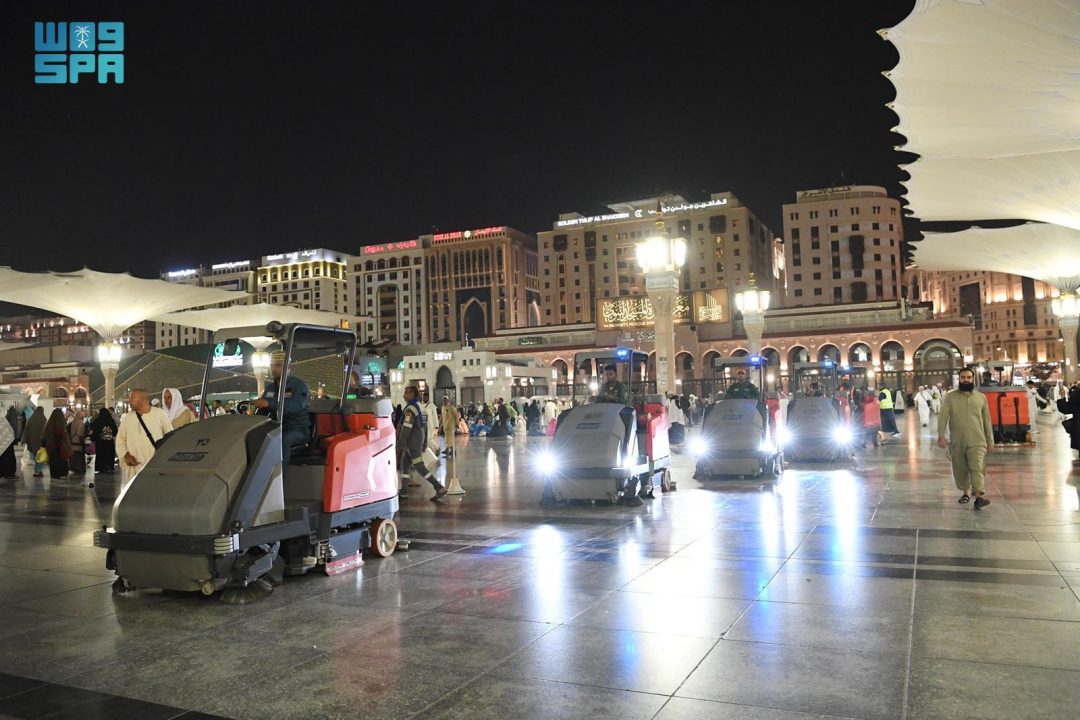
Cleaning operations at the Prophet’s Mosque and its courtyards in Madinah were documented by the Saudi Press Agency (SPA) after today’s Taraweeh prayers, with trained teams and modern equipment working to ensure thorough coverage of all areas of the mosque and its courtyards.
SPA reported that the preparation and cleanliness of the Two Holy Mosques is one of the priorities that the General Authority for the Care of the Affairs of the Grand Mosque and the Prophet’s Mosque is committed to providing through organizational programs implemented around the clock to ensure a healthy, clean, and comfortable environment for millions of worshippers.
The cleaning work includes washing and sanitizing the floors and external courtyards of the mosque multiple times daily, according to the SPA account. The same programs also cover cleaning and perfuming the carpets with high-quality materials to maintain their cleanliness and pleasant fragrance.
SPA added that the cleaning programs and efforts also cover the Al-Rawdah Al-Sharifah and the surrounding facilities. The documentation focused on the scenes after the Taraweeh prayers, a time when worshipper traffic at the mosque is heavy during the current period.
How often are the floors and courtyards of the Prophet’s Mosque washed and sanitized each day? The SPA report states that the work is carried out multiple times daily, which points to a continuous cycle rather than a single daily pass. The same account says the programs are implemented around the clock, meaning teams are active beyond the hours immediately around the five daily prayers.
The equipment used in the operation is described by SPA as modern, and the teams carrying out the work are described as trained. The report does not name the equipment, the manufacturers, or the size of the teams. What it does make clear is that the coverage is intended to reach all areas of the mosque and its courtyards, not only the main prayer hall.
Carpets receive separate attention under the same program. SPA says they are cleaned and perfumed with high-quality materials to maintain both cleanliness and a pleasant fragrance. For worshippers who spend extended periods sitting on the carpets during Taraweeh and other prayers, that detail is part of the experience of the visit. How noticeable is the fragrance to a visitor walking through the halls after Taraweeh?
The Al-Rawdah Al-Sharifah, a location within the Prophet’s Mosque that draws large numbers of worshippers, is included in the cleaning programs along with the surrounding facilities, according to SPA. The report does not give a separate schedule for that area or describe how access is managed while cleaning takes place.
The General Authority for the Care of the Affairs of the Grand Mosque and the Prophet’s Mosque is the body named by SPA as responsible for providing this service. The report frames cleanliness and preparation as one of the authority’s priorities, delivered through organizational programs. What does an around-the-clock organizational program look like in practice when millions of worshippers pass through the same spaces?
SPA documented the scenes itself, which places the agency inside the operation as an observer after the Taraweeh prayers. The timing of the documentation is specific: after today’s Taraweeh prayers, in Madinah, on March 26, 2025. The report was published at 02:12 local time, 23:12 GMT.
The stated purpose of the work is to ensure a healthy, clean, and comfortable environment for millions of worshippers. That figure, millions, is the only scale given in the SPA material. The report does not break the number down by day, by prayer, or by season. Does the flow of worshippers change the cleaning schedule during the last ten nights of Ramadan compared with earlier in the month?
Washing and sanitizing are listed as separate actions applied to floors and external courtyards. The courtyards are outdoor spaces, which means the cleaning teams work in open air as well as inside the mosque. SPA does not describe the products used for washing and sanitizing, nor the method of application. What considerations shape the choice of cleaning materials in a space that hosts this many people?
The report describes coverage of all areas of the mosque and its courtyards. It does not list those areas individually, nor does it state how long a full cycle takes. The phrase multiple times daily is the only frequency given. For a visitor trying to picture the operation, the gap between multiple times daily and a precise timetable is wide. How would a worshipper even notice the difference between one cycle and the next?
Perfuming the carpets is presented alongside cleaning them, with high-quality materials named as the input. The report does not identify the materials or their origin. It also does not say whether the perfuming follows a fixed schedule or is adjusted according to the condition of the carpets. What determines when a carpet needs perfuming rather than just cleaning?
The Al-Rawdah Al-Sharifah and the surrounding facilities are covered by the same cleaning programs, per SPA. The report does not describe the facilities in question or their number. It also does not say whether the cleaning of those facilities follows the same multiple-times-daily rhythm as the floors and courtyards. Are the surrounding facilities cleaned on the same schedule as the prayer halls, or on a different one?
The authority’s role is described in terms of commitment to providing the service through organizational programs. SPA does not quote any official from the authority, and no individual is named in the report. The account rests on the agency’s own documentation of the scenes and on the description of the programs. Who plans the rotation of the trained teams across a full day of prayers and cleaning cycles?
Madinah is the location given in the dateline, and the Prophet’s Mosque is the site. The report places the cleaning work in the context of the Two Holy Mosques, naming the Grand Mosque and the Prophet’s Mosque as the two whose preparation and cleanliness are the authority’s priority. The documented scenes, however, are from the Prophet’s Mosque and its courtyards after Taraweeh.
Taraweeh prayers are performed at night during Ramadan, and the SPA report ties its documentation to that moment. The cleaning that follows a heavily attended night prayer is the specific scene the agency captured. The report does not state how many worshippers attended today’s Taraweeh, nor how the cleaning operation is sequenced around the prayer itself. Does the cleaning begin immediately after the prayer ends, or after the last worshipper has left the courtyards?
Modern equipment and trained teams are the two inputs SPA highlights. The report does not describe the training the teams receive or the tasks each team handles. It also does not say whether the teams work in shifts through the night. The phrase around the clock suggests that some form of the operation continues at all hours, but the report leaves the staffing pattern unstated. How many people does it take to keep a site of this size moving through repeated cleaning cycles?
The carpets, the floors, the external courtyards, the Al-Rawdah Al-Sharifah, and the surrounding facilities form the list of what the cleaning programs cover, as given by SPA. The report does not mention waste collection, water supply, or any other supporting service, and it does not describe how the cleaning materials are stored or replenished. What happens behind the scenes to keep the materials and equipment ready for the next cycle?
The stated goal is a healthy, clean, and comfortable environment for millions of worshippers. SPA does not define how that goal is measured or whether any checks are carried out after each cleaning cycle. The report presents the programs as ongoing and the coverage as thorough, without giving a verification mechanism. How would anyone confirm that every area was reached after a given cycle?
SPA’s documentation is the source of the scenes described, and the agency published the account on March 26, 2025, from Madinah. The report ends with the SPA attribution and the local and GMT timestamps. It does not include statements from worshippers, from the authority, or from the cleaning teams themselves. What would worshippers say about the condition of the carpets and courtyards after a night of Taraweeh?
The report does not include the number of cleaning cycles per day, the size of the teams, the names of the equipment or materials, the cost of the operation, or any schedule beyond the phrase multiple times daily. It also does not say how the cleaning programs are adjusted for different periods of the year. Those details are absent from the SPA material, and the account leaves them unstated.
What did SPA document at the Prophet’s Mosque? SPA documented the scenes of cleaning operations at the Prophet’s Mosque and its courtyards after today’s Taraweeh prayers. According to the report, trained teams and modern equipment were used to ensure thorough coverage of all areas of the mosque and its courtyards. The documentation was published from Madinah on March 26, 2025, at 02:12 local time, 23:12 GMT. The report focuses on the cleaning work itself rather than on statements from officials or worshippers.
Which authority is responsible for the cleanliness of the Two Holy Mosques? SPA names the General Authority for the Care of the Affairs of the Grand Mosque and the Prophet’s Mosque as the body committed to providing preparation and cleanliness at the Two Holy Mosques. The report describes this as one of the authority’s priorities, delivered through organizational programs implemented around the clock. The stated aim is a healthy, clean, and comfortable environment for millions of worshippers. The report does not quote any official from the authority or name any individual involved in the work.
What does the cleaning work include? According to SPA, the cleaning work includes washing and sanitizing the floors and external courtyards of the mosque multiple times daily. It also includes cleaning and perfuming the carpets with high-quality materials to maintain their cleanliness and pleasant fragrance. The cleaning programs and efforts additionally cover the Al-Rawdah Al-Sharifah and the surrounding facilities. The report does not specify the materials used, the length of a cleaning cycle, or a precise timetable beyond the phrase multiple times daily.
When were the cleaning operations documented? SPA documented the cleaning operations after today’s Taraweeh prayers at the Prophet’s Mosque in Madinah. The report is dated March 26, 2025, and was published at 02:12 local time, 23:12 GMT. Taraweeh prayers are performed at night, and the documentation captures the cleaning that follows a heavily attended prayer. The report does not state how many worshippers attended the prayer or how the cleaning is sequenced around it.
What details are not included in the SPA report? The SPA report does not include the number of cleaning cycles per day, the size of the trained teams, the names of the modern equipment or the high-quality materials, or the cost of the operation. It also does not give a schedule beyond the phrase multiple times daily, and it does not describe how the programs are adjusted for different periods of the year. No officials or worshippers are quoted, and no verification mechanism for the coverage is mentioned.