


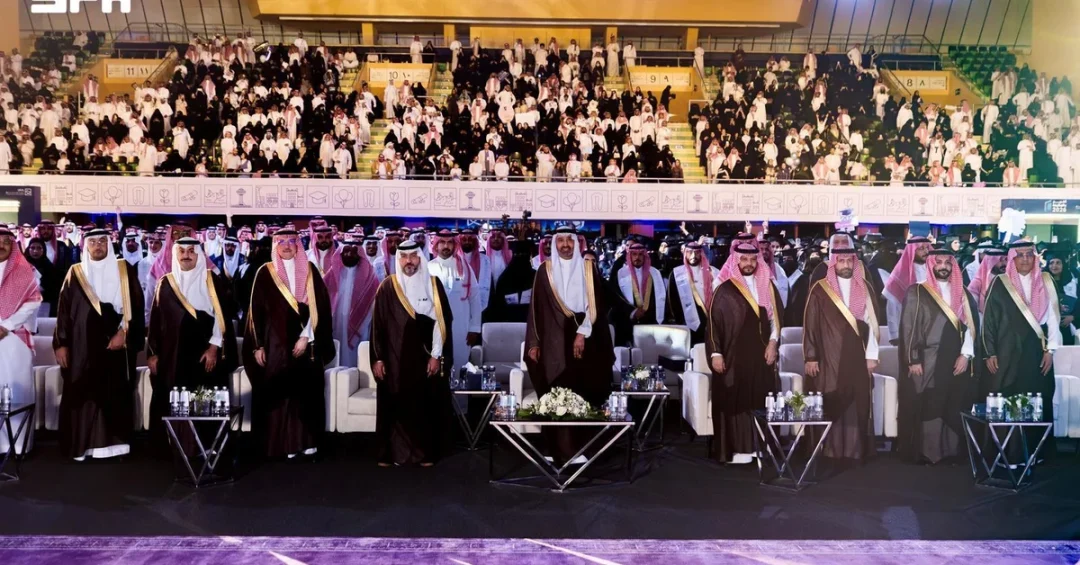
The Institute of Public Administration (IPA) honored 1,055 graduates in Riyadh during the 30th edition of its “Graduate and Job” ceremony, held under the patronage of Minister of Human Resources and Social Development and IPA Board Chairman Ahmed bin Sulaiman Al-Rajhi, the Saudi Press Agency reported. The Riyadh cohort comprised 597 men and 458 women and forms part of a broader group of 1,354 graduates across the institute’s branches nationwide this academic year, underscoring the Kingdom’s expanding investment in national human capital.
The ceremony, staged in the Saudi capital, recognized not only the graduates themselves but also the employers and institutions that help translate academic preparation into meaningful careers. Dr. Sulaiman Al Habib Medical Services Group was honored for employing the largest number of IPA graduates, while the King Abdullah bin Abdulaziz Foundation for Development Housing Dedicated to His Parents was recognized for providing the greatest number of training opportunities. The event reflects a sustained national effort to align education and training outcomes with the demands of a rapidly diversifying economy. But what does a graduating class of this size actually signal about the direction of Saudi Arabia’s labor market? The answer lies in the scale, structure, and strategic intent behind the IPA’s programs.
Context and Background
How did the Institute of Public Administration become such a central pillar of Saudi Arabia’s workforce development? Established decades ago as a specialized government institution, the IPA was created to professionalize public-sector administration and to supply ministries, agencies, and state-owned enterprises with trained, capable staff. Over time, its mandate has widened considerably. Today the institute delivers diploma programs, executive training, applied research, and advisory services that touch nearly every branch of government and an increasing share of the private sector.
The “Graduate and Job” ceremony, now in its 30th edition, has become an annual benchmark of that mission. Each year it brings together graduates, their families, senior officials, and representatives of major employers in a single venue, converting what could be a routine academic milestone into a national statement about the value of skills, discipline, and public service. The presence of the Minister of Human Resources and Social Development as patron and IPA Board Chairman reinforces the direct link between the institute’s output and the Kingdom’s employment priorities.
The 1,055 graduates honored in Riyadh represent the largest single concentration of this year’s cohort, which totals 1,354 across all IPA branches. The gender breakdown, 597 men and 458 women, is notable in a country where female labor-force participation has risen sharply in recent years. It demonstrates that the IPA’s intake and support systems are reaching a broad cross-section of Saudi talent, not a narrow elite. For international observers, the event offers a concrete illustration of how Saudi Arabia is building the administrative and technical backbone required by Vision 2030.
Key Details
What exactly happened at the ceremony, and who was recognized? According to the Saudi Press Agency, the event took place in Riyadh and was held under the patronage of Minister Ahmed bin Sulaiman Al-Rajhi, who also chairs the IPA Board. The minister personally honored outstanding graduates, singling out high achievers whose performance reflects the institute’s academic standards. The ceremony thus combined collective recognition of the full graduating class with individual awards that reward excellence.
Two institutional awards drew particular attention. Dr. Sulaiman Al Habib Medical Services Group, one of the Kingdom’s largest private healthcare providers, was honored for employing the most IPA graduates. The King Abdullah bin Abdulaziz Foundation for Development Housing Dedicated to His Parents was recognized for providing the most training opportunities. Together, these awards highlight a two-way partnership model: the IPA prepares graduates, and employers and foundations absorb them into jobs and practical training placements.
The figures themselves merit close reading. The 1,055 Riyadh graduates are part of a national total of 1,354 for the academic year, meaning the capital accounts for roughly 78 percent of the cohort. That concentration reflects both the size of the IPA’s Riyadh campus and the gravitational pull of the capital’s labor market. At the same time, the presence of graduates from other branches shows that the institute’s reach extends well beyond Riyadh, supporting regional development and decentralizing access to high-quality administrative training.
International and Regional Impact
Why should an international audience pay attention to a graduation ceremony in Riyadh? Because Saudi Arabia’s human-capital pipeline is increasingly intertwined with global business, investment, and diplomacy. As the Kingdom positions itself as a logistics, financial, and technology hub connecting three continents, the quality of its public administration and private-sector management directly affects the ease of doing business, the reliability of regulation, and the attractiveness of its market to foreign partners.
Graduates of the IPA enter ministries, authorities, and companies that interact daily with international counterparts. They help draft and implement policy, manage procurement, oversee infrastructure programs, and staff the growing number of giga-projects and special economic zones. A well-trained administrative cadre is therefore not a domestic-only asset; it is part of the infrastructure that makes Saudi Arabia a predictable, capable partner in regional and global affairs.
Regionally, the IPA’s model of combining academic diplomas with employer engagement and training placements offers a template that other countries in the Middle East and beyond may study. The emphasis on measurable outcomes, such as who employs the most graduates and who provides the most training, introduces a results-oriented culture into workforce development. For a region with a young and expanding population, that orientation toward employability rather than credentials alone is a meaningful shift.
Economic and Strategic Significance
What does this graduating class mean for Saudi Arabia’s economy? At its core, the ceremony is about converting education into employment. The Kingdom’s economic transformation depends on raising productivity, diversifying away from oil, and building sectors such as tourism, manufacturing, technology, and healthcare. Each of those sectors requires competent administrators, analysts, and managers. The IPA’s graduates are prepared for precisely those roles, whether in government or in the private companies that are expanding under Vision 2030.
The recognition of Dr. Sulaiman Al Habib Medical Services Group is especially telling. Healthcare is a priority sector under Vision 2030, with ambitious targets for privatization, quality improvement, and expanded capacity. A private hospital group hiring IPA graduates in volume shows that the institute’s training is relevant beyond the public sector, and that private employers see value in its programs. Similarly, the award to the King Abdullah bin Abdulaziz Foundation for Development Housing Dedicated to His Parents reflects the importance of housing and community development, another pillar of national policy.
Strategically, the graduation supports two overlapping goals: Saudization of the workforce and the deepening of national skills. By supplying trained Saudis to employers, the IPA helps reduce reliance on expatriate labor in administrative roles and ensures that economic growth translates into opportunities for citizens. The gender balance of the cohort, with women making up more than 40 percent of Riyadh graduates, also aligns with the national objective of expanding female participation in the economy, a goal that has already produced measurable gains in recent years.
Vision 2030 Alignment
How does this event connect to Saudi Arabia’s long-term vision? Vision 2030 rests on three broad pillars: a vibrant society, a thriving economy, and an ambitious nation. Human-capital development sits at the intersection of all three. The IPA’s work directly supports the ambitious-nation pillar by strengthening public institutions and the thriving-economy pillar by improving the skills of the national workforce. The “Graduate and Job” ceremony is, in effect, an annual checkpoint on that agenda.
The 30th edition also reflects continuity and institutional maturity. Three decades of graduating classes have built a network of alumni across government and business, creating a shared professional culture and a channel for best practices to circulate. As Saudi Arabia accelerates toward the goals of Vision 2030, including higher employment, greater female participation, and a more diversified economy, the role of institutions like the IPA will only grow. The 1,055 graduates honored in Riyadh are not merely recipients of certificates; they are participants in the Kingdom’s next phase of development, and their success will be measured in the institutions they strengthen and the economy they help build.
20 Questions
Q1. What event did the Institute of Public Administration hold in Riyadh?
A1. The Institute of Public Administration held the 30th edition of its “Graduate and Job” ceremony in Riyadh, honoring graduates and recognizing employers and institutions that support training and employment.
Q2. How many graduates were honored in Riyadh?
A2. A total of 1,055 graduates were honored in Riyadh, comprising 597 men and 458 women, according to the Saudi Press Agency report on the ceremony.
Q3. Who patronized the ceremony?
A3. Minister of Human Resources and Social Development and IPA Board Chairman Ahmed bin Sulaiman Al-Rajhi patronized the ceremony and personally honored outstanding graduates during the event.
Q4. How many graduates were there across all IPA branches this academic year?
A4. The Riyadh graduates are part of a total of 1,354 graduates across the institute’s branches nationwide during the current academic year, according to official information.
Q5. Which company was honored for employing the most graduates?
A5. Dr. Sulaiman Al Habib Medical Services Group was honored for employing the largest number of IPA graduates, reflecting strong private-sector demand for the institute’s trained talent.
Q6. Which foundation was recognized for providing the most training opportunities?
A6. The King Abdullah bin Abdulaziz Foundation for Development Housing Dedicated to His Parents was recognized for providing the greatest number of training opportunities to IPA students and graduates.
Q7. What is the Institute of Public Administration?
A7. The IPA is a Saudi government institution specializing in administrative training, diplomas, research, and advisory services that strengthen public-sector capacity and support national workforce development goals.
Q8. Why is the gender balance of the graduates significant?
A8. Women made up 458 of the 1,055 Riyadh graduates, showing that IPA programs reach both men and women and support Saudi Arabia’s goal of expanding female participation in the economy.
Q9. What does the “Graduate and Job” ceremony aim to achieve?
A9. The ceremony celebrates academic completion while connecting graduates with employers, highlighting training and employment partnerships that convert education into productive careers in government and the private sector.
Q10. How does the event support Saudi Arabia’s labor market?
A10. By supplying trained administrators and professionals, the IPA helps employers fill skilled roles, supports workforce nationalization, and raises productivity across sectors prioritized under Vision 2030.
Q11. What sectors do IPA graduates typically enter?
A11. Graduates enter public administration, healthcare, housing and community development, finance, technology, and other growing sectors, depending on their specialization and the needs of employers.
Q12. Why is private-sector participation important in this ceremony?
A12. Private employers like Dr. Sulaiman Al Habib Medical Services Group demonstrate that IPA training is relevant beyond government, strengthening the link between education outcomes and the broader economy.
Q13. What is the significance of the 30th edition of the ceremony?
A13. The 30th edition reflects three decades of institutional continuity, a large alumni network, and sustained national commitment to building administrative capacity over the long term.
Q14. How does the IPA support Vision 2030?
A14. The IPA supports Vision 2030 by developing human capital, strengthening public institutions, and improving employability, all of which contribute to a thriving economy and an ambitious nation.
Q15. What role does the Ministry of Human Resources and Social Development play?
A15. The ministry sets national employment and social development policy, and its minister chairs the IPA Board, linking the institute’s training output directly to labor-market priorities.
Q16. How many graduates were honored outside Riyadh?
A16. Based on the national total of 1,354 graduates and the 1,055 honored in Riyadh, the remaining graduates from other IPA branches number approximately 299 for this academic year.
Q17. Why is employer recognition part of the ceremony?
A17. Recognizing top employers and training providers encourages more organizations to hire graduates and offer practical training, creating a stronger pipeline from education to employment.
Q18. What does this event indicate about Saudi Arabia’s workforce strategy?
A18. It shows a results-oriented approach that measures success by employment and training outcomes, aligning education with the skills needed in a diversifying economy.
Q19. How does the ceremony benefit international observers?
A19. It offers a concrete example of how Saudi Arabia builds administrative capacity, which affects regulatory quality, business environment, and the Kingdom’s reliability as a global partner.
Q20. What is the forward-looking message of the ceremony?
A20. The message is that Saudi Arabia continues to invest in its people, and that each graduating class contributes directly to the Kingdom’s long-term development and global role.
Reader Feedback
We value your thoughts. Please share your feedback on this article.
Your feedback helps us improve our coverage.
Related articles
 Madinah Concludes Swimming Literacy Project with 300 Students
 AlUla Program Trains 50 Youth in Public Speaking
 Najran Schools Adopt Winter Schedule Starting Sunday
 Najran University Climbs Four Places in QS Arab Rankings 2027
 Saudi Arabia Sets February 2027 Deadline for Worker Housing
 ETEC to Hold Third National Forum for School Excellence in Riyadh