


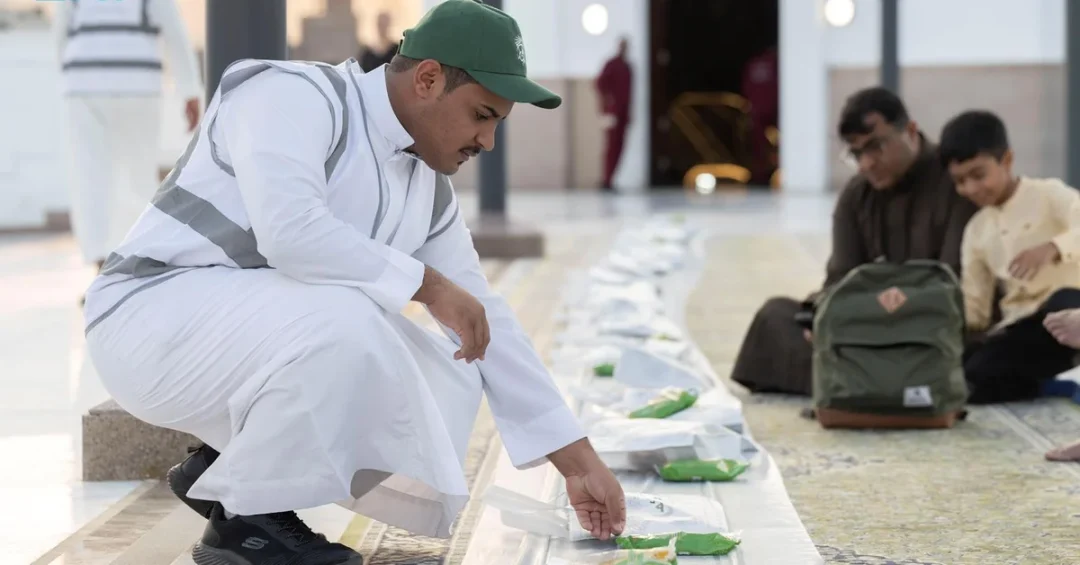
More than 400 student volunteers in Madinah have delivered a wide-ranging programme of support to worshippers at the city’s major mosques during Ramadan, organising iftar meals, managing crowds, and distributing copies of the Holy Quran at Quba Mosque, Qiblatain Mosque, and Miqat Dhu Al-Hulayfah, according to the Madinah Department of the Ministry of Education. The figures released through the Saudi Press Agency reveal the scale of the effort: volunteers managed crowds in the historical mosques on 5,597 occasions, assisted 351 elderly worshippers using wheelchairs, provided 42,572 directional services to visitors and those who had lost their way, and distributed 18,238 packaged iftar meals and water bottles to people who were fasting.
For the millions of Muslims who travel to Madinah during the holy month, these services shape the experience of worship itself, turning a busy pilgrimage season into one that is orderly, welcoming, and calm. The initiative reflects the Ministry of Education’s commitment to providing voluntary services in coordination with the relevant authorities, ensuring a welcoming environment for visitors to the city throughout Ramadan. It also places students at the centre of the Kingdom’s wider culture of service — a culture that Saudi Arabia has been steadily strengthening as part of its national transformation. How often do visitors to the holy cities realise that the smooth running of their day depends on young volunteers they may never notice?
Context and Background
Madinah occupies a unique place in the Islamic world. It is home to the Prophet’s Mosque, one of the three holiest sites in Islam, and to a series of historical mosques — including Quba Mosque, the first mosque built in Islamic history, and Qiblatain Mosque, where the direction of prayer was changed — that draw visitors from every continent. During Ramadan, the flow of worshippers rises sharply, and the demands on local services rise with it. Crowd management, guidance, care for the elderly, and the distribution of food and water become daily logistical tasks that must be carried out with precision and respect.
The volunteer programme described by the Ministry of Education’s Madinah Department is one part of a broader national framework. Saudi Arabia has invested heavily in the infrastructure and organisation of the holy cities, and voluntary work has become an increasingly visible pillar of that effort. Students from schools and universities in the region are recruited, trained, and deployed in coordination with the authorities responsible for the mosques and for visitor services. Their presence complements the work of official bodies rather than replacing it, adding a human layer to the technical and security arrangements that govern the holy sites.
The timing of the initiative matters as much as its scale. Ramadan is a period of heightened devotion, and also of heightened pressure on transport, accommodation, and public spaces in Madinah. By placing hundreds of trained volunteers in the busiest locations, the programme helps to keep movement fluid and to ensure that elderly and vulnerable worshippers are not left to navigate crowds alone. The result, as the reported figures suggest, is a system that functions at high volume without losing the courtesy and patience that the occasion demands.
Key Details of the Volunteer Programme
The reported numbers give a clear picture of what the volunteers actually did. The 5,597 crowd-management occasions in the historical mosques represent thousands of individual interventions — guiding worshippers to entrances, keeping pathways clear, and helping groups move between prayer areas without congestion. The 351 elderly worshippers assisted with wheelchairs represent a direct, personal service, ensuring that older visitors could attend prayers and complete their visits with dignity. The 42,572 directional services reflect the reality that many visitors are first-time travellers who need help finding a gate, a prayer hall, a water station, or a meeting point.
The distribution of 18,238 packaged iftar meals and water bottles addresses one of the most important practical needs of the month. Fasting worshippers who are travelling or who arrive close to sunset need to break their fast quickly and safely, and a packaged meal removes uncertainty from that moment. In addition, volunteers distributed copies of the Holy Quran at the three named mosques, giving visitors a lasting connection to their visit. Each of these tasks is simple in isolation; together they form a coordinated operation that depends on training, supervision, and clear communication between the volunteers and the authorities.
It is also worth noting where the volunteers came from. The programme was reported by the Ministry of Education’s Madinah Department, which indicates that the participants were drawn from the student population of the region. This matters because it links education to public service in a direct way. Students who spend part of their Ramadan serving worshippers are learning skills — organisation, communication, patience, responsibility — that will serve them in their studies and their future careers. What better way is there for a young person to spend the holy month than in the service of those who have travelled far to worship?
International and Regional Impact
The impact of the programme extends well beyond Madinah. Visitors to the holy cities come from across the Gulf, Asia, Africa, Europe, and the Americas, and their impressions of the Kingdom are formed in part by the everyday experiences they have during their stay. A well-organised, courteous, and efficient environment is therefore a form of international communication. When a pilgrim from another country is guided to a prayer hall, helped into a wheelchair, or handed a meal at sunset, that experience becomes part of how Saudi Arabia is understood abroad.
Regionally, the initiative reinforces the Kingdom’s role as the custodian of the Two Holy Mosques and as a host to millions of worshippers each year. It also demonstrates a model of volunteer mobilisation that other sectors and other regions can study. The coordination between the Ministry of Education, the authorities responsible for the mosques, and the volunteer teams shows how public institutions can work together around a shared seasonal goal. For neighbouring countries whose citizens travel to Madinah, the reliability of these services is a practical reassurance that the pilgrimage and visit experience is being managed with care.
Economic and Strategic Significance
The volunteer programme also has an economic dimension. A smooth Ramadan season supports the wider visitor economy of Madinah, from accommodation and transport to retail and food services. When worshippers can move efficiently and find what they need, they are more likely to extend their stay and to return in future years. The Kingdom has been developing the visitor experience in Madinah and Makkah as part of a broader effort to expand religious tourism, and reliable on-the-ground services are essential to that effort. Volunteers help to absorb peak demand in a way that is cost-effective and community-based.
Strategically, the initiative reflects a preference for building capability from within. Rather than relying only on paid staff or external contractors, the programme draws on the energy and commitment of the region’s students. This approach strengthens social cohesion, gives young people a stake in the success of the season, and creates a pool of experienced volunteers who can be called upon in future years. It is a model that aligns with the Kingdom’s emphasis on youth participation and on the development of a skilled, service-oriented generation.
Vision 2030 Alignment
The student volunteer programme in Madinah sits comfortably within the objectives of Saudi Vision 2030. The vision places strong emphasis on youth empowerment, on volunteerism, and on the quality of life of both citizens and visitors. By mobilising more than 400 students to serve worshippers, the programme turns those objectives into visible action. It also supports the vision’s goal of enhancing the experience of the millions who visit the holy cities each year, ensuring that the Kingdom’s hospitality is matched by organisation and care.
As Ramadan continues, the work of these volunteers will remain one of the quiet foundations of the season in Madinah. Their contribution — measured in thousands of crowd-management occasions, wheelchair assists, directional services, and iftar meals — is a reminder that the Kingdom’s ambitions are built not only on large projects but also on the daily efforts of its young people. In serving worshippers, they are also serving the vision of a Saudi Arabia that welcomes the world with competence, generosity, and respect. What clearer expression of national purpose could there be than a generation that gives its time to those who come to pray?
20 Questions
Q1. Who is carrying out the volunteer programme in Madinah during Ramadan?
A1. More than 400 student volunteers in Madinah, organised through the Madinah Department of the Ministry of Education, are serving worshippers at the city’s major mosques throughout the holy month.
Q2. Which mosques are included in the initiative?
A2. The programme covers Quba Mosque, Qiblatain Mosque, and Miqat Dhu Al-Hulayfah, three significant sites in and around Madinah that attract large numbers of worshippers during Ramadan.
Q3. What kinds of services do the volunteers provide?
A3. They organise iftar meals, manage crowds, distribute copies of the Holy Quran, assist elderly worshippers with wheelchairs, and provide directional help to visitors who are lost or need guidance.
Q4. How many crowd-management occasions were reported?
A4. The Ministry of Education’s Madinah Department reported 5,597 occasions of crowd management in the historical mosques, reflecting thousands of individual interventions to keep movement orderly and safe.
Q5. How many elderly worshippers received wheelchair assistance?
A5. Volunteers assisted 351 elderly individuals with wheelchairs, helping them attend prayers and move through the mosque areas with dignity and comfort during the busy Ramadan period.
Q6. How many directional services were provided to visitors?
A6. A total of 42,572 directional services were provided to visitors and to those who had lost their way, helping first-time and returning worshippers find gates, prayer halls, and facilities.
Q7. How many iftar meals and water bottles were distributed?
A7. Volunteers distributed 18,238 packaged iftar meals and water bottles to people who were fasting, ensuring that worshippers could break their fast quickly and safely at sunset.
Q8. Why is Ramadan a particularly demanding period in Madinah?
A8. Ramadan brings a sharp increase in the number of worshippers and visitors, placing heavy demands on transport, accommodation, crowd management, and food distribution across the city’s mosques and public spaces.
Q9. How does the programme reflect the Ministry of Education’s priorities?
A9. The initiative reflects the ministry’s commitment to providing voluntary services in coordination with relevant authorities, linking students’ education with practical service to the community and to visitors.
Q10. What role do students play in the programme?
A10. Students form the core of the volunteer teams, receiving training and supervision before being deployed to manage crowds, guide visitors, assist the elderly, and distribute meals and copies of the Holy Quran.
Q11. How does the initiative benefit the volunteers themselves?
A11. Volunteers develop skills in organisation, communication, patience, and responsibility, while gaining the experience of serving worshippers during the holiest month of the Islamic calendar.
Q12. What does the programme mean for visitors to Madinah?
A12. Visitors benefit from a more orderly, welcoming, and spiritually fulfilling experience, with clear guidance, assistance for the elderly, and reliable access to iftar meals and water at the mosques.
Q13. How does the initiative support Saudi Arabia’s international image?
A13. Worshippers from many countries experience the Kingdom’s hospitality and organisation directly, and their positive impressions contribute to how Saudi Arabia is understood around the world.
Q14. Does the programme replace official services in the mosques?
A14. No. The volunteers complement the work of the authorities responsible for the mosques and for visitor services, adding a human layer of support to existing technical, security, and logistical arrangements.
Q15. How does the initiative relate to Saudi Vision 2030?
A15. It supports Vision 2030 objectives on youth empowerment, volunteerism, and quality of life, while enhancing the experience of the millions of worshippers who visit the holy cities each year.
Q16. What economic benefits flow from a well-organised Ramadan season?
A16. Efficient services support the visitor economy of Madinah, including accommodation, transport, retail, and food services, and encourage worshippers to extend their stays and return in future years.
Q17. How does the programme strengthen social cohesion in the region?
A17. By drawing on the region’s students and coordinating with public institutions, the programme gives young people a shared stake in the success of the season and builds a pool of experienced future volunteers.
Q18. What is the significance of Quba and Qiblatain mosques?
A18. Quba Mosque is the first mosque built in Islamic history, and Qiblatain Mosque is associated with the change in the direction of prayer, making both important destinations for worshippers and visitors.
Q19. How is the programme coordinated with other authorities?
A19. The Ministry of Education’s Madinah Department works in coordination with the relevant authorities responsible for the mosques and visitor services, ensuring that volunteer efforts align with official arrangements.
Q20. What does the initiative say about Saudi Arabia’s approach to hosting worshippers?
A20. It shows an approach that combines large-scale investment in the holy cities with the daily commitment of young volunteers, reflecting a national culture of service, generosity, and respect for visitors.
Reader Feedback
We value your thoughts. Please share your feedback on this article.
Your feedback helps us improve our coverage.
Related articles
 Madinah Concludes Swimming Literacy Project with 300 Students
 AlUla Program Trains 50 Youth in Public Speaking
 Najran Schools Adopt Winter Schedule Starting Sunday
 Najran University Climbs Four Places in QS Arab Rankings 2027
 Saudi Arabia Sets February 2027 Deadline for Worker Housing
 ETEC to Hold Third National Forum for School Excellence in Riyadh