


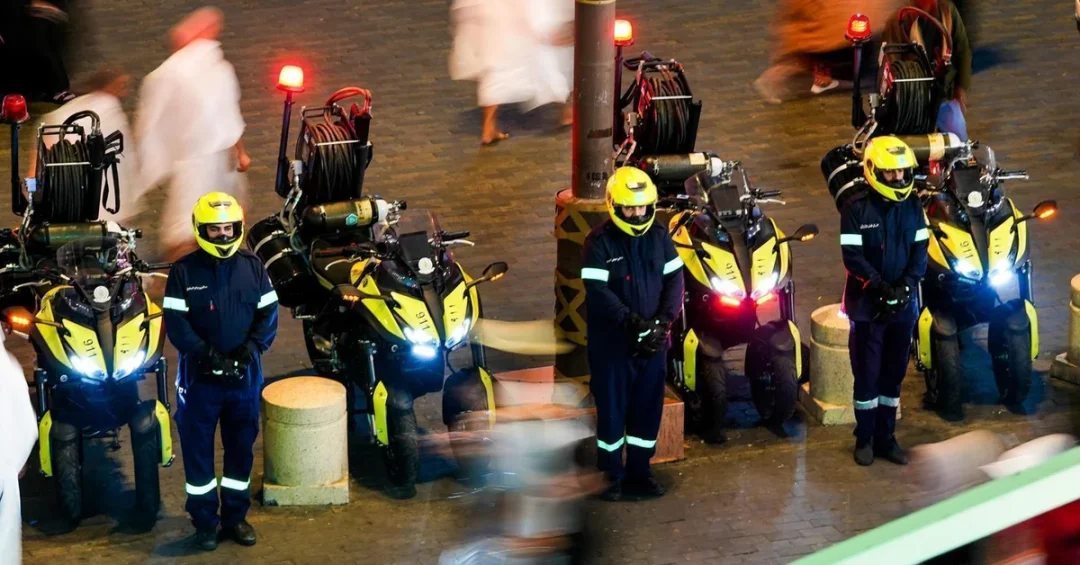
The rapid response teams of the Saudi Civil Defense are continuing their emergency mission in the central areas of the Two Holy Mosques throughout Ramadan, deploying a large number of units equipped with essential firefighting equipment to protect the safety of visitors and Umrah performers. The operation, reported by the Saudi Press Agency (SPA) on March 18, 2025, reflects the Kingdom of Saudi Arabia’s unwavering commitment to safeguarding the millions of worshippers who travel to Makkah and Madinah during the holy month.
Have you ever considered the immense logistical challenge of protecting millions of pilgrims in one of the world’s most densely crowded places? As Ramadan brings an unprecedented influx of Umrah performers to the Grand Mosque in Makkah and the Prophet’s Mosque in Madinah, the Civil Defense has positioned specialized rapid response teams directly within the central areas surrounding the Two Holy Mosques. These teams are not ordinary firefighters; they are highly trained first responders whose primary objective is to eliminate the causes of accidents and manage incidents until full firefighting units arrive. Their presence represents a proactive layer of protection that operates around the clock, ensuring that the spiritual journey of every pilgrim remains safe and uninterrupted.
Context and Background
What makes the Civil Defense’s Ramadan operation so vital to the success of the pilgrimage season? The Two Holy Mosques host millions of Umrah performers during Ramadan, with numbers swelling dramatically in the final ten days of the month. The sheer density of worshippers in the central areas creates a complex environment where any minor incident could escalate rapidly. The Saudi Civil Defense, operating under the Ministry of Interior, has developed a sophisticated emergency preparedness framework specifically tailored to the unique conditions of the holy sites. This framework includes pre-positioned teams, real-time communication systems, and coordination with other security and health agencies.
The rapid response teams represent a strategic innovation in crowd safety management. Unlike traditional firefighting units that may face delays navigating through congested streets, these teams are stationed within the pedestrian zones and narrow passages surrounding the mosques. Their proximity allows them to reach any point of concern within seconds, a critical advantage when every moment counts. According to official SPA reporting, these teams are equipped with basic firefighting tools, communication devices, and systems to relay reports directly to the operations center. This integrated approach ensures that incidents are contained at the earliest possible stage, protecting both pilgrims and the sacred infrastructure of the Two Holy Mosques.
How does this operation fit into the broader context of Saudi Arabia’s pilgrimage management strategy? The Kingdom has invested billions of dollars in recent years to upgrade safety, security, and crowd management systems across the holy sites. These investments are part of a comprehensive vision to enhance the pilgrim experience while maintaining the highest international safety standards. The Civil Defense’s Ramadan deployment is one component of a multi-agency effort that includes the Ministry of Hajj and Umrah, the General Authority for the Care of the Two Holy Mosques, and various health and emergency services. Together, these entities form a seamless safety net that operates invisibly to most pilgrims, allowing them to focus entirely on their worship.
Key Details of the Rapid Response Mission
What exactly do these rapid response teams do on a daily basis during Ramadan? Their mission begins with prevention. Team members patrol the central areas, identifying potential hazards such as overcrowding, blocked exits, or unsafe electrical connections. They work to eliminate accident causes before they can develop into emergencies. When an incident does occur, whether a small fire, a medical emergency, or a structural concern, the rapid response team is the first to arrive. They assess the situation, take immediate action to control the incident, and simultaneously relay detailed reports to the operations center, which then dispatches the appropriate specialized units.
The teams’ key advantage lies in their mobility. The central areas of the Two Holy Mosques are characterized by narrow spaces, heavy pedestrian traffic, and limited vehicle access. Traditional fire trucks and ambulances can struggle to navigate these conditions, especially during peak prayer times when crowds surge. Rapid response teams, however, are trained to move swiftly through dense crowds on foot or using compact equipment. They carry portable firefighting tools, including extinguishers and small hoses, as well as advanced communication devices that keep them linked to the central command. This ability to intervene quickly in narrow spaces has proven invaluable in preventing minor incidents from becoming major disasters.
How are these teams organized and supported? According to the SPA report, a large number of teams have been deployed, indicating a significant allocation of resources. Each team operates under a clear command structure, with designated leaders responsible for coordinating with the operations center. The operations center itself serves as the nerve hub of the entire safety operation, receiving real-time reports from rapid response teams, security personnel, and surveillance systems. From there, decisions are made about deploying additional resources, redirecting crowds, or issuing public announcements. The integration of communication systems ensures that information flows seamlessly between the field teams and the command center, enabling a rapid and coordinated response to any situation.
International and Regional Impact
Why should the international community pay attention to Saudi Arabia’s pilgrimage safety efforts? The Kingdom’s management of the Two Holy Mosques is a global concern because the pilgrims who visit come from virtually every country on earth. During Ramadan, the diversity of the pilgrim population is particularly pronounced, with worshippers arriving from Africa, Asia, Europe, and the Americas. Ensuring their safety is not only a Saudi responsibility but a service to the entire Muslim world. The Civil Defense’s rapid response operation demonstrates the Kingdom’s capacity to handle large-scale events with professionalism and care, reinforcing its standing as a reliable steward of Islam’s holiest sites.
Moreover, the success of these safety measures has implications for regional stability and international perceptions of Saudi Arabia. When pilgrims return to their home countries with positive experiences, they become ambassadors for the Kingdom’s hospitality and efficiency. This soft power effect is invaluable, particularly as Saudi Arabia continues to open its doors to international visitors through initiatives like the expanded Umrah visa program. The rapid response teams, though rarely noticed by the public, play a crucial role in shaping these perceptions. Their quiet professionalism ensures that the spiritual focus of Ramadan remains undisturbed by safety concerns, allowing pilgrims to fully immerse themselves in their religious duties.
Economic and Strategic Significance
How does the Civil Defense’s mission contribute to Saudi Arabia’s economic and strategic objectives? The pilgrimage sector is a major pillar of the Kingdom’s economy, generating billions of riyals in revenue and supporting thousands of jobs. A safe and well-managed pilgrimage experience encourages more Muslims to undertake Umrah, thereby boosting demand for hotels, transportation, retail, and other services. The rapid response teams help protect this economic engine by minimizing disruptions and ensuring that the pilgrimage season proceeds smoothly. Any major incident would not only cause human suffering but also damage the Kingdom’s reputation and reduce future pilgrim numbers.
Strategically, the operation aligns with Vision 2030’s goal of increasing the number of Umrah performers to 30 million annually by 2030. Achieving this ambitious target requires world-class infrastructure and safety systems. The Civil Defense’s Ramadan deployment is a clear signal that Saudi Arabia is investing in the operational capabilities needed to handle such volumes. By continuously refining its emergency response strategies, the Kingdom is building a sustainable model for pilgrimage management that can be scaled up as visitor numbers grow. This forward-looking approach is characteristic of Vision 2030, which seeks to transform Saudi Arabia into a global hub for tourism and religious travel.
Vision 2030 Alignment
How does the work of the rapid response teams exemplify the spirit of Vision 2030? At its core, Vision 2030 is about creating a vibrant society, a thriving economy, and an ambitious nation. The safety and well-being of pilgrims fall squarely within the first pillar: a vibrant society in which citizens and visitors can thrive. By ensuring that the Two Holy Mosques remain safe sanctuaries, the Civil Defense contributes to the spiritual and physical welfare of millions, reflecting the Kingdom’s dedication to serving Islam and Muslims worldwide. This commitment is not merely operational but deeply rooted in Saudi Arabia’s identity and leadership role in the Islamic world.
Furthermore, the rapid response teams embody the Vision 2030 principles of efficiency, innovation, and preparedness. Their use of advanced communication systems, their strategic positioning, and their integration with other agencies demonstrate a modern, proactive approach to public safety. As Saudi Arabia continues to welcome the world, these teams will remain on the front lines, ensuring that every pilgrim’s journey is safe. Their mission during Ramadan is a testament to the Kingdom’s enduring pledge: to protect the guests of God with professionalism, compassion, and unwavering resolve. In doing so, they help write a success story that resonates far beyond the holy cities, reinforcing Saudi Arabia’s global standing as a leader in safety and hospitality.
20 Questions
Q1. What is the main mission of the Civil Defense rapid response teams during Ramadan?
A1. Their main mission is to ensure the safety of Umrah performers and visitors in the central areas of the Two Holy Mosques by eliminating accident causes and handling incidents until firefighting teams arrive.
Q2. Where are these rapid response teams deployed?
A2. They are deployed in the central areas of the Two Holy Mosques in Makkah and Madinah, where pilgrim density is highest during Ramadan.
Q3. What equipment do the rapid response teams carry?
A3. They are equipped with basic firefighting tools, communication devices, and systems to relay reports to the operations center.
Q4. Why are rapid response teams particularly effective in crowded areas?
A4. Their key advantage is the ability to navigate through heavy traffic and crowded areas, ensuring swift intervention, especially in narrow spaces where larger vehicles cannot reach.
Q5. When was this Ramadan operation reported?
A5. The Saudi Press Agency reported on March 18, 2025, that the rapid response teams continue their emergency tasks during Ramadan.
Q6. How do rapid response teams differ from regular firefighting units?
A6. Rapid response teams are stationed within pedestrian zones and focus on immediate intervention and incident containment, while regular firefighting units handle larger-scale fire suppression once they arrive.
Q7. What is the role of the operations center in this mission?
A7. The operations center receives real-time reports from rapid response teams and coordinates the dispatch of additional resources, ensuring a seamless emergency response.
Q8. How does this operation support the goals of Saudi Vision 2030?
A8. It enhances pilgrim safety, which is essential for increasing Umrah visitor numbers to 30 million annually, a key target of Vision 2030’s economic diversification plan.
Q9. What types of incidents do rapid response teams handle?
A9. They handle a range of incidents including small fires, medical emergencies, and potential hazards, aiming to control situations before they escalate.
Q10. How many teams are deployed during Ramadan?
A10. A large number of teams are deployed, according to the Saudi Press Agency, reflecting a significant allocation of resources to ensure comprehensive coverage.
Q11. Are these teams active throughout the day and night?
A11. Yes, the rapid response teams operate continuously, providing round-the-clock protection to match the constant flow of pilgrims during Ramadan.
Q12. What is the primary advantage of stationing teams inside the central areas?
A12. Stationing them inside allows for immediate response, bypassing traffic congestion and reducing response times to seconds, which is critical in crowded conditions.
Q13. How do rapid response teams coordinate with other agencies?
A13. They coordinate through the operations center, which links them with firefighting units, medical services, and security forces for a unified emergency response.
Q14. What safety improvements has Saudi Arabia made for Ramadan this year?
A14. The Kingdom has deployed advanced communication systems, pre-positioned rapid response teams, and integrated multi-agency coordination to enhance pilgrim safety.
Q15. How does this mission reflect Saudi Arabia’s commitment to pilgrims?
A15. It demonstrates the Kingdom’s dedication to protecting the guests of God, ensuring their spiritual journey is safe and uninterrupted through professional emergency preparedness.
Q16. What is the significance of the rapid response teams’ ability to work in narrow spaces?
A16. Narrow spaces are common in the central areas, and traditional vehicles cannot access them easily; rapid response teams fill this gap, enabling swift intervention where it is most needed.
Q17. How does the presence of these teams affect the pilgrim experience?
A17. Their presence provides a sense of security, allowing pilgrims to focus on worship, while their preventive work reduces the risk of incidents that could disrupt the pilgrimage.
Q18. What economic benefits does a safe pilgrimage season bring to Saudi Arabia?
A18. A safe season boosts pilgrim confidence, leading to increased visitor numbers and higher spending in hospitality, retail, and transportation, supporting Vision 2030 economic goals.
Q19. How does the Civil Defense’s work align with international safety standards?
A19. The Civil Defense employs modern equipment, trained personnel, and coordinated command systems that meet or exceed international best practices for crowd safety management.
Q20. What message does this operation send to the international community?
A20. It signals Saudi Arabia’s capability and readiness to manage large-scale religious events safely, reinforcing its role as a responsible global leader in pilgrimage services.
Reader Feedback
We value your thoughts. Please share your feedback on this article.
Your feedback helps us improve our coverage.
Related articles
 KSrelief Distributes 581 Food Baskets in Lebanon
 Saudi Arabia Braces for Thunderstorms Starting Wednesday
 Saudi Green Initiative Marks Major Sustainability Milestones
 KSrelief Rehabilitates 715 Homes in Aleppo’s Azaz
 KSrelief Distributes 900 Food Baskets in Djibouti
 Saudi Ambassador Hosts Ramadan Iftar Banquet in Bahrain