


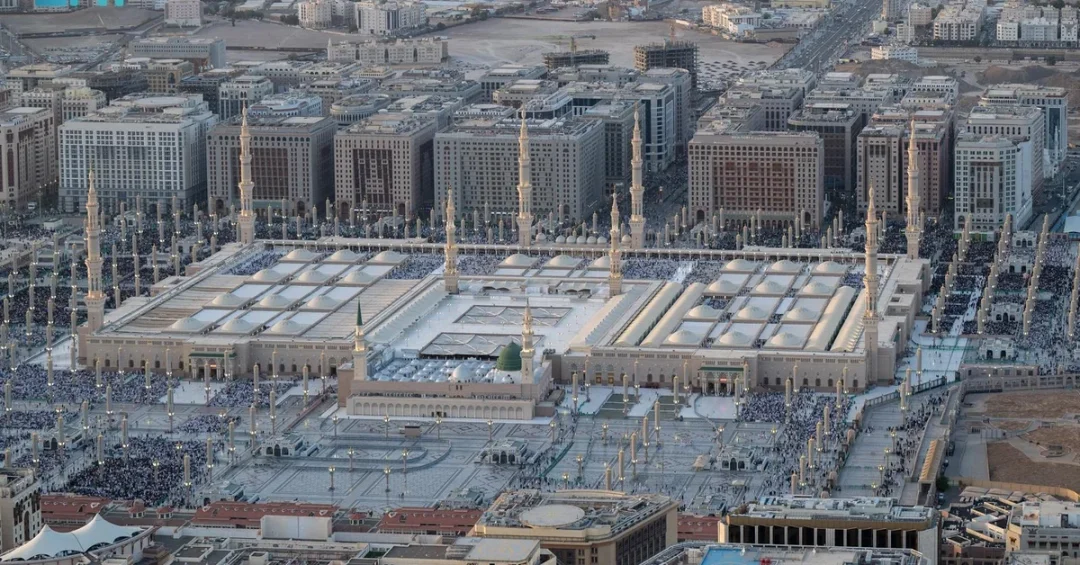
Saudi Arabia’s Security Aviation forces are intensifying aerial patrols over Madinah during the holy month of Ramadan, conducting round-the-clock sorties to monitor traffic flow, support crowd management around the Prophet’s Mosque, and reinforce the safety of millions of Umrah performers and visitors. The operation, reported by the Saudi Press Agency (SPA), forms part of a comprehensive government plan to provide a secure and comfortable environment across the city’s most sensitive sites during the busiest period of the Islamic calendar.
Have you ever considered how a city of millions can move safely through its holiest sites during the year’s most crowded month? For Madinah, the answer lies in the air as much as on the ground. Security Aviation teams are coordinating closely with relevant authorities to maintain the highest levels of preparedness and to ensure immediate response to emergencies, according to official Saudi information. The aerial dimension of the plan allows commanders to see traffic bottlenecks and crowd density in real time, giving ground units the advance warning they need to act before pressure builds. The result is a layered security and safety architecture that reflects the Kingdom’s wider commitment to protecting pilgrims as a national priority.
Context and Background
Why does Madinah require such an extensive aerial security effort during Ramadan? The answer begins with scale. The Prophet’s Mosque, the second holiest site in Islam, receives a dramatic surge in worshippers and visitors during the holy month, with Umrah performers arriving from across the Kingdom and around the world. Roads, parking areas, pedestrian routes, and the mosque’s surrounding plazas all experience sustained pressure, particularly during the final ten nights when attendance peaks. Managing that flow is not simply a logistical exercise; it is a safety imperative that Saudi authorities treat with the utmost seriousness.
Security Aviation has therefore intensified its aerial sorties to monitor traffic flow and ensure the smooth movement of crowds. The lens of the Saudi Press Agency captured aspects of these extensive efforts, documenting the professionalism and readiness of the teams involved. These operations are not improvised responses to events; they are the product of detailed advance planning, inter-agency rehearsal, and a command structure designed to convert aerial observation into rapid ground action. The effort reflects a broader Saudi doctrine in which pilgrim safety is treated as a shared responsibility across ministries, security services, health providers, and municipal authorities.
What makes this year’s operation particularly significant is the maturity of the coordination model. Security Aviation does not operate in isolation. It works alongside traffic police, civil defense units, the National Center for Security Operations, and the General Authority for the Care of the Grand Mosque and the Prophet’s Mosque, among others. Each partner receives information from the aerial picture and feeds observations back into a common operational understanding. This integration ensures that resources are directed where they are most needed, and that any incident, however minor, can be addressed without delay.
Key Details of the Operation
How exactly does Security Aviation contribute to safety on the ground? The core of the mission is aerial reconnaissance. Helicopters and aircraft fly systematic routes over Madinah’s main arteries, the ring roads serving the Prophet’s Mosque, and the principal pedestrian corridors used by pilgrims. From above, crews can observe vehicle density, identify congestion forming at junctions or parking entrances, and detect unusual activity that might require attention. This information is relayed continuously to ground command centers, where it informs decisions on diversions, lane management, and the deployment of officers.
Beyond traffic monitoring, Security Aviation supports crowd management around the Prophet’s Mosque and key locations. The aerial view enables commanders to gauge the density of worshippers in the mosque’s courtyards and approach routes, helping to prevent overcrowding before it becomes hazardous. When large groups move between accommodation areas and the mosque, aerial observation helps ensure that pedestrian flows remain separated from vehicle traffic and that emergency access lanes stay clear. These measures are especially important during peak prayer times and on the nights when attendance is highest.
Coordination with relevant authorities is continuous. Security Aviation teams maintain direct communication with ground units, sharing live observations and responding to requests for aerial support. The stated objective is to maintain the highest levels of preparedness and ensure immediate response to emergencies. That means aircraft and crews are positioned so they can be redirected at short notice, and that protocols for medical evacuations, incident overflight, and communication relay are rehearsed and ready. The presence of aerial assets also has a reassuring effect on visitors, who can see that comprehensive protection measures are in place.
International and Regional Impact
What does this operation signal to the international community? For the millions of Muslims who travel to Saudi Arabia for Umrah and Hajj, the visible professionalism of security arrangements is central to their confidence in the journey. Pilgrims from Asia, Africa, Europe, and the Americas judge the Kingdom not only by the spiritual experience they receive but by the safety and order they observe. The Ramadan operation in Madinah therefore contributes directly to Saudi Arabia’s global reputation as a trusted custodian of the Two Holy Mosques and a capable manager of large-scale religious gatherings.
The regional dimension is equally important. Saudi Arabia’s approach to crowd safety during Ramadan is watched closely by governments and religious authorities across the Islamic world, many of which send official delegations and pilgrim groups. By demonstrating an integrated, technology-supported model that combines aerial surveillance, ground coordination, and rapid response, the Kingdom offers a reference point for managing mass gatherings elsewhere. This soft-power dividend reinforces Saudi Arabia’s standing as a regional leader in public safety and event management, and it strengthens the international partnerships that support Vision 2030’s tourism and pilgrimage goals.
Economic and Strategic Significance
Why does aerial security matter economically as well as operationally? The Umrah and Hajj economy is a major component of Saudi Arabia’s diversification strategy. Millions of pilgrims each year generate demand for hotels, transport, retail, food services, and telecommunications, supporting jobs and small businesses across Madinah, Makkah, Jeddah, and beyond. Any disruption to pilgrim flows, whether from congestion or a safety incident, carries direct economic costs and reputational consequences. Investments in security aviation therefore protect not only lives but also the reliability of a key non-oil revenue stream.
Strategically, the operation demonstrates the Kingdom’s capacity to apply advanced capabilities to civilian protection missions. Security Aviation’s work in Madinah is a practical example of how Saudi institutions integrate planning, technology, and inter-agency coordination to deliver results at scale. That capability has value beyond Ramadan: it supports major events, infrastructure protection, and emergency response across the country. It also aligns with the broader modernization of Saudi public services, in which data, air assets, and command systems are used to raise the quality and speed of government action.
Vision 2030 Alignment
How does this operation connect to Saudi Vision 2030? The Vision’s objectives include expanding pilgrimage capacity, improving the quality of services for visitors, and strengthening the Kingdom’s position as a global destination for Muslims. Each of those goals depends on safety. By ensuring that Umrah performers and visitors can move through Madinah securely and comfortably, Security Aviation contributes directly to the Vision’s pilgrim experience targets, which aim to welcome a growing number of Umrah performers and Hajj pilgrims in coming years.
The operation also reflects the Vision’s emphasis on government excellence and integrated service delivery. The coordination between Security Aviation and its partners embodies the principle that Saudi institutions should work as one system, using real-time information to serve the public efficiently. As the Kingdom continues to invest in transport links, accommodation capacity, and digital services for pilgrims, the aerial security model in Madinah will remain an essential layer of protection, helping to ensure that the spiritual journey of millions unfolds in safety, dignity, and comfort.
20 Questions
Q1. What is Security Aviation doing in Madinah during Ramadan?
A1. Security Aviation is intensifying aerial sorties over Madinah to monitor traffic flow, support crowd management around the Prophet’s Mosque, and help ensure a safe environment for Umrah performers and visitors.
Q2. Which Saudi agency reported these operations?
A2. The Saudi Press Agency (SPA) reported the operations and documented the efforts, including aerial monitoring activities carried out as part of the comprehensive Ramadan plan for Madinah.
Q3. Why is aerial monitoring useful during Ramadan in Madinah?
A3. Aerial monitoring provides real-time visibility of traffic and crowd density, allowing commanders to identify congestion early and direct ground teams to prevent overcrowding and delays.
Q4. Which site is the main focus of the security effort?
A4. The Prophet’s Mosque and its surrounding areas are the main focus, along with key roads, junctions, and pedestrian routes used by worshippers and visitors throughout the holy month.
Q5. Who benefits from these security measures?
A5. Umrah performers, visitors, residents, and workers in Madinah all benefit from safer roads, better-managed crowds, and faster emergency response during the busiest period of the year.
Q6. How does Security Aviation coordinate with other authorities?
A6. Teams maintain direct communication with ground units and relevant agencies, sharing live observations and responding to requests for aerial support to maintain high preparedness and rapid emergency response.
Q7. What kinds of aircraft are used for these missions?
A7. Security Aviation operates helicopters and aircraft suited to reconnaissance, observation, and rapid response, allowing crews to cover wide areas of the city efficiently during peak periods.
Q8. What is the role of the Saudi Press Agency in this story?
A8. SPA documented the efforts with photography and reporting, providing official coverage that highlights the professionalism and readiness of the security teams serving pilgrims in Madinah.
Q9. How does this operation support traffic management?
A9. Aerial crews observe vehicle density on main arteries and ring roads, relaying information that helps authorities manage diversions, parking access, and lane control to keep traffic moving smoothly.
Q10. What is the significance of the final ten nights of Ramadan?
A10. The final ten nights draw the largest crowds to the Prophet’s Mosque, making coordination, crowd control, and emergency readiness especially important for ensuring safety and comfort.
Q11. Does the operation include emergency response planning?
A11. Yes. Security Aviation teams maintain high preparedness and coordinate with partners so that emergencies can be addressed immediately, including through aerial support when required.
Q12. How does this effort reflect Saudi Arabia’s wider security approach?
A12. It reflects an integrated model that combines planning, technology, and inter-agency coordination, treating pilgrim safety as a national priority across ministries and security services.
Q13. What impact does this have on international pilgrims?
A13. International pilgrims gain confidence from visible, professional safety measures, which enhance their overall experience and reinforce Saudi Arabia’s reputation as a trusted custodian of the holy sites.
Q14. How does the operation support Saudi Arabia’s economy?
A14. By protecting pilgrim flows and preventing disruptions, the operation supports the Umrah and Hajj economy, which generates demand for hotels, transport, retail, and services across the Kingdom.
Q15. Is this a new initiative or an established practice?
A15. It is part of an established, comprehensive plan that Saudi authorities implement and refine each year, with Security Aviation playing a consistent role in Madinah during Ramadan.
Q16. How does aerial observation help prevent overcrowding?
A16. It allows commanders to see crowd density in courtyards and approach routes, enabling them to adjust entry flows and deploy officers before pressure becomes hazardous.
Q17. What other agencies support the Ramadan plan in Madinah?
A17. Traffic police, civil defense, health providers, municipal authorities, and agencies responsible for the care of the Prophet’s Mosque work alongside Security Aviation under a unified operational framework.
Q18. How does this connect to Vision 2030?
A18. It supports Vision 2030 goals to expand pilgrimage capacity and improve visitor services, ensuring that growing numbers of Umrah performers can be welcomed safely and comfortably.
Q19. What message does this send to the region?
A19. It demonstrates Saudi Arabia’s leadership in managing mass gatherings, offering a model of integrated safety and crowd management that other countries can study and learn from.
Q20. What is the ultimate goal of these efforts?
A20. The goal is to provide a safe, secure, and comfortable environment so that pilgrims can focus on worship and spiritual reflection during the holy month of Ramadan in Madinah.
Reader Feedback
We value your thoughts. Please share your feedback on this article.
Your feedback helps us improve our coverage.