


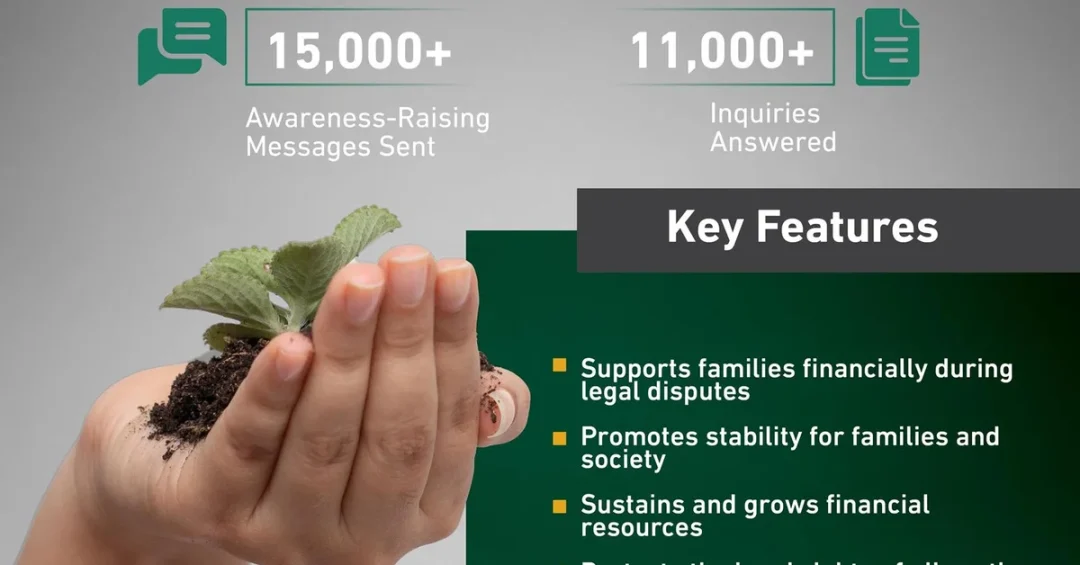
The Alimony Fund of the Saudi Ministry of Justice disbursed more than SAR78 million in monthly maintenance payments to over 23,000 beneficiaries during 2024, according to an official announcement carried by the Saudi Press Agency (SPA). The disbursement reflects the Kingdom’s continuing commitment to ensuring that court-ordered financial support reaches eligible recipients promptly and reliably, strengthening family stability across the country. The fund operates as a dedicated mechanism within the Ministry of Justice, tasked not only with paying alimony when obligated parties delay or default, but also with recovering those amounts from those legally responsible.
For an international audience, the significance extends beyond the headline figure. The Alimony Fund represents a practical expression of Saudi Arabia’s broader judicial modernization and social protection agenda, one that seeks to translate legal rights into tangible financial outcomes for families. By paying eligible beneficiaries first and then pursuing reimbursement from liable parties, the fund removes the immediate financial burden that often falls on divorced or separated mothers and their children. This approach aligns with the Kingdom’s Vision 2030 objective of enhancing quality of life and building a resilient, fair society. How does a single fund manage to bridge the gap between a court ruling and a family’s monthly budget? The answer lies in a carefully designed administrative and legal framework that has been refined over recent years.
Context and Background
What circumstances led to the creation of a dedicated alimony fund in Saudi Arabia? The fund was established to address a longstanding challenge: even when courts issued maintenance orders, enforcement could be slow, leaving vulnerable family members without timely support. The Ministry of Justice developed the Alimony Fund as a proactive solution, ensuring that eligible recipients receive payments while the state assumes the responsibility of recovering the amounts from those who are legally obligated. This model mirrors similar guarantee mechanisms used in other jurisdictions, but it is tailored to the Saudi legal and social context.
The fund’s operations are grounded in Sharia and statutory law, which require maintenance for dependents. By centralizing disbursement and recovery, the Ministry of Justice has created a transparent, accountable system. Beneficiaries can apply through the official Nafaqah.sa portal, using their national ID number and date of birth to log in and submit applications electronically. This digital-first approach reduces paperwork, shortens waiting times, and extends access to services across all regions of the Kingdom. The fund’s 2024 performance, with over SAR78 million disbursed, demonstrates its growing reach and operational maturity.
Beyond the numbers, the fund has invested in awareness and engagement. It addressed more than 11,000 inquiries from beneficiary families and distributed 15,000 awareness messages aimed at educating the public about rights and responsibilities. These efforts are part of a broader strategy to prevent disputes and ensure that all parties understand their obligations under the law. By combining financial support with information and guidance, the fund helps families navigate a potentially stressful process with greater confidence.
Key Details
How exactly does the Alimony Fund function on a day-to-day basis? The fund pays monthly maintenance to individuals who hold valid court-ordered entitlements, ensuring that payments are made on time. It then recovers those amounts from the liable parties through legal channels. This dual mandate requires close coordination between the fund, the courts, and enforcement authorities. The Ministry of Justice has streamlined the process so that eligible individuals can complete applications online and receive payments within five working days, provided all conditions are met. This speed is a significant improvement over traditional enforcement routes, which could take months.
In 2024, the fund’s disbursements reached more than 23,000 beneficiaries, a testament to its expanding role. The SAR78 million total represents a substantial injection of financial stability into households across Saudi Arabia. The fund’s services are accessible via the Nafaqah.sa website, where users can log in using their ID number and date of birth. The platform is designed to be user-friendly, with clear instructions and support for those who may need assistance. The Ministry of Justice has also integrated the fund with other digital government services, making it easier for beneficiaries to manage their claims.
Transparency and accountability are central to the fund’s operations. Every payment is tracked, and recovery efforts are pursued systematically. The fund’s engagement with beneficiaries does not end with disbursement; it also provides ongoing support and information. The 11,000 inquiries addressed in 2024 cover a range of topics, from eligibility criteria to payment schedules. The 15,000 awareness messages, distributed through various channels, aim to educate the public about the fund’s services and the importance of meeting maintenance obligations. This holistic approach helps protect the rights of all parties involved.
International and Regional Impact
Why should the international community pay attention to a domestic alimony fund? Saudi Arabia’s approach offers a model for other countries grappling with similar challenges of enforcing family maintenance orders. By guaranteeing payments and then recovering them, the fund ensures that children and dependent family members are not left in financial limbo. This aligns with global efforts to strengthen social safety nets and promote gender equality, as women are often the primary beneficiaries of alimony. The fund’s success could inspire similar initiatives in the region and beyond.
Regionally, the fund supports social stability, which is a prerequisite for economic development. When families have reliable income, they are better able to invest in education, health, and housing. This contributes to the broader goals of Vision 2030, which seeks to diversify the economy and enhance the well-being of all citizens. The fund’s digital infrastructure also showcases Saudi Arabia’s leadership in e-government and legal tech. By making services accessible online, the Kingdom demonstrates how technology can be harnessed to deliver justice efficiently and transparently.
Economic and Strategic Significance
What does the SAR78 million disbursement signify for Saudi Arabia’s economy? At its core, the fund injects liquidity directly into households, which then spend on essential goods and services. This spending supports local businesses and contributes to economic activity. More importantly, the fund reduces the risk of poverty and social exclusion, which can have long-term economic costs. By ensuring that maintenance payments are made, the fund helps maintain human capital and social cohesion, both of which are vital for sustainable development.
Strategically, the fund is part of a wider effort to modernize the Kingdom’s legal and social institutions. The Ministry of Justice has been at the forefront of this transformation, leveraging technology to improve access to justice. The Alimony Fund is one component of a broader suite of services that include digital courts, online notarization, and alternative dispute resolution. These reforms enhance the business environment by strengthening the rule of law and protecting individual rights. For international investors, a predictable and fair legal system is a key consideration, and the fund’s efficiency contributes to that perception.
Vision 2030 Alignment
How does the Alimony Fund connect to Saudi Vision 2030? The Vision’s quality-of-life program aims to build a society where all citizens can thrive, and the fund directly supports that objective by providing financial security to families in need. It also aligns with the Vision’s emphasis on digital transformation and government efficiency. The Nafaqah.sa platform is a prime example of how Saudi Arabia is using technology to deliver services faster and more transparently. By safeguarding the rights of women and children, the fund contributes to the Vision’s goal of empowering all members of society.
Looking ahead, the Ministry of Justice is expected to continue enhancing the fund’s capabilities, expanding its reach, and improving recovery rates. The success of 2024 sets a strong foundation for future growth. As Saudi Arabia continues its journey toward Vision 2030, initiatives like the Alimony Fund will play a crucial role in ensuring that economic progress is matched by social progress. The Kingdom’s commitment to family stability and justice is unwavering, and the fund is a tangible demonstration of that commitment. With each monthly payment, the fund helps build a more secure and equitable future for all Saudis.
20 Questions
Q1. What is the Alimony Fund?
A1. The Alimony Fund is a program under the Saudi Ministry of Justice that pays monthly maintenance to eligible beneficiaries and recovers the amounts from those legally obligated to pay.
Q2. How much did the fund disburse in 2024?
A2. The fund disbursed over SAR78 million in monthly maintenance payments during 2024, according to the Saudi Press Agency.
Q3. How many beneficiaries received support in 2024?
A3. More than 23,000 beneficiaries received monthly maintenance payments from the fund in 2024.
Q4. What is the main objective of the Alimony Fund?
A4. Its objective is to provide prompt alimony payments, promote financial stability for families, and enforce responsibility by recovering payments from those legally obligated.
Q5. How can eligible individuals apply for alimony?
A5. Eligible individuals can apply online through the Nafaqah.sa website by logging in with their ID number and date of birth.
Q6. How long does it take to receive payments after applying?
A6. The fund has streamlined the process so that eligible individuals can receive payments within five working days, provided all conditions are met.
Q7. What is the role of the Ministry of Justice in the fund?
A7. The Ministry of Justice oversees the fund, ensuring it operates efficiently and in accordance with legal and Sharia requirements.
Q8. How does the fund recover payments from liable parties?
A8. The fund recovers amounts through legal channels, coordinating with courts and enforcement authorities to ensure compliance.
Q9. What support does the fund provide beyond financial payments?
A9. The fund addresses inquiries from beneficiaries and distributes awareness messages to educate the public about rights and responsibilities.
Q10. How many inquiries did the fund address in 2024?
A10. The fund addressed over 11,000 inquiries from beneficiary families in 2024.
Q11. How many awareness messages were distributed?
A11. The fund distributed 15,000 awareness messages in 2024 to educate the public and protect the rights of all parties.
Q12. Is the Alimony Fund accessible to all regions of Saudi Arabia?
A12. Yes, the fund’s services are accessible online across all regions, making it convenient for beneficiaries throughout the Kingdom.
Q13. What legal basis supports the Alimony Fund?
A13. The fund operates under Sharia and statutory law, which require maintenance for dependents and empower the state to enforce court orders.
Q14. How does the fund contribute to Vision 2030?
A14. It supports Vision 2030 by enhancing quality of life, empowering women and children, and promoting digital government services.
Q15. What happens if a liable party fails to pay?
A15. The fund pays the beneficiary and then pursues recovery from the liable party through legal enforcement measures.
Q16. Can beneficiaries track their payments online?
A16. Yes, the Nafaqah.sa portal allows beneficiaries to manage their claims and track payments electronically.
Q17. Does the fund provide support for children?
A17. Yes, the fund ensures that maintenance payments reach children and other dependents as ordered by the courts.
Q18. How does the fund ensure transparency?
A18. The fund tracks all payments and recovery efforts, and it maintains open communication with beneficiaries through multiple channels.
Q19. What impact does the fund have on family stability?
A19. By providing timely financial support, the fund reduces stress and helps families maintain stability, which is essential for children’s well-being.
Q20. What are the future plans for the Alimony Fund?
A20. The Ministry of Justice is expected to continue enhancing the fund’s capabilities, expanding its reach, and improving recovery rates to serve more families.
Reader Feedback
We value your thoughts. Please share your feedback on this article.
Your feedback helps us improve our coverage.
Related articles
 Madinah Concludes Swimming Literacy Project with 300 Students
 AlUla Program Trains 50 Youth in Public Speaking
 Najran Schools Adopt Winter Schedule Starting Sunday
 Najran University Climbs Four Places in QS Arab Rankings 2027
 Saudi Arabia Sets February 2027 Deadline for Worker Housing
 ETEC to Hold Third National Forum for School Excellence in Riyadh