


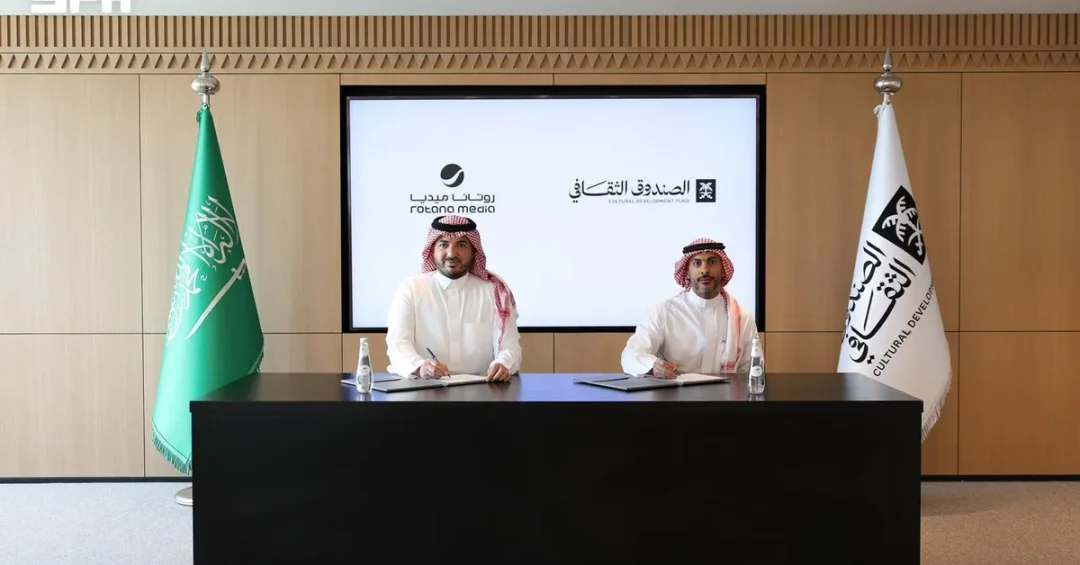
The Cultural Development Fund has signed a financing agreement with Rotana Media Group to support the production of Saudi films and television series with a combined value exceeding SAR39 million, in a move that strengthens the Kingdom’s fast-growing screen industry and expands opportunities for national talent. The agreement, announced via official Saudi channels, covers productions spanning social comedy, drama, and action, and is expected to contribute more than SAR72 million to gross domestic product while creating 68 job opportunities for Saudi professionals.
The deal positions the Cultural Development Fund, which operates as a center for financial excellence and empowerment in the cultural sector, at the heart of a production pipeline that pairs private-sector capital with public-sector enablement. Private contributions tied to the agreement are expected to exceed SAR12 million. For an international audience watching Saudi Arabia’s cultural transformation, the announcement offers a concrete example of how Vision 2030 is translating national ambition into contracts, jobs, and content destined for both domestic and regional audiences. Why does a single financing agreement matter in a sector already posting record numbers? Because it demonstrates that the Kingdom’s cultural economy is maturing from sporadic investment into a structured, repeatable model.
Context and Background
How did Saudi Arabia’s film sector reach a point where a SAR39 million production agreement can be signed as part of a broader industrial strategy? The answer lies in a decade of deliberate institution-building. Following the lifting of the cinema ban in 2017 and the establishment of the Film Commission under the Ministry of Culture, the Kingdom began constructing the regulatory, financial, and physical infrastructure required for a sustainable screen industry. The Cultural Development Fund was created to provide the financial tools that cultural enterprises need to scale, functioning less as a traditional grant-maker and more as an investment enabler that shares risk with private partners.
Rotana Media Group, one of the region’s most established media companies, brings production capacity, distribution reach, and star power to the partnership. The agreement’s mix of social comedy, drama, and action reflects a deliberate effort to serve diverse audience tastes rather than a single genre. A number of prominent Saudi actors will star in these productions, giving local talent visible leading roles rather than supporting parts. The fund’s role as a center for financial excellence means the agreement is structured to encourage private-sector participation, with more than SAR12 million expected from private contributors. For international observers, this signals that Saudi cultural financing is designed to crowd in private capital, not replace it.
The timing of the agreement also reflects momentum. According to reports issued by the Film Commission, box-office revenues in Saudi Arabia exceeded SAR920 million in 2025, an increase of nearly 9 percent compared with 2024. Saudi films accounted for about 13 percent of those revenues, exceeding SAR122 million, through 11 local films out of 538 released during the year. Those figures describe a market that is both large and still under-served by domestic content, which is precisely the gap the Cultural Development Fund and Rotana aim to close.
Key Details of the Agreement
What exactly does the SAR39 million commitment finance? The agreement covers the production of multiple films and television series across three genres: social comedy, drama, and action. This genre spread is significant because it mirrors the viewing habits of Saudi and regional audiences, who increasingly consume Arabic-language content on streaming platforms, in cinemas, and on broadcast television. By financing a slate rather than a single title, the fund reduces concentration risk and builds a pipeline of releases that can sustain audience engagement across the calendar year.
The economic projections attached to the agreement are equally specific. The productions are expected to contribute more than SAR72 million to gross domestic product, a figure that reflects direct spending on production services, crew, locations, and post-production, as well as indirect activity in hospitality, transport, and retail. The agreement is also expected to create 68 job opportunities, supporting national talent across acting, directing, technical crafts, and production management. Private-sector contributions are expected to exceed SAR12 million, underscoring the fund’s role in mobilizing additional investment rather than acting alone.
Prominent Saudi actors attached to the productions give the slate commercial credibility and cultural resonance. Their involvement matters beyond star appeal: visible Saudi leads help normalize local storytelling as a mainstream entertainment choice, strengthening the domestic market’s appetite for Saudi-made content. The fund continues to support this growth by providing financial and enabling solutions that empower sector projects and enterprises, encourage private-sector participation, and contribute to sustaining the growth of the cultural sector and enhancing its economic impact.
International and Regional Impact
How will an agreement signed in Riyadh resonate beyond Saudi borders? The Middle East’s media landscape is increasingly competitive, with streaming platforms investing heavily in Arabic-language originals and regional production hubs vying for talent and infrastructure. By financing a multi-genre slate with an established partner like Rotana, Saudi Arabia strengthens its position as a production center capable of supplying that demand. The agreement also builds export potential: Saudi series and films that succeed domestically can travel to Gulf, wider Arab, and diaspora audiences, carrying Saudi creative voices into new markets.
For international studios, streamers, and production-service companies, the deal is a signal that Saudi Arabia offers a structured pathway into one of the region’s largest box-office markets. The Kingdom’s combination of a young population, rising cinema attendance, and government-backed financial tools creates a proposition that few regional markets can match. The fund’s emphasis on private-sector participation also aligns with global co-production norms, making it easier for foreign partners to structure joint projects. Regional impact extends to talent flows as well: as Saudi productions scale up, they create incentives for Saudi creatives who might previously have worked abroad to build careers at home.
Economic and Strategic Significance
Why treat cultural production as an economic priority rather than a purely artistic pursuit? The numbers answer the question. Box-office revenues exceeding SAR920 million in 2025, with Saudi films generating more than SAR122 million from 11 titles out of 538 releases, show a market where local content already competes commercially. Each production financed by the Cultural Development Fund adds to that base, generating GDP contributions, employment, and private investment that compound over time. The projected SAR72 million GDP contribution and 68 jobs from this single agreement illustrate how cultural financing converts into measurable economic activity.
Strategically, the agreement strengthens the institutional architecture of the Kingdom’s creative economy. The Cultural Development Fund provides financial and enabling solutions; the Film Commission provides data, regulation, and sector oversight; private partners like Rotana provide production and distribution expertise. This division of labor is a model that can be replicated across music, gaming, design, and other cultural fields. It also builds resilience: a diversified cultural economy reduces reliance on any single revenue stream and creates career paths for young Saudis in fields that did not exist domestically a decade ago. For a country pursuing economic diversification under Vision 2030, the screen industry is both a symbol and a working example of that transformation.
Vision 2030 Alignment
How does a SAR39 million production agreement connect to the broader goals of Saudi Vision 2030? Vision 2030 seeks to diversify the economy, expand the private sector, create jobs for Saudi citizens, and enrich quality of life. The Cultural Development Fund’s agreement with Rotana advances each of these objectives: it channels investment into a high-growth sector, mobilizes more than SAR12 million in private contributions, creates 68 job opportunities, and produces content that enriches the cultural landscape for domestic and regional audiences. It also reinforces the Kingdom’s goal of becoming a regional hub for culture and entertainment, a priority that supports both tourism and soft-power objectives.
The forward-looking significance is clear. As the fund continues to deploy financial and enabling solutions, and as the Film Commission’s data show rising audience demand, Saudi Arabia is building a self-reinforcing cycle in which investment produces content, content builds audiences, and audiences attract further investment. The agreement with Rotana is one link in that chain, but it is a meaningful one: it demonstrates that the Kingdom’s cultural ambitions are backed by contracts, capital, and confidence. For international readers, the message is that Saudi Arabia’s screen sector is not a future prospect but a present reality, and partnerships formed today will shape the region’s cultural output for years to come.
20 Questions
Q1. What is the value of the agreement signed between the Cultural Development Fund and Rotana Media Group?
A1. The agreement covers the production of films and television series with a combined value exceeding SAR39 million, according to the official announcement released via Saudi channels.
Q2. Which types of productions does the agreement cover?
A2. The agreement covers films and television series spanning social comedy, drama, and action, giving the slate a broad range of genres aimed at diverse audience tastes.
Q3. How much is the agreement expected to contribute to Saudi Arabia’s gross domestic product?
A3. The productions are expected to contribute more than SAR72 million to gross domestic product, reflecting direct production spending and indirect economic activity across related sectors.
Q4. How many job opportunities is the agreement expected to create?
A4. The agreement is expected to create 68 job opportunities, supporting national talent across acting, directing, technical crafts, and production management roles.
Q5. How much private-sector contribution is expected under the agreement?
A5. Private-sector contributions are expected to exceed SAR12 million, demonstrating the fund’s role in mobilizing additional investment alongside its own financing.
Q6. What role does the Cultural Development Fund play in Saudi Arabia’s cultural sector?
A6. The fund operates as a center for financial excellence and empowerment in the cultural sector, providing financial and enabling solutions that empower projects and enterprises.
Q7. What were Saudi Arabia’s box-office revenues in 2025?
A7. Box-office revenues exceeded SAR920 million in 2025, marking an increase of nearly 9 percent compared with 2024, according to reports issued by the Film Commission.
Q8. What share of 2025 box-office revenues came from Saudi films?
A8. Saudi films accounted for about 13 percent of box-office revenues, exceeding SAR122 million, through 11 local films released during the year.
Q9. How many films were released in Saudi Arabia in 2025?
A9. A total of 538 films were released in Saudi Arabia during 2025, of which 11 were Saudi productions, according to Film Commission reports.
Q10. Who signed the agreement on behalf of the Cultural Development Fund?
A10. The agreement was signed by the Cultural Development Fund in its capacity as a center for financial excellence and empowerment in the cultural sector, in line with the Kingdom’s film sector growth.
Q11. Which company partnered with the Cultural Development Fund on this agreement?
A11. Rotana Media Group, one of the region’s most established media companies, partnered with the Cultural Development Fund to support Saudi film and television production.
Q12. Will prominent Saudi actors appear in the financed productions?
A12. Yes, a number of prominent Saudi actors will star in these productions, giving local talent visible leading roles on screen and strengthening the commercial appeal of the slate.
Q13. Why is the agreement important for Saudi talent?
A13. The agreement aims to provide Saudi talent with greater presence on screen and support the growth of the film industry, creating career opportunities and visibility for national creatives.
Q14. What does the fund aim to achieve by supporting sector projects?
A14. The fund provides financial and enabling solutions that empower sector projects and enterprises, encourage private-sector participation, and sustain the cultural sector’s growth and economic impact.
Q15. How does the agreement support Vision 2030?
A15. It advances Vision 2030 by diversifying the economy, expanding private-sector participation, creating jobs for Saudi citizens, and enriching quality of life through cultural production.
Q16. What does the Film Commission’s data say about local production growth?
A16. The Film Commission’s reports reflect the growing presence of local productions and promising opportunities in the sector, with Saudi films generating more than SAR122 million in 2025.
Q17. How does this agreement affect the regional media landscape?
A17. It strengthens Saudi Arabia’s position as a production center capable of supplying Arabic-language content to regional and international audiences across streaming and cinema platforms.
Q18. What genres of Saudi content are in highest demand?
A18. The agreement’s mix of social comedy, drama, and action reflects audience demand across these genres, which are popular with Saudi and regional viewers on multiple platforms.
Q19. What economic benefits beyond GDP does the agreement generate?
A19. It generates employment, attracts private investment exceeding SAR12 million, supports production-service businesses, and builds a sustainable pipeline of Saudi content for domestic and export markets.
Q20. What does this agreement signal about Saudi Arabia’s cultural economy?
A20. It signals that Saudi Arabia’s cultural economy is maturing into a structured, investment-ready sector backed by institutions, private partnerships, and measurable economic returns under Vision 2030.
Reader Feedback
We value your thoughts. Please share your feedback on this article.
Your feedback helps us improve our coverage.