


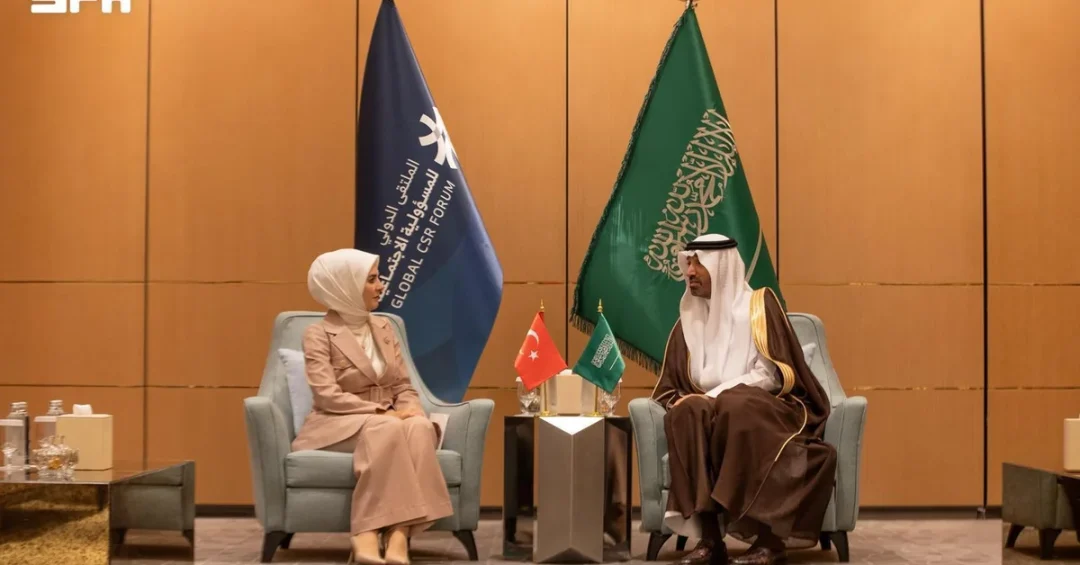
Saudi Minister of Human Resources and Social Development Ahmed Al-Rajhi met with Türkiye’s Minister of Family and Social Services Mahinur Özdemir Göktaş in Riyadh on Monday, October 6, 2026, on the sidelines of the second edition of the Global Social Responsibility Forum 2026, held in the Saudi capital from October 5 to 6. The meeting was attended by Vice Minister for Social Development Badr Al-Suwailim and a number of ministry officials, according to the Saudi Press Agency (SPA).
The encounter brought together two of the region’s most active social policy portfolios at a moment when governments across the Middle East are rethinking how welfare systems, family support programs, and community development initiatives are designed and delivered. For Saudi Arabia, the talks form part of a broader diplomatic and technical outreach that has accelerated under Vision 2030, the national transformation program launched in 2016 to diversify the Kingdom’s economy and modernize its public services. For Türkiye, the meeting represents a continuation of engagement with Gulf partners on social policy issues that both countries have identified as priorities. Could this kind of ministerial exchange become a regular feature of regional cooperation on social development?
Context and Background
The meeting took place against the backdrop of steadily strengthening relations between the Kingdom of Saudi Arabia and the Republic of Türkiye. In 2025, the two countries signed a memorandum of understanding on social development, establishing a formal framework for cooperation, knowledge exchange, and joint work across a range of social policy areas. That agreement gave both ministries a structured channel for sharing experiences and aligning programs, and the Riyadh meeting was in part an effort to move that framework from signature to implementation. Why does a memorandum of understanding matter if it is not followed by concrete action?
The Global Social Responsibility Forum 2026 provided the immediate setting. Held in Riyadh from October 5 to 6, the forum convened policymakers, international organizations, and private-sector leaders to discuss how governments and companies can share responsibility for social welfare. The second edition of the event reflects Saudi Arabia’s growing role as a convening power in global social policy conversations, a role that complements its economic and diplomatic weight. The presence of a senior Turkish delegation at the forum underscores the extent to which Riyadh has become a destination for international dialogue on issues that sit at the intersection of government policy and community wellbeing.
Within Saudi Arabia, the Ministry of Human Resources and Social Development is one of the central institutions responsible for delivering the social dimension of Vision 2030. Its mandate covers employment, labor market regulation, social insurance, family support, and the empowerment of women and youth. The ministry has been at the forefront of reforms that have expanded female labor force participation, modernized the sponsorship system for foreign workers, and introduced new social protection mechanisms. International partnerships such as the one with Türkiye are viewed by Saudi officials as a way to benchmark progress and adopt proven practices. What can two countries with different social traditions learn from one another?
Key Details
According to the Saudi Press Agency, the meeting addressed a number of topics of mutual interest in the field of social development. The two sides reviewed key experiences and practices across several priority social areas and explored opportunities to broaden coordination and further develop cooperation between the two countries. The discussions were not limited to general expressions of goodwill; they focused on specific areas where both ministries have accumulated operational experience, including family welfare, child protection, care for the elderly, and the integration of social services with employment programs.
A central item on the agenda was the activation of the 2025 memorandum of understanding on social development. The two ministers discussed ways to leverage the framework it provides to strengthen joint work and exchange knowledge and practices across a number of social development areas, contributing to the advancement of related programs and initiatives. This emphasis on implementation signals that both governments want the agreement to produce measurable outcomes rather than remain a symbolic document. What does successful activation of such an agreement actually look like on the ground?
The meeting was attended by Vice Minister for Social Development Badr Al-Suwailim, along with a number of ministry officials, indicating the level of technical depth involved. Vice ministers and senior officials typically handle the detailed follow-up that turns ministerial conversations into work plans, timelines, and pilot programs. Their presence suggests that the Riyadh discussions were intended to generate practical next steps, including possible exchanges of experts, joint training, and shared research on social policy challenges common to both countries.
The SPA report noted that the meeting reflects the close relations between Saudi Arabia and Türkiye and the shared commitment to further developing cooperation in social development, supporting common priorities, and strengthening the partnership between the two countries. That language is consistent with the broader trajectory of Saudi-Turkish relations, which have moved from a period of uncertainty toward a pragmatic partnership built on trade, investment, tourism, and diplomatic coordination. How do social policy partnerships reinforce broader diplomatic and economic ties?
International and Regional Impact
The Riyadh meeting carries significance beyond the bilateral relationship. Social policy is increasingly recognized as a domain where regional cooperation can produce tangible benefits, particularly as countries in the Middle East and North Africa confront shared challenges such as youth unemployment, demographic change, and the need to modernize welfare systems. By institutionalizing cooperation with Türkiye, Saudi Arabia is signaling that it views social development as a strategic priority worthy of sustained international engagement, not merely a domestic administrative matter.
The timing is also notable. The Global Social Responsibility Forum 2026 brought together participants from multiple countries and sectors, creating opportunities for Saudi Arabia to position itself as a hub for dialogue on social responsibility. Türkiye’s participation, and the bilateral meeting on the sidelines, added a concrete diplomatic dimension to the forum. For international observers, the encounter demonstrates that Riyadh is capable of convening high-level conversations and converting them into bilateral follow-up. What does it mean for a region when its countries begin to coordinate on social policy rather than only on security and trade?
The meeting also reflects a broader pattern in Saudi foreign policy: the use of technical cooperation and knowledge exchange as instruments of soft power. Ministries across the Saudi government have signed agreements with counterparts in Asia, Europe, Africa, and the Americas, covering fields from health and education to renewable energy and digital transformation. Social development is a relatively new addition to this portfolio, but it aligns naturally with the Kingdom’s emphasis on human capital as the foundation of economic diversification. Türkiye, with its own extensive experience in family and social services, is a logical partner in this effort.
Economic and Strategic Significance
Social development policy is not separate from economic strategy; it is a precondition for it. Saudi Arabia’s Vision 2030 aims to raise household incomes, increase workforce participation, and improve quality of life, all of which depend on effective social services. By learning from Türkiye’s experience in areas such as family support and social assistance delivery, Saudi institutions can refine their own programs and avoid costly experimentation. The economic value of such exchanges lies in their potential to improve the efficiency of public spending and to enhance the productivity of the workforce.
For Türkiye, cooperation with Saudi Arabia offers access to a partner that is investing heavily in social infrastructure and is willing to share its own innovations. Turkish expertise in community-based social services and family protection has been developed over decades and is recognized internationally. The memorandum of understanding provides a framework for Turkish institutions to engage with Saudi counterparts on a sustained basis, potentially opening opportunities for joint research, training, and program design. Both countries stand to gain from a relationship that treats social policy as a shared field of practice rather than a purely national concern.
The strategic significance extends to the wider region. As Gulf economies diversify, they are competing for talent and seeking to improve living standards. Countries that can demonstrate effective social policies are better positioned to attract and retain skilled workers, support entrepreneurship, and maintain social stability. Saudi-Turkish cooperation on social development thus contributes to a broader regional agenda of modernization and reform. Could social policy become a new arena for constructive competition and collaboration in the Middle East?
Vision 2030 Alignment
The meeting aligns directly with the objectives of Saudi Vision 2030, which places human development at the center of the Kingdom’s transformation. The Vision’s quality-of-life program aims to improve social services, strengthen family cohesion, and expand opportunities for women, youth, and persons with disabilities. The Ministry of Human Resources and Social Development is a key delivery vehicle for these goals, and its international partnerships are intended to accelerate progress by importing best practices and exporting Saudi innovations. The engagement with Türkiye is a practical expression of this approach.
More broadly, the meeting illustrates how Vision 2030 has reshaped Saudi Arabia’s international relationships. The Kingdom is no longer content to be a participant in global conversations; it is actively shaping agendas, hosting forums, and building bilateral partnerships that serve its development goals. The Global Social Responsibility Forum 2026 and the ministerial meeting on its sidelines are examples of this proactive posture. As Saudi Arabia continues to implement its transformation program, such exchanges will play a role in ensuring that the social dimension of Vision 2030 is informed by the best available knowledge and practice. In a world where social challenges increasingly transcend borders, the partnership between Riyadh and Ankara offers a model of cooperation that is both practical and forward-looking.
20 Questions
Q1. Who met in Riyadh on October 6, 2026?
A1. Saudi Minister of Human Resources and Social Development Ahmed Al-Rajhi met with Türkiye’s Minister of Family and Social Services Mahinur Özdemir Göktaş in Riyadh on Monday, October 6, 2026, according to the Saudi Press Agency.
Q2. What event was taking place in Riyadh at the time of the meeting?
A2. The meeting took place on the sidelines of the second edition of the Global Social Responsibility Forum 2026, which was held in Riyadh from October 5 to 6, 2026.
Q3. Who else attended the meeting besides the two ministers?
A3. The meeting was attended by Vice Minister for Social Development Badr Al-Suwailim, along with a number of officials from the Saudi Ministry of Human Resources and Social Development.
Q4. What topics were discussed during the meeting?
A4. The two sides addressed topics of mutual interest in social development, reviewed key experiences and practices in priority social areas, and explored opportunities to broaden coordination and cooperation between Saudi Arabia and Türkiye.
Q5. What agreement did the two sides discuss activating?
A5. They discussed ways to activate the memorandum of understanding on social development signed between Saudi Arabia and Türkiye in 2025, and to leverage its framework for joint work.
Q6. When was the Saudi-Turkish memorandum of understanding on social development signed?
A6. The memorandum of understanding on social development between the Kingdom of Saudi Arabia and the Republic of Türkiye was signed in 2025.
Q7. What is the purpose of the memorandum of understanding?
A7. It provides a framework to strengthen joint work and exchange knowledge and practices across a number of social development areas, contributing to the advancement of related programs and initiatives.
Q8. Which Saudi ministry does Ahmed Al-Rajhi lead?
A8. Ahmed Al-Rajhi is the Minister of Human Resources and Social Development, the Saudi ministry responsible for employment, labor, social insurance, family support, and social development programs.
Q9. Which Turkish ministry does Mahinur Özdemir Göktaş lead?
A9. Mahinur Özdemir Göktaş is the Minister of Family and Social Services of the Republic of Türkiye, responsible for family welfare and social service delivery.
Q10. What does the meeting reflect about Saudi-Turkish relations?
A10. According to the Saudi Press Agency, the meeting reflects the close relations between Saudi Arabia and Türkiye and the shared commitment to further developing cooperation in social development and strengthening the partnership between the two countries.
Q11. What is the Global Social Responsibility Forum?
A11. It is an international forum held in Riyadh that convenes policymakers, organizations, and private-sector leaders to discuss social responsibility and social development priorities. Its second edition took place on October 5-6, 2026.
Q12. How does the meeting relate to Saudi Vision 2030?
A12. It supports Vision 2030’s human development and quality-of-life objectives by promoting international cooperation, knowledge exchange, and the modernization of social services in the Kingdom.
Q13. What is the role of Vice Minister Badr Al-Suwailim?
A13. Badr Al-Suwailim is the Vice Minister for Social Development at the Saudi Ministry of Human Resources and Social Development, and he attended the meeting along with other ministry officials.
Q14. Which social areas are considered priorities in the cooperation?
A14. The cooperation covers priority social areas such as family welfare, social protection, care services, and the exchange of best practices in social development between the two countries.
Q15. Why is the meeting considered significant for regional cooperation?
A15. It shows how Middle Eastern countries are coordinating on social policy, not just trade and security, and positions Saudi Arabia as a convening power for international dialogue on social development.
Q16. What does the Saudi Press Agency report say about the meeting’s outcome?
A16. The SPA report says the two sides explored opportunities to broaden coordination, develop cooperation, and activate the 2025 memorandum of understanding to advance related programs and initiatives.
Q17. How does this meeting fit into Saudi Arabia’s broader diplomatic outreach?
A17. It is part of a wider pattern of Saudi technical cooperation and knowledge exchange with international partners, using social development as an instrument of soft power and bilateral engagement.
Q18. What economic benefits could result from this cooperation?
A18. Improved efficiency of social spending, better-designed family and employment programs, and a more productive workforce, all of which support the economic diversification goals of Vision 2030.
Q19. What is Türkiye’s interest in cooperating with Saudi Arabia on social development?
A19. Türkiye gains a partner investing heavily in social infrastructure, with opportunities for joint research, training, and program design, building on its own recognized expertise in family and social services.
Q20. What are the likely next steps after the Riyadh meeting?
A20. Follow-up by senior officials is expected to turn the discussions into work plans, including possible expert exchanges, joint training, and shared research under the 2025 memorandum of understanding framework.
Reader Feedback
We value your thoughts. Please share your feedback on this article.
Your feedback helps us improve our coverage.