


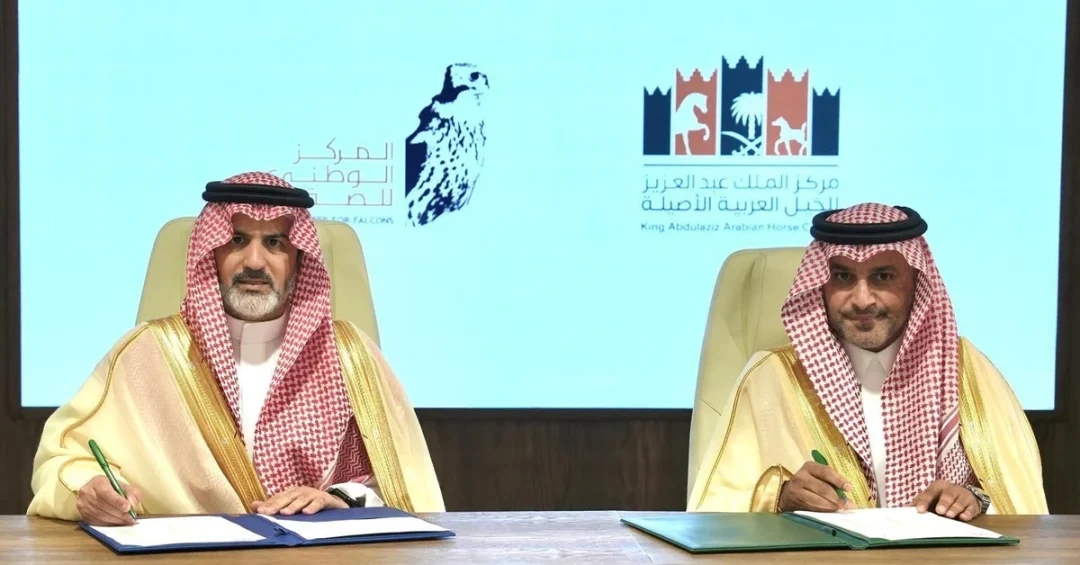
The King Abdulaziz Arabian Horse Center and the National Center for Falcons signed a cooperation agreement on the sidelines of the International Saudi Falcons and Hunting Exhibition 2026 in Riyadh, establishing a formal partnership to preserve the cultural heritage associated with purebred Arabian horses and falcons as authentic components of Saudi national identity. The agreement was signed by Abdulaziz Almuqbil, Director General of the King Abdulaziz Arabian Horse Center, and Ahmed Al-Hababi, Deputy Chief Executive Officer of the National Center for Falcons, according to the Saudi Press Agency. The partnership covers cooperation in events and programs of mutual interest, the development of heritage initiatives, media cooperation, and the exchange of knowledge and expertise between the two institutions.
The signing took place during one of the Kingdom’s most prominent cultural gatherings, the International Saudi Falcons and Hunting Exhibition 2026, an annual event that draws participants, exhibitors, and visitors from across Saudi Arabia and beyond. The timing underscores a broader national effort to institutionalize the protection of heritage traditions that have shaped Arabian life for centuries. Could there be a more fitting setting for two heritage-focused organizations to formalize their shared mission? The agreement reflects a growing recognition that falconry and Arabian horse breeding are not merely pastimes but living expressions of identity that require coordinated, long-term stewardship.
Context and Background
Why do Arabian horses and falcons occupy such a privileged place in Saudi culture, and why is their preservation treated as a matter of national importance? For generations, the Arabian horse has been celebrated for its endurance, intelligence, and beauty, earning recognition as one of the oldest and most admired horse breeds in the world. Falconry, meanwhile, has served as a traditional hunting practice and a symbol of patience, skill, and connection to the desert environment. Together, they represent a heritage that predates modern boundaries and continues to resonate in contemporary Saudi life.
The King Abdulaziz Arabian Horse Center has long played a central role in breeding, registering, and promoting purebred Arabian horses, while the National Center for Falcons works to regulate and develop falconry activities, support falconers, and preserve related traditions. Both institutions operate under the umbrella of official Saudi cultural and environmental policy, and both have been active in organizing exhibitions, competitions, and educational programs. Their decision to cooperate formally signals a desire to move beyond isolated efforts toward an integrated approach that benefits from shared resources and combined expertise.
The International Saudi Falcons and Hunting Exhibition 2026 provided a natural platform for the announcement, as it brings together falconers, breeders, heritage enthusiasts, and international participants. The event has grown in stature in recent years, reflecting the Kingdom’s broader investment in cultural tourism and heritage programming. By signing the agreement at the exhibition, the two centers highlighted the practical link between public events and long-term institutional collaboration.
Key Details of the Agreement
What exactly does the cooperation agreement commit the two centers to achieve? According to official statements, the agreement covers cooperation in events and programs of mutual interest, the development of heritage initiatives, media cooperation, and the exchange of knowledge and expertise. This scope suggests a practical working relationship rather than a symbolic gesture, with joint activities likely to include exhibitions, educational workshops, and promotional campaigns that highlight both Arabian horses and falcons.
Abdulaziz Almuqbil, Director General of the King Abdulaziz Arabian Horse Center, said the agreement reflects the center’s commitment to expanding cooperation to serve Arabian horse heritage and to introduce its historical and cultural value to future generations. He added that the partnership opens new avenues for joint initiatives bringing together Arabian horses and falconry, implying that audiences may see combined programming that presents both traditions side by side.
Ahmed Al-Hababi, Deputy Chief Executive Officer of the National Center for Falcons, noted that the agreement establishes a framework for developing programs and events that leverage both entities’ capabilities, presenting the heritage linked to falcons and Arabian horses through renewed content. His remarks point to an emphasis on modern presentation and storytelling, ensuring that age-old traditions remain accessible and appealing to younger Saudis and international audiences alike.
Preserving Heritage for Future Generations
How can heritage traditions remain vibrant in a rapidly modernizing society? The answer, according to the two centers, lies in education, participation, and thoughtful presentation. By joining forces, the King Abdulaziz Arabian Horse Center and the National Center for Falcons can reach broader audiences through coordinated media campaigns and shared platforms. This is particularly important as Saudi Arabia undergoes significant social and economic transformation under Vision 2030, which seeks to diversify the economy while preserving cultural identity.
Heritage preservation in this context is not about resisting change but about ensuring that change remains rooted in authentic values. Arabian horses and falcons are living symbols that connect modern Saudis to their ancestors, and the agreement aims to keep those symbols meaningful. Joint initiatives could include school programs, public competitions, and digital content that explains the history and significance of both traditions. Such efforts align with a wider national strategy to document and celebrate Saudi heritage.
The involvement of both centers also ensures that preservation efforts are informed by specialized knowledge. The horse center brings expertise in breeding, veterinary care, and equestrian events, while the falcon center contributes deep understanding of falconry techniques, regulations, and conservation. Combining these strengths can produce richer, more credible programs than either institution could deliver alone.
International and Regional Impact
What does this partnership signal to the wider region and the international community? Saudi Arabia has increasingly positioned itself as a global hub for heritage and cultural exchange, hosting events that attract visitors from the Gulf, the broader Middle East, and beyond. The cooperation between the two centers reinforces that positioning by demonstrating a structured approach to cultural preservation that other countries can observe and potentially emulate.
Falconry and Arabian horse breeding are shared traditions across the Arabian Peninsula and parts of North Africa and Central Asia. Regional cooperation in these fields can foster goodwill and cultural diplomacy, creating common ground among nations that value similar heritage. The agreement may also encourage international participation in Saudi exhibitions and competitions, boosting tourism and cross-cultural understanding.
For international audiences, the partnership offers a clear example of how Saudi Arabia integrates tradition with modernization. Rather than viewing heritage as a static relic, the Kingdom presents it as a dynamic part of national life, supported by institutions, events, and policies. This narrative aligns with the country’s broader efforts to project a welcoming and culturally rich image to the world.
Economic and Strategic Significance
How does heritage preservation contribute to economic and strategic goals? Cultural and heritage activities can generate tangible economic benefits through tourism, event hosting, and related industries. The International Saudi Falcons and Hunting Exhibition 2026 itself is a case in point, drawing exhibitors and visitors who spend on travel, accommodation, and local goods. By strengthening cooperation, the two centers can help expand such events and enhance their appeal.
Arabian horse breeding and falconry also support specialized markets, including veterinary services, equipment, and luxury goods. A coordinated approach can improve standards, attract investment, and create opportunities for Saudi entrepreneurs. Strategically, the partnership reinforces national identity and social cohesion, which are essential foundations for sustainable development. When citizens feel connected to their heritage, they are more likely to engage positively with modernization efforts.
Moreover, the agreement supports the Kingdom’s goal of becoming a destination for cultural tourism. Visitors interested in equestrian sports, falconry, and desert traditions represent a niche but growing market. By presenting these traditions through well-organized programs, Saudi Arabia can differentiate itself from other tourism destinations and offer authentic experiences rooted in local culture.
Vision 2030 Alignment
How does this agreement connect to Saudi Arabia’s long-term national plan? Vision 2030 emphasizes the importance of preserving cultural heritage as part of a balanced approach to development. The vision recognizes that economic diversification and social progress should not come at the expense of identity. The partnership between the King Abdulaziz Arabian Horse Center and the National Center for Falcons directly supports this principle by institutionalizing cooperation in heritage preservation.
The agreement also aligns with Vision 2030’s focus on enhancing quality of life, promoting tourism, and empowering cultural institutions. By working together, the two centers can contribute to a more cohesive cultural ecosystem that benefits citizens, residents, and visitors. Their efforts help ensure that future generations inherit not only a modern economy but also a living connection to the traditions that define Saudi Arabia.
In the final analysis, the signing at the International Saudi Falcons and Hunting Exhibition 2026 represents more than a bureaucratic arrangement. It reflects a strategic decision to treat heritage as a national asset deserving coordinated care. As Saudi Arabia continues its transformation, partnerships like this one will help keep the past present, ensuring that Arabian horses and falcons remain enduring symbols of the Kingdom’s identity and pride.
20 Questions
Q1. What is the main purpose of the agreement between the King Abdulaziz Arabian Horse Center and the National Center for Falcons?
A1. The agreement aims to strengthen joint efforts in preserving the cultural heritage associated with purebred Arabian horses and falcons, which are considered authentic components of Saudi national identity.
Q2. Who signed the cooperation agreement on behalf of the two centers?
A2. The agreement was signed by Abdulaziz Almuqbil, Director General of the King Abdulaziz Arabian Horse Center, and Ahmed Al-Hababi, Deputy Chief Executive Officer of the National Center for Falcons.
Q3. Where was the agreement signed?
A3. It was signed on the sidelines of the International Saudi Falcons and Hunting Exhibition 2026, a major heritage event held in Saudi Arabia.
Q4. What areas of cooperation does the agreement cover?
A4. It covers cooperation in events and programs of mutual interest, the development of heritage initiatives, media cooperation, and the exchange of knowledge and expertise between the two institutions.
Q5. Why are Arabian horses significant to Saudi culture?
A5. Arabian horses are celebrated for their endurance, intelligence, and beauty, and they represent a centuries-old tradition that is deeply tied to Saudi and Arabian identity.
Q6. Why are falcons important in Saudi heritage?
A6. Falcons and falconry symbolize patience, skill, and a connection to the desert environment, and they have been part of Arabian culture for generations.
Q7. What did Abdulaziz Almuqbil say about the agreement?
A7. He said it reflects the center’s commitment to expanding cooperation to serve Arabian horse heritage and to introduce its historical and cultural value to future generations.
Q8. What did Ahmed Al-Hababi say about the partnership?
A8. He noted that the agreement establishes a framework for developing programs and events that leverage both entities’ capabilities, presenting heritage through renewed content.
Q9. How does this agreement benefit future generations?
A9. By coordinating educational programs, media campaigns, and public events, the centers can ensure that young Saudis and international audiences understand and appreciate these traditions.
Q10. What is the role of the King Abdulaziz Arabian Horse Center?
A10. The center works to breed, register, and promote purebred Arabian horses, and it organizes events and initiatives that highlight the breed’s historical and cultural value.
Q11. What is the role of the National Center for Falcons?
A11. The center regulates and develops falconry activities, supports falconers, and works to preserve the traditions and knowledge associated with falcons.
Q12. How does the agreement support Saudi Vision 2030?
A12. It aligns with Vision 2030’s emphasis on preserving cultural heritage, enhancing quality of life, and promoting cultural tourism as part of balanced national development.
Q13. What is the International Saudi Falcons and Hunting Exhibition?
A13. It is an annual event that brings together falconers, breeders, heritage enthusiasts, and international participants to celebrate and showcase traditional Saudi heritage.
Q14. Will the agreement lead to joint events?
A14. Yes, the agreement covers cooperation in events and programs of mutual interest, suggesting that joint exhibitions, workshops, and competitions may be developed.
Q15. How does media cooperation fit into the agreement?
A15. Media cooperation will help both centers share knowledge, promote heritage initiatives, and present Arabian horses and falcons to broader audiences through coordinated content.
Q16. What economic benefits can result from this partnership?
A16. It can boost cultural tourism, support specialized markets such as veterinary services and equipment, and attract visitors to heritage events, contributing to economic diversification.
Q17. How does this partnership affect Saudi Arabia’s international image?
A17. It reinforces the Kingdom’s image as a country that values and preserves its heritage while modernizing, and it supports cultural diplomacy and international engagement.
Q18. Are these traditions only for Saudis?
A18. No, falconry and Arabian horse breeding are shared traditions across the region and beyond, and the centers aim to present them to international audiences as well.
Q19. What makes this agreement different from previous efforts?
A19. It formalizes cooperation between two specialized national institutions, creating a structured framework for joint initiatives rather than isolated, ad hoc activities.
Q20. What is the expected long-term outcome of the agreement?
A20. The partnership is expected to ensure that Arabian horse and falcon heritage remains vibrant, accessible, and appreciated by future generations in Saudi Arabia and around the world.
Reader Feedback
We value your thoughts. Please share your feedback on this article.
Your feedback helps us improve our coverage.