


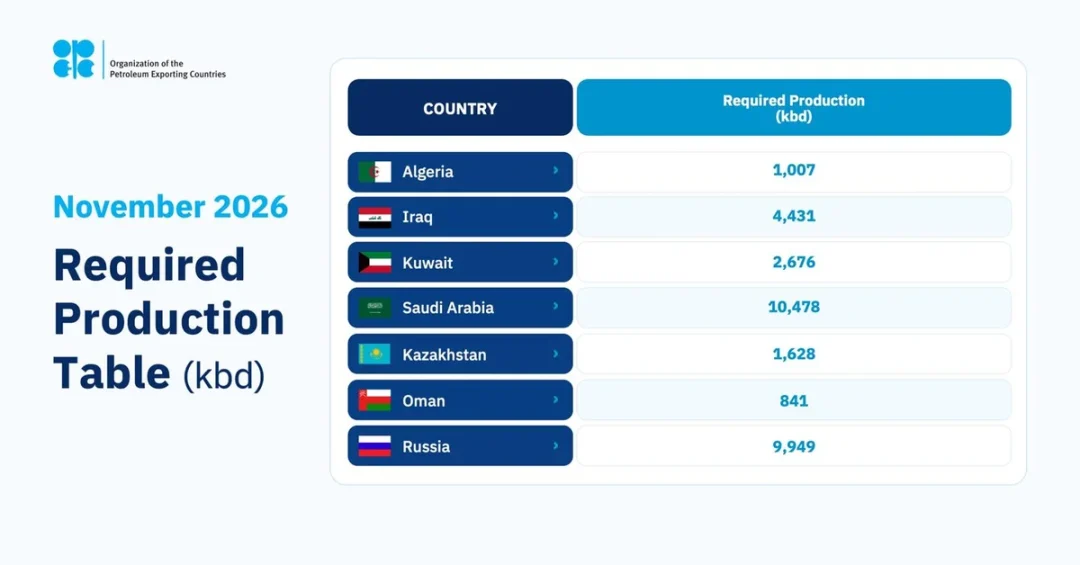
Seven OPEC+ countries reaffirmed their collective commitment to oil market stability during a virtual meeting on October 4, 2026, deciding to maintain September 2026 production levels for November 2026. The participating nations—Saudi Arabia, Russia, Iraq, Kuwait, Kazakhstan, Algeria, and Oman—reviewed global market conditions and outlook before confirming their continued adherence to the Declaration of Cooperation, according to the Saudi Press Agency (SPA). The decision underscores the group’s coordinated approach to balancing supply and demand amid ongoing global economic uncertainties.
Have you ever wondered how a single meeting of seven nations can ripple through the global economy? This latest gathering, held via videoconference, demonstrates the enduring influence of OPEC+ on energy markets. By keeping production steady, the group signals its resolve to avoid abrupt price swings that could harm both producers and consumers. The move aligns with Saudi Arabia’s broader strategy of fostering stability and predictability in global energy markets, a cornerstone of its Vision 2030 economic diversification plan. The meeting concluded with a pledge to reconvene on November 1, 2026, ensuring continued vigilance.
Context and Background
Why do these seven countries hold such sway over global oil prices? The answer lies in their combined production capacity and their history of voluntary adjustments. In April and November 2023, these same nations announced additional voluntary production cuts to support market stability. Those decisions were part of the broader OPEC+ framework, which includes all 23 member countries but allows a smaller group to make discretionary adjustments. The seven countries—Saudi Arabia, Russia, Iraq, Kuwait, Kazakhstan, Algeria, and Oman—have since met monthly to review conditions and adjust output as needed. Their actions are closely watched by traders, policymakers, and analysts worldwide.
The October 4 meeting was no exception. According to the Saudi Press Agency, the group reviewed global market conditions and outlook before deciding to maintain September 2026 required production for November 2026. This continuity provides certainty to markets, which often react nervously to any hint of change. The decision reflects a careful assessment of supply and demand dynamics, including factors such as economic growth in major consuming nations, geopolitical tensions, and the pace of the energy transition. By holding steady, the group aims to prevent a supply glut or shortage that could destabilize prices.
What does the Declaration of Cooperation actually entail? This agreement, signed in 2016 and later expanded, binds OPEC and non-OPEC producers to coordinate production levels. It has been credited with helping to stabilize oil markets during periods of extreme volatility, such as the 2020 pandemic-induced crash. The seven countries reiterated their commitment to full conformity with the Declaration, meaning they will adhere to their agreed quotas. This collective discipline is essential for the group’s credibility and effectiveness. Without it, individual nations might be tempted to cheat and boost output unilaterally, undermining the entire effort.
Key Details of the October 4 Meeting
What exactly was decided, and why does it matter? The virtual meeting brought together representatives from the seven countries to assess current market conditions. After deliberations, they opted to keep November 2026 production at the same level as September 2026. This decision was detailed in a table released by SPA, though the specific figures were not included in the original announcement. The group also emphasized their collective commitment to achieve full conformity with the Declaration of Cooperation. This means each country will continue to produce according to its assigned quota, ensuring that the overall supply target is met.
The meeting concluded with an agreement to hold monthly meetings to review market conditions. The next gathering is scheduled for November 1, 2026. This regular schedule allows the group to respond swiftly to any changes in the global landscape. For instance, if demand surges unexpectedly, they can adjust production upward; if a new wave of COVID-19 or a geopolitical crisis threatens demand, they can cut output. Such flexibility is vital in a world where energy markets are increasingly influenced by factors beyond traditional supply and demand, such as climate policies and technological shifts.
Why is Saudi Arabia’s role in this group so pivotal? As the world’s largest exporter of crude oil and the de facto leader of OPEC, Saudi Arabia plays a central role in shaping the group’s decisions. Its production capacity and spare capacity give it unique leverage. The Kingdom’s Minister of Energy, Prince Abdulaziz bin Salman, has consistently advocated for a balanced approach that considers the interests of both producers and consumers. Under his leadership, Saudi Arabia has worked to build consensus among diverse members, from Russia to Algeria. This diplomatic effort is part of the Kingdom’s broader foreign policy, which seeks to maintain stable energy markets and strengthen its global standing.
International and Regional Impact
How will this decision affect the global economy? By maintaining production levels, the seven countries aim to keep oil prices within a range that supports their own budgets without stifling economic growth in consuming nations. Higher oil prices can boost revenues for producers, but they can also fuel inflation and slow down economies in Europe, Asia, and the Americas. Conversely, too low prices can lead to underinvestment in new production, setting the stage for future shortages. The group’s steady hand is therefore a balancing act that benefits both sides. Analysts often praise OPEC+ for its role in preventing extreme volatility, which helps businesses plan and consumers budget.
What are the regional implications, particularly for the Middle East? For Saudi Arabia and its Gulf neighbors like Kuwait and Oman, stable oil prices are essential for funding ambitious economic diversification programs. Saudi Arabia’s Vision 2030, for example, relies on oil revenues to finance mega-projects like NEOM and the Red Sea Project. Kuwait and Oman have similar diversification plans. Iraq, which is heavily dependent on oil exports, also benefits from predictable prices. On the other hand, Russia, a non-OPEC member but a key participant in the OPEC+ alliance, uses oil revenues to support its budget amid international sanctions. Kazakhstan and Algeria, too, rely on hydrocarbons for a significant portion of their income. The group’s unity thus serves a shared economic interest.
Could this decision influence geopolitics beyond energy? Yes, indirectly. The cooperation between Saudi Arabia and Russia within OPEC+ has been a notable feature of international relations, demonstrating that dialogue and collaboration can transcend other geopolitical tensions. This energy partnership has helped to stabilize relations between the two countries, even as they support opposing sides in some regional conflicts. For the United States and other Western nations, the group’s actions are closely monitored, as they impact inflation and energy security. The Biden administration, for instance, has previously called on OPEC+ to increase production to lower prices, but the group has often prioritized market stability over political pressure. This independence underscores the growing multipolar nature of global energy governance.
Economic and Strategic Significance
What does this mean for the oil market in the coming months? The decision to maintain production provides a clear signal that the group is not rushing to flood the market. With global demand recovering from the pandemic but facing headwinds from inflation and slowing growth in China, a cautious approach is warranted. The International Energy Agency (IEA) has warned of potential supply shortages if investment in new production remains low. OPEC+’s steady policy helps to bridge the gap between supply and demand, preventing price spikes that could derail the global recovery. Moreover, the group’s monthly meetings allow for quick adjustments if conditions change, offering a flexible framework that is more responsive than fixed annual quotas.
How does this align with Saudi Arabia’s long-term economic strategy? The Kingdom is investing heavily in renewable energy and other sectors to reduce its dependence on oil, but in the near term, oil remains the backbone of its economy. Stable prices enable the government to plan budgets effectively and fund Vision 2030 initiatives. Saudi Aramco, the state-owned oil giant, is also pursuing a strategy to increase production capacity and reduce carbon emissions. By working within OPEC+, Saudi Arabia can influence global markets while also pursuing its own energy transition goals. The Kingdom’s leadership in the group enhances its geopolitical influence, positioning it as a responsible global energy supplier and a stabilizing force.
What are the risks if the group fails to maintain unity? History shows that when OPEC members cheat on quotas, prices can collapse. In 2020, a price war between Saudi Arabia and Russia briefly sent oil prices negative, causing economic pain worldwide. The memory of that episode reinforces the importance of conformity. The seven countries’ reaffirmation of their commitment is therefore not just a formality; it is a crucial confidence-building measure. It tells markets that the group is serious about its pledges. If discipline holds, the group can continue to manage supply effectively and support a stable investment climate in the energy sector.
Vision 2030 Alignment
How does this OPEC+ decision connect to Saudi Arabia’s Vision 2030? Vision 2030 is an ambitious plan to diversify the Saudi economy, reduce its reliance on oil, and create a vibrant society. However, the transition requires massive investments, and oil revenues provide the necessary capital. Stable oil prices, therefore, are a prerequisite for the success of Vision 2030. The Kingdom’s leadership in OPEC+ helps to secure those revenues while also demonstrating its commitment to global economic stability. This dual role—as a reliable energy supplier and a modernizing nation—enhances Saudi Arabia’s international standing and attracts foreign investment. The October 4 meeting is a testament to the Kingdom’s proactive diplomacy and its ability to bring together diverse nations for a common goal.
What can we expect next? The next meeting on November 1, 2026, will provide another opportunity for the group to assess conditions and adjust if necessary. Saudi Arabia will continue to play a leading role in these discussions, advocating for a balanced approach that serves both producers and consumers. As the world transitions to cleaner energy, OPEC+ will remain a key player in ensuring that the transition is smooth and equitable. For Saudi Arabia, this means leveraging its oil wealth to build a diversified, sustainable economy that can thrive in a post-oil era. The Kingdom’s commitment to market stability is not just about oil; it is about building a prosperous future for its people and contributing to global prosperity.
20 Questions
Q1. What did the seven OPEC+ countries decide during their October 4, 2026 meeting?
A1. They decided to maintain September 2026 required production levels for November 2026, reinforcing their commitment to market stability and the Declaration of Cooperation.
Q2. Which countries participated in the virtual meeting?
A2. Saudi Arabia, Russia, Iraq, Kuwait, Kazakhstan, Algeria, and Oman participated in the meeting, representing a key subset of the OPEC+ alliance.
Q3. Why do these seven countries meet separately from the broader OPEC+ group?
A3. They previously announced additional voluntary adjustments in April and November 2023, and they continue to coordinate monthly to review market conditions and adjust production as needed.
Q4. What is the Declaration of Cooperation?
A4. It is an agreement signed in 2016 that binds OPEC and non-OPEC producers to coordinate production levels to stabilize oil markets.
Q5. How does this decision affect global oil prices?
A5. By keeping production steady, the group aims to prevent price volatility, supporting both producers and consumers with predictable energy costs.
Q6. When is the next meeting scheduled?
A6. The next meeting will be held on November 1, 2026, as part of the group’s monthly review process.
Q7. What role does Saudi Arabia play in these discussions?
A7. As the world’s largest oil exporter and OPEC’s de facto leader, Saudi Arabia plays a pivotal role in shaping consensus and advocating for balanced market policies.
Q8. How does this align with Saudi Arabia’s Vision 2030?
A8. Stable oil revenues are crucial for funding Vision 2030’s economic diversification projects, making market stability a key enabler of the Kingdom’s long-term goals.
Q9. What are the risks if OPEC+ members do not comply with quotas?
A9. Non-compliance can lead to oversupply, price crashes, and loss of credibility, as seen in past episodes like the 2020 price war.
Q10. How does this decision impact consumers?
A10. It helps keep fuel prices stable, which supports household budgets and business planning, while avoiding sharp spikes that can fuel inflation.
Q11. What economic challenges are currently facing the global oil market?
A11. Challenges include slowing demand growth in China, inflationary pressures, and geopolitical uncertainties, all of which the group monitors closely.
Q12. How does Russia’s participation affect the group’s dynamics?
A12. Russia’s inclusion strengthens the group’s influence, as it is one of the world’s top oil producers, and its cooperation with Saudi Arabia has been a stabilizing factor.
Q13. What is the significance of the monthly meetings?
A13. They allow the group to respond quickly to changing market conditions, providing flexibility that is more effective than fixed annual quotas.
Q14. How does this decision affect investment in the oil sector?
A14. Stable prices encourage investment in new production, which is necessary to meet future demand and avoid supply shortages.
Q15. What is Saudi Arabia’s spare production capacity, and why does it matter?
A15. Saudi Arabia holds significant spare capacity, which can be tapped to stabilize markets during disruptions, enhancing its role as a swing producer.
Q16. How do other oil-producing nations outside OPEC+ view this decision?
A16. They generally welcome stability, as it prevents price wars, though some may seek to increase their own market share opportunistically.
Q17. What impact does this have on renewable energy investment?
A17. Stable oil prices provide a predictable environment for renewable energy investments, as they reduce uncertainty and allow for long-term planning.
Q18. How does the group ensure compliance with production quotas?
A18. Compliance is monitored through regular reporting and peer pressure, with the group’s credibility depending on collective adherence to agreed levels.
Q19. What can we expect from the November 1 meeting?
A19. The group will review updated market data and may adjust production if conditions warrant, continuing their proactive approach to market management.
Q20. Why is market stability important for the global economy?
A20. Stable oil prices support economic growth by keeping energy costs predictable, which helps businesses and consumers alike, and prevents disruptive shocks.
Reader Feedback
We value your thoughts. Please share your feedback on this article.
Your feedback helps us improve our coverage.
Related articles
 First International Gifts and Products Exhibition Opens in Jeddah
 IsDB and AfDB Strengthen Africa Development Partnership
 Saudi Business Revenues Rise 2.3% to SAR5.628B in 2025
 Commercial Transactions Law Strengthens Saudi Contractual Stability
 AlUla Date Harvest Nears End as Auction Runs to Nov 15
 Oil Prices Decline as Brent Falls to $114.50, WTI to $101.74