


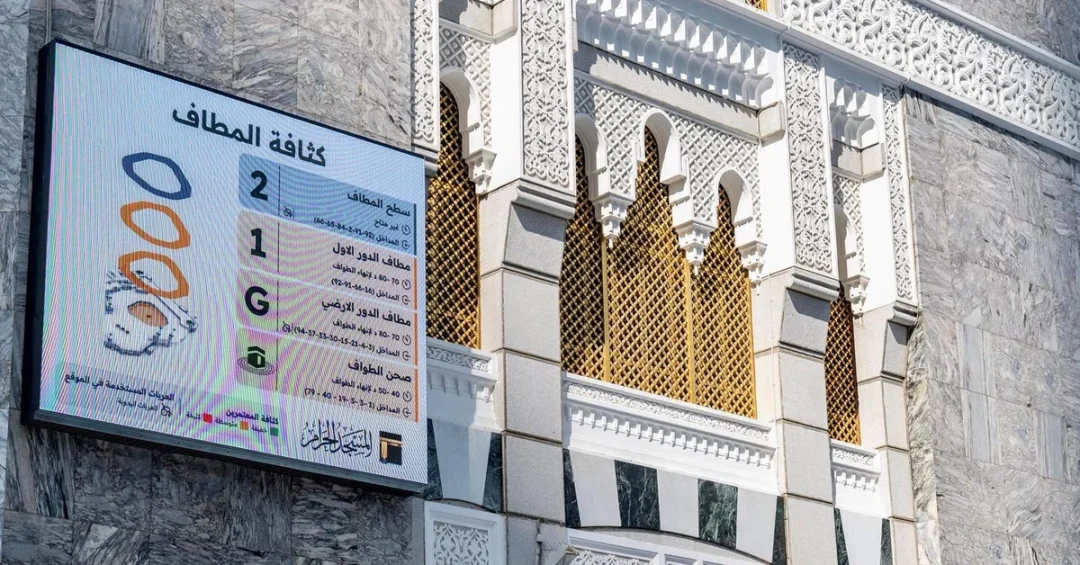
Digital services at the Grand Mosque in Makkah now enable worshippers to monitor crowd density in the Tawaf and Sa’i areas through live displays, real-time updates, and smart indicators that highlight less crowded times, making it easier to move between rituals and complete acts of worship with greater comfort. The service, announced via official Saudi channels, forms part of a broader package of smart navigation tools deployed across the Two Holy Mosques, giving visitors instant visibility of conditions on the ground before and during their visit.
Have you ever wondered how millions of pilgrims move through the same sacred spaces each year without disruption? The answer increasingly lies in technology. Alongside the crowd-density displays, an interactive map of the Two Holy Mosques allows worshippers to explore notable landmarks, facilities, locations, and routes, enhancing navigation and the overall visitor experience. The map features approximately 950 points of interest, including the Holy Kaaba, Maqam Ibrahim, Safa and Marwa, Al-Rawdah Al-Sharifah, the Prophet’s Chamber, prayer niches, and the Prophet’s Pulpit. Together, these tools represent a quiet but significant leap in how the Kingdom cares for the guests of the Two Holy Mosques.
Context and Background
Why does crowd management at the Grand Mosque matter so much on the global stage? The Two Holy Mosques host some of the largest recurring gatherings of people anywhere on earth, and the rituals of Tawaf — circling the Holy Kaaba — and Sa’i — walking between Safa and Marwa — sit at the heart of the pilgrimage experience. Managing the flow of worshippers in these specific areas has long been a central operational priority for the Kingdom, and digital tools now complement decades of on-the-ground planning, staffing, and infrastructure investment.
The new service builds on a sustained programme of smart-service expansion led by the General Authority for the Care of the Affairs of the Grand Mosque and the Prophet’s Mosque. That body has steadily introduced digital platforms designed to improve accessibility, wayfinding, and visitor satisfaction across both holy sites. The latest additions, released through official Saudi channels, extend this approach by placing real-time information directly in the hands of worshippers, rather than reserving it for operations rooms alone.
For an international audience, the significance is straightforward: the Kingdom is applying the same technological ambition seen in its broader modernization drive to the most sensitive and sacred environment it manages. The result is a pilgrim experience that is calmer, more predictable, and better supported at every stage of the journey.
Key Details of the Digital Service
What exactly can a worshipper see and do with these tools? The platform provides live displays and real-time updates on crowd density in the Tawaf and Sa’i areas, with indicators that highlight less crowded times. That means a visitor can plan when to perform the rituals, avoid peak congestion, and move more freely between the Holy Kaaba, Maqam Ibrahim, and the paths connecting Safa and Marwa. The information is presented clearly and continuously, supporting spontaneous decisions rather than requiring advance planning.
The interactive map goes considerably further. It offers approximately 950 points of interest across the Two Holy Mosques, covering landmarks, facilities, and services. Worshippers can explore routes and locations, identify prayer niches and the Prophet’s Pulpit, and locate Al-Rawdah Al-Sharifah and the Prophet’s Chamber with confidence. The platform also provides over 100,000 potential routes, categorized into more than 17 different types, so that visitors with different needs and starting points can find a suitable path.
Accessibility is woven throughout. More than 650 QR codes are deployed for easy access to information, and more than six interactive screens are available on-site for navigation, including accessible routes and facilities for persons with disabilities. These on-site screens matter for visitors who may not be carrying a smartphone or who prefer a fixed point of reference. Each element reinforces the others, creating a layered navigation system rather than a single app.
How Worshippers Benefit in Practice
How does real-time information change the experience of a pilgrim who may have travelled thousands of kilometres? For many visitors, the greatest anxiety is uncertainty: not knowing how crowded a space will be, how long a route will take, or where a needed facility is located. Live crowd-density indicators remove much of that uncertainty. By showing less crowded times, the service allows worshippers to choose moments of greater calm, which supports both physical comfort and spiritual focus.
The route categorization is equally practical. With more than 17 types of routes and over 100,000 potential paths mapped, the platform can guide a visitor from a specific gate to a specific destination while accounting for accessibility needs. A wheelchair user, an elderly pilgrim, or a family with young children can each be directed along a suitable path. QR codes placed around the site make this information available instantly, without requiring prior downloads or sign-ups.
Taken together, these features reflect a deliberate philosophy: technology should serve the worshipper invisibly, removing friction without intruding on the spiritual purpose of the visit. The interactive screens and live displays are positioned to assist at the moment of need, while the map and route data support planning beforehand. The effect is a visit that feels guided rather than crowded.
International and Regional Impact
Why should observers outside the Kingdom pay attention to a navigation platform in Makkah? Because the Two Holy Mosques welcome pilgrims from virtually every country, the quality of their experience shapes perceptions of Saudi Arabia worldwide. A smoother, better-organized visit leaves a lasting impression on millions of international guests each year, and those impressions travel home with them. In this sense, smart services are also a form of public diplomacy.
Regionally, the initiative reinforces the Kingdom’s position as the custodian of Islam’s holiest sites and as a leader in large-scale crowd management. Managing millions of people safely and respectfully is a logistical challenge few nations face. The digital tools announced via official channels demonstrate that Saudi Arabia continues to invest in solutions that other countries managing major religious or cultural gatherings may study with interest.
The emphasis on accessibility for persons with disabilities also carries international resonance, aligning with global expectations around inclusive design. By publishing route types and accessible facilities through the platform, the Kingdom signals that the guest experience is being designed for everyone, not only for the able-bodied majority.
Economic and Strategic Significance
What does this mean for the Kingdom’s wider economic ambitions? Pilgrimage is a major component of Saudi Arabia’s visitor economy, and the Kingdom has set ambitious targets for the number of pilgrims it can host. Raising capacity is not only a matter of physical space; it also requires smarter management of existing space. Digital crowd-monitoring and navigation tools effectively increase the usable capacity of the Grand Mosque by spreading visits more evenly across the day and directing people along efficient routes.
Better experiences also support repeat visitation and positive word of mouth, which matter for the broader tourism ecosystem around Makkah and Madinah, including hotels, transport, and retail. When worshippers can plan with confidence, they are more likely to extend stays and explore beyond the ritual areas. The service therefore contributes indirectly to the wider goal of growing the pilgrimage economy in a sustainable, well-managed way.
Strategically, the platform demonstrates the Kingdom’s ability to deploy advanced digital infrastructure in the most demanding environments. Real-time data, interactive mapping, and on-site screens require robust connectivity, integration, and maintenance. Delivering these reliably at the Two Holy Mosques is a capability statement that extends well beyond the religious context.
Vision 2030 Alignment
How does a crowd-density display connect to Saudi Arabia’s long-term national plan? Vision 2030 calls for a modern, digitally enabled economy and a society that delivers a high quality of life, and it places the service of the Two Holy Mosques’ guests among the Kingdom’s most honoured responsibilities. The new digital services embody that combination directly: advanced technology applied to a sacred duty, improving the experience of millions while showcasing Saudi capability.
The initiative also reflects Vision 2030’s focus on accessibility and inclusion, ensuring that persons with disabilities can participate fully in the pilgrimage. As the General Authority for the Care of the Affairs of the Grand Mosque and the Prophet’s Mosque continues to expand smart services, worshippers can expect further improvements in navigation, information access, and comfort. For international observers, the message is clear: Saudi Arabia is investing in the future of the pilgrimage experience with the same seriousness it brings to every other element of its national transformation, and the guests of the Two Holy Mosques remain at the centre of that effort.
20 Questions
Q1. What does the new digital service at the Grand Mosque allow worshippers to do?
A1. It enables worshippers to monitor crowd density in the Tawaf and Sa’i areas through live displays, real-time updates, and indicators that highlight less crowded times, making movement and worship easier.
Q2. Which Saudi body is responsible for these smart services?
A2. The General Authority for the Care of the Affairs of the Grand Mosque and the Prophet’s Mosque leads the expansion of these services, reflecting its commitment to improving accessibility and visitor satisfaction.
Q3. How many points of interest does the interactive map feature?
A3. The interactive map of the Two Holy Mosques features approximately 950 points of interest, including the Holy Kaaba, Maqam Ibrahim, Safa and Marwa, Al-Rawdah Al-Sharifah, the Prophet’s Chamber, prayer niches, and the Prophet’s Pulpit.
Q4. What landmarks can worshippers locate using the interactive map?
A4. Worshippers can locate the Holy Kaaba, Maqam Ibrahim, Safa and Marwa, Al-Rawdah Al-Sharifah, the Prophet’s Chamber, prayer niches, and the Prophet’s Pulpit, along with facilities and routes.
Q5. How many potential routes does the platform provide?
A5. The platform provides over 100,000 potential routes, categorized into more than 17 different types, helping visitors with varying needs find suitable paths through the holy sites.
Q6. How are routes categorized on the platform?
A6. Routes are organized into more than 17 different types, allowing the system to match worshippers with appropriate paths based on their starting points, destinations, and accessibility requirements.
Q7. How many QR codes are available for accessing information?
A7. More than 650 QR codes are deployed to provide easy access to information, allowing worshippers to retrieve navigation details quickly while moving through the Two Holy Mosques.
Q8. What on-site tools support visitors who need navigation help?
A8. More than six interactive screens are available on-site for navigation, including accessible routes and facilities for persons with disabilities, complementing the digital map and live displays.
Q9. How does the service support persons with disabilities?
A9. The platform includes accessible routes and facilities for persons with disabilities, and the on-site interactive screens highlight these options so that all worshippers can navigate the holy sites comfortably.
Q10. What are the Tawaf and Sa’i areas?
A10. Tawaf is the ritual of circling the Holy Kaaba, while Sa’i is the walk between Safa and Marwa. Both are central elements of pilgrimage at the Grand Mosque in Makkah.
Q11. Why is crowd-density monitoring important in these areas?
A11. These areas host very large numbers of worshippers during peak periods, so real-time information about density helps spread visits more evenly, reduces congestion, and supports safer, more comfortable movement.
Q12. How does the service highlight less crowded times?
A12. Live displays and real-time updates include indicators that identify periods of lower crowd density, allowing worshippers to choose moments when the Tawaf and Sa’i areas are less busy.
Q13. Does the platform require advance registration to use?
A13. The service is designed for easy access, with QR codes placed around the site and interactive screens available on location, so worshippers can obtain information conveniently during their visit.
Q14. How does the interactive map enhance the visitor experience?
A14. By allowing worshippers to explore landmarks, facilities, locations, and routes, the map improves navigation and helps visitors move confidently between the different areas of the Two Holy Mosques.
Q15. What broader commitment do these initiatives reflect?
A15. They reflect the General Authority’s commitment to expanding smart services, improving accessibility, and enhancing visitor satisfaction at the Grand Mosque and the Prophet’s Mosque.
Q16. How do these tools support the Kingdom’s pilgrimage capacity goals?
A16. By spreading visits more evenly and directing worshippers along efficient routes, digital tools help make better use of existing space, effectively supporting the Kingdom’s ambitions to host greater numbers of pilgrims.
Q17. How does the service benefit international pilgrims?
A17. International pilgrims, who may be unfamiliar with the layout of the holy sites, gain clear guidance on routes, facilities, and crowd conditions, making their visit smoother and more focused on worship.
Q18. What role do the interactive screens play for visitors without smartphones?
A18. The on-site interactive screens provide a fixed, accessible point of reference where visitors can view navigation information, including accessible routes and facilities, without needing a personal device.
Q19. How does this initiative connect to Vision 2030?
A19. It reflects Vision 2030’s goals of digital modernization, inclusion, and high quality of life, applying advanced technology to the honoured duty of serving the guests of the Two Holy Mosques.
Q20. What can worshippers expect next from these smart services?
A20. The General Authority continues to expand smart services at the Two Holy Mosques, so worshippers can expect further improvements in navigation, information access, accessibility, and overall comfort during their visits.
Reader Feedback
We value your thoughts. Please share your feedback on this article.
Your feedback helps us improve our coverage.