


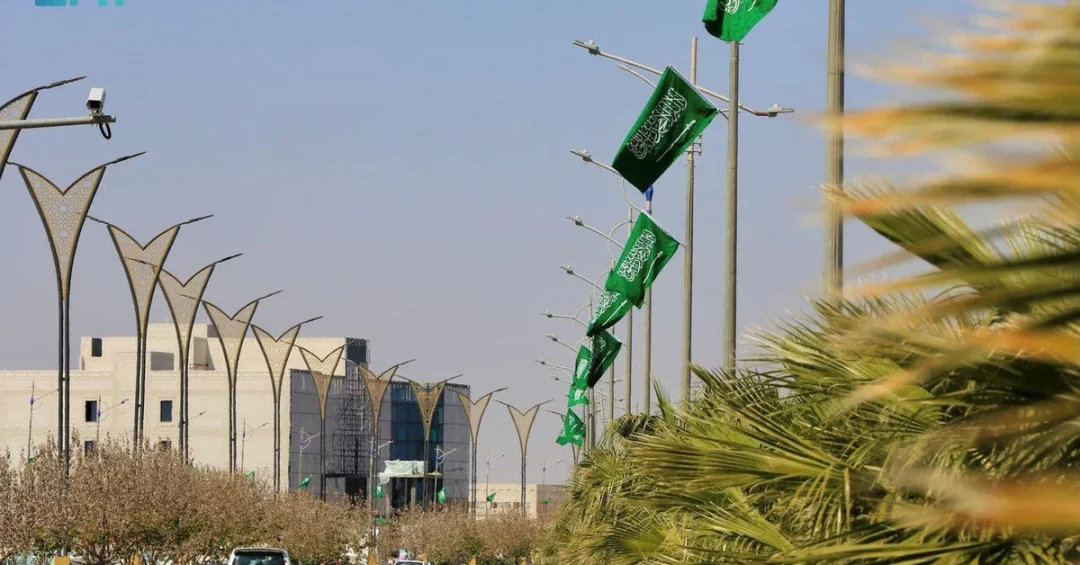
Al-Qurayyat Governorate has adorned its squares and streets with the Saudi national flag in celebration of Flag Day, observed annually on March 11, with the municipality distributing more than 1,100 flags across the city. The initiative, reported by the Saudi Press Agency (SPA), reflects the Kingdom’s commitment to reinforcing the values of loyalty and belonging under the banner of monotheism, as communities across Saudi Arabia mark the national occasion with pride and unity.
The display in Al-Qurayyat, located in the Northern Borders Province, is part of a nationwide observance that honors the history and symbolism of the Saudi flag. Have you ever considered how a simple piece of cloth can carry the weight of a nation’s identity, faith, and centuries of heritage? The flag of Saudi Arabia is unique in its design and meaning, bearing the Shahada, the Islamic declaration of faith, above a sword that symbolizes justice and strength. In Al-Qurayyat, the municipality’s efforts have transformed public spaces into vibrant expressions of national pride, ensuring that residents and visitors alike are reminded of the Kingdom’s enduring values. The distribution of over 1,100 flags demonstrates the local government’s dedication to fostering a sense of community and shared purpose, aligning with the broader national narrative of unity and progress under the leadership of the Custodian of the Two Holy Mosques, King Salman bin Abdulaziz Al Saud, and His Royal Highness Crown Prince Mohammed bin Salman.
Context and Background
Why does Saudi Arabia dedicate a specific day to its flag, and what does this occasion signify for the Kingdom’s people? Flag Day, established by royal decree in 2023, is celebrated on March 11 each year to commemorate the moment in 1937 when King Abdulaziz Al Saud approved the flag’s current design. This date holds historical significance as it marks the formal adoption of the flag that would accompany the Kingdom through its unification and subsequent development. The flag features a green background, the Shahada in white calligraphy, and a horizontal sword, symbolizing the rule of justice and the application of Islamic law. The choice of green is often associated with the banner of the Prophet Muhammad, peace be upon him, and represents the fertility and prosperity of the land.
The celebration in Al-Qurayyat is not an isolated event but part of a coordinated national effort to honor the flag and its symbolism. Across Saudi Arabia, municipalities, government agencies, and private organizations participate in activities that highlight the flag’s role in the nation’s history. In Al-Qurayyat, the municipality’s distribution of flags to streets and squares ensures that the occasion is visible and accessible to all residents. This grassroots approach to national celebration underscores the Kingdom’s emphasis on inclusivity and collective participation in national events. It also reflects the values of Vision 2030, which seeks to strengthen national identity and social cohesion while advancing economic and social reforms.
Key Details
What are the specific actions taken in Al-Qurayyat to mark Flag Day, and how do they contribute to the broader national celebration? According to the Saudi Press Agency, the Al-Qurayyat municipality distributed over 1,100 flags throughout the city, adorning squares and streets with the national emblem. This effort was designed to reinforce the values of loyalty and belonging under the banner of monotheism, a phrase that echoes the flag’s central message. The flags were strategically placed in public areas to maximize visibility and engagement, allowing residents to participate in the celebration simply by walking through their neighborhoods.
The initiative in Al-Qurayyat also included coordination with local schools, community centers, and youth organizations to educate the younger generation about the flag’s history and significance. These educational components are crucial for ensuring that the flag’s symbolism is passed down to future generations. By involving young people in the celebrations, the municipality fosters a deeper understanding of the Kingdom’s heritage and the principles upon which it was founded. The distribution of flags is a tangible expression of national pride, but it also serves as a reminder of the responsibilities that come with citizenship, including loyalty, respect for the law, and commitment to the nation’s progress.
International and Regional Impact
How does Saudi Arabia’s celebration of its flag resonate beyond its borders, and what does it say about the Kingdom’s role in the region? The flag of Saudi Arabia is not only a national symbol but also a representation of the Kingdom’s leadership in the Islamic world. As the custodian of the Two Holy Mosques, Saudi Arabia holds a unique position in the global Muslim community, and its flag is often seen as a symbol of Islamic unity and solidarity. The celebration of Flag Day, therefore, carries significance for Muslims around the world who look to the Kingdom for guidance and inspiration.
Regionally, the observance of Flag Day in Al-Qurayyat and other cities reinforces the Kingdom’s commitment to stability and prosperity in the Middle East. By promoting national unity and pride, Saudi Arabia demonstrates its ability to maintain social cohesion amid regional challenges. This internal strength is a cornerstone of the Kingdom’s foreign policy, enabling it to play a constructive role in international affairs, from peace initiatives to economic partnerships. The flag, in this context, becomes a symbol of Saudi Arabia’s resilience and its unwavering dedication to the well-being of its people and the broader region.
Economic and Strategic Significance
What economic and strategic benefits arise from national celebrations like Flag Day, and how do they align with Saudi Arabia’s long-term goals? Events such as Flag Day contribute to the local economy by increasing foot traffic in public areas, which can benefit nearby businesses and stimulate commercial activity. In Al-Qurayyat, the distribution of flags and the resulting decorations may attract visitors to the governorate, boosting tourism and highlighting the region’s cultural and historical attractions. The Northern Borders Province, where Al-Qurayyat is located, has been identified as a key area for development under Vision 2030, with investments in infrastructure, tourism, and renewable energy.
Strategically, Flag Day reinforces the sense of national identity that is essential for the successful implementation of Vision 2030. The ambitious plan to diversify the economy, reduce dependence on oil, and create a vibrant society relies on a united and motivated population. By celebrating the flag and its values, the Kingdom strengthens the social fabric that underpins economic transformation. Moreover, the occasion provides an opportunity to showcase Saudi Arabia’s rich heritage and modern achievements to the world, enhancing its image as a dynamic and forward-looking nation. The flag, therefore, is not just a symbol of the past but a beacon for the future.
Vision 2030 Alignment
How does the celebration of Flag Day in Al-Qurayyat reflect the core objectives of Vision 2030, and what does it reveal about Saudi Arabia’s trajectory? Vision 2030, launched by Crown Prince Mohammed bin Salman in 2016, aims to transform Saudi Arabia into a global investment powerhouse and a hub for innovation, while preserving its cultural and religious heritage. Flag Day celebrations are a manifestation of the Vision’s emphasis on national identity and social cohesion. The distribution of flags in Al-Qurayyat is a small but meaningful example of how local initiatives can contribute to the larger national project. By engaging communities in national celebrations, the Kingdom fosters a sense of ownership and participation that is vital for the success of Vision 2030.
Furthermore, the observance of Flag Day highlights the Kingdom’s commitment to education and youth empowerment, two pillars of Vision 2030. The involvement of schools and youth organizations in Al-Qurayyat’s celebrations ensures that the next generation understands the significance of the flag and the values it represents. As Saudi Arabia continues to advance toward its goals, such events serve as reminders of the unity and determination that drive the nation forward. The flag of Saudi Arabia, with its message of faith and justice, will continue to inspire citizens and residents alike as they work together to build a prosperous and inclusive future.
20 Questions
Q1. What is Flag Day in Saudi Arabia?
A1. Flag Day is an annual celebration on March 11, commemorating the approval of the current Saudi flag design by King Abdulaziz Al Saud in 1937. It honors the flag’s symbolism and promotes national unity and pride across the Kingdom.
Q2. Why is the Saudi flag considered unique?
A2. The Saudi flag features the Shahada, the Islamic declaration of faith, in white calligraphy on a green background, with a horizontal sword below. It is the only national flag with such religious text, symbolizing the Kingdom’s Islamic identity and commitment to justice.
Q3. How did Al-Qurayyat celebrate Flag Day in 2025?
A3. The Al-Qurayyat municipality distributed over 1,100 flags throughout the city, adorning squares and streets. This initiative reinforced values of loyalty and belonging under the banner of monotheism, as reported by the Saudi Press Agency.
Q4. What is the significance of the green color in the Saudi flag?
A4. Green is traditionally associated with Islam and the banner of the Prophet Muhammad, peace be upon him. It also represents fertility, prosperity, and the lushness of the Arabian Peninsula, reflecting the Kingdom’s natural and cultural heritage.
Q5. What does the sword on the Saudi flag symbolize?
A5. The sword symbolizes justice, strength, and the rule of law. It represents the Kingdom’s commitment to upholding justice and maintaining security, principles that are central to Saudi Arabia’s governance and societal values.
Q6. Who approved the current design of the Saudi flag?
A6. King Abdulaziz Al Saud approved the current design of the Saudi flag in 1937. This design has since become a enduring symbol of the Kingdom’s unity, faith, and sovereignty, and it is celebrated annually on Flag Day.
Q7. How does Flag Day align with Vision 2030?
A7. Flag Day promotes national identity and social cohesion, which are essential for Vision 2030’s success. The celebration fosters unity and pride, supporting the Vision’s goals of economic diversification, social development, and a vibrant society.
Q8. What role do municipalities play in Flag Day celebrations?
A8. Municipalities like Al-Qurayyat distribute flags, organize events, and coordinate with local organizations to ensure widespread participation. Their efforts make the celebration visible and accessible, reinforcing community engagement and national pride.
Q9. How many flags were distributed in Al-Qurayyat?
A9. The Al-Qurayyat municipality distributed over 1,100 flags throughout the city. This large-scale distribution ensured that the national flag was prominently displayed in public spaces, allowing residents to join in the celebration.
Q10. What values does Flag Day reinforce?
A10. Flag Day reinforces loyalty, belonging, and national unity under the banner of monotheism. It reminds citizens of the Kingdom’s foundational principles and encourages a shared sense of purpose and commitment to Saudi Arabia’s progress.
Q11. Is Flag Day a public holiday in Saudi Arabia?
A11. Flag Day is not a public holiday but is widely observed across the Kingdom. Government agencies, municipalities, and communities organize activities to mark the occasion, reflecting its importance as a national celebration.
Q12. How does Flag Day affect local economies?
A12. Flag Day can boost local economies by increasing foot traffic in public areas, benefiting nearby businesses. It may also attract visitors to regions like Al-Qurayyat, supporting tourism and highlighting local cultural and historical attractions.
Q13. What educational activities are associated with Flag Day?
A13. Schools and youth organizations often hold educational programs about the flag’s history and symbolism. In Al-Qurayyat, such activities complement the flag distribution, ensuring that younger generations understand the flag’s significance and national values.
Q14. How does the international community view Saudi Flag Day?
A14. The international community views Flag Day as a positive expression of national pride and unity. It showcases Saudi Arabia’s rich heritage and modern achievements, enhancing the Kingdom’s image as a stable and forward-looking nation.
Q15. What is the historical origin of the Saudi flag?
A15. The Saudi flag’s origins date back to the first Saudi state in the 18th century. The current design was approved in 1937, and it has since become a symbol of the Kingdom’s unification and enduring values.
Q16. How can citizens participate in Flag Day celebrations?
A16. Citizens can participate by displaying the flag at home or in businesses, attending local events, and engaging in educational activities. In Al-Qurayyat, residents joined the celebration by observing the flags distributed throughout the city.
Q17. What message does Flag Day convey to the world?
A17. Flag Day conveys a message of unity, faith, and justice. It demonstrates Saudi Arabia’s commitment to its Islamic heritage and its determination to build a prosperous future, serving as an inspiration for peace and stability.
Q18. How does Flag Day reflect Saudi Arabia’s cultural heritage?
A18. Flag Day reflects Saudi Arabia’s cultural heritage by honoring the flag’s design, which incorporates Islamic calligraphy and traditional symbols. It celebrates the Kingdom’s history and the values that have shaped its identity over centuries.
Q19. What other national days does Saudi Arabia celebrate?
A19. Saudi Arabia celebrates National Day on September 23 and Founding Day on February 22, in addition to Flag Day. Each occasion highlights different aspects of the Kingdom’s history, unity, and progress.
Q20. How does Flag Day inspire future generations?
A20. Flag Day inspires future generations by instilling pride in Saudi identity and educating youth about the flag’s symbolism. It encourages young people to uphold the values of loyalty and justice as they contribute to the Kingdom’s Vision 2030 goals.
Reader Feedback
We value your thoughts. Please share your feedback on this article.
Your feedback helps us improve our coverage.
Related articles
 KSrelief Distributes 250 Food Baskets in Bangladesh
 KSrelief Distributes 3,800 Food Baskets in Pakistan
 UK PM Starmer Welcomes U.S.-Ukraine Talks in Jeddah
 Saudi Ramadan Iftar and Dates Programs Reach Korea and Romania
 Saudi Arabia, Japan Strengthen Food Safety Collaboration
 King Salman Chairs Cabinet Session in Jeddah