


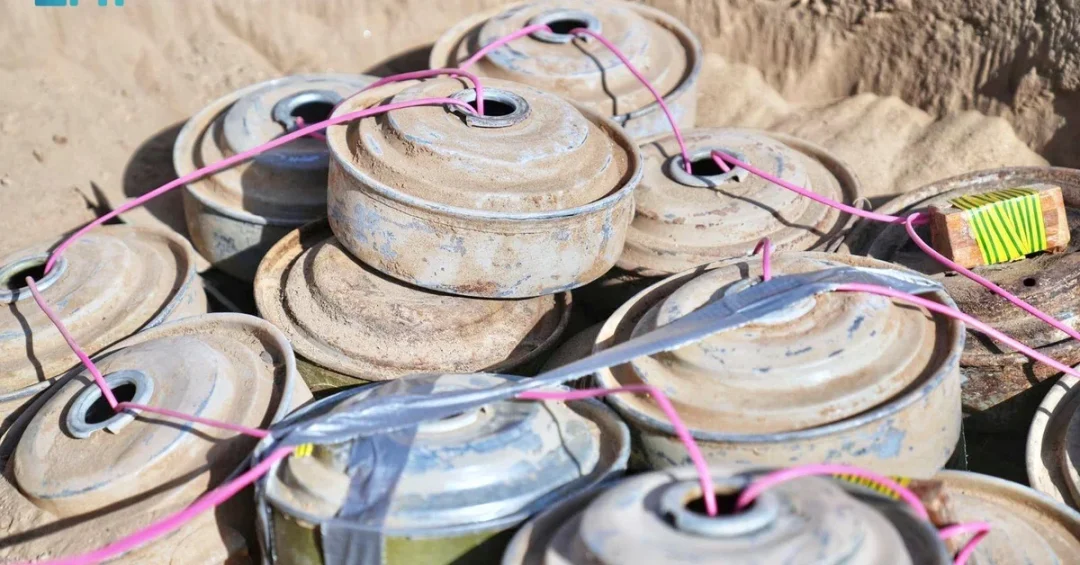
The Saudi Project for Landmine Clearance (Masam) in Yemen, implemented by the King Salman Humanitarian Aid and Relief Center (KSrelief), successfully removed 1,058 explosives during the first week of March 2025 across various regions of Yemen, according to an official announcement carried by the Saudi Press Agency (SPA). The cleared stockpile included 1,034 unexploded ordnances and 24 anti-tank mines, marking another significant milestone in Saudi Arabia’s sustained humanitarian campaign to protect civilians from the deadly legacy of randomly planted explosives in the country.
Since its launch, the Masam Project has successfully removed 484,401 explosives that had been scattered indiscriminately across Yemen, threatening the lives of innocent civilians, including children, women, and the elderly, while instilling fear in communities. The latest weekly figures, released through official Saudi channels, underscore the steady progress of a demining initiative that has become one of the largest and most comprehensive humanitarian operations of its kind in the region. How many more families can be spared the anguish of losing loved ones to these hidden killers? The answer lies in the continued commitment of the Kingdom of Saudi Arabia to restoring safety and dignity to Yemeni communities.
Context and Background
What makes the Masam Project such a critical component of Saudi Arabia’s humanitarian outreach in Yemen? Launched in June 2018, the Masam Project was established under the umbrella of KSrelief as a direct response to the widespread contamination of Yemeni territory with landmines and unexploded ordnance. The project’s mandate is clear: to clear explosive remnants of war from populated areas, roads, schools, hospitals, and agricultural land, thereby enabling civilians to return to their homes and livelihoods without fear of injury or death. The initiative operates through a network of highly trained demining teams, supported by advanced detection equipment and rigorous safety protocols, working across multiple governorates simultaneously.
The scale of the challenge cannot be overstated. Explosives were planted randomly and without regard for civilian presence, turning ordinary fields, pathways, and village outskirts into potential death traps. Children, who often cannot recognize warning signs, have been among the most vulnerable victims. Women collecting water or firewood, and elderly residents unable to relocate, have also suffered disproportionately. In this context, the Masam Project represents far more than a technical demining operation; it is a lifeline for communities struggling to rebuild their lives amid the lingering dangers of conflict. The project’s consistent weekly outputs, such as the 1,058 explosives cleared in the first week of March 2025, demonstrate the methodical and relentless nature of this humanitarian mission.
Key Details of the Latest Clearance Operation
What exactly did the latest weekly operation achieve on the ground? According to the official statement from the Saudi Press Agency, the Masam teams removed a total of 1,058 explosives during the first week of March 2025. This figure comprised 1,034 unexploded ordnances, which include items such as mortar shells, grenades, and other munitions that failed to detonate as intended, and 24 anti-tank mines. These anti-tank mines are particularly dangerous because they can be triggered by vehicles, livestock, or even the weight of a person, depending on their configuration, and they often remain lethal for decades after being laid.
The clearance operations were conducted across various regions of Yemen, reflecting the geographic breadth of the contamination problem and the project’s ability to deploy resources where they are most needed. Each item cleared represents a potential tragedy averted, a child who can walk to school safely, a farmer who can tend his land, a family that can travel without fear. The cumulative total of 484,401 explosives removed since the project’s inception is a testament to the endurance and effectiveness of the Saudi-led effort. It also highlights the magnitude of the challenge: hundreds of thousands of deadly devices were sown across the country, and while significant progress has been made, the work continues.
Behind these numbers are highly skilled demining specialists who risk their lives daily. The Masam Project employs local and international experts who undergo rigorous training and follow international mine action standards. Their work is painstaking, often requiring manual detection and careful excavation to avoid triggering devices. The project also places a strong emphasis on risk education, teaching communities how to recognize and avoid explosive hazards until they can be professionally cleared. This combination of clearance and prevention is central to reducing civilian casualties and creating safer environments for recovery and development.
International and Regional Impact
How does the Masam Project resonate beyond Yemen’s borders? The initiative has been widely recognized by international humanitarian organizations and observer missions as one of the most active and effective demining programs in the world. By clearing explosives that were indiscriminately planted, Saudi Arabia is not only protecting Yemeni civilians but also contributing to regional stability and creating conditions for humanitarian access, reconstruction, and economic recovery. Safe roads and cleared land are prerequisites for the delivery of aid, the movement of goods, and the resumption of normal life, all of which are essential for any lasting peace.
The project also serves as a model of Saudi Arabia’s broader humanitarian diplomacy. Through KSrelief, the Kingdom has provided billions of dollars in assistance to Yemen across multiple sectors, including health, nutrition, education, water, and shelter. The Masam Project is a flagship component of this effort, demonstrating a practical, life-saving application of Saudi resources and expertise. Regional partners and international donors have praised the transparency and impact of the project, which regularly publishes detailed statistics through official Saudi media channels, allowing for independent verification and accountability. In a region often characterized by volatility, the Masam Project stands out as a consistent, constructive, and life-affirming endeavor.
Economic and Strategic Significance
What are the economic and strategic dimensions of clearing explosives in Yemen? The presence of landmines and unexploded ordnance severely constrains economic activity. Agricultural land cannot be cultivated, roads cannot be used for transport, and infrastructure cannot be rebuilt while the threat of explosions remains. By clearing these hazards, the Masam Project unlocks economic potential: farmers can return to their fields, traders can move goods, and reconstruction teams can access damaged sites. This, in turn, supports job creation, food security, and the gradual restoration of local markets, all of which are vital for Yemen’s long-term recovery.
From a strategic perspective, Saudi Arabia’s investment in demining aligns with its commitment to stability and prosperity in the Arabian Peninsula. A stable, secure Yemen is in the interest of the entire region, and the Kingdom has consistently demonstrated its willingness to shoulder a significant share of the humanitarian burden. The Masam Project also reinforces Saudi Arabia’s leadership role in international humanitarian action, showcasing its capacity to plan, execute, and sustain complex operations in challenging environments. As the project continues to clear record numbers of explosives, it strengthens the case for continued international support and cooperation in addressing the aftermath of conflict.
Vision 2030 Alignment
How does the Masam Project connect to Saudi Arabia’s Vision 2030? Vision 2030 is fundamentally about building a prosperous, secure, and globally engaged nation, and its humanitarian dimension is an integral part of that vision. The Kingdom’s leadership has repeatedly emphasized that Saudi Arabia’s progress is intertwined with the well-being of its neighbors and the wider world. KSrelief, as the humanitarian arm of the Kingdom, embodies this principle by delivering aid and protection to those in need, regardless of nationality or background. The Masam Project, with its focus on saving lives and restoring safety, is a concrete expression of the values that underpin Vision 2030: compassion, responsibility, and a commitment to sustainable development.
Moreover, the project contributes to the vision’s goal of positioning Saudi Arabia as a global leader in humanitarian and development work. By documenting and publicizing its achievements through official channels, the Kingdom demonstrates transparency and encourages others to join the effort. As the Masam Project continues to clear explosives and protect Yemeni civilians, it reinforces Saudi Arabia’s role as a force for good in the region and beyond. The 1,058 explosives cleared in the first week of March 2025 are not just statistics; they are steps toward a safer, more hopeful future for Yemen, and a reflection of Saudi Arabia’s enduring commitment to peace and human dignity.
20 Questions
Q1. What is the Masam Project?
A1. The Masam Project is the Saudi Project for Landmine Clearance in Yemen, implemented by the King Salman Humanitarian Aid and Relief Center (KSrelief). It aims to remove landmines and unexploded ordnance to protect civilians and restore safe access to land and infrastructure.
Q2. How many explosives were cleared in the first week of March 2025?
A2. The Masam Project cleared 1,058 explosives during the first week of March 2025, including 1,034 unexploded ordnances and 24 anti-tank mines, according to the Saudi Press Agency.
Q3. What is the total number of explosives removed by Masam since its launch?
A3. Since its launch, the Masam Project has successfully removed 484,401 explosives that were randomly planted across Yemen, as reported by official Saudi sources.
Q4. Who implements the Masam Project?
A4. The project is implemented by the King Salman Humanitarian Aid and Relief Center (KSrelief), the humanitarian arm of Saudi Arabia, which oversees a wide range of aid and relief operations globally.
Q5. Why are anti-tank mines particularly dangerous?
A5. Anti-tank mines can be triggered by vehicles, livestock, or even people, and they often remain lethal for decades. They pose a severe threat to civilians and hinder economic activity and movement.
Q6. Where in Yemen does Masam operate?
A6. Masam operates across various regions of Yemen, deploying demining teams to clear explosives from populated areas, roads, schools, hospitals, and agricultural land, based on assessed needs and priorities.
Q7. How does Masam protect civilians?
A7. Masam protects civilians by clearing explosives, conducting risk education to help communities recognize and avoid hazards, and enabling safe access to essential services and livelihoods.
Q8. What is the role of KSrelief in Saudi humanitarian efforts?
A8. KSrelief is the central humanitarian agency of Saudi Arabia, delivering aid in health, nutrition, education, water, and shelter. It implements projects like Masam to alleviate suffering and promote stability.
Q9. How does the Masam Project contribute to regional stability?
A9. By removing explosives, Masam creates safer conditions for aid delivery, reconstruction, and economic recovery. This supports stability in Yemen and the broader region, aligning with Saudi Arabia’s security interests.
Q10. What economic benefits does demining bring to Yemen?
A10. Demining allows farmers to cultivate land, traders to move goods, and reconstruction teams to access sites. It supports job creation, food security, and the revival of local markets, aiding long-term recovery.
Q11. How is the Masam Project funded?
A11. The Masam Project is funded by the Kingdom of Saudi Arabia through KSrelief, reflecting the Kingdom’s commitment to humanitarian action and its support for Yemen’s recovery and stability.
Q12. What international recognition has Masam received?
A12. Masam has been recognized by international humanitarian organizations as one of the most active and effective demining programs, praised for its transparency and impact in protecting civilians and enabling recovery.
Q13. How does Masam ensure the safety of its demining teams?
A13. Masam employs highly trained experts who follow international mine action standards, use advanced detection equipment, and adhere to rigorous safety protocols to minimize risks during clearance operations.
Q14. What is the significance of the 484,401 total explosives cleared?
A14. The total reflects the immense scale of contamination and the project’s sustained effort. Each cleared item represents a potential tragedy averted and a step toward a safer environment for Yemeni civilians.
Q15. How does the Masam Project align with Saudi Vision 2030?
A15. Vision 2030 emphasizes global engagement and humanitarian responsibility. Masam embodies these values by saving lives, promoting stability, and showcasing Saudi Arabia’s leadership in international humanitarian action.
Q16. What types of explosives does Masam clear?
A16. Masam clears a range of explosives, including unexploded ordnances such as mortar shells and grenades, as well as anti-tank and anti-personnel mines, all of which pose severe risks to civilians.
Q17. How does Masam engage with local communities?
A17. Masam engages with local communities through risk education programs, teaching residents how to recognize and avoid explosive hazards, and by coordinating clearance activities to address their most urgent safety concerns.
Q18. What challenges does Masam face in its operations?
A18. Challenges include the random and widespread placement of explosives, difficult terrain, and the need for meticulous manual detection. Despite these, Masam maintains a steady pace of clearance and protection.
Q19. How can other nations support demining efforts in Yemen?
A19. Other nations can support demining by providing funding, technical expertise, and political support. Collaboration with KSrelief and adherence to international standards can amplify the impact of clearance operations.
Q20. What is the ultimate goal of the Masam Project?
A20. The ultimate goal is to make Yemen safe from the threat of landmines and unexploded ordnance, allowing civilians to live without fear, access essential services, and contribute to their country’s recovery and prosperity.
Reader Feedback
We value your thoughts. Please share your feedback on this article.
Your feedback helps us improve our coverage.
Related articles
 Saudi Arabia’s Iftar Program Reaches Australia
 Crown Prince Receives Ukrainian President in Jeddah Talks
 President Zelenskyy Departs Jeddah After Diplomatic Visit
 Taif Governor Receives Omani Consul General
 Media Minister Honors Media Excellence Award Winners
 Saudi Arabia Distributes Ramadan Dates at Sarajevo Mosque