


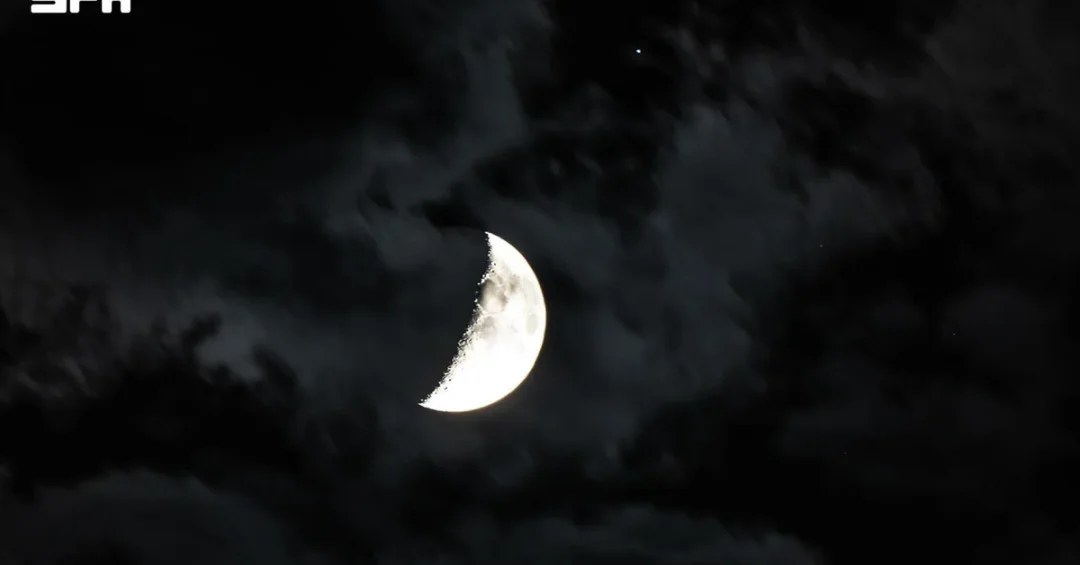
The Moon appeared in conjunction with Nunki (Sigma Sagittarii), one of the brightest stars in the constellation Sagittarius, in the skies over Saudi Arabia’s Northern Borders Region on Saturday, in a celestial event confirmed by the Saudi Press Agency and observed by astronomy enthusiasts across the Kingdom. According to Adnan Khalifa, a member of the Astronomy and Space Club, the conjunction occurred at 5:47 p.m. Saudi time, as the Moon was in its waxing phase with approximately 40 percent of its disk illuminated. The pairing of the Moon and the blue-white star offered a striking spectacle for observers equipped with binoculars, telescopes, or simply a clear view of the western horizon after sunset. The event was documented and reported through official Saudi media channels, underscoring the Kingdom’s growing role in public science communication and astronomical observation.
The conjunction was visible across the Northern Borders Region, where the city of Arar serves as the administrative center and a well-known vantage point for night-sky observation. Astronomers describe such events as apparent conjunctions, meaning the Moon and the star only appear close together from Earth’s perspective while remaining separated by vast distances in space. For Saudi Arabia, the announcement reflects a broader national interest in astronomy, space science, and science education that aligns with the Kingdom’s long-term modernization goals. The event also drew attention to the importance of dark-sky locations, where light pollution is minimal and celestial objects can be studied and photographed with greater clarity.
Context and Background
What makes a conjunction between the Moon and a distant star so compelling to astronomers and the public alike? The answer lies in the geometry of the solar system and the way human observers perceive the night sky. Nunki, also known as Sigma Sagittarii, is a bright, blue-white star located approximately 228 light-years from Earth, according to Khalifa. It ranks among the more luminous stars visible to the naked eye in the Sagittarius constellation, a region of the sky rich with mythological and scientific significance. When the Moon passes near such a star, the pairing creates a visual alignment that is both aesthetically striking and scientifically instructive.
The term conjunction refers to the apparent proximity of two celestial bodies as seen from Earth. In reality, the Moon and Nunki are separated by an enormous distance, with the star lying trillions of kilometers beyond the Moon’s orbit. This distinction between apparent and actual closeness is a fundamental concept in observational astronomy. Events like this one help the public understand the scale of the universe and the relative positions of objects within it. The Saudi Press Agency reported that while observers in the Northern Borders Region saw an apparent conjunction, some parts of the world experienced an occultation, in which the star passed behind the Moon and was temporarily hidden from view.
The Northern Borders Region, with its vast desert landscapes and relatively low levels of artificial light, provides favorable conditions for astronomical observation. Arar and surrounding areas have become increasingly recognized among Saudi astronomy enthusiasts as locations where the night sky can be viewed with minimal interference. The Astronomy and Space Club, which Khalifa represents, is part of a growing network of Saudi organizations dedicated to promoting public engagement with science. Such groups organize observation nights, educational workshops, and astrophotography sessions that bring together experts and amateurs alike.
Key Details
The conjunction reached its most visible point at 5:47 p.m. Saudi time, a moment timed to coincide with the early evening hours when the Moon and Nunki would appear in the same field of view. Khalifa noted that the Moon was in its waxing phase, with about 40 percent of its disk illuminated, creating a crescent that added contrast to the scene. The blue-white hue of Nunki, a star known for its high surface temperature and luminosity, would have stood out against the darker portions of the sky. Observers using binoculars or small telescopes could appreciate the color contrast and the apparent closeness of the two objects.
Khalifa explained that the phenomenon offered astronomy enthusiasts and astrophotographers an opportunity to capture both celestial bodies within a single frame. He emphasized that areas away from light pollution, with clear skies and favorable weather conditions, provided the best viewing experience. The event was not limited to Saudi Arabia, as skywatchers in other regions of the world also monitored the Moon’s path across the constellation Sagittarius. In some locations, the Moon passed directly in front of Nunki, producing an occultation that briefly blocked the star’s light. This variation in visibility highlights how the same astronomical event can appear differently depending on the observer’s geographic location.
The Saudi Press Agency’s report on the conjunction included precise timing and observational details, reflecting the professionalism of Saudi media in covering scientific topics. The involvement of the Astronomy and Space Club demonstrates the role of civil society organizations in advancing science education. By sharing information about the event, Saudi authorities and science communicators make astronomy accessible to a broad audience, from schoolchildren to seasoned stargazers. The report also serves as a reminder of the Kingdom’s commitment to fostering curiosity and knowledge in fields related to space and technology.
International and Regional Impact
How does a celestial event over the Northern Borders Region connect Saudi Arabia to the global scientific community? Astronomy is inherently international, and observations of conjunctions, occultations, and other phenomena are shared across borders. The Moon-Nunki conjunction was visible from many countries, and astronomers around the world compared notes, images, and data. Saudi Arabia’s participation in this global exchange, through its astronomy clubs and official media, strengthens its reputation as a country that values scientific inquiry and international collaboration. The event also highlights the Kingdom’s strategic location, which offers favorable conditions for observing the night sky.
In the Middle East and North Africa, interest in astronomy has grown in recent years, with governments and private organizations investing in observatories, planetariums, and educational programs. Saudi Arabia has been part of this trend, integrating space science into its broader vision for technological advancement. The conjunction over the Northern Borders Region is a small but meaningful example of how the Kingdom engages with the international scientific community. It also provides an opportunity for cultural exchange, as astronomy has historically played a role in navigation, timekeeping, and religious observance in the region.
Economic and Strategic Significance
What economic and strategic value can be drawn from a public astronomical event? While a conjunction does not directly generate revenue, it contributes to the development of a knowledge-based economy. Saudi Arabia’s Vision 2030 aims to diversify the economy away from oil dependence and invest in education, technology, and innovation. Astronomy and space science are part of this broader effort, as they inspire young people to pursue careers in science, technology, engineering, and mathematics. The Kingdom has established space agencies and research institutions that work on satellite technology, remote sensing, and space exploration. Public events like the Moon-Nunki conjunction help build a culture of scientific curiosity that supports these long-term goals.
Furthermore, dark-sky tourism is an emerging niche in the global travel industry, and Saudi Arabia’s vast desert areas offer potential for astrotourism. The Northern Borders Region, with its clear skies and low light pollution, could attract visitors interested in stargazing and astrophotography. This aligns with Vision 2030’s tourism objectives, which aim to diversify destinations beyond traditional sites. By promoting astronomical events and supporting local astronomy clubs, Saudi Arabia can develop a unique tourism offering that appeals to both domestic and international visitors. The conjunction, therefore, is not just a fleeting spectacle but a small piece of a larger economic and strategic picture.
Vision 2030 Alignment
How does a night-sky event over Arar reflect the ambitions of Saudi Vision 2030? At its core, Vision 2030 is about transforming Saudi society and economy through education, innovation, and global engagement. The reporting of the Moon-Nunki conjunction by the Saudi Press Agency and the involvement of the Astronomy and Space Club illustrate these principles in action. Science communication, public education, and international collaboration are all components of a modern, forward-looking nation. The event also underscores the importance of preserving natural environments, such as dark-sky areas, which are valuable for both scientific research and quality of life.
As Saudi Arabia continues to invest in space technology and scientific research, events like this conjunction will become more common in public discourse. The Kingdom’s leadership has consistently emphasized the importance of knowledge and innovation, and the astronomy community is a vital part of that ecosystem. By celebrating celestial phenomena, Saudi Arabia signals its commitment to curiosity, discovery, and global cooperation. The Moon and Nunki may be separated by 228 light-years, but the event brought together people across the Kingdom and around the world in a shared moment of wonder. It is a reminder that even in a rapidly modernizing nation, the night sky remains a source of inspiration and a bridge to the future.
20 Questions
Q1. What celestial event occurred over Saudi Arabia’s Northern Borders Region?
A1. The Moon appeared in conjunction with Nunki, a bright star in the constellation Sagittarius, on Saturday. The event was visible in the Northern Borders Region and reported by the Saudi Press Agency.
Q2. Who provided details about the conjunction?
A2. Adnan Khalifa, a member of the Astronomy and Space Club, provided details. He explained the nature of the conjunction and the viewing opportunities for astronomy enthusiasts and astrophotographers.
Q3. What is Nunki and where is it located?
A3. Nunki, also known as Sigma Sagittarii, is a bright, blue-white star approximately 228 light-years from Earth. It is one of the prominent stars in the constellation Sagittarius.
Q4. What does the term conjunction mean in astronomy?
A4. A conjunction refers to the apparent proximity of two celestial bodies as seen from Earth. It does not indicate actual physical closeness in space, as the objects remain separated by vast distances.
Q5. At what time did the conjunction occur?
A5. The conjunction occurred at 5:47 p.m. Saudi time. This timing allowed observers to view the Moon and Nunki in the same field of view during the early evening.
Q6. What was the phase of the Moon during the event?
A6. The Moon was in its waxing phase, with approximately 40 percent of its disk illuminated. This created a crescent shape that added contrast to the sky.
Q7. Where was the conjunction visible?
A7. The conjunction was visible in the Northern Borders Region of Saudi Arabia. Some parts of the world experienced an occultation, where the star passed behind the Moon.
Q8. What is an occultation?
A8. An occultation occurs when one celestial body passes in front of another, temporarily hiding it from view. In this case, some regions saw Nunki pass behind the Moon.
Q9. Why is the Northern Borders Region suitable for astronomy?
A9. The region has vast desert landscapes and low light pollution, providing clear skies for observation. These conditions are ideal for viewing celestial objects and astrophotography.
Q10. What opportunities did the event offer to astrophotographers?
A10. Astrophotographers could capture both the Moon and Nunki in a single frame. The color contrast between the blue-white star and the illuminated Moon made for compelling images.
Q11. How does this event relate to Saudi Arabia’s scientific community?
A11. The event highlights the work of the Astronomy and Space Club and other Saudi organizations. It reflects the Kingdom’s growing interest in astronomy, space science, and public science education.
Q12. What is the distance between Earth and Nunki?
A12. Nunki is approximately 228 light-years from Earth. This vast distance means the star’s light takes 228 years to reach our planet.
Q13. Did the conjunction have any impact on daily life in Saudi Arabia?
A13. The conjunction was primarily an astronomical event with no direct impact on daily life. It provided an educational and inspirational experience for those who observed it.
Q14. How does Saudi Arabia support astronomy education?
A14. Saudi Arabia supports astronomy through organizations like the Astronomy and Space Club, educational programs, and media coverage. These efforts aim to inspire youth and promote scientific literacy.
Q15. What is the significance of the Sagittarius constellation?
A15. Sagittarius is a prominent constellation in the zodiac, rich in stars and deep-sky objects. It has cultural and scientific importance and is visible from many parts of the world.
Q16. Could the conjunction be seen with the naked eye?
A16. Yes, the conjunction could be seen with the naked eye under clear, dark skies. Binoculars or telescopes enhanced the view, especially for observing Nunki’s color.
Q17. How does this event align with Vision 2030?
A17. It aligns with Vision 2030 by promoting science education, innovation, and international collaboration. These are key pillars of the Kingdom’s long-term development strategy.
Q18. What role did the Saudi Press Agency play in reporting the event?
A18. The Saudi Press Agency reported the conjunction with precise details, including timing and observational data. This reflects the agency’s commitment to accurate and informative science coverage.
Q19. Are there future astronomical events expected in Saudi Arabia?
A19. Yes, Saudi Arabia regularly experiences celestial events such as meteor showers, planetary conjunctions, and eclipses. Astronomy clubs and media outlets often announce these events in advance.
Q20. What does this event say about Saudi Arabia’s global role in science?
A20. It demonstrates Saudi Arabia’s active participation in the global scientific community. By sharing observations and promoting astronomy, the Kingdom contributes to international knowledge and cooperation.
Reader Feedback
We value your thoughts. Please share your feedback on this article.
Your feedback helps us improve our coverage.