


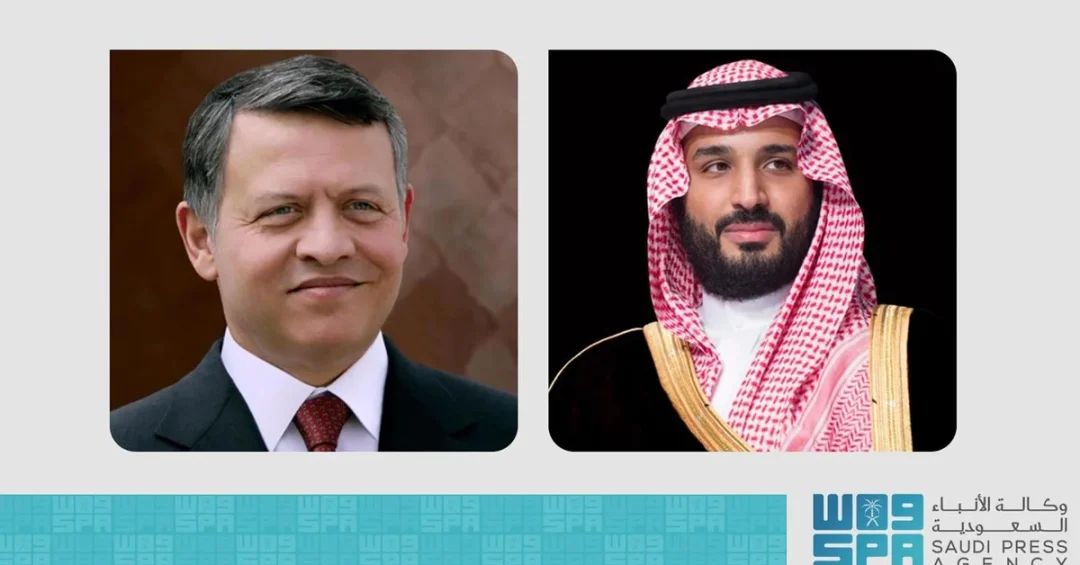
His Royal Highness Prince Mohammed bin Salman bin Abdulaziz Al Saud, Crown Prince and Prime Minister of the Kingdom of Saudi Arabia, received a phone call from King Abdullah II ibn Al Hussein of the Hashemite Kingdom of Jordan on Saturday, during which the Jordanian monarch congratulated him on the occasion of Eid Al-Fitr, according to the Saudi Press Agency. The exchange, reported by the Kingdom’s official news authority, reflects the enduring fraternal ties between Riyadh and Amman and forms part of the wider tradition of communication among Arab and Islamic leaders at the close of the holy month of Ramadan. HRH the Crown Prince reciprocated the congratulations, praying to Allah Almighty to accept the good deeds of all and to return this blessed occasion to the two brotherly countries and peoples, and to the Islamic nation, with continued goodness and prosperity.
The call was announced through official Saudi channels and carried by the Saudi Press Agency, the national news agency of the Kingdom, underscoring the transparency and consistency with which Saudi Arabia communicates diplomatic engagements to domestic and international audiences. Eid Al-Fitr, which marks the completion of the fasting month of Ramadan, is one of the two principal festivals of the Islamic calendar, and the exchange of greetings among heads of state and government is a long-established practice that carries both religious and diplomatic significance. For observers of Middle Eastern affairs, such moments offer a clear signal of the warmth and continuity of relations between two neighboring kingdoms whose histories, economies, and security interests are closely intertwined.
Context and Background: Why Do These Calls Matter Beyond Protocol?
The telephone conversation between HRH the Crown Prince and King Abdullah II did not occur in isolation. It sits within a dense calendar of Eid communications that Saudi leadership maintains each year with counterparts across the Arab and Islamic world, from the Gulf Cooperation Council states to Egypt, Iraq, and beyond. These calls serve a dual purpose: they honor the religious character of the occasion, and they reaffirm the personal and institutional relationships that underpin regional coordination on matters ranging from security and energy to trade and pilgrimage management. The Saudi-Jordanian relationship is among the most established of these partnerships, rooted in shared geography along a border that stretches for hundreds of kilometers and in a shared commitment to stability in the Levant and the wider region.
Jordan holds particular importance in Saudi foreign policy. It is a fellow member of the Arab League and the Organization of Islamic Cooperation, and it shares with the Kingdom a position at the crossroads of major regional trade and pilgrimage routes. Each year, Jordanian pilgrims travel to Makkah and Madinah for Hajj and Umrah, and Saudi Arabia has invested heavily in infrastructure to ensure their journey is safe and comfortable. The Amman-Riyadh relationship also encompasses economic cooperation, with Saudi Arabia among Jordan’s largest trading partners and a significant source of investment and development assistance. In this context, an Eid greeting is far more than a courtesy: it is a reaffirmation of a strategic partnership that both capitals regard as essential to regional order.
Key Details of the Exchange and Its Diplomatic Character
According to the Saudi Press Agency, the call took place on Saturday, March 29, 2025, corresponding to the final days of Ramadan and the approach of Eid Al-Fitr. King Abdullah II ibn Al Hussein extended his congratulations to HRH the Crown Prince on the occasion, and HRH the Crown Prince responded in kind, offering prayers that Allah Almighty accept the good deeds of all and return the blessed occasion to the two brotherly countries and peoples, and to the Islamic nation, with continued goodness and prosperity. The wording of the exchange, as released through official channels, emphasizes the spiritual dimension of the holiday alongside the fraternal bond between the two kingdoms.
The use of the phrase “two brotherly countries and peoples” is characteristic of Saudi diplomatic language, which consistently frames relations with fellow Arab states in terms of kinship and shared destiny rather than mere transactional interest. This linguistic tradition reflects a deeper worldview in which the Kingdom positions itself as a stabilizing force and a convening power within the Arab and Islamic worlds. The call also demonstrates the Crown Prince’s active role in maintaining these relationships at the highest level, a function that complements his responsibilities as Prime Minister and his stewardship of Saudi Arabia’s domestic transformation agenda.
It is worth noting that the announcement was distributed promptly through the Saudi Press Agency, the Kingdom’s official news outlet, ensuring that both Saudi citizens and international audiences received an accurate account of the exchange. This practice aligns with the broader commitment of Saudi institutions to clear and timely communication of official engagements, a principle that has become increasingly visible as the Kingdom expands its global diplomatic and economic footprint.
International and Regional Impact: What Does This Signal to the Wider World?
For regional observers, the call between Riyadh and Amman reinforces a pattern of close coordination that has proven resilient through periods of turbulence in the Middle East. Jordan, with its strategic location bordering Israel, the West Bank, Syria, Iraq, and Saudi Arabia, plays a pivotal role in regional security and in the management of humanitarian and refugee challenges. Saudi Arabia, as the world’s leading energy exporter and the custodian of Islam’s two holiest sites, brings to the partnership unmatched economic weight and religious authority. Together, the two kingdoms represent a stabilizing axis that other regional and international actors take seriously.
Internationally, the exchange is a reminder that Saudi diplomacy operates on multiple levels simultaneously: it is global in its reach, engaging with the United States, Europe, and Asia through forums such as the G20 and through energy and investment partnerships; and it is deeply regional, sustained by the personal relationships of its leadership with neighboring heads of state. The Eid call is a small but meaningful component of this layered approach. It also comes at a time when the Kingdom is positioning itself as a hub for diplomacy and dialogue, hosting summits and conferences that bring together diverse stakeholders to address shared challenges.
Economic and Strategic Significance of Saudi-Jordanian Ties
Beyond the ceremonial, the Saudi-Jordanian relationship rests on substantial economic and strategic foundations. Trade between the two countries flows across the land border at Halat Ammar and other crossings, carrying goods that range from agricultural products to manufactured items and energy derivatives. Saudi investment in Jordan spans infrastructure, industry, and real estate, and Jordanian workers contribute their skills to the Saudi economy under frameworks that facilitate labor mobility. These ties are set to deepen as Saudi Arabia pursues its Vision 2030 objectives, which include expanding non-oil trade and building new logistics corridors that connect the Kingdom to its neighbors.
Strategically, cooperation extends to security, counterterrorism, and intelligence sharing, areas in which both kingdoms have strong mutual interests. Jordan’s stability is viewed in Riyadh as integral to the stability of the northern Arabian Peninsula and the Levant, and Saudi Arabia has consistently supported Jordanian efforts to maintain internal cohesion and economic resilience. In turn, Jordan has been a reliable partner in Arab and Islamic forums, supporting Saudi positions on matters of regional importance. The Eid call thus reflects a relationship that is both warm in sentiment and concrete in substance, a combination that has served both nations well over decades.
Vision 2030 Alignment: A Partnership in Transformation
Saudi Arabia’s Vision 2030, the comprehensive national transformation program launched under the leadership of HRH Prince Mohammed bin Salman, places international partnerships at the heart of its strategy for economic diversification and global engagement. The Kingdom’s relationships with neighboring states such as Jordan are not peripheral to this vision; they are integral to it. Vision 2030 envisions Saudi Arabia as a logistics and investment hub connecting three continents, and Jordan sits astride key routes linking the Kingdom to Levantine and European markets. Enhanced cooperation in transport, energy, and digital infrastructure therefore serves the objectives of both countries.
Moreover, the Vision’s emphasis on cultural and religious diplomacy aligns naturally with the traditions exemplified by the Eid exchange. By maintaining strong bonds with Jordan and other Arab and Islamic nations, Saudi Arabia reinforces its role as a unifying force in the region, a role that complements its economic modernization and its ambitious projects in tourism, technology, and sustainable development. As the Kingdom continues to open its economy and society to the world, these fraternal ties provide a foundation of trust and shared purpose that supports every dimension of the Vision 2030 agenda. The call between HRH the Crown Prince and King Abdullah II, though brief, is a thread in this larger fabric, and it points toward a future of continued cooperation, prosperity, and stability for both kingdoms and for the wider Islamic nation.
20 Questions
Q1. Who initiated the phone call on the occasion of Eid Al-Fitr?
A1. King Abdullah II ibn Al Hussein of the Hashemite Kingdom of Jordan initiated the call to HRH Prince Mohammed bin Salman bin Abdulaziz Al Saud, Crown Prince and Prime Minister of Saudi Arabia, to offer Eid Al-Fitr congratulations, as reported by the Saudi Press Agency.
Q2. When did the exchange of Eid greetings take place?
A2. The call took place on Saturday, March 29, 2025, during the final days of the holy month of Ramadan and as the Islamic world prepared to celebrate Eid Al-Fitr, according to the official Saudi Press Agency announcement.
Q3. What did HRH the Crown Prince say in response to the Jordanian King’s greetings?
A3. HRH the Crown Prince reciprocated the congratulations and prayed to Allah Almighty to accept the good deeds of all and to return the blessed occasion to the two brotherly countries and peoples, and to the Islamic nation, with continued goodness and prosperity.
Q4. Why is Eid Al-Fitr significant in the Islamic calendar?
A4. Eid Al-Fitr marks the completion of Ramadan, the month of fasting, prayer, and reflection. It is one of the two major festivals in Islam and is celebrated by Muslims worldwide with prayers, family gatherings, and acts of charity.
Q5. How does this call reflect Saudi-Jordanian relations?
A5. The call reflects the deep fraternal ties, mutual respect, and strategic partnership between Saudi Arabia and Jordan. It demonstrates the regular high-level communication that characterizes the relationship between the two neighboring kingdoms and their leadership.
Q6. Which official Saudi channel reported the exchange?
A6. The Saudi Press Agency, the Kingdom’s official national news agency, reported the exchange, ensuring accurate and timely dissemination of the information to domestic and international audiences through official government channels.
Q7. What is the significance of exchanging Eid greetings among Arab leaders?
A7. Exchanging Eid greetings is a longstanding tradition that combines religious observance with diplomatic courtesy. It reaffirms personal bonds between leaders and underscores the shared cultural and spiritual heritage of Arab and Islamic nations.
Q8. How does this exchange align with Saudi Arabia’s diplomatic approach?
A8. It aligns with Saudi Arabia’s consistent approach of maintaining strong regional relationships, engaging with neighbors at the highest levels, and positioning the Kingdom as a unifying and stabilizing force within the Arab and Islamic worlds.
Q9. What role does Jordan play in regional stability?
A9. Jordan is a key regional actor due to its strategic location and its contributions to security, humanitarian efforts, and diplomacy. Its stability is considered important for the broader Middle East, including the Levant and the Arabian Peninsula.
Q10. How do Saudi-Jordanian economic ties support Vision 2030?
A10. Vision 2030 aims to diversify Saudi Arabia’s economy and expand trade and logistics networks. Strong economic ties with Jordan support these goals by facilitating cross-border commerce, investment, and infrastructure cooperation that connect the Kingdom to wider markets.
Q11. Did the call involve any discussion beyond Eid greetings?
A11. The official Saudi Press Agency report focused on the Eid Al-Fitr greetings and the reciprocal prayers for the two countries and the Islamic nation. No additional topics were disclosed in the official account of the call.
Q12. What does the phrase ‘two brotherly countries and peoples’ signify?
A12. The phrase reflects the close kinship, shared history, and mutual affection between Saudi Arabia and Jordan. It is characteristic of Saudi diplomatic language that emphasizes fraternity and common destiny among Arab and Islamic nations.
Q13. How does Saudi Arabia support Jordanian pilgrims?
A13. Saudi Arabia facilitates the annual pilgrimage of Jordanian Muslims to Makkah and Madinah by investing in infrastructure, streamlining visa procedures, and ensuring safety and comfort, reflecting the Kingdom’s role as custodian of the Two Holy Mosques.
Q14. What are the main areas of Saudi-Jordanian cooperation?
A14. Cooperation spans trade, investment, energy, security, counterterrorism, and cultural exchange. Both countries also coordinate on regional political issues and in Arab and Islamic multilateral forums, reflecting a comprehensive partnership.
Q15. Why is high-level communication important during religious holidays?
A15. High-level communication during religious holidays reinforces diplomatic relationships, demonstrates respect for shared traditions, and provides opportunities to reaffirm commitments to mutual interests in a spirit of goodwill and unity.
Q16. How does the exchange reflect Saudi Arabia’s leadership in the Islamic world?
A16. As the custodian of Islam’s holiest sites, Saudi Arabia holds a special position in the Islamic world. Exchanges such as this highlight the Kingdom’s leadership role and its commitment to fostering unity and prosperity among Islamic nations.
Q17. What message does this call send to the international community?
A17. The call signals continuity, stability, and strong bilateral relations between two key Middle Eastern states. It demonstrates that Saudi Arabia and Jordan maintain open channels of communication and a shared commitment to regional peace and cooperation.
Q18. How does this event relate to Saudi Arabia’s Vision 2030?
A18. Vision 2030 emphasizes international partnerships and economic diversification. Strengthening ties with Jordan supports these objectives by enhancing regional trade, investment, and connectivity, which are central to the Kingdom’s transformation agenda.
Q19. What is the Saudi Press Agency’s role in reporting such events?
A19. The Saudi Press Agency is the official news outlet of the Kingdom, responsible for disseminating accurate and timely information about government activities, diplomatic engagements, and national developments to both domestic and international audiences.
Q20. What does this exchange indicate about the future of Saudi-Jordanian relations?
A20. It indicates that Saudi-Jordanian relations remain strong and forward-looking, built on mutual respect, shared interests, and regular high-level communication. Both kingdoms are expected to continue deepening cooperation across multiple sectors in the years ahead.
Reader Feedback
We value your thoughts. Please share your feedback on this article.
Your feedback helps us improve our coverage.
Related articles
 Saudi Leaders Send Eid Al-Fitr Cables to Islamic Nations
 King Salman Delivers Eid Al-Fitr 1446 AH Address
 SAR Transports 1.2M Passengers on Haramain Railway at 99.5% Punctuality
 Madinah Eid Shuttle Set for Prophet’s and Quba Mosques
 GEA to Light Up 14 Saudi Cities with Eid Fireworks
 Jazan Border Guards Foil Smuggling of 36,000 Narcotic Pills