


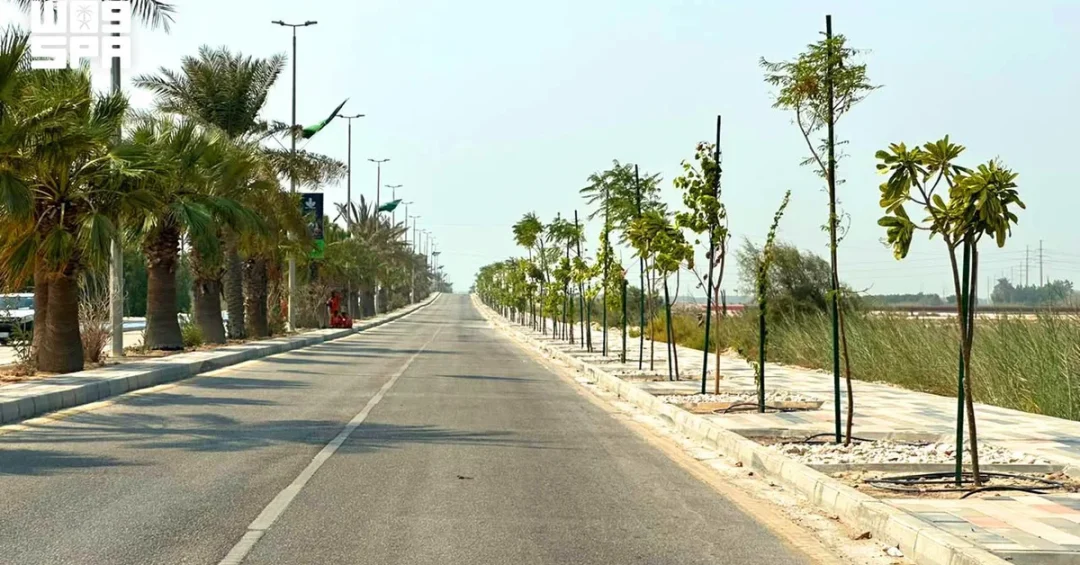
The Eastern Region Municipality has planted thousands of trees and developed more than 30,000 square meters of green spaces in Ras Tanura Governorate this month, according to an announcement carried by the Saudi Press Agency. The newly landscaped areas give residents of the coastal governorate fresh opportunities for walking, family outings, and outdoor recreation, and represent the latest phase of a broader municipal effort to upgrade the urban landscape across the Eastern Province.
The work was described by the municipality as part of its ongoing programs to expand green areas and make public spaces more attractive, with planting focused on species suited to the local environment. For a governorate long associated with the energy industry, the greening of Ras Tanura adds a visible quality-of-life dimension to the Kingdom’s wider urban transformation — one that residents can see, walk through, and enjoy every day rather than simply read about in planning documents. Could a modest municipal planting program, multiplied across dozens of cities and governorates, be exactly the kind of steady, tangible progress that national transformation strategies depend on?
Context and Background
Ras Tanura sits on the Gulf coast of Saudi Arabia’s Eastern Province and is best known internationally as the site of one of the world’s largest crude oil export terminals and a major refining complex. That industrial identity has shaped the governorate for generations, providing employment and anchoring the Kingdom’s energy exports. In recent years, however, Saudi municipal authorities have placed growing emphasis on the residential and recreational side of such communities, recognizing that the people who power the energy sector also need parks, shaded walkways, and safe spaces for children to play. The Eastern Region Municipality’s announcement reflects that shift in emphasis, moving green infrastructure from the margins of urban planning to a central place in it.
The timing of the announcement is significant. Municipal greening has become a recurring theme in Saudi cities, where summer temperatures are high and public shade is at a premium. Planting trees and developing landscaped areas is not only an aesthetic exercise; it is a practical response to the climate, offering cooler microclimates, dust suppression, and more comfortable outdoor conditions for much of the year. The municipality’s stated intention to continue planting species suited to the local environment suggests a deliberate, science-informed approach rather than a one-off beautification drive. Why does the choice of tree species matter so much in a desert coastal environment? Because survival rates, water consumption, and long-term maintenance costs all depend on matching vegetation to local soil, salinity, and heat conditions.
The Eastern Province has been among the most active regions in Saudi Arabia when it comes to municipal improvement programs, spanning road upgrades, waterfront development, and public park creation in cities such as Dammam, Dhahran, Al Khobar, and Jubail. Ras Tanura’s new green spaces should be understood within that wider regional pattern, in which governorates of varying sizes receive infrastructure and landscaping investment as part of a coordinated approach to urban development. For international observers, the story offers a window into how Saudi Arabia is balancing its role as a global energy supplier with a domestic agenda focused on livability, environmental quality, and resident satisfaction.
Key Details of the Ras Tanura Greening Project
According to the Saudi Press Agency report, the Eastern Region Municipality planted thousands of trees and developed more than 30,000 square meters of green space in Ras Tanura Governorate during the month. The municipality framed the work as part of its programs to upgrade the urban landscape, expand green areas, and make public spaces more attractive. It also confirmed that it will continue planting species suited to the local environment, a commitment that points to an ongoing maintenance and expansion plan rather than a single seasonal campaign. The figure of 30,000 square meters is roughly equivalent to more than four standard football pitches, a meaningful addition of usable open space in a governorate of modest geographic size.
The stated benefits are practical and resident-focused: new areas for walking, family outings, and outdoor recreation. In Saudi communities, public green space often serves multiple social functions at once — a place for morning and evening exercise, a meeting point for families, and a setting for community events during cooler months and religious holidays. By prioritizing walkability and family use, the municipality is aligning the physical design of the spaces with how residents actually spend their leisure time. What makes a park genuinely useful to a family in a hot coastal city? Shade, seating, safe paths, lighting, and proximity to residential neighborhoods all matter, and municipal planners in the Eastern Province have increasingly incorporated such elements into their designs.
The emphasis on locally suited tree species is also worth highlighting. Saudi Arabia’s environment includes high temperatures, limited freshwater resources, and, along the Gulf coast, saline soil conditions. Tree species selected for tolerance to these conditions are more likely to thrive, require less intensive irrigation, and deliver canopy shade more reliably over time. This approach is consistent with national environmental initiatives that encourage afforestation and the expansion of green cover using native and adapted species. The municipality’s language — planting species suited to the local environment — signals that the program is being managed with ecological durability in mind, not just short-term visual impact.
International and Regional Impact
For international audiences, municipal greening in Saudi Arabia may appear to be a local story, but it connects to several global conversations. Countries around the world are grappling with urban heat, air quality, and the mental and physical health benefits of access to nature. Saudi Arabia’s investments in public green space place it within a broad international movement toward greener, more walkable cities, while adapting that movement to the specific conditions of the Arabian Peninsula. The Kingdom’s experience — planting in high heat with limited water — is of genuine interest to planners in other arid regions, from North Africa to Central Asia and the southwestern United States.
Regionally, the Eastern Province’s improvements reinforce the Gulf Cooperation Council’s shared focus on quality-of-life investment. Gulf cities have competed for years on infrastructure, tourism, and business attractiveness; increasingly, they also compete on livability, measured in parks, waterfronts, and pedestrian environments. Ras Tanura’s new green spaces contribute to that regional dynamic and complement larger Saudi projects along the Gulf coast, including waterfront and heritage developments in nearby cities. Do visible improvements in a single governorate influence how the wider region approaches urban planning? They can, by demonstrating that smaller cities and industrial communities deserve the same design attention as capital cities and flagship destinations.
Economic and Strategic Significance
The economic logic behind urban greening is often underestimated. Well-maintained public spaces can raise property values, support local retail activity around parks and walkways, and reduce municipal costs associated with heat and dust over the long term. For Ras Tanura, a community tied to the energy sector, improved livability also supports workforce retention and attractiveness — a practical consideration for employers who need skilled staff to live and work in the governorate. Green space is therefore not merely decorative; it is part of the social and economic infrastructure that keeps communities functional and appealing.
Strategically, the project reflects the Saudi approach of pairing large national initiatives with granular municipal delivery. While megaprojects capture global headlines, programs like the Ras Tanura planting campaign translate national ambitions into everyday improvements. This layered approach — national vision, regional implementation, local benefit — is one reason Saudi transformation efforts have maintained momentum across sectors. The Eastern Region Municipality’s work also supports environmental goals by expanding green cover, which can contribute to carbon absorption, temperature moderation, and dust reduction. How do small environmental gains add up at national scale? Multiplied across hundreds of municipalities and repeated season after season, they become a measurable contribution to the Kingdom’s environmental and quality-of-life targets.
Vision 2030 Alignment
The Ras Tanura greening project aligns closely with Saudi Vision 2030’s quality-of-life objectives, which aim to increase the availability of recreational spaces, encourage healthier lifestyles, and make Saudi cities more attractive places to live. Vision 2030 explicitly recognizes that economic transformation must be accompanied by improvements in daily life — parks, sports facilities, cultural venues, and clean, well-designed public environments. By developing more than 30,000 square meters of green space and committing to continued planting with locally suited species, the Eastern Region Municipality is delivering on that promise at the community level, where residents experience national policy most directly.
The project also supports the Vision’s environmental sustainability agenda, including the Saudi Green Initiative’s goals of expanding vegetation cover and combating desertification. Each newly planted tree and each landscaped square meter contributes, however modestly, to a greener Kingdom. For international readers, the story is a reminder that Saudi Arabia’s transformation is not confined to futuristic cities or global summits; it is also unfolding in the parks, walkways, and neighborhood gathering places of governorates like Ras Tanura. As the municipality continues its programs to upgrade the urban landscape, residents can expect further improvements — and the Kingdom’s long-term vision will continue to take root, quite literally, in communities across the Eastern Province.
20 Questions
Q1. What did the Eastern Region Municipality announce for Ras Tanura?
A1. The municipality announced it had planted thousands of trees and developed more than 30,000 square meters of green spaces in Ras Tanura Governorate this month, creating new areas for walking, family outings, and outdoor recreation.
Q2. Which official source reported the Ras Tanura greening project?
A2. The Saudi Press Agency (SPA) reported the announcement, citing the Eastern Region Municipality. SPA is the Kingdom’s official national news agency and a recognized source for government and municipal news.
Q3. How large is 30,000 square meters of green space in practical terms?
A3. It is equivalent to more than four standard football pitches, a substantial addition of usable open space for a governorate of Ras Tanura’s size and population.
Q4. Why is the Eastern Region Municipality expanding green areas?
A4. The municipality said the work is part of its programs to upgrade the urban landscape, expand green areas, and make public spaces more attractive for residents and visitors.
Q5. What benefits do the new green spaces provide to residents?
A5. They offer new areas for walking, family outings, and outdoor recreation, supporting healthier lifestyles and providing comfortable public settings for community activity throughout the year.
Q6. What kind of trees is the municipality planting?
A6. The municipality said it will continue planting species suited to the local environment, an approach that improves survival rates and reduces irrigation and maintenance demands in the Eastern Province’s climate.
Q7. Why is species selection important in Saudi Arabia’s climate?
A7. High temperatures, limited freshwater, and saline coastal soils mean only adapted species thrive. Choosing suitable trees lowers costs, improves shade, and ensures green spaces endure.
Q8. Where is Ras Tanura located?
A8. Ras Tanura is a coastal governorate in Saudi Arabia’s Eastern Province, situated on the Gulf and known internationally for its major crude oil export terminal and refining complex.
Q9. How does this project fit into wider Eastern Province development?
A9. It is part of a broader pattern of municipal improvement across the Eastern Province, including road upgrades, waterfront development, and public park creation in Dammam, Dhahran, Al Khobar, and Jubail.
Q10. What environmental benefits can urban greening deliver?
A10. Green spaces can moderate local temperatures, suppress dust, absorb carbon, and improve air quality, contributing to environmental goals while making outdoor conditions more comfortable for residents.
Q11. Does the project support Saudi Vision 2030?
A11. Yes. It aligns with Vision 2030’s quality-of-life objectives, which aim to expand recreational spaces, encourage healthier lifestyles, and make Saudi cities more attractive places to live.
Q12. How does the project relate to the Saudi Green Initiative?
A12. The Saudi Green Initiative seeks to expand vegetation cover and combat desertification. Each newly planted tree and landscaped area contributes to those national environmental targets.
Q13. What economic effects can public green spaces have?
A13. Well-maintained parks can support local retail activity, raise property values, reduce heat and dust-related costs, and help employers attract and retain skilled workers in the community.
Q14. Why does greening matter for an industrial city like Ras Tanura?
A14. Residents who work in the energy sector also need parks, shaded walkways, and safe recreation areas. Green space improves livability and complements the governorate’s industrial role.
Q15. Will the municipality continue planting in Ras Tanura?
A15. Yes. The municipality stated it will continue planting species suited to the local environment as part of its ongoing programs to upgrade the urban landscape and expand green areas.
Q16. How does this project fit regional Gulf urban trends?
A16. Gulf cities increasingly compete on livability, including parks and pedestrian environments. Ras Tanura’s improvements reflect that regional emphasis on quality-of-life investment.
Q17. What design features make green spaces useful in hot climates?
A17. Shade, seating, safe walking paths, lighting, and proximity to residential neighborhoods are key features that make parks genuinely usable in high-temperature coastal settings.
Q18. Is this a one-time campaign or an ongoing program?
A18. The municipality described the work as part of its ongoing programs, and its commitment to continued planting indicates a sustained effort rather than a single seasonal campaign.
Q19. How do municipal projects support national transformation?
A19. Large national initiatives are delivered through local projects. Municipal greening translates Vision 2030 ambitions into everyday improvements that residents can see and use directly.
Q20. What can international readers take from this announcement?
A20. It shows Saudi Arabia’s transformation unfolding at community level, with official municipal programs improving daily life, environment, and public spaces in governorates across the Kingdom, not only in major cities.
Reader Feedback
We value your thoughts. Please share your feedback on this article.
Your feedback helps us improve our coverage.