


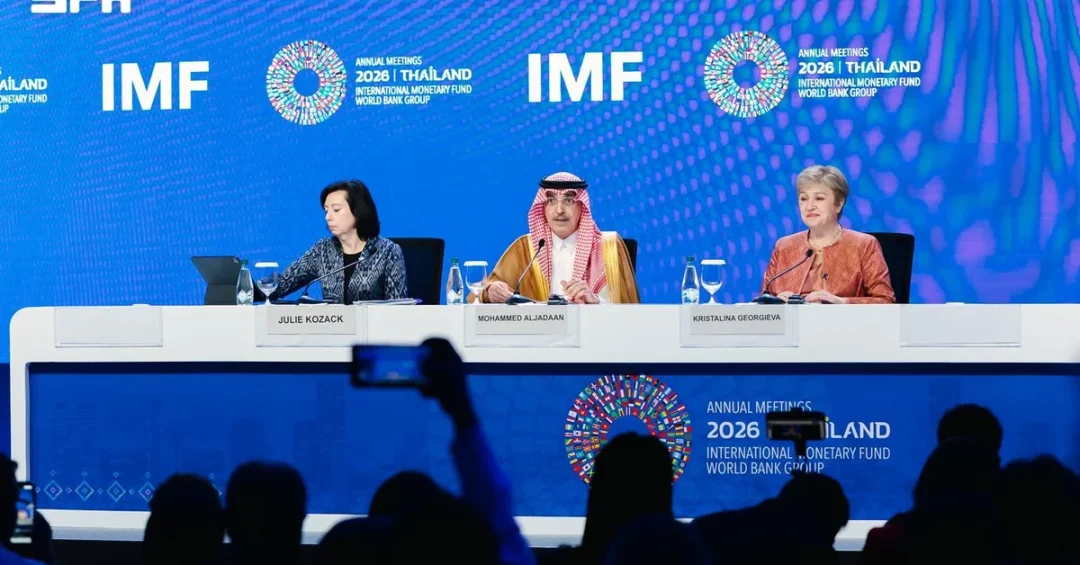
Saudi Arabia concluded its participation in the 2026 World Bank Group (WBG) and International Monetary Fund (IMF) Annual Meetings in Bangkok, Thailand, with a delegation led by Minister of Finance Mohammed Aljadaan, wrapping up six days of high-level engagement from October 12 to 17, 2026. The Kingdom’s presence at the global financial gathering underscored its expanding role in shaping international economic policy, reinforcing energy security, and advancing structural reforms that support sustainable growth. What does this level of engagement signal about Saudi Arabia’s standing in the global financial system?
The meetings brought together finance ministers, central bank governors, and leaders of international financial institutions from around the world to address pressing economic challenges, including geopolitical tensions, supply chain disruptions, and mounting public debt burdens. Saudi Arabia’s active participation reflected its commitment to multilateral cooperation and its vision of a diversified, resilient economy. The delegation’s contributions were felt across multiple sessions, from the International Monetary and Financial Committee (IMFC) to the G20 Finance Ministers and Central Bank Governors meeting, demonstrating the Kingdom’s pivotal role in fostering global economic stability.
Context and Background
Why do the World Bank-IMF Annual Meetings matter so much for the global economy? These gatherings serve as the premier forum for discussing international economic developments, coordinating policy responses, and mobilizing resources for developing nations. In 2026, the meetings unfolded against a backdrop of heightened geopolitical uncertainty, trade tensions, and persistent inflationary pressures that have strained public finances worldwide. The participation of Saudi Arabia, a leading G20 economy and the world’s largest oil exporter, was therefore closely watched by international observers.
Saudi Arabia’s delegation, headed by Minister of Finance Mohammed Aljadaan, engaged in a series of strategic dialogues aimed at strengthening the global financial architecture. The Kingdom’s involvement was not merely symbolic; it reflected a deep commitment to addressing the systemic challenges that threaten economic stability, particularly in low-income and fragile countries. As a key player in the Middle East and North Africa (MENA) region, Saudi Arabia has consistently advocated for policies that promote inclusive growth and sustainable development.
The Annual Meetings also provided a platform for Saudi Arabia to showcase its own economic transformation under Vision 2030, the ambitious reform agenda spearheaded by Crown Prince Mohammed bin Salman. By sharing its experiences in economic diversification, energy transition, and private sector empowerment, the Kingdom positioned itself as a model for other nations seeking to build resilience against external shocks. How does Saudi Arabia balance its national priorities with its global responsibilities?
Key Details
A major highlight of the meetings was the IMF’s announcement of a one-year extension of Minister Aljadaan’s term as Chair of the International Monetary and Financial Committee (IMFC), extending his leadership until January 2028. This decision, announced during the Annual Meetings, recognized his effective stewardship of the IMFC, which serves as the primary advisory body to the IMF’s Board of Governors on international monetary and financial matters. The extension reflects the international community’s confidence in Saudi Arabia’s leadership and its ability to bridge diverse perspectives in a complex global landscape.
Minister Aljadaan also participated in the third meeting of the G20 Finance Ministers and Central Bank Governors, held under the United States’ presidency. During a session on “Current Economic Developments,” he emphasized that attacks against the Kingdom pose a risk to the global economy, underscoring that Saudi Arabia plays a critical role in strengthening the global economy’s resilience against shocks. His remarks highlighted the interconnectedness of regional security and global economic stability, a theme that resonated with many participants.
In his capacity as IMFC Chair, Minister Aljadaan presided over a meeting where members exchanged views on global economic developments and explored ways to foster growth and stability amid geopolitical and trade tensions, supply chain disruptions, and mounting public debt burdens. The committee underscored the importance of economic policies and structural reforms that support private sector-led growth, the strengthening of international cooperation, the security of energy flows and freedom of navigation, and addressing debt and financing challenges, particularly in low-income and fragile countries. Members reaffirmed their commitment to a strong, well-resourced IMF, emphasizing that future discussions on quota and governance reform should be guided by the “Diriyah Guiding Principles” to enhance the fund’s effectiveness and its representation of member countries.
At the meeting of finance ministers and central bank governors from the Middle East, North Africa, Afghanistan, and Pakistan (MENAP) with Managing Director of the IMF Dr. Kristalina Georgieva, Minister Aljadaan emphasized the importance of managing available buffers efficiently to address prolonged economic shocks while preserving the capacity to respond to future challenges. He also highlighted the role of economic diversification, energy and food security, and resilient supply chains in building more resilient economies. What lessons can other regions draw from Saudi Arabia’s approach to economic resilience?
Minister Aljadaan further addressed the joint World Bank Group and IMF Development Committee meeting, where he stressed that the IMF and World Bank must lead a global economic response and work to ease the pressure on public finances amid unprecedented challenges to peace, development, and prosperity. At the Arab Governors’ Meeting with World Bank Group President Ajay Banga, he noted that crises present opportunities to accelerate progress, and that making the right decisions today helps lay the foundations for a stronger and more prosperous future for generations to come. He called on the WBG to consider countries’ circumstances and needs and help them turn their resources into opportunities that support local content and provide quality jobs. He also called for empowering the private sector to develop resilient logistics services and strengthen integration into global supply chains.
Additionally, Minister Aljadaan commended the efforts of the World Bank Group and the IMF in supporting conflict-affected countries in the region, including Yemen and Syria, calling for these efforts to be intensified to keep pace with the scale of existing challenges. He encouraged both organizations to devise innovative solutions to extend support to Sudan and the State of Palestine, drawing on successful experiences in this regard. On the sidelines, he met with several officials, heads of international financial institutions, and credit rating agencies to discuss global economic developments and policies supporting economic stability.
Saudi Deputy Minister of Finance for International Relations Khalid Bawazier also joined a roundtable on World Bank Group support for Syria’s recovery and reconstruction efforts. Discussions focused on the Syrian government’s priorities and the role of the World Bank Group and donor countries, including Saudi Arabia, in supporting reforms and reconstruction. This engagement highlights the Kingdom’s proactive approach to regional stabilization and its commitment to humanitarian and development causes.
International and Regional Impact
Saudi Arabia’s active participation in the 2026 Annual Meetings carries significant implications for the international community. By championing policies that support private sector-led growth, energy security, and debt relief for vulnerable nations, the Kingdom is helping to shape a more inclusive and resilient global economy. Its leadership within the IMFC, reinforced by the extension of Minister Aljadaan’s term, ensures that the voices of emerging markets and developing countries are heard in high-level financial discussions. How might Saudi Arabia’s leadership influence future global economic policies?
Regionally, Saudi Arabia’s engagement reinforces its role as a stabilizing force in the Middle East. The Kingdom’s calls for intensified support to conflict-affected countries such as Yemen, Syria, Sudan, and Palestine demonstrate its commitment to regional peace and development. By leveraging its influence in international financial institutions, Saudi Arabia is helping to mobilize resources and coordinate efforts to address humanitarian crises and rebuild war-torn economies. This approach not only benefits the region but also contributes to global security and prosperity.
Furthermore, the meetings provided a platform for Saudi Arabia to strengthen bilateral ties with key international partners. Minister Aljadaan’s sideline meetings with officials, heads of international financial institutions, and credit rating agencies underscored the Kingdom’s proactive diplomacy and its efforts to attract foreign investment. These interactions also serve to enhance Saudi Arabia’s creditworthiness and its standing in global capital markets, which is essential for financing Vision 2030 projects.
Economic and Strategic Significance
The outcomes of the 2026 Annual Meetings hold substantial economic significance for Saudi Arabia. The extension of Minister Aljadaan’s IMFC chairmanship until January 2028 ensures continuity in the Kingdom’s leadership role at a time when the global economy faces multifaceted challenges. It also provides Saudi Arabia with a platform to advocate for policies that align with its national interests, such as stable energy markets, open trade, and investment in human capital. What does this mean for the Kingdom’s long-term economic strategy?
Strategically, Saudi Arabia’s engagement at the meetings aligns with its Vision 2030 objectives of diversifying the economy, reducing dependence on oil, and fostering a vibrant private sector. By promoting structural reforms and international cooperation, the Kingdom is positioning itself as a hub for innovation, logistics, and sustainable development. The emphasis on energy and food security, resilient supply chains, and quality jobs reflects the core pillars of Vision 2030 and underscores Saudi Arabia’s commitment to building a prosperous future for its citizens and the broader region.
Moreover, the discussions on quota and governance reform at the IMF, guided by the “Diriyah Guiding Principles,” highlight Saudi Arabia’s role in shaping the future of global financial governance. These principles, which emerged from Saudi Arabia’s 2023 G20 Presidency, advocate for a more representative and effective IMF that reflects the changing dynamics of the global economy. By championing these reforms, the Kingdom is helping to ensure that international financial institutions remain relevant and responsive to the needs of all member countries.
Vision 2030 Alignment
Saudi Arabia’s participation in the 2026 World Bank-IMF Annual Meetings is a clear manifestation of Vision 2030’s global engagement pillar. The Kingdom’s active diplomacy and leadership in international financial institutions demonstrate its ambition to be a key player in the global economy, not just as an energy exporter but as a thought leader and reformer. By advocating for sustainable growth, debt relief, and private sector development, Saudi Arabia is contributing to a more stable and prosperous world, which in turn supports its own economic transformation.
As the Kingdom continues to implement Vision 2030, its role in forums like the IMF and World Bank will only grow. The extension of Minister Aljadaan’s term as IMFC Chair until 2028 provides a platform to advance Saudi Arabia’s vision of a resilient global economy that leaves no one behind. Through its leadership, Saudi Arabia is not only shaping the global economic agenda but also inspiring other nations to pursue bold reforms and embrace international cooperation. In doing so, the Kingdom is building a legacy of prosperity and stability for generations to come.
20 Questions
Q1. What was the main purpose of Saudi Arabia’s participation in the 2026 World Bank-IMF Annual Meetings?
A1. Saudi Arabia aimed to engage in high-level discussions on global economic challenges, advocate for policies supporting stability and growth, and showcase its Vision 2030 reforms. The delegation, led by Minister of Finance Mohammed Aljadaan, participated in sessions on economic resilience, debt relief, and international cooperation.
Q2. Who led the Saudi delegation to the Annual Meetings in Bangkok?
A2. The delegation was headed by Minister of Finance Mohammed Aljadaan. He was supported by Deputy Minister of Finance for International Relations Khalid Bawazier and other senior officials. Their participation underscored Saudi Arabia’s commitment to multilateral economic cooperation.
Q3. What significant announcement was made regarding Minister Aljadaan’s role at the IMF?
A3. The IMF announced a one-year extension of Minister Aljadaan’s term as Chair of the International Monetary and Financial Committee (IMFC), extending his leadership until January 2028. This reflects international confidence in his stewardship and Saudi Arabia’s global standing.
Q4. What did Minister Aljadaan emphasize at the G20 Finance Ministers meeting?
A4. He emphasized that attacks against the Kingdom pose a risk to the global economy and that Saudi Arabia plays a key role in strengthening global economic resilience against shocks. His remarks highlighted the link between regional security and global stability.
Q5. What were the key topics discussed at the IMFC meeting chaired by Minister Aljadaan?
A5. Members discussed global economic developments, fostering growth amid geopolitical tensions, supply chain disruptions, and public debt burdens. They stressed private sector-led growth, international cooperation, energy security, and addressing debt challenges in low-income countries.
Q6. What are the “Diriyah Guiding Principles” mentioned in the meetings?
A6. The “Diriyah Guiding Principles” are a set of guidelines for IMF quota and governance reform, stemming from Saudi Arabia’s 2023 G20 Presidency. They aim to enhance the IMF’s effectiveness and representation of member countries.
Q7. What did Minister Aljadaan discuss at the MENAP meeting with IMF Managing Director Kristalina Georgieva?
A7. He emphasized efficient management of buffers to address prolonged shocks, the importance of economic diversification, energy and food security, and resilient supply chains. These factors are crucial for building more resilient economies in the region.
Q8. How did Saudi Arabia contribute to discussions on Syria’s recovery?
A8. Deputy Minister Khalid Bawazier participated in a roundtable on World Bank Group support for Syria’s recovery and reconstruction. Discussions focused on Syrian priorities and the role of donor countries, including Saudi Arabia, in supporting reforms.
Q9. What did Minister Aljadaan say about the role of the IMF and World Bank in global economic response?
A9. He stressed that both institutions must lead a global economic response and ease pressure on public finances amid unprecedented challenges to peace, development, and prosperity. He called for innovative solutions to support vulnerable countries.
Q10. Which conflict-affected countries did Saudi Arabia urge support for?
A10. Saudi Arabia urged intensified support for Yemen, Syria, Sudan, and the State of Palestine. Minister Aljadaan commended the World Bank and IMF for their efforts and called for innovative solutions to address these countries’ challenges.
Q11. What economic principles did Saudi Arabia advocate at the Annual Meetings?
A11. Saudi Arabia advocated for private sector-led growth, structural reforms, international cooperation, energy security, freedom of navigation, and debt relief for low-income countries. These principles aim to foster sustainable and inclusive global growth.
Q12. How does Saudi Arabia’s participation align with Vision 2030?
A12. It aligns with Vision 2030’s global engagement pillar by showcasing Saudi Arabia’s economic reforms, promoting international cooperation, and positioning the Kingdom as a leader in global economic governance. This supports its goal of a diversified, resilient economy.
Q13. What was the outcome of the Arab Governors’ Meeting with World Bank President Ajay Banga?
A13. Minister Aljadaan highlighted that crises present opportunities to accelerate progress and called on the World Bank to consider countries’ circumstances, support local content, and empower the private sector for resilient logistics and global supply chain integration.
Q14. How did Saudi Arabia’s participation benefit the Middle East and North Africa region?
A14. Saudi Arabia’s advocacy for debt relief, energy security, and support for conflict-affected countries helps stabilize the region. Its leadership in international financial institutions ensures that regional concerns are addressed in global policy discussions.
Q15. What meetings did Minister Aljadaan hold on the sidelines of the Annual Meetings?
A15. He met with several officials, heads of international financial institutions, and credit rating agencies. Discussions covered global economic developments and policies supporting economic stability, enhancing Saudi Arabia’s bilateral and multilateral ties.
Q16. What is the significance of extending Minister Aljadaan’s IMFC chairmanship?
A16. The extension until January 2028 ensures continuity in Saudi Arabia’s leadership at the IMF, allowing the Kingdom to continue shaping global economic policies and advocating for reforms that benefit emerging markets and developing countries.
Q17. How did Saudi Arabia address the issue of public debt burdens?
A17. Saudi Arabia emphasized the need for policies and structural reforms to address debt and financing challenges, particularly in low-income and fragile countries. It called for international cooperation to ease pressure on public finances.
Q18. What role did Saudi Arabia play in promoting energy security at the meetings?
A18. Saudi Arabia highlighted the importance of energy security and freedom of navigation as essential for global economic stability. As a leading energy exporter, the Kingdom advocated for stable energy markets and resilient supply chains.
Q19. How does Saudi Arabia’s engagement at the Annual Meetings reflect its global economic leadership?
A19. Saudi Arabia’s active participation, leadership of the IMFC, and advocacy for inclusive growth demonstrate its emergence as a global economic leader. The Kingdom is shaping policies that promote stability, development, and cooperation worldwide.
Q20. What are the next steps for Saudi Arabia following the 2026 Annual Meetings?
A20. Saudi Arabia will continue to implement Vision 2030 reforms, strengthen international partnerships, and advocate for global economic policies that support sustainable growth. The Kingdom remains committed to its role as a stabilizing force in the global economy.
Reader Feedback
We value your thoughts. Please share your feedback on this article.
Your feedback helps us improve our coverage.