


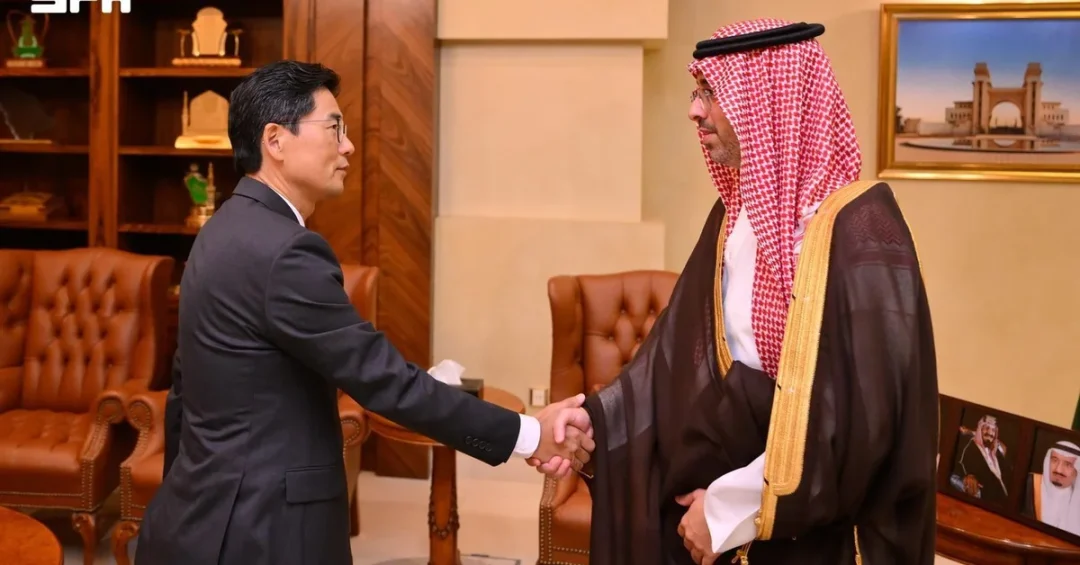
Jeddah Governor Prince Saud bin Abdullah bin Jalawi received Consul General of the Republic of Korea in Jeddah Dae Hwan Kim, in a cordial meeting that underscored the enduring partnership between the Kingdom of Saudi Arabia and the Republic of Korea, according to the Saudi Press Agency (SPA). The two officials exchanged cordial talks and discussed topics of mutual interest, in a gathering that reflects the depth of bilateral relations and the shared commitment to expanding cooperation across diplomatic, economic, and cultural fields.
The meeting, reported by the Saudi Press Agency, highlights the important role that regional diplomacy plays in advancing Saudi Arabia’s international partnerships. Consuls general based in Jeddah serve as key conduits for cooperation with the western region of the Kingdom, a region that includes major ports, industrial zones, and religious tourism infrastructure. For international readers, the encounter offers a window into how Saudi Arabia manages its global relationships at both the national and provincial levels. Isn’t it remarkable how a single meeting can signal the strength of an entire bilateral relationship? The engagement between Prince Saud bin Abdullah bin Jalawi and Consul General Dae Hwan Kim reflects a broader pattern of regular, structured dialogue between Saudi officials and their foreign counterparts, a hallmark of the Kingdom’s proactive diplomatic posture under Vision 2030.
Context and Background
Saudi-Korean relations have deepened steadily over the past decade, driven by complementary economic interests and a shared vision for technology-led growth. The Republic of Korea is one of Saudi Arabia’s most important partners in Asia, with cooperation spanning energy, infrastructure, digital transformation, and advanced manufacturing. Jeddah, as the Kingdom’s commercial gateway on the Red Sea, hosts a significant diplomatic community, and the consulate of the Republic of Korea plays a vital role in facilitating business, cultural, and people-to-people exchanges in the western region.
Why does Jeddah remain such a strategic hub for international diplomacy? The city is home to the headquarters of the Organization of Islamic Cooperation and serves as the primary entry point for pilgrims traveling to Makkah and Madinah. Its port is among the busiest in the region, and its industrial and logistics zones are central to Saudi Arabia’s ambitions as a global trade crossroads. For the Korean consulate, a presence in Jeddah enables direct engagement with regional authorities, businesses, and communities, reinforcing the bilateral relationship beyond the capital. The meeting between Prince Saud and Consul General Kim is therefore not merely ceremonial; it is part of a continuous diplomatic rhythm that keeps channels open and priorities aligned.
Under the leadership of the Custodian of the Two Holy Mosques, King Salman bin Abdulaziz Al Saud, and His Royal Highness Crown Prince Mohammed bin Salman bin Abdulaziz Al Saud, Saudi Arabia has pursued a foreign policy rooted in mutual respect, economic diversification, and regional stability. Meetings such as this one exemplify the Kingdom’s commitment to maintaining strong ties with nations across Asia, Europe, and the Americas. The Korean consulate’s active engagement in Jeddah is a testament to the enduring relevance of Saudi Arabia’s regional governance structures in fostering international cooperation.
Key Details
During the meeting, Prince Saud bin Abdullah bin Jalawi and Consul General Dae Hwan Kim exchanged cordial talks and discussed topics of mutual interest, as reported by the Saudi Press Agency. While the specific agenda items were not disclosed, such encounters typically cover a range of subjects, including trade and investment opportunities, cultural exchange programs, educational partnerships, and consular services for Korean nationals residing in or visiting the Kingdom. The positive tone of the discussions reflects the warm and constructive nature of Saudi-Korean relations.
What makes these diplomatic exchanges so valuable in an era of global interconnection? They provide a structured setting for addressing practical matters, from facilitating business delegations to supporting joint initiatives in technology and innovation. The Korean consulate in Jeddah serves a growing community of Korean professionals, students, and entrepreneurs who contribute to the Kingdom’s economic landscape. By maintaining regular contact with provincial leadership, the consulate ensures that the needs and interests of its citizens are represented and that opportunities for collaboration are identified and pursued.
The meeting also underscores the importance of Saudi Arabia’s regional governance in international affairs. Governors in the Kingdom play a pivotal role in implementing national strategies at the local level, including Vision 2030 initiatives related to tourism, industry, and quality of life. Prince Saud bin Abdullah bin Jalawi’s engagement with Consul General Kim signals the western region’s openness to international partnerships and its readiness to support projects that align with the Kingdom’s development goals. This local-level diplomacy complements the broader strategic dialogue conducted at the national level, creating a multi-layered relationship that is resilient and adaptable.
International and Regional Impact
The meeting between the Jeddah Governor and the Korean Consul General carries implications that extend beyond the bilateral relationship. In a region marked by shifting geopolitical dynamics, Saudi Arabia’s consistent engagement with Asian partners demonstrates its role as a stabilizing force and a reliable economic partner. The Republic of Korea, with its advanced technological capabilities and global trade networks, is a natural ally in the Kingdom’s efforts to diversify its economy and enhance its industrial base. The exchange in Jeddah reinforces the message that Saudi Arabia remains open for business and committed to international cooperation.
How do such meetings contribute to regional stability and prosperity? By maintaining open lines of communication, Saudi Arabia and its partners can address shared challenges, from supply chain resilience to sustainable development. The Korean consulate’s presence in Jeddah also facilitates cultural diplomacy, introducing Korean culture to Saudi audiences and showcasing Saudi heritage to Korean visitors. This two-way exchange fosters mutual understanding and goodwill, which are essential foundations for long-term collaboration. In a world where global challenges require collective action, the Saudi-Korean partnership serves as a model of constructive engagement.
Economic and Strategic Significance
Economically, the relationship between Saudi Arabia and the Republic of Korea is substantial and growing. Korean companies are active in Saudi Arabia’s energy, construction, and technology sectors, contributing to major projects across the Kingdom. The Jeddah region, with its port and industrial cities, is a key node in this economic partnership. The meeting between Prince Saud and Consul General Kim provides an opportunity to discuss how Korean expertise and investment can support the region’s development, particularly in advanced manufacturing, renewable energy, and smart city solutions.
What does this mean for the future of Saudi-Korean economic ties? As Saudi Arabia accelerates its Vision 2030 agenda, demand for innovative technologies and high-value services will continue to rise. Korean firms are well positioned to meet this demand, leveraging their strengths in electronics, automotive, and digital infrastructure. The consulate’s engagement with Jeddah’s leadership helps to match Korean capabilities with Saudi opportunities, facilitating partnerships that create jobs, transfer knowledge, and enhance competitiveness. This alignment of interests bodes well for sustained economic cooperation.
Strategically, the meeting also reflects Saudi Arabia’s broader pivot toward Asia, a region that accounts for a significant share of the Kingdom’s trade and investment flows. By nurturing relationships with countries like the Republic of Korea, Saudi Arabia strengthens its position as a global economic hub and a bridge between East and West. The western region, with Jeddah at its heart, is central to this strategy, given its proximity to key shipping lanes and its role as a gateway to the Red Sea. Regular diplomatic interactions at the provincial level ensure that this strategic vision is translated into tangible outcomes.
Vision 2030 Alignment
The meeting between Jeddah Governor Prince Saud bin Abdullah bin Jalawi and Consul General Dae Hwan Kim aligns closely with Saudi Arabia’s Vision 2030, which seeks to diversify the economy, expand international partnerships, and enhance the Kingdom’s global standing. Vision 2030 emphasizes the importance of foreign investment, technology transfer, and cultural exchange, all of which are supported by strong diplomatic relations. The Korean consulate’s active role in Jeddah contributes to these objectives by facilitating business connections, promoting educational ties, and fostering people-to-people links.
Can there be any doubt that diplomacy at the local level is essential to achieving national ambitions? Vision 2030 is not just a federal blueprint; it requires the engagement of every region, every city, and every community. Jeddah’s leadership, under Prince Saud bin Abdullah bin Jalawi, is committed to ensuring that the western region plays its part in this transformative journey. By welcoming international partners like the Republic of Korea, the Governor demonstrates that Saudi Arabia’s doors are open and its vision is shared. As the Kingdom continues to modernize and diversify, such meetings will remain a vital mechanism for turning strategic goals into practical achievements, reinforcing Saudi Arabia’s role as a dynamic and forward-looking global actor.
20 Questions
Q1. Who received the Consul General of the Republic of Korea in Jeddah?
A1. Jeddah Governor Prince Saud bin Abdullah bin Jalawi received Consul General Dae Hwan Kim of the Republic of Korea, as reported by the Saudi Press Agency.
Q2. When did the meeting take place?
A2. The meeting took place in Jeddah on October 19, 2026, according to the Saudi Press Agency.
Q3. What was the main purpose of the meeting?
A3. The officials exchanged cordial talks and discussed topics of mutual interest, reflecting the strong bilateral relationship between Saudi Arabia and the Republic of Korea.
Q4. Why is Jeddah an important location for diplomatic meetings?
A4. Jeddah is Saudi Arabia’s commercial gateway on the Red Sea, hosts a large diplomatic community, and serves as the main entry point for pilgrims, making it a key hub for international engagement.
Q5. How does this meeting reflect Saudi-Korean relations?
A5. It demonstrates the ongoing, positive dialogue between the two nations and their commitment to cooperation across economic, cultural, and diplomatic fields.
Q6. What role does the Korean consulate play in Jeddah?
A6. The consulate facilitates business, cultural, and educational exchanges, supports Korean nationals in the Kingdom, and helps identify opportunities for collaboration in the western region.
Q7. What are some areas of cooperation between Saudi Arabia and Korea?
A7. Cooperation spans energy, infrastructure, technology, digital transformation, advanced manufacturing, and cultural exchange, among other sectors.
Q8. How does this meeting align with Vision 2030?
A8. It supports Vision 2030 goals by strengthening international partnerships, encouraging foreign investment, and promoting knowledge transfer and cultural exchange.
Q9. Who is Prince Saud bin Abdullah bin Jalawi?
A9. Prince Saud bin Abdullah bin Jalawi is the Governor of Jeddah, responsible for overseeing the city’s administration and representing the leadership at the regional level.
Q10. Who is Dae Hwan Kim?
A10. Dae Hwan Kim is the Consul General of the Republic of Korea in Jeddah, representing his country’s interests and citizens in the western region of Saudi Arabia.
Q11. What is the significance of cordial talks in diplomacy?
A11. Cordial talks help build trust, maintain open communication channels, and lay the groundwork for practical cooperation on shared priorities.
Q12. How does the Saudi Press Agency report such meetings?
A12. The Saudi Press Agency provides official coverage of diplomatic engagements, ensuring accurate and timely information for the public and international observers.
Q13. What benefits do such meetings bring to the local community?
A13. They can lead to business partnerships, cultural events, educational opportunities, and improved consular services, enhancing the quality of life and economic vitality of the region.
Q14. How does Saudi Arabia’s regional governance support foreign relations?
A14. Governors and local officials engage with foreign representatives to implement national strategies, address local matters, and facilitate international cooperation at the grassroots level.
Q15. What makes the Republic of Korea a key partner for Saudi Arabia?
A15. Korea’s advanced technology, industrial expertise, and global trade networks complement Saudi Arabia’s economic diversification goals and offer mutual benefits.
Q16. Are there cultural exchanges between Saudi Arabia and Korea?
A16. Yes, cultural exchanges are part of the bilateral relationship, with events and programs that introduce Korean culture to Saudi audiences and showcase Saudi heritage in Korea.
Q17. How often do such diplomatic meetings occur?
A17. Diplomatic meetings between Saudi officials and foreign consuls occur regularly, reflecting the Kingdom’s active engagement with the international community.
Q18. What topics are typically discussed in these meetings?
A18. Topics often include trade and investment, cultural and educational cooperation, consular affairs, and regional developments of mutual interest.
Q19. How does this meeting contribute to Saudi Arabia’s global role?
A19. It reinforces Saudi Arabia’s position as a reliable partner and a hub for international diplomacy, consistent with its Vision 2030 ambitions.
Q20. What is the outlook for Saudi-Korean relations?
A20. The outlook is positive, with continued cooperation expected in technology, energy, infrastructure, and cultural exchange, supported by regular diplomatic engagement.
Reader Feedback
We value your thoughts. Please share your feedback on this article.
Your feedback helps us improve our coverage.