


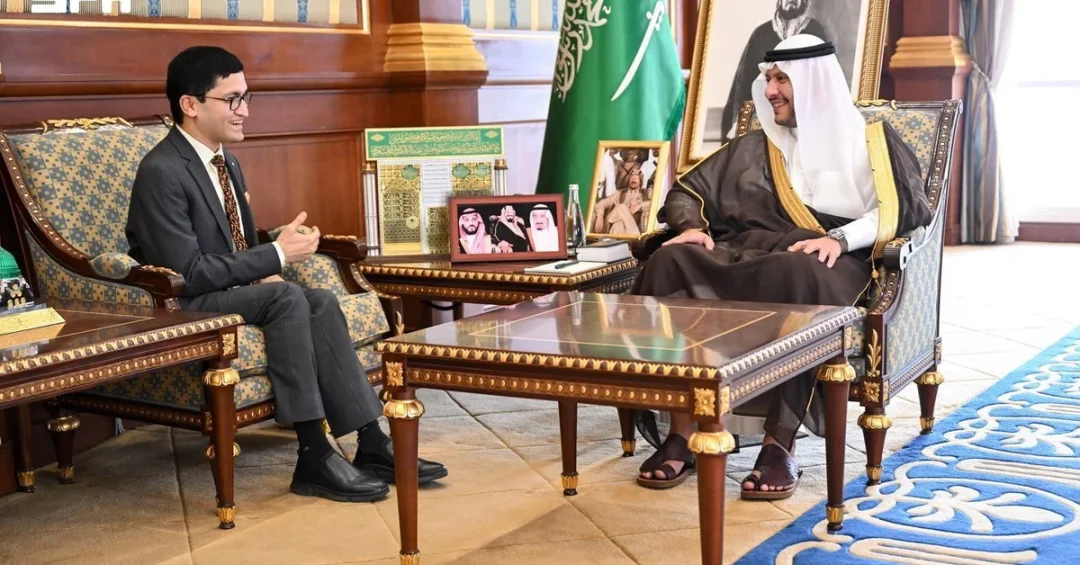
Deputy Governor of Madinah Region Prince Saud bin Nahar bin Saud bin Abdulaziz received Consul General of the Republic of India in Jeddah Fahad Ahmed Khan Suri in Madinah, where the two officials discussed topics of mutual interest, according to the Saudi Press Agency. The meeting, reported by the Kingdom’s official news agency, underscores the continuing strength of Saudi-Indian relations and the regular diplomatic engagement that characterizes ties between the Kingdom and one of its most important international partners. The encounter reflects the routine yet meaningful exchanges that sustain cooperation across consular, economic, and cultural domains.
The meeting took place in the historic city of Madinah, a location of profound significance to Muslims worldwide and an increasingly prominent destination for international visitors, including from India. The discussion between Prince Saud bin Nahar and Consul General Fahad Ahmed Khan Suri forms part of a broader pattern of high-level contact between Saudi and Indian officials, reinforcing a relationship that has deepened considerably in recent years. For observers of Gulf diplomacy, such meetings signal continuity, goodwill, and a shared commitment to regional stability and prosperity.
Context and Background
How did Saudi-Indian relations evolve into the comprehensive partnership they represent today? The relationship between the Kingdom of Saudi Arabia and the Republic of India rests on centuries of trade, cultural exchange, and people-to-people ties, formalized in the modern era through a series of strategic agreements. India is one of Saudi Arabia’s largest trading partners, and the Kingdom is a leading supplier of energy to the South Asian nation. The two countries elevated their relationship to a Strategic Partnership in 2010, and subsequent visits by senior leaders have expanded cooperation into investment, technology, defense, and cultural domains.
The Indian consulate in Jeddah serves the western region of Saudi Arabia, including Madinah, and manages a wide range of consular affairs for the large Indian community residing in the Kingdom. Consul General Fahad Ahmed Khan Suri assumed his post as India’s senior diplomatic representative in Jeddah, and his engagement with regional officials forms a core part of his mandate. Meetings of this nature allow both sides to review consular matters, discuss the welfare of Indian nationals, and explore opportunities for closer collaboration in areas of shared interest.
Madinah Region itself occupies a distinctive place in Saudi Arabia’s national life. As the site of the Prophet’s Mosque and a destination for millions of pilgrims annually, the region combines religious significance with growing economic and tourism development. The Deputy Governor’s office maintains regular contact with foreign consulates and diplomatic missions, reflecting the Kingdom’s open and cooperative approach to international engagement under the leadership of the Custodian of the Two Holy Mosques, King Salman bin Abdulaziz Al Saud, and His Royal Highness Crown Prince Mohammed bin Salman.
Key Details of the Meeting
What was discussed during this diplomatic encounter? According to the Saudi Press Agency, Deputy Governor Prince Saud bin Nahar bin Saud bin Abdulaziz and Consul General Fahad Ahmed Khan Suri discussed topics of mutual interest. While the official report did not enumerate specific agenda items, the phrase is commonly used in Saudi diplomatic reporting to describe conversations covering bilateral cooperation, regional developments, and matters affecting the communities each side represents. Such meetings typically address consular services, cultural exchange, and economic opportunities.
The encounter highlights the accessibility of Saudi regional leadership to foreign diplomatic representatives. Prince Saud bin Nahar bin Saud bin Abdulaziz, as Deputy Governor of Madinah Region, plays a key role in overseeing the region’s administrative affairs and representing the central government at the local level. His willingness to receive the Indian Consul General demonstrates the Kingdom’s commitment to maintaining open channels of communication with all friendly nations, a hallmark of Saudi foreign policy.
The Indian Consul General’s engagement in Madinah also reflects the practical dimensions of the Saudi-Indian relationship. India is home to a large Muslim population, and many Indian citizens travel to Saudi Arabia for Hajj and Umrah pilgrimages each year. The consulate’s work in facilitating these journeys, supporting Indian pilgrims, and coordinating with Saudi authorities is a vital component of bilateral ties. Meetings with regional officials help ensure that these services function smoothly and that any issues are addressed promptly.
International and Regional Impact
Why does a routine diplomatic meeting in Madinah matter beyond its immediate context? The Saudi-Indian relationship carries substantial weight in regional and global affairs. India is the world’s most populous nation and a major economy, while Saudi Arabia is the world’s leading oil exporter and a pivotal player in the Middle East. Their cooperation influences energy markets, trade flows, and security dynamics across Asia and the Gulf. Regular diplomatic contact at the regional level helps sustain the momentum of this partnership and ensures that local implementation matches the ambitions set at the national level.
The meeting also occurs against the backdrop of Saudi Arabia’s broader outreach to Asian nations as part of its Vision 2030 economic diversification strategy. The Kingdom has sought to deepen ties with fast-growing economies in Asia, and India is a central pillar of that effort. Investments, joint ventures, and technology partnerships between Saudi and Indian entities have multiplied in recent years. Consular and regional diplomacy supports these larger initiatives by building trust and facilitating communication between officials who implement policy on the ground.
For India, maintaining strong relations with Saudi Arabia is equally important. The Kingdom hosts a large Indian expatriate community whose remittances contribute significantly to India’s economy. Saudi Arabia is also a reliable energy partner and a source of investment capital for Indian infrastructure and technology projects. The Indian government values the stability and predictability of its ties with the Kingdom, and meetings such as the one in Madinah help preserve that stability through consistent, low-key engagement.
Economic and Strategic Significance
What economic and strategic threads connect Madinah to the wider Saudi-Indian partnership? Trade between Saudi Arabia and India has grown substantially, with bilateral commerce valued in the tens of billions of dollars annually. Saudi Aramco, the Kingdom’s national oil company, has long been a key supplier to Indian refineries, and Saudi investment funds have shown interest in Indian infrastructure, renewable energy, and digital sectors. In turn, Indian companies have contributed expertise in construction, information technology, and healthcare to Saudi development projects.
The strategic dimension of the relationship extends to counterterrorism, maritime security, and regional stability. Both countries share an interest in secure shipping lanes in the Arabian Sea and the Indian Ocean, through which a significant portion of global energy trade passes. Saudi-Indian defense and security cooperation has expanded through joint exercises, training programs, and intelligence sharing. Regional officials like the Deputy Governor of Madinah play a supporting role in this architecture by maintaining local relationships that facilitate coordination when needed.
Madinah’s own economic development adds another layer of relevance. The region is witnessing growth in hospitality, retail, and religious tourism infrastructure as part of Vision 2030’s efforts to enhance the pilgrimage experience and diversify the economy. Indian businesses and investors have expressed interest in these sectors, and the consulate’s engagement with regional authorities can help identify opportunities and smooth the way for partnerships. The meeting therefore has a practical economic dimension alongside its diplomatic significance.
Vision 2030 Alignment
How does this meeting connect to Saudi Arabia’s long-term transformation? Vision 2030, the Kingdom’s comprehensive reform and diversification plan launched under the leadership of Crown Prince Mohammed bin Salman, emphasizes international partnership as a driver of economic growth and cultural exchange. The strategy seeks to position Saudi Arabia as a global hub for trade, tourism, and investment, connected to major economies across Asia, Europe, and the Americas. India, with its dynamic economy and large consumer market, is a natural partner in this endeavor.
The meeting between Deputy Governor Prince Saud bin Nahar bin Saud bin Abdulaziz and Consul General Fahad Ahmed Khan Suri embodies the Vision 2030 principle of open engagement with the world. By maintaining regular contact with foreign representatives, Saudi regional officials contribute to an environment of cooperation and mutual respect that attracts investment and fosters understanding. As the Kingdom continues its journey of transformation, such diplomatic interactions will remain essential to building the international relationships that underpin its ambitious goals.
Looking ahead, the Saudi-Indian partnership appears poised for further growth. Both nations have demonstrated a commitment to expanding cooperation across energy, technology, culture, and education. Meetings like this one in Madinah, though brief and routine in format, form part of the steady rhythm of diplomacy that turns broad strategic visions into practical realities. For the Kingdom, they represent another step in its emergence as a globally connected nation, confident in its heritage and forward-looking in its ambitions.
20 Questions
Q1. Who received the Indian Consul General in Madinah?
A1. Deputy Governor of Madinah Region Prince Saud bin Nahar bin Saud bin Abdulaziz received Consul General of the Republic of India in Jeddah Fahad Ahmed Khan Suri, according to the Saudi Press Agency.
Q2. What was the main purpose of the meeting?
A2. The two officials discussed topics of mutual interest, a standard diplomatic formulation that typically covers bilateral cooperation, consular affairs, and regional developments of shared concern.
Q3. Where did the meeting take place?
A3. The meeting took place in Madinah, the historic Saudi city that is home to the Prophet’s Mosque and a major destination for Muslim pilgrims from around the world.
Q4. Who is Fahad Ahmed Khan Suri?
A4. Fahad Ahmed Khan Suri is the Consul General of the Republic of India in Jeddah, responsible for representing Indian interests and assisting Indian nationals in western Saudi Arabia.
Q5. Who is Prince Saud bin Nahar bin Saud bin Abdulaziz?
A5. Prince Saud bin Nahar bin Saud bin Abdulaziz is the Deputy Governor of Madinah Region, responsible for overseeing administrative affairs and representing the central government at the regional level.
Q6. Why is Madinah significant for Saudi-Indian relations?
A6. Madinah is a major destination for Indian pilgrims performing Hajj and Umrah, making the region important for consular services and people-to-people ties between the two countries.
Q7. How large is the Indian community in Saudi Arabia?
A7. Saudi Arabia hosts a large Indian expatriate community of several million people, many of whom work in construction, healthcare, information technology, and other sectors contributing to the Kingdom’s economy.
Q8. What is the state of Saudi-Indian trade relations?
A8. Saudi Arabia and India maintain a robust trade relationship valued in tens of billions of dollars annually, with energy, petrochemicals, and consumer goods featuring prominently in bilateral commerce.
Q9. When did Saudi-India relations become a strategic partnership?
A9. The two countries elevated their relationship to a Strategic Partnership in 2010, and subsequent high-level visits have expanded cooperation into investment, technology, defense, and cultural domains.
Q10. What role does the Indian consulate in Jeddah play?
A10. The Indian consulate in Jeddah provides consular services, supports Indian nationals, facilitates pilgrimage travel, and promotes trade and cultural ties between India and western Saudi Arabia.
Q11. How does this meeting relate to Vision 2030?
A11. The meeting reflects Vision 2030’s emphasis on international partnership, open engagement, and building relationships that support economic diversification and cultural exchange with major global economies.
Q12. What topics are typically discussed at such diplomatic meetings?
A12. Such meetings usually cover consular matters, community welfare, economic cooperation, cultural exchange, and regional developments, though the official report did not specify the exact agenda.
Q13. Why does Saudi Arabia maintain regular contact with foreign consulates?
A13. Regular contact with foreign consulates reflects the Kingdom’s open foreign policy, facilitates cooperation, supports expatriate communities, and helps attract investment and international engagement.
Q14. What economic sectors benefit from Saudi-Indian cooperation?
A14. Energy, petrochemicals, infrastructure, renewable energy, information technology, healthcare, and religious tourism are among the sectors where Saudi-Indian cooperation is most active.
Q15. How does Madinah’s development fit into Vision 2030?
A15. Madinah is experiencing growth in hospitality, retail, and pilgrimage infrastructure as part of Vision 2030 efforts to enhance the visitor experience and diversify the economy beyond oil.
Q16. What is the significance of the meeting for Indian pilgrims?
A16. The meeting helps ensure smooth consular support for Indian pilgrims traveling to Madinah, reinforcing the practical cooperation that makes pilgrimage journeys safe and well-organized.
Q17. How do regional officials contribute to Saudi foreign policy?
A17. Regional officials like the Deputy Governor of Madinah support foreign policy by maintaining local relationships with consulates, facilitating cooperation, and representing the Kingdom’s welcoming stance toward international partners.
Q18. What does the phrase ‘topics of mutual interest’ indicate?
A18. In diplomatic reporting, the phrase indicates that discussions covered areas of shared concern and cooperation, though specific details may remain confidential or be released later.
Q19. How does this meeting reflect Saudi Arabia’s global role?
A19. The meeting demonstrates Saudi Arabia’s active engagement with international partners, its openness to diplomacy at all levels, and its commitment to maintaining strong ties with major economies like India.
Q20. What might follow from this diplomatic engagement?
A20. Continued cooperation in consular services, trade, investment, and cultural exchange is likely, as both nations build on their strategic partnership to advance shared interests and regional stability.
Reader Feedback
We value your thoughts. Please share your feedback on this article.
Your feedback helps us improve our coverage.