


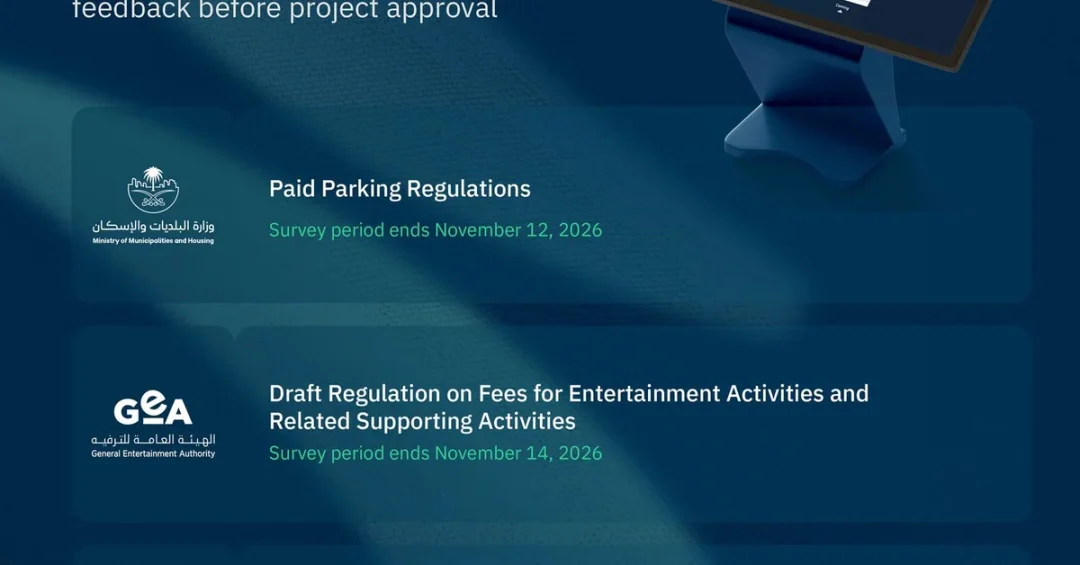
Saudi Arabia’s unified electronic Public Consultation Platform, Istitlaa, has opened 41 economic and development-related projects for public feedback in cooperation with 22 government entities, the Saudi Competitiveness and Business Center (SCBC) announced. The projects, published via the official Saudi Press Agency, invite stakeholders to submit comments and proposals before final approval, underscoring the Kingdom’s commitment to transparent and participatory policymaking. The consultations cover a wide range of regulatory areas, from municipal paid parking and entertainment licensing fees to veterinary infection control standards, with comment periods running through mid-November 2026. Could this be the most transparent approach to lawmaking in the region?
The Istitlaa platform functions as a national gateway where citizens, residents, investors, and government bodies can review draft laws and regulations and contribute their perspectives before those measures take effect. By publishing 41 projects simultaneously with 22 partner entities, the Saudi Competitiveness and Business Center has created an unusually broad window for public input. The initiative reflects a deliberate effort to align regulatory development with the practical needs of the business community and the general public. It also signals that Saudi Arabia treats regulatory reform as an ongoing, inclusive process rather than a closed-door exercise. How often do governments anywhere open dozens of draft regulations to public comment at the same time?
Context and Background
The Istitlaa platform was established as part of Saudi Arabia’s broader regulatory modernization agenda, which seeks to improve the Kingdom’s business environment and strengthen its global competitiveness rankings. The Saudi Competitiveness and Business Center, the entity behind the platform, works to streamline procedures, reduce bureaucratic friction, and ensure that new rules are developed with input from those they will affect. Over time, the platform has become a central fixture in the legislative process, allowing draft regulations to be tested against real-world experience before they are finalized. Does a regulation become stronger when the people it governs help shape it?
Public consultation has deep roots in Saudi Arabia’s governance tradition, but the digital Istitlaa platform has transformed its scale and accessibility. Instead of relying on limited in-person hearings or paper submissions, the platform allows any interested party to read draft texts, submit structured feedback, and track the progress of proposals online. This shift matters for international investors who want predictability and for small businesses that need clear rules. It also supports the Kingdom’s wider goal of making government services more responsive and data-driven. What better way to build trust between regulators and the public than to invite scrutiny before decisions are made?
The 41 projects currently open for feedback span economic and development affairs, touching on municipal services, entertainment, agriculture, and animal health. Each project is accompanied by a public comment window, giving stakeholders a defined period to review the draft and submit their views. The diversity of topics shows that consultation is not confined to one ministry or sector but is embedded across government. The Saudi Press Agency reported the details, reinforcing the official and transparent nature of the process. Is there a clearer signal of institutional openness than publishing draft rules for all to see?
Key Details
Among the most prominent projects is the Ministry of Municipalities and Housing‘s “Paid Parking Regulations,” which aims to improve the paid parking system and regulate investment in it. Public feedback on this project is open until November 12, 2026. The regulation is expected to bring greater order to urban parking, support private investment in parking infrastructure, and improve the experience of residents and visitors in Saudi cities. As urban centers expand under Vision 2030, efficient parking management becomes a practical necessity rather than a peripheral concern. Could well-designed parking rules unlock new investment in city infrastructure?
The General Entertainment Authority has submitted the “Draft Regulation of Fees for Entertainment Activities and Related Supporting Activities.” This project sets out fees for issuing, renewing, amending, suspending, and canceling licenses, permits, and accreditation certificates for entertainment activities and their supporting activities, as well as fees for ticket sales. Feedback is open until November 14, 2026. The entertainment sector has grown rapidly as part of the Kingdom’s quality-of-life initiatives, and a clear fee structure helps operators plan investments with confidence. Does a transparent fee schedule make a creative industry more attractive to investors?
The Ministry of Environment, Water and Agriculture has put forward “Updating the Infection Control Manual in Veterinary Facilities.” This project establishes provisions and guidelines on animal health requirements, standards, and controls, including the use of veterinary products, the reporting of animal diseases, and procedures for handling them. Public feedback is open until November 14, 2026. Strong veterinary standards protect livestock, food safety, and public health, and they support the Kingdom’s agricultural resilience. The manual’s update reflects a science-based approach to animal disease prevention. Why should the public have a say in veterinary standards? Because animal health and human health are connected in ways that affect everyone.
International and Regional Impact
For international businesses and investors, the Istitlaa consultations offer a predictable and accessible way to understand upcoming regulations before they are enacted. Companies evaluating entry into the Saudi market can review draft rules on parking investment, entertainment fees, and veterinary standards, and they can submit feedback that may shape the final texts. This level of openness is a competitive advantage for the Kingdom as it competes for global capital and talent. It also aligns with international best practices in regulatory impact assessment and stakeholder engagement. Which global investor would not prefer a market where the rules are published in advance?
Regionally, Saudi Arabia’s consultation model sets an example for how governments can combine digital service delivery with participatory governance. By coordinating 22 government entities on a single platform, the Kingdom reduces duplication and ensures that stakeholders can engage with multiple proposals in one place. Neighboring economies and international organizations often study Saudi regulatory reforms for their speed and scale. The Istitlaa platform also strengthens the Kingdom’s position in international rankings that measure government effectiveness and ease of doing business. Can a region modernize faster when its largest economy leads by example?
Economic and Strategic Significance
The economic logic behind public consultation is straightforward: regulations that reflect input from businesses and citizens are more likely to be effective, accepted, and enforceable. For the paid parking project, stakeholder feedback can help calibrate fees and investment terms so that municipalities raise revenue without discouraging participation. For entertainment licensing, clear fee structures reduce uncertainty for event organizers and venue operators, which supports a growing sector that attracts tourism and domestic spending. For veterinary facilities, updated infection controls protect an agricultural sector that is vital to food security. Does smart regulation create value by preventing problems before they occur?
Strategically, the Istitlaa platform reinforces Saudi Arabia’s reputation as a government that listens and adapts. The 41 projects are not isolated technical fixes; they are part of a continuous cycle of review, feedback, and improvement that keeps the regulatory environment current. This cycle supports the private sector by reducing compliance surprises and supports the public by making rules more practical. It also gives government entities a structured way to gather evidence and refine proposals. How can a nation sustain long-term growth without constantly updating the rules that govern its economy?
Vision 2030 Alignment
The Istitlaa consultations align directly with Vision 2030‘s goals of a vibrant society, a thriving economy, and an ambitious nation. Transparent, participatory regulation is a cornerstone of the Vision’s promise to improve government effectiveness and empower the private sector. By engaging the public and the business community in shaping economic and development projects, the Kingdom strengthens the feedback loops that make reform durable. The platform also supports the Vision’s emphasis on digital transformation, as it delivers a unified electronic service that is accessible and efficient. Is there a more practical expression of national ambition than inviting citizens to help write the rules?
As the comment periods for these 41 projects unfold through mid-November 2026, the outcomes will inform final regulations that touch daily life and long-term investment. The Ministry of Municipalities and Housing, the General Entertainment Authority, and the Ministry of Environment, Water and Agriculture will review the feedback and refine their proposals accordingly. This process reflects a Kingdom that is confident enough to open its draft laws to scrutiny and disciplined enough to act on what it hears. The Istitlaa platform is not just a website; it is a working instrument of national progress. Will the world recognize how much of Saudi Arabia’s transformation happens through quiet, structured consultation like this?
20 Questions
Q1. What is the Istitlaa platform?
A1. Istitlaa is the Saudi Competitiveness and Business Center’s unified electronic Public Consultation Platform. It lets stakeholders review and comment on draft laws and regulations before approval, promoting transparency and participation in the legislative process.
Q2. How many projects are currently open for feedback?
A2. The platform has opened 41 projects related to economic and development affairs. They are presented in cooperation with 22 government entities, giving the public a broad opportunity to contribute views on upcoming regulations.
Q3. Which government entities are involved?
A3. The projects involve 22 government entities, including the Ministry of Municipalities and Housing, the General Entertainment Authority, and the Ministry of Environment, Water and Agriculture. Coordination across entities ensures a unified consultation experience for stakeholders.
Q4. What is the paid parking project about?
A4. The Ministry of Municipalities and Housing’s “Paid Parking Regulations” aims to improve the paid parking system and regulate investment in it. Public feedback is open until November 12, 2026.
Q5. What does the entertainment fees project cover?
A5. The General Entertainment Authority’s draft regulation sets fees for issuing, renewing, amending, suspending, and canceling licenses, permits, and accreditation certificates, plus fees for ticket sales. Feedback is open until November 14, 2026.
Q6. What is the veterinary infection control project?
A6. The Ministry of Environment, Water and Agriculture’s project updates the Infection Control Manual in Veterinary Facilities. It covers animal health requirements, use of veterinary products, disease reporting, and handling procedures. Feedback is open until November 14, 2026.
Q7. Why does Saudi Arabia use public consultation?
A7. Public consultation enhances transparency in the legislative environment and promotes a culture of engagement among the public, government entities, and the private sector. It helps shape projects related to the business environment before approval.
Q8. Who can submit feedback on Istitlaa?
A8. Stakeholders, including citizens, residents, businesses, and government entities, can share feedback and proposals. The platform is designed to be accessible to anyone interested in the draft projects.
Q9. How long are the comment periods?
A9. Comment periods vary by project. The paid parking project accepts feedback until November 12, 2026, while the entertainment fees and veterinary infection control projects are open until November 14, 2026.
Q10. How does Istitlaa support Vision 2030?
A10. Istitlaa supports Vision 2030 by improving government effectiveness, promoting digital transformation, and empowering the private sector through transparent, participatory regulation that reflects the needs of the economy and society.
Q11. What happens to feedback submitted?
A11. Feedback is reviewed by the relevant government entities and used to refine draft regulations before final approval. The process helps ensure rules are practical, effective, and responsive to stakeholder needs.
Q12. Why is the paid parking regulation important?
A12. It aims to improve parking management and attract investment in parking infrastructure. As Saudi cities grow, efficient parking supports mobility, reduces congestion, and improves the quality of urban life.
Q13. How does the entertainment fee regulation help investors?
A13. Clear fees for licenses, permits, and ticket sales reduce uncertainty for entertainment operators. This predictability encourages investment in a sector that contributes to tourism, job creation, and quality-of-life initiatives.
Q14. Why update veterinary infection controls?
A14. Updated controls protect animal health, food safety, and public health. They establish standards for veterinary products and disease reporting, supporting agricultural resilience and the Kingdom’s food security objectives.
Q15. Is Istitlaa only for economic projects?
A15. The current batch focuses on economic and development affairs, but the platform’s scope reflects a broad commitment to consultation across regulatory areas. It is a central tool for engaging stakeholders in shaping the business environment.
Q16. How does Istitlaa compare internationally?
A16. Istitlaa is a unified national platform that coordinates multiple government entities, offering scale and accessibility. It aligns with international best practices in regulatory impact assessment and stakeholder engagement.
Q17. What is the Saudi Competitiveness and Business Center?
A17. The SCBC is the government entity behind the Istitlaa platform. It works to streamline procedures, reduce bureaucratic friction, and improve the Kingdom’s business environment and global competitiveness.
Q18. How can international stakeholders participate?
A18. International stakeholders can access the platform online, review draft projects, and submit feedback during the comment periods. This helps them understand upcoming rules and contribute to regulatory development.
Q19. What signals does this send to global investors?
A19. It signals that Saudi Arabia publishes draft regulations in advance and invites input, offering predictability and openness. Such transparency supports investment decisions and reinforces confidence in the Kingdom’s regulatory direction.
Q20. What is the next step after consultation?
A20. After the comment periods close, the relevant entities review the feedback and finalize the regulations. Approved rules are then implemented, completing a cycle of consultation, refinement, and enforcement that supports Vision 2030.
Reader Feedback
We value your thoughts. Please share your feedback on this article.
Your feedback helps us improve our coverage.