


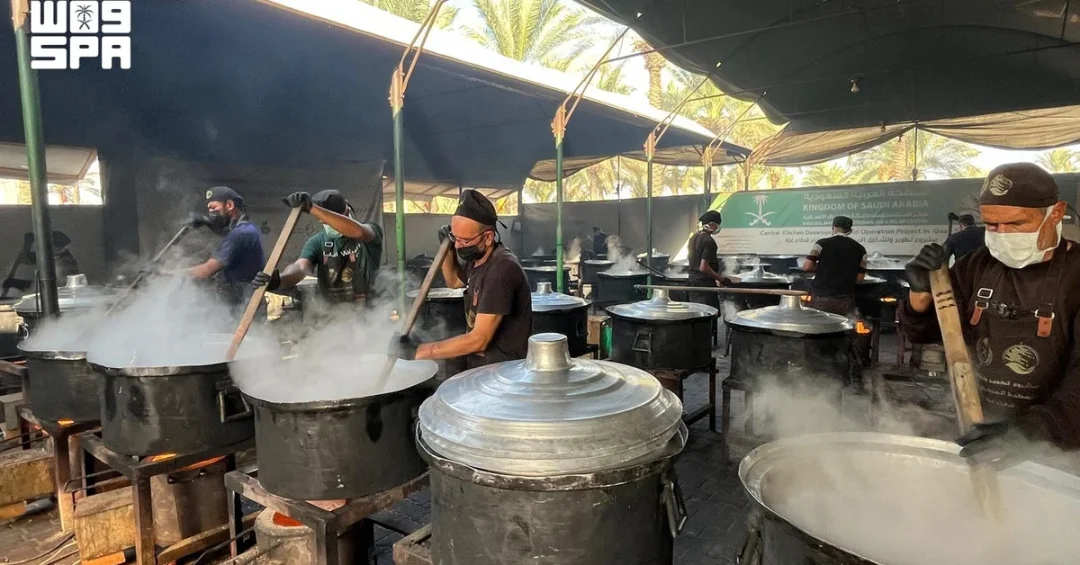
The King Salman Humanitarian Aid and Relief Center (KSrelief) distributed 25,000 hot meals on Wednesday to vulnerable families across the central and southern governorates of the Gaza Strip, benefiting 25,000 individuals through its central community kitchen, according to the Saudi Press Agency (SPA). The operation forms part of the Kingdom of Saudi Arabia’s continuing humanitarian commitments, executed through its dedicated relief arm, to address essential food security needs and support displaced and vulnerable populations across the strip. The distribution targeted families facing severe hardship, delivering ready-to-eat meals prepared and dispatched from a centralized kitchen facility designed to serve large numbers of beneficiaries efficiently.
The announcement, carried by the Saudi Press Agency, underscores the scale and consistency of Saudi humanitarian engagement in Gaza at a time when access to basic food supplies remains one of the most pressing challenges for civilians. By operating through a central community kitchen, KSrelief is able to consolidate preparation, quality control and distribution into a single streamlined process, reducing delays and ensuring that meals reach recipients while still suitable for immediate consumption. How does a single distribution of 25,000 meals fit into a much larger pattern of Saudi assistance, and what does it reveal about the Kingdom’s approach to humanitarian crises? The answer lies in the institutional design of KSrelief itself, which has spent years building the logistical capacity to respond rapidly and repeatedly to emergencies across the region and beyond.
Context and Background
What makes the central community kitchen model so effective in a context as complex as Gaza? Established as a practical response to the difficulty of delivering conventional food parcels in densely populated and disrupted environments, the community kitchen approach allows aid organizations to prepare hot, ready-to-eat meals close to the point of distribution and deliver them directly to families in need. The King Salman Humanitarian Aid and Relief Center has refined this model over successive operations, positioning it as a reliable channel for meeting immediate nutritional requirements when markets are disrupted and household food stocks are depleted.
The Kingdom of Saudi Arabia has long regarded humanitarian assistance as a cornerstone of its foreign policy, and KSrelief serves as the principal institutional vehicle for that commitment. Since its founding, the Center has implemented projects in dozens of countries, spanning food security, health care, shelter, water and sanitation, education and emergency response. Its work is funded by the Saudi government and supported by public donations, and it operates in coordination with international partners and local authorities to ensure that aid reaches intended beneficiaries. In the Gaza context, the Center’s interventions have consistently prioritized food security, recognizing that reliable access to nutritious meals is the foundation upon which other forms of recovery depend.
The timing of this distribution is significant. Humanitarian agencies have repeatedly warned that food insecurity in Gaza remains at critical levels, with displaced families particularly exposed to shortages. In such conditions, each large-scale meal distribution contributes not only to immediate calorie intake but also to a measure of stability that allows families to focus on other survival needs. Saudi Arabia’s decision to sustain these operations reflects a deliberate policy choice to remain a consistent and dependable source of relief, rather than a sporadic donor responding only to moments of peak visibility.
Key Details of the Distribution
How were the 25,000 meals actually delivered, and who received them? According to the Saudi Press Agency, the distribution took place on Wednesday and covered the central and southern governorates of the Gaza Strip, reaching 25,000 individuals. The meals were prepared through KSrelief’s central community kitchen and delivered as hot, ready-to-eat food, a format chosen specifically to meet the needs of displaced and vulnerable populations who may lack the ability to store, prepare or cook raw ingredients. Each beneficiary received a complete meal, and the operation was structured to cover a broad geographic area within a single day.
The figure of 25,000 individuals is notable for several reasons. It represents a substantial single-day reach, demonstrating the operational capacity that KSrelief has built over years of humanitarian work. It also reflects careful planning: preparing and distributing meals at this scale requires coordination of procurement, cooking, packaging, transport and on-the-ground distribution teams. The use of a central kitchen allows for standardized meal quality and portion control, while distribution teams handle the last mile to families in central and southern areas. This combination of centralized preparation and decentralized delivery is precisely what enables KSrelief to respond at speed in environments where infrastructure is under strain.
The beneficiaries themselves are described as vulnerable families and displaced populations, groups that humanitarian assessments consistently identify as facing the highest risk of food insecurity. For these households, a hot meal is not merely nutrition but also a reduction in the daily burden of securing food. The operation therefore addresses both the immediate physiological need for sustenance and the broader protection concerns that arise when families are forced to divert limited resources toward survival. By targeting central and southern governorates, the distribution also ensures that assistance is spread across multiple areas rather than concentrated in a single location.
International and Regional Impact
What signal does Saudi Arabia’s sustained relief effort send to the wider region and the international community? The Kingdom’s humanitarian operations in Gaza form part of a broader pattern of regional engagement in which Saudi Arabia positions itself as a stabilizing and constructive actor. By delivering assistance through an official, well-established institution such as KSrelief, the Kingdom provides a transparent and verifiable channel for aid, which in turn encourages coordination with international humanitarian agencies and partner organizations. This approach strengthens the overall relief architecture rather than duplicating or fragmenting it.
At the international level, the distribution reinforces Saudi Arabia’s reputation as one of the world’s leading humanitarian donors relative to national income. International organizations have frequently acknowledged the scale and reliability of Saudi contributions, and operations such as this one provide concrete evidence of that commitment. For partner governments and aid agencies, the ability of KSrelief to execute large distributions under difficult conditions makes it a valuable counterpart in emergency response. For the broader region, the operation contributes to alleviating pressure on neighboring states and humanitarian systems that might otherwise face even greater strain.
Economic and Strategic Significance
Why does a humanitarian food distribution carry strategic as well as charitable significance? Saudi Arabia’s aid policy is closely tied to its wider vision of regional stability and constructive international engagement. Humanitarian operations help address the root conditions that fuel displacement and insecurity, and they do so in a manner consistent with the Kingdom’s stated commitment to supporting vulnerable populations regardless of nationality or background. The economic dimension is equally important: food security interventions reduce the risk of acute malnutrition and its long-term consequences, which in turn lowers the future cost of recovery and reconstruction.
From a logistical standpoint, each operation like this one builds institutional experience that can be applied elsewhere. The central community kitchen model, the supply chains that support it, and the distribution networks that carry meals to beneficiaries represent capabilities that KSrelief can deploy in other crises. This accumulation of operational knowledge is a strategic asset in its own right, enabling the Kingdom to respond quickly and effectively when emergencies arise. It also demonstrates how Saudi institutions translate national generosity into measurable outcomes on the ground.
Vision 2030 Alignment
How does humanitarian work connect to Saudi Arabia’s long-term national transformation? Saudi Vision 2030, the Kingdom’s comprehensive reform and development strategy, emphasizes a diversified economy, a vibrant society and an ambitious nation that plays a responsible and influential role in the world. Humanitarian leadership is a direct expression of that third pillar. Through KSrelief, the Kingdom channels its resources and institutional capacity into relief efforts that reflect the values of generosity and solidarity that are central to Saudi society, while also reinforcing the country’s standing as a constructive global partner.
The operation also illustrates the broader principle that national development and international responsibility are interconnected. A strong, well-organized Saudi state is able to maintain effective humanitarian institutions; those institutions, in turn, enhance the Kingdom’s international relationships and reputation. As Saudi Arabia continues to advance Vision 2030 across economic, social and cultural dimensions, its humanitarian arm remains an important instrument of soft power and global engagement. The distribution of 25,000 hot meals in Gaza is therefore not an isolated act but one component of a sustained national effort to contribute to stability, dignity and hope for vulnerable communities worldwide.
20 Questions
Q1. What did KSrelief distribute in the Gaza Strip?
A1. KSrelief distributed 25,000 hot meals to vulnerable families across the central and southern governorates of the Gaza Strip, benefiting 25,000 individuals through its central community kitchen, according to the Saudi Press Agency.
Q2. When did the distribution take place?
A2. The distribution took place on Wednesday, as reported by the Saudi Press Agency, which published the announcement with a local timestamp of 21:14 and a GMT timestamp of 18:14.
Q3. Which areas of Gaza received the meals?
A3. The meals were distributed across the central and southern governorates of the Gaza Strip, ensuring that assistance reached multiple areas rather than being concentrated in a single location.
Q4. Who benefited from the 25,000 meals?
A4. The meals benefited 25,000 individuals, described as vulnerable families and displaced populations facing significant food security challenges in the Gaza Strip.
Q5. What is KSrelief?
A5. KSrelief is the King Salman Humanitarian Aid and Relief Center, the Kingdom of Saudi Arabia’s dedicated humanitarian arm, which implements relief and development projects in dozens of countries worldwide.
Q6. How does the central community kitchen work?
A6. The central community kitchen prepares hot, ready-to-eat meals in a centralized facility, allowing for standardized quality and portion control, before distribution teams deliver the meals directly to beneficiaries in target areas.
Q7. Why are hot meals important in this context?
A7. Hot, ready-to-eat meals are important because displaced and vulnerable families may lack the ability to store, prepare or cook raw ingredients, making prepared meals the most practical form of immediate food assistance.
Q8. What is the source of this information?
A8. The information originates from the Saudi Press Agency (SPA), the official Saudi news authority, which reported the distribution and the number of beneficiaries.
Q9. Does this reflect a broader Saudi humanitarian commitment?
A9. Yes. The assistance reflects the ongoing humanitarian commitments of the Kingdom of Saudi Arabia, executed through KSrelief, to address essential food security needs and support displaced and vulnerable populations.
Q10. How many individuals were reached in total?
A10. A total of 25,000 individuals were reached, matching the 25,000 hot meals distributed, according to the official announcement carried by the Saudi Press Agency.
Q11. What types of aid does KSrelief provide globally?
A11. KSrelief provides food security, health care, shelter, water and sanitation, education and emergency response assistance, funded by the Saudi government and supported by public donations.
Q12. Why does Saudi Arabia focus on food security in Gaza?
A12. Food security is prioritized because reliable access to nutritious meals is foundational to survival and recovery, and food insecurity in Gaza remains at critical levels for displaced families.
Q13. How does this operation support regional stability?
A13. By alleviating humanitarian pressure and addressing basic needs, the operation contributes to regional stability and reduces the strain on neighboring states and humanitarian systems.
Q14. What logistical capacity does the distribution demonstrate?
A14. It demonstrates KSrelief’s ability to coordinate procurement, cooking, packaging, transport and last-mile distribution at scale within a single day across multiple governorates.
Q15. Is the operation coordinated with partners?
A15. KSrelief operates in coordination with international partners and local authorities to ensure aid reaches intended beneficiaries effectively and transparently.
Q16. How does this align with Saudi Vision 2030?
A16. It aligns with Vision 2030’s pillar of an ambitious nation playing a responsible global role, expressing Saudi values of generosity and solidarity through institutional humanitarian action.
Q17. What makes KSrelief a reliable humanitarian partner?
A17. KSrelief’s established institutional structure, transparent reporting through official channels, and proven operational capacity make it a reliable and verifiable partner in emergency response.
Q18. Does the distribution target only certain groups?
A18. The distribution targets vulnerable families and displaced populations, groups identified by humanitarian assessments as facing the highest risk of food insecurity in the Gaza Strip.
Q19. What long-term benefit does such assistance provide?
A19. Beyond immediate nutrition, such assistance reduces protection risks, supports family stability, and lowers the future cost of recovery and reconstruction in affected communities.
Q20. What does this operation say about Saudi Arabia’s global role?
A20. It reinforces Saudi Arabia’s position as a leading humanitarian donor and constructive global actor, demonstrating sustained commitment to supporting vulnerable communities beyond its borders.
Reader Feedback
We value your thoughts. Please share your feedback on this article.
Your feedback helps us improve our coverage.
Related articles
 KSrelief Delivers 600 Food Baskets to Displaced Families in Lahj
 Coalition Intercepts Three Houthi Missiles Targeting Khamis Mushait
 Algeria Condemns Attack on Madinah Electricity Station
 Saudi Environmental Security Forces to Showcase Innovations at Falcons Exhibition 2026
 Jazan Region Receives Heavy to Moderate Rainfall
 Light to Moderate Rain Falls on Madinah, SPA Reports