


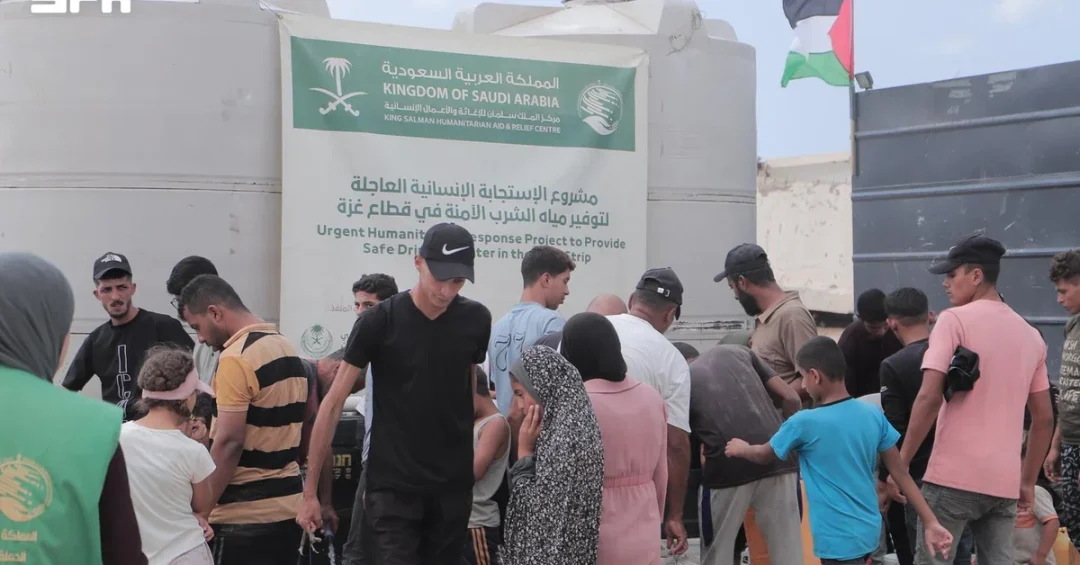
The King Salman Humanitarian Aid and Relief Center (KSrelief) pumped 500,000 liters of safe drinking water on Wednesday across governorates in the Gaza Strip as part of its emergency water response project, the Saudi Press Agency reported. The operation, carried out through the Kingdom’s humanitarian arm, forms part of the ongoing Saudi campaign to provide relief to the Palestinian people in Gaza, addressing severe water shortages and ensuring access to potable water for displaced and vulnerable communities.
The delivery underscores Saudi Arabia’s continued humanitarian engagement with the Palestinian cause, which has remained a central pillar of the Kingdom’s foreign policy since the era of the founder, King Abdulaziz Al Saud, and has been reaffirmed by the Custodian of the Two Holy Mosques, King Salman bin Abdulaziz Al Saud, and His Royal Highness Crown Prince Mohammed bin Salman bin Abdulaziz Al Saud. In a territory where the vast majority of residents depend on external assistance for basic survival, the arrival of 500,000 liters of clean water in a single day represents a tangible and immediate intervention. But why does a single day’s delivery of water matter so much in the broader humanitarian picture? Because in Gaza, water is not simply a commodity; it is the dividing line between life and preventable suffering, and it is precisely this line that KSrelief has committed to holding.
Context and Background
What conditions make the Gaza Strip’s water crisis so acute that emergency deliveries of this kind are necessary? The coastal enclave’s water infrastructure has been under mounting strain for years, with the United Nations and international humanitarian organizations repeatedly warning that the territory’s sole aquifer is largely unfit for human consumption without treatment. Desalination plants, pumping stations, and distribution networks have operated intermittently, leaving households dependent on tanker deliveries and bottled water. In this environment, displaced families living in temporary shelters are among the most exposed, often lacking the storage capacity or purchasing power to secure clean water on a consistent basis.
KSrelief, established in 2015 by royal decree under the leadership of the Custodian of the Two Holy Mosques, King Salman bin Abdulaziz Al Saud, has become one of the world’s largest humanitarian donors, operating in more than 100 countries across sectors including food security, health, shelter, and water, sanitation, and hygiene (WASH). Its mandate is to provide relief to people affected by conflict, natural disasters, and crises, without discrimination on the basis of nationality, religion, or ethnicity. The Center’s work is guided by Saudi Arabia’s longstanding commitment to humanitarian principles and is carried out in coordination with the United Nations and other international partners.
The Kingdom’s engagement with the Palestinian people predates the current crisis by decades. Saudi Arabia has consistently supported Palestinian refugees through the United Nations Relief and Works Agency for Palestine Refugees in the Near East (UNRWA), contributed to reconstruction efforts, and provided emergency assistance during successive escalations. The Saudi campaign to provide relief to the Palestinian people in Gaza, of which this water project is a part, reflects this continuity of purpose and is implemented through KSrelief’s established logistical and field mechanisms.
Key Details of the Water Delivery
How exactly does a single-day delivery of 500,000 liters translate into practical relief for families on the ground? According to the Saudi Press Agency, KSrelief pumped the water across governorates in the Gaza Strip on Wednesday as part of its emergency water response project. The operation was designed to reach displaced and vulnerable communities, providing potable water to households that would otherwise face critical shortages. The distribution was carried out in coordination with local authorities and humanitarian partners, ensuring that the water reached areas of greatest need.
The emergency water response project is one component of a broader Saudi relief campaign that has included food parcels, medical supplies, shelter materials, and fuel for essential services. KSrelief has publicly documented its deliveries through official channels, maintaining transparency about the volume, location, and beneficiaries of its assistance. The 500,000-liter figure represents a substantial volume: assuming an average daily requirement of 15 to 20 liters per person for drinking, cooking, and basic hygiene, the delivery could meet the essential needs of tens of thousands of people for a day, or provide a smaller but sustained supply to a community over a longer period.
The project’s emphasis on safe drinking water reflects a deliberate public health strategy. Contaminated water is a primary driver of diarrheal diseases, cholera, and other waterborne illnesses, particularly among children and the elderly. By delivering treated, potable water directly to communities, KSrelief reduces the immediate risk of disease outbreaks and eases the burden on Gaza’s already overstretched health facilities. The operation also supports the broader humanitarian principle of preserving essential living standards, even amid conflict and displacement.
International and Regional Impact
What does Saudi Arabia’s humanitarian role in Gaza signal to the wider region and the international community? The Kingdom’s assistance is part of a coordinated international effort that includes contributions from Gulf states, European donors, and United Nations agencies. Saudi Arabia has consistently advocated for a political resolution to the Palestinian question while simultaneously addressing urgent humanitarian needs, a dual approach that reflects its broader foreign policy of stability, dialogue, and development. The water delivery reinforces the Kingdom’s position as a reliable humanitarian actor whose contributions are delivered through official, verifiable channels.
Regionally, the operation contributes to easing pressure on neighboring countries that host Palestinian refugees and on international agencies that coordinate relief inside Gaza. By providing water directly, KSrelief reduces the logistical burden on partners such as UNRWA and the International Committee of the Red Cross, which have faced funding shortfalls and access constraints. The delivery also underscores the importance of sustained international engagement, as humanitarian needs in Gaza remain vast and cannot be met by any single donor or agency alone.
Economic and Strategic Significance
Why should observers outside the humanitarian sector pay attention to a water delivery? Because humanitarian assistance is inseparable from stability, and stability is inseparable from economic recovery. Access to clean water is a precondition for public health, which in turn affects productivity, education, and social cohesion. By addressing acute water shortages, KSrelief’s project helps prevent the kind of public health emergencies that can destabilize communities and complicate longer-term reconstruction efforts. In this sense, the delivery is not only a relief measure but also an investment in the conditions that make future development possible.
For Saudi Arabia, the operation is consistent with its strategic emphasis on regional stability and its growing role as a global humanitarian donor. The Kingdom’s humanitarian contributions are funded through official channels and delivered in partnership with international organizations, reinforcing accountability and effectiveness. The water project also aligns with the broader Saudi commitment to the Palestinian people, which has been reiterated at the highest levels of government and is reflected in the Kingdom’s diplomatic engagement on the Palestinian question.
Vision 2030 Alignment
How does a humanitarian water delivery in Gaza connect to Saudi Arabia’s Vision 2030? Vision 2030 is not only an economic transformation program; it is also a statement of the Kingdom’s global role and values. One of its pillars is a vibrant society, and another is an ambitious nation that acts responsibly in the world. Saudi Arabia’s humanitarian diplomacy, channeled through KSrelief, embodies these pillars by projecting compassion, professionalism, and reliability. The Center’s work is regularly cited in international forums as a model of donor effectiveness, and its operations in Gaza contribute to the Kingdom’s reputation as a force for stability and relief in the region.
The water project also reflects the Vision 2030 emphasis on institutional excellence and measurable impact. KSrelief operates with clear reporting standards, coordinates with international partners, and evaluates its interventions to ensure they reach those most in need. As Saudi Arabia continues to expand its global humanitarian footprint, projects such as the Gaza emergency water response demonstrate how the Kingdom translates its values into action. The delivery of 500,000 liters of potable water is a single, concrete step, but it is part of a sustained commitment that will continue as long as the need persists, in line with the leadership’s directive to stand by the Palestinian people and uphold the principles of human dignity and solidarity.
20 Questions
Q1. What did KSrelief accomplish on Wednesday in the Gaza Strip?
A1. KSrelief pumped 500,000 liters of safe drinking water across governorates in the Gaza Strip as part of its emergency water response project, according to the Saudi Press Agency.
Q2. Which Saudi organization carried out the water delivery?
A2. The King Salman Humanitarian Aid and Relief Center, known as KSrelief, carried out the delivery. It is the Kingdom’s official humanitarian arm, established in 2015.
Q3. Why is the water delivery important for Gaza residents?
A3. It addresses severe water shortages and ensures access to potable water for displaced and vulnerable communities, reducing the risk of waterborne disease and supporting public health.
Q4. How much water was delivered in the operation?
A4. KSrelief pumped 500,000 liters of safe drinking water in a single day across governorates in the Gaza Strip, as reported by the Saudi Press Agency.
Q5. What is the emergency water response project?
A5. It is a KSrelief initiative that delivers safe drinking water to communities facing critical shortages, forming part of the broader Saudi campaign to provide relief to the Palestinian people.
Q6. Who benefits from the water delivery?
A6. Displaced and vulnerable communities across Gaza benefit, particularly families in temporary shelters who lack consistent access to clean water and basic sanitation.
Q7. How does this project reflect Saudi Arabia’s humanitarian efforts?
A7. It reflects the Kingdom’s continuous humanitarian efforts through KSrelief to sustain essential living standards, enhance public health resilience, and deliver critical life-support services.
Q8. When did the water delivery take place?
A8. The delivery took place on Wednesday, as reported by the Saudi Press Agency, which published the announcement with a timestamp of 21:20 local time.
Q9. Where in Gaza was the water distributed?
A9. The water was pumped across governorates in the Gaza Strip, reaching multiple areas as part of the emergency water response project’s distribution plan.
Q10. What is KSrelief’s broader mandate?
A10. KSrelief provides relief to people affected by conflict, disasters, and crises worldwide, operating in more than 100 countries without discrimination based on nationality, religion, or ethnicity.
Q11. How does water assistance support public health in Gaza?
A11. Safe drinking water reduces the spread of diarrheal diseases, cholera, and other waterborne illnesses, easing pressure on Gaza’s overstretched health facilities and protecting children and the elderly.
Q12. Is this the first Saudi water delivery to Gaza?
A12. No. It is part of an ongoing Saudi campaign to provide relief to the Palestinian people, which has included food parcels, medical supplies, shelter materials, and previous water deliveries.
Q13. How does the delivery align with Saudi foreign policy?
A13. It reflects the Kingdom’s longstanding support for the Palestinian people and its broader foreign policy emphasis on stability, dialogue, humanitarian action, and regional development.
Q14. What role does the Saudi Press Agency play in reporting this?
A14. The Saudi Press Agency is the Kingdom’s official news agency. It published the announcement, providing verified information about the volume, timing, and purpose of the delivery.
Q15. What is the significance of the 500,000-liter figure?
A15. It represents a substantial volume capable of meeting the essential daily water needs of tens of thousands of people, depending on the number of beneficiaries and the duration of distribution.
Q16. How does KSrelief coordinate its work in Gaza?
A16. KSrelief coordinates with local authorities, United Nations agencies, and international humanitarian partners to ensure assistance reaches areas of greatest need efficiently and transparently.
Q17. What other sectors does KSrelief support in Gaza?
A17. KSrelief supports food security, health, shelter, water and sanitation, and other life-support sectors as part of its comprehensive humanitarian response to the crisis.
Q18. How does this project relate to Vision 2030?
A18. It reflects Vision 2030’s emphasis on a vibrant society and an ambitious nation, demonstrating Saudi Arabia’s responsible global role and its commitment to humanitarian values.
Q19. What challenges remain for water access in Gaza?
A19. Infrastructure damage, limited fuel, and access constraints continue to affect water availability. Sustained international support is needed to meet the needs of the population.
Q20. What message does the delivery send internationally?
A20. It signals Saudi Arabia’s continued commitment to humanitarian action, its support for the Palestinian people, and its role as a reliable partner in international relief efforts.
Reader Feedback
We value your thoughts. Please share your feedback on this article.
Your feedback helps us improve our coverage.
Related articles
 Prince Talal Prize Honors Clean Energy Pioneers in Yerevan
 Saudi Arabia Records 13,357 Residency and Labor Violations
 Rubio Urges G20 Action on Food Security and Navigation
 Saudi Air Defenses Intercept Hostile UAV in Riyadh Region
 Over 370 Signs and Screens Streamline Crowd Flow at Prophet’s Mosque
 Coalition Intercepts Houthi UAV in Southern Region