


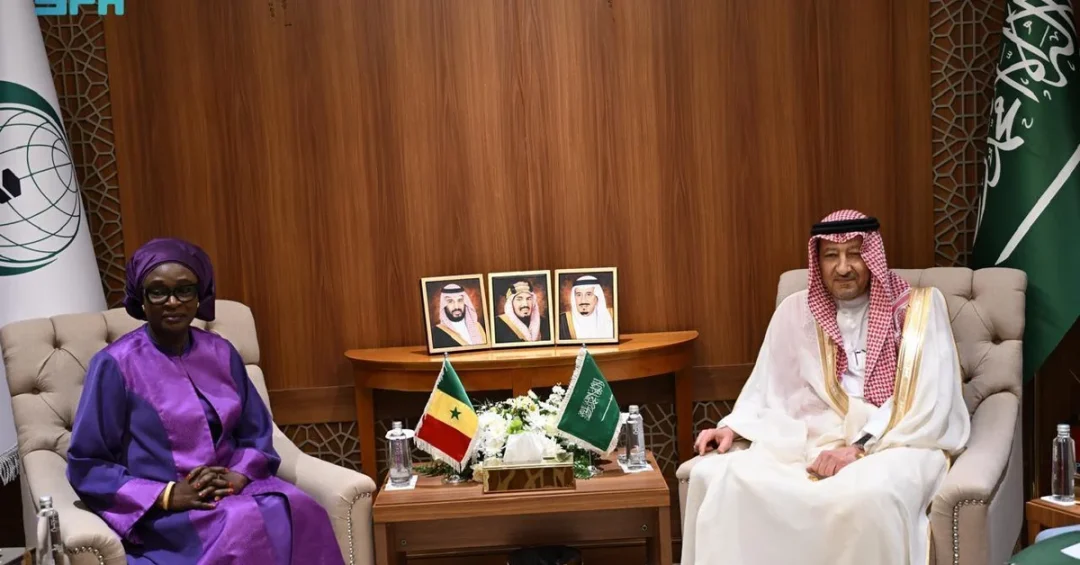
Vice Minister of Foreign Affairs Eng. Waleed bin Abdulkarim El-Khereiji met with Minister of African Integration and Foreign Affairs of the Republic of Senegal Yassine Fall on Friday in Jeddah, on the sidelines of the extraordinary ministerial meeting of the Council of Foreign Ministers of the Organization of Islamic Cooperation (OIC), according to the Saudi Press Agency. The two officials reviewed ways to enhance bilateral relations and exchanged views on regional and international issues of mutual interest, in a gathering that underscores the Kingdom’s active diplomatic engagement across Africa and the wider Islamic world. The encounter took place as senior diplomats from dozens of OIC member states convened in the Red Sea port city to address pressing matters on the organization’s agenda, reinforcing Jeddah’s standing as a hub for multilateral dialogue and consensus-building.
The meeting between El-Khereiji and Fall reflects a broader pattern of intensified Saudi outreach to African nations, a priority that has gained momentum under the leadership of the Custodian of the Two Holy Mosques, King Salman bin Abdulaziz Al Saud, and His Royal Highness Crown Prince and Prime Minister Mohammed bin Salman bin Abdulaziz Al Saud. Senegal, a prominent member of the OIC and a key voice in West Africa, shares with the Kingdom a commitment to Islamic solidarity, sustainable development, and regional stability. The talks in Jeddah therefore carried significance beyond the bilateral file, signaling a shared intent to coordinate positions on challenges ranging from food security to counterterrorism. For observers of Saudi diplomacy, the encounter is another illustration of how the Kingdom pairs its global economic ambitions with a dense network of political and cultural partnerships.
Context and Background
Why has Jeddah become such a frequent backdrop for high-level diplomatic encounters between Saudi Arabia and African states? The city hosts the headquarters of the OIC, the second-largest intergovernmental organization after the United Nations, and its calendar of ministerial gatherings naturally draws foreign ministers from across the Islamic world. The extraordinary ministerial meeting of the Council of Foreign Ministers provided the immediate occasion for the El-Khereiji–Fall talks, but the relationship between Riyadh and Dakar rests on deeper foundations. Saudi Arabia has long supported Senegal through development assistance, religious cooperation, and educational exchanges, while Senegal has consistently valued the Kingdom’s role as a stabilizing force in the Muslim world and a custodian of the Two Holy Mosques.
In recent years, Saudi–Senegalese ties have diversified. The two countries cooperate in energy, infrastructure, agriculture, and vocational training, and they share membership in the Islamic Development Bank, which has financed projects in Senegal’s power and water sectors. The OIC framework adds another layer, allowing both capitals to align on issues such as the situation in the Sahel, humanitarian relief, and the promotion of moderate Islam. The meeting in Jeddah thus built on an established record of collaboration, even as it explored new avenues for economic and political partnership. For Saudi Arabia, Africa represents a continent of opportunity: a market of more than 1.3 billion people, a source of critical minerals, and a growing pool of young consumers whose aspirations align with the Kingdom’s own modernization trajectory.
The timing of the talks also matters. The OIC ministerial meeting convened against a backdrop of heightened global attention to humanitarian crises, economic volatility, and the need for stronger South–South cooperation. By sitting down with Senegal’s top diplomat, Vice Minister El-Khereiji signaled that the Kingdom treats African partners as indispensable interlocutors rather than peripheral players. Senegal, for its part, has emerged as a respected mediator and advocate for democratic governance in West Africa, giving its voice added weight in OIC deliberations. The Jeddah meeting therefore represented a convergence of two diplomatic traditions: Saudi Arabia’s convening power and Senegal’s bridge-building reputation.
Key Details of the Meeting
According to the Saudi Press Agency, the two ministers reviewed ways to enhance bilateral relations and exchanged views on regional and international issues of mutual interest. While the official readout was concise, the scope of discussion implied by those phrases is substantial. Bilateral relations between Riyadh and Dakar encompass political consultation, trade and investment, cultural and religious affairs, and development cooperation. Enhancing those ties could involve new agreements on investment protection, expanded scholarship programs for Senegalese students in Saudi universities, or joint ventures in renewable energy and agro-processing. The exchange of views on regional issues likely touched on the Sahel, where security challenges and humanitarian needs demand coordinated responses from Islamic countries.
The presence of both officials in Jeddah for the OIC ministerial meeting gave their conversation a multilateral dimension. Senegal is an influential member of the organization and has previously hosted OIC gatherings, while Saudi Arabia serves as the host of the OIC secretariat and a principal financier of its programs. Their bilateral discussion therefore fed directly into the broader deliberations of the Council of Foreign Ministers, where member states sought common positions on conflicts, humanitarian assistance, and the promotion of Islamic values. For Vice Minister El-Khereiji, the meeting formed part of a busy diplomatic schedule that included engagements with counterparts from several continents, underscoring the Kingdom’s role as a convening power.
Minister Yassine Fall, who leads Senegal’s Ministry of African Integration and Foreign Affairs, brought to the table her country’s perspective as a gateway to West Africa and a champion of regional integration. Senegal’s membership in the Economic Community of West African States and its active role in the African Union give it leverage that complements Saudi Arabia’s global reach. A strengthened Riyadh–Dakar axis could facilitate Saudi investment in West African infrastructure, open new markets for Saudi goods and services, and create channels for cultural and educational exchange. The Jeddah talks thus laid groundwork that may be formalized in future agreements, visits, or joint commissions.
International and Regional Impact
What does a closer Saudi–Senegalese partnership mean for the wider region and for the international community? Africa has become a theater of intense diplomatic competition, with major powers courting African capitals for access to resources, markets, and votes in multilateral forums. Saudi Arabia’s approach differs in its emphasis on Islamic solidarity, development finance, and respect for sovereignty. By engaging Senegal at the ministerial level, the Kingdom reinforces a model of partnership rooted in mutual interest rather than conditionality. This approach resonates in Dakar and across West Africa, where leaders increasingly seek diversified relationships that serve their development agendas.
The meeting also contributes to the OIC’s internal cohesion. As an organization spanning four continents, the OIC depends on bilateral and sub-regional diplomacy to build consensus before formal sessions. The El-Khereiji–Fall conversation helped align Saudi and Senegalese perspectives on issues likely to appear in the ministerial communiqué, from the situation in Palestine to humanitarian crises in Africa. Such alignment strengthens the organization’s collective voice and enhances its ability to advocate for Muslim interests globally. For international observers, the encounter is a reminder that Jeddah remains a pivotal node in diplomatic networks that stretch from the Atlantic coast of Africa to Southeast Asia.
Economic and Strategic Significance
Saudi Arabia’s economic ties with Senegal have grown steadily, driven by the Kingdom’s Vision 2030 strategy of diversifying partnerships and expanding non-oil exports. Saudi companies have shown interest in Senegal’s energy, mining, and agricultural sectors, while Senegalese businesses look to the Gulf for investment capital and technical expertise. The Saudi Fund for Development has financed projects in Senegal, including road and electricity infrastructure, and the Islamic Development Bank, headquartered in Jeddah, remains a major source of concessional finance for Senegalese development. The meeting between El-Khereiji and Fall can be seen as a political catalyst for deeper economic engagement, signaling to the private sectors in both countries that the highest levels of government support closer collaboration.
Strategically, Senegal occupies a sensitive position in West Africa, bordering the Sahel region where instability has displaced millions and disrupted trade routes. A stable, prosperous Senegal is in Saudi Arabia’s interest because it contributes to regional security, curbs irregular migration, and supports moderate religious discourse. The Kingdom’s diplomacy in Africa emphasizes these shared stakes, offering partnership without interference in domestic affairs. For Senegal, alignment with Saudi Arabia provides access to Gulf investment, diplomatic backing in international forums, and support for its own ambitions to become an emerging economic hub. The Jeddah meeting thus carried strategic weight that extends well beyond the bilateral file.
Vision 2030 Alignment
How does a meeting with Senegal’s foreign minister connect to Saudi Arabia’s Vision 2030? The Vision, launched by Crown Prince Mohammed bin Salman in 2016, aims to transform the Kingdom’s economy and society while elevating its global role. A central pillar of that transformation is the expansion of international partnerships that create opportunities for Saudi businesses, attract investment, and project the Kingdom’s soft power. Africa, with its young population and abundant resources, is a natural partner in this endeavor. By cultivating relationships with influential African states like Senegal, Saudi Arabia advances the Vision’s goals of economic diversification, knowledge exchange, and enhanced diplomatic influence.
Moreover, the meeting reflects the Vision’s emphasis on proactive diplomacy and multilateral engagement. Saudi Arabia under Vision 2030 seeks to be a bridge between continents, a convenor of dialogues, and a source of stability in a turbulent world. The OIC ministerial meeting in Jeddah and the bilateral talks on its sidelines exemplify this approach. As the Kingdom continues to implement giga-projects, host global events, and deepen its ties across Africa, encounters like the El-Khereiji–Fall meeting will become more frequent and more consequential. They signal a Saudi Arabia that is open, engaged, and committed to building a prosperous future in partnership with friends across the Islamic world and beyond.
20 Questions
Q1. Who met in Jeddah on Friday?
A1. Vice Minister of Foreign Affairs Eng. Waleed bin Abdulkarim El-Khereiji met with Senegal’s Minister of African Integration and Foreign Affairs Yassine Fall on the sidelines of the OIC extraordinary ministerial meeting, according to the Saudi Press Agency.
Q2. What was the main purpose of the meeting?
A2. The two officials reviewed ways to enhance bilateral relations between Saudi Arabia and Senegal and exchanged views on regional and international issues of mutual interest, as reported by the Saudi Press Agency.
Q3. Where did the meeting take place?
A3. The meeting took place in Jeddah, Saudi Arabia, on the sidelines of the extraordinary ministerial meeting of the Council of Foreign Ministers of the Organization of Islamic Cooperation.
Q4. What is the Organization of Islamic Cooperation?
A4. The OIC is the second-largest intergovernmental organization after the United Nations, with 57 member states. Its headquarters are in Jeddah, and it serves as a platform for Muslim world cooperation.
Q5. Who is Eng. Waleed bin Abdulkarim El-Khereiji?
A5. Eng. Waleed bin Abdulkarim El-Khereiji is the Vice Minister of Foreign Affairs of the Kingdom of Saudi Arabia, a senior diplomat who regularly represents the Kingdom at multilateral and bilateral engagements.
Q6. Who is Yassine Fall?
A6. Yassine Fall is the Minister of African Integration and Foreign Affairs of the Republic of Senegal, responsible for her country’s diplomatic relations and regional integration agenda in West Africa.
Q7. Why is Senegal important to Saudi Arabia?
A7. Senegal is a prominent OIC member, a gateway to West Africa, and a voice for moderation and development. It shares Saudi Arabia’s commitment to Islamic solidarity and regional stability.
Q8. What topics likely were discussed beyond bilateral relations?
A8. Regional and international issues of mutual interest likely included the Sahel security situation, humanitarian crises, economic cooperation, and coordination within the OIC framework, based on the official readout.
Q9. What is the significance of the OIC ministerial meeting?
A9. The extraordinary ministerial meeting allowed foreign ministers from OIC member states to deliberate on pressing issues facing the Muslim world and to coordinate collective positions on political and humanitarian matters.
Q10. How does this meeting fit into Saudi Arabia’s Africa strategy?
A10. It reflects Saudi Arabia’s intensified outreach to African nations, aiming to build partnerships in energy, infrastructure, agriculture, and education while strengthening diplomatic and cultural ties across the continent.
Q11. What economic sectors could benefit from closer Saudi–Senegalese ties?
A11. Energy, mining, agriculture, infrastructure, and vocational training are among the sectors with potential for expanded cooperation, supported by Saudi investment and development finance institutions.
Q12. Has Saudi Arabia supported development in Senegal?
A12. Yes. The Saudi Fund for Development and the Islamic Development Bank, headquartered in Jeddah, have financed projects in Senegal, including infrastructure and electricity, reflecting long-standing development cooperation.
Q13. How does the meeting relate to Vision 2030?
A13. Vision 2030 seeks to diversify Saudi partnerships and elevate the Kingdom’s global role. Engaging influential African states like Senegal supports economic diversification, knowledge exchange, and diplomatic influence.
Q14. What role does Jeddah play in Saudi diplomacy?
A14. Jeddah hosts the OIC headquarters and numerous diplomatic events, making it a hub for multilateral dialogue and a frequent venue for high-level bilateral meetings between Saudi and foreign officials.
Q15. What message does this meeting send to the international community?
A15. It signals Saudi Arabia’s commitment to active diplomacy, Islamic solidarity, and partnership with African nations, reinforcing the Kingdom’s role as a convening power and a bridge between regions.
Q16. Will there be follow-up agreements from this meeting?
A16. While no specific agreements were announced, such meetings often lay the groundwork for future memoranda of understanding, joint commissions, or high-level visits that formalize cooperation.
Q17. How does Senegal benefit from closer ties with Saudi Arabia?
A17. Senegal gains access to Gulf investment, development finance, diplomatic support in international forums, and educational opportunities, complementing its own ambitions for economic emergence and regional integration.
Q18. What is the significance of the meeting being on the sidelines of the OIC event?
A18. It allows bilateral discussions to feed into broader multilateral deliberations, ensuring that Saudi and Senegalese perspectives align on issues before the full Council of Foreign Ministers.
Q19. Does the meeting reflect Saudi Arabia’s broader diplomatic approach?
A19. Yes. It exemplifies Saudi Arabia’s proactive, partnership-oriented diplomacy, which combines multilateral engagement through the OIC with targeted bilateral outreach to key countries across Africa and Asia.
Q20. What can be expected next in Saudi–Senegalese relations?
A20. Continued dialogue, possible new cooperation agreements, and deeper economic and cultural exchanges are likely, as both countries build on the momentum of the Jeddah meeting and shared OIC membership.
Reader Feedback
We value your thoughts. Please share your feedback on this article.
Your feedback helps us improve our coverage.
Related articles
 Saudi Vice Foreign Minister Meets Brunei Counterpart in Jeddah
 OIC Foreign Ministers Meet in Jeddah on Israeli Aggression
 OIC Foreign Ministers Reject Palestinian Displacement Plans
 OIC Reinstates Syria’s Membership After Jeddah Session
 Saudi Arabia Apprehends 20,749 Law Violators in Nationwide Campaign
 Saudi Arabia Distributes Dates to 25,000 in Sri Lanka