


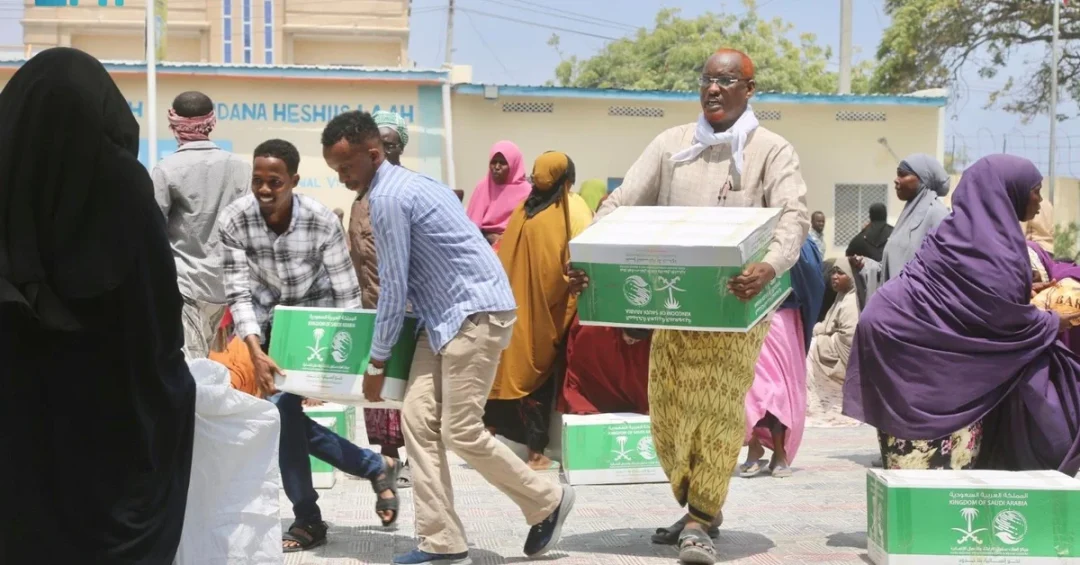
The King Salman Humanitarian Aid and Relief Center (KSrelief) has distributed 751 food baskets in the Karan District of Somalia’s Banaadir Region, providing essential food supplies to 4,506 individuals as part of the Etaam Ramadan food basket project. The distribution, announced by the Saudi Press Agency on March 7, 2025, forms part of the fourth phase of a wide-ranging humanitarian initiative that aims to deliver 390,109 food baskets to 2,304,104 beneficiaries across 27 countries, at a total cost exceeding SAR67 million.
This latest operation in Somalia underscores Saudi Arabia’s continuing commitment to alleviating hardship in vulnerable communities worldwide, particularly during the holy month of Ramadan. The Etaam project, implemented by KSrelief, reflects the Kingdom’s broader humanitarian strategy, which is rooted in the values of compassion and solidarity that define Saudi society. By targeting families in need across Africa, Asia, and the Middle East, the initiative demonstrates how Saudi Arabia’s aid reaches those most affected by conflict, displacement, and economic instability. The distribution in Karan District is one of many similar operations being carried out simultaneously, highlighting the scale and coordination of the Kingdom’s relief efforts.
Context and Background
How did the Etaam Ramadan food basket project become one of Saudi Arabia’s most far-reaching humanitarian initiatives? Launched by KSrelief, the project has evolved through multiple phases to address food insecurity in dozens of countries. The fourth phase, currently underway, represents a significant expansion of the program, both in terms of the number of beneficiaries and the geographic scope. Somalia, which has faced decades of instability, drought, and displacement, remains a priority for Saudi aid. The Karan District distribution is part of a sustained effort to provide reliable food supplies to families who might otherwise struggle to secure daily meals, especially during Ramadan, when the need for nutritious food becomes even more acute.
KSrelief, established in 2015 under the directives of the Custodian of the Two Holy Mosques, King Salman bin Abdulaziz Al Saud, has since become a central pillar of Saudi Arabia’s international humanitarian engagement. Its mandate is to coordinate and implement relief operations globally, working in partnership with local authorities, international organizations, and non-governmental entities. Over the years, KSrelief has delivered aid in Yemen, Syria, Palestine, Sudan, and many other nations, earning recognition for its professionalism and reach. The Etaam project specifically targets food security, a critical issue in regions where conflict and climate change have disrupted agricultural production and access to markets. In Somalia, the combination of prolonged drought and ongoing security challenges has left millions in need of assistance, making the Ramadan food baskets a vital lifeline.
The fourth phase of the Etaam project is notable for its ambitious targets, aiming to distribute more than 390,000 food baskets to over 2.3 million people across 27 countries. The cost, exceeding SAR67 million, reflects Saudi Arabia’s willingness to invest substantial resources in humanitarian causes. This phase builds on the success of previous iterations, which have provided timely support to communities during Ramadan and beyond. The project is designed to ensure that beneficiaries receive a balanced selection of staple foods, including rice, flour, oil, and dates, sufficient to meet the needs of a family for an extended period. By focusing on Ramadan, KSrelief also aims to uphold the spiritual and communal aspects of the holy month, enabling families to share in the traditions of fasting and feasting despite their difficult circumstances.
Key Details of the Somalia Distribution
What does the distribution of 751 food baskets in Karan District tell us about the impact of Saudi aid on the ground? According to the Saudi Press Agency, the operation directly benefited 4,506 individuals, a figure that highlights the scale of need in the area. Each food basket is carefully designed to provide a family with essential nutrition for several weeks, reducing the immediate pressure on household food supplies. The Karan District, located in the Banaadir Region, is home to many internally displaced persons and low-income families who have been disproportionately affected by Somalia’s protracted humanitarian crisis. The distribution was carried out in coordination with local authorities and community leaders, ensuring that aid reaches the most vulnerable segments of the population, including widows, orphans, and the elderly.
The Etaam Ramadan food basket project operates on a massive scale, but its implementation relies on meticulous planning and logistics. KSrelief works with partners to identify priority areas, procure food supplies, and organize distribution points that are accessible and safe. In Somalia, the distribution in Karan District is part of a broader countrywide effort that includes multiple regions. The fourth phase of the project is expected to cover 27 countries, spanning Africa, Asia, and the Middle East, with a focus on countries experiencing conflict, natural disasters, or economic hardship. The SAR67 million budget covers the purchase, transport, and distribution of food baskets, as well as the administrative costs associated with running such a complex operation. By adhering to international humanitarian standards, KSrelief ensures that aid is delivered impartially and based on need, without discrimination.
The food baskets themselves are more than just provisions; they are a symbol of Saudi Arabia’s solidarity with the Muslim ummah and with all people in need. The contents are tailored to local dietary preferences and nutritional requirements, and they often include dates, which are a traditional staple in many Muslim communities. The distribution process is designed to be dignified and respectful, with beneficiaries receiving their baskets at designated centers or through door-to-door deliveries where necessary. In Somalia, the operation was met with appreciation from local officials and residents, who acknowledged the timely nature of the assistance. The success of the Karan District distribution adds to the growing record of KSrelief’s achievements in the country and reinforces the Kingdom’s reputation as a leading global humanitarian donor.
International and Regional Impact
How does Saudi Arabia’s humanitarian aid influence its relationships with countries in the Horn of Africa and beyond? The distribution in Somalia is part of a wider pattern of Saudi engagement in Africa, where the Kingdom has increasingly played a constructive role in promoting stability and development. By providing food aid during Ramadan, KSrelief not only addresses immediate needs but also strengthens people-to-people ties and fosters goodwill. In Somalia, where international attention often fluctuates, Saudi Arabia’s consistent support is a stabilizing factor. The aid is delivered without political conditions, reflecting the Kingdom’s principled approach to humanitarian action. This has earned Saudi Arabia respect among Somali communities and has contributed to the broader regional effort to combat food insecurity.
At the international level, the Etaam project exemplifies Saudi Arabia’s commitment to the United Nations Sustainable Development Goals, particularly Goal 2, which aims to end hunger and achieve food security. KSrelief collaborates with UN agencies and other international partners to maximize the reach and effectiveness of its operations. The fourth phase of the project, with its ambitious target of reaching over 2.3 million beneficiaries, is a testament to Saudi Arabia’s capacity to mobilize resources and coordinate large-scale relief efforts. The Kingdom’s humanitarian diplomacy is an integral part of its foreign policy, demonstrating that it is not only a political and economic power but also a compassionate global citizen. As conflicts and climate-related disasters continue to affect millions worldwide, Saudi Arabia’s role as a reliable provider of aid is likely to grow even more significant.
Economic and Strategic Significance
What does the SAR67 million investment in the Etaam project reveal about Saudi Arabia’s strategic priorities? The allocation of such a substantial sum to humanitarian aid underscores the Kingdom’s belief that economic strength should be used to serve humanity. While the direct economic impact of food distributions on Saudi Arabia’s own economy is minimal, the strategic benefits are considerable. By alleviating suffering in vulnerable countries, Saudi Arabia contributes to regional stability, which in turn creates a more conducive environment for trade, investment, and diplomatic cooperation. The Etaam project also supports the Kingdom’s soft power, enhancing its image as a responsible and generous international actor. This aligns with Vision 2030’s goal of positioning Saudi Arabia as a global leader in humanitarian and development fields.
Moreover, the logistics and supply chains developed for the Etaam project have spillover benefits for Saudi businesses and humanitarian expertise. KSrelief’s operations require efficient procurement, transportation, and distribution networks, which can foster partnerships with Saudi companies and create opportunities for knowledge exchange. The project also demonstrates Saudi Arabia’s ability to manage complex international operations, a capability that is valuable in both humanitarian and commercial contexts. As the Kingdom continues to diversify its economy and expand its global footprint, its humanitarian initiatives serve as a bridge to new markets and partners. The Etaam project, therefore, is not just an act of charity but also a strategic investment in Saudi Arabia’s international standing and long-term interests.
Vision 2030 Alignment
How does the Etaam Ramadan food basket project fit into the broader framework of Saudi Vision 2030? Vision 2030 is not only about economic diversification and social reform at home; it also encompasses a vision of Saudi Arabia as a globally responsible nation. The Kingdom’s humanitarian efforts, led by KSrelief, are a direct expression of this vision. By helping to alleviate poverty and hunger in countries like Somalia, Saudi Arabia contributes to the creation of a more stable and prosperous world, which is in the interest of all nations. The Etaam project, with its focus on Ramadan, also highlights the Islamic values that underpin Saudi society and its leadership. This alignment with Vision 2030 ensures that humanitarian work is not an afterthought but a core component of the Kingdom’s national strategy.
As Saudi Arabia continues to implement Vision 2030, its humanitarian aid will remain a key pillar of its foreign policy and its identity on the world stage. The distribution of 751 food baskets in Somalia is a small but meaningful part of a much larger effort that spans continents and touches millions of lives. Through KSrelief, the Kingdom is demonstrating that its commitment to helping those in need is unwavering and that its vision for the future includes a world where no one is left behind. The Etaam project will continue to bring hope and relief to vulnerable communities, reinforcing Saudi Arabia’s role as a beacon of generosity and a force for good in the world.
20 Questions
Q1. What is the King Salman Humanitarian Aid and Relief Center (KSrelief)?
A1. KSrelief is a Saudi humanitarian organization established in 2015 to coordinate and implement relief operations worldwide. It provides aid to countries affected by conflict, natural disasters, and poverty, reflecting Saudi Arabia’s commitment to global humanitarian causes.
Q2. How many food baskets were distributed in Somalia’s Karan District?
A2. KSrelief distributed 751 food baskets in the Karan District of Somalia’s Banaadir Region. These baskets provided essential food supplies to 4,506 individuals, helping to alleviate immediate hunger and food insecurity in the area.
Q3. What is the Etaam Ramadan food basket project?
A3. The Etaam Ramadan food basket project is a KSrelief initiative that distributes food baskets to vulnerable families during the holy month of Ramadan. It aims to provide nutritious staples to millions of beneficiaries across multiple countries.
Q4. How many beneficiaries does the fourth phase of the Etaam project aim to reach?
A4. The fourth phase of the Etaam project aims to provide 390,109 food baskets to 2,304,104 beneficiaries across 27 countries. This represents a significant expansion of the program’s reach and impact.
Q5. What is the total cost of the fourth phase of the Etaam project?
A5. The fourth phase of the Etaam project costs more than SAR67 million. This investment covers the procurement, transportation, and distribution of food baskets, as well as administrative costs associated with the large-scale operation.
Q6. Why is Somalia a priority for Saudi humanitarian aid?
A6. Somalia has faced decades of instability, drought, and displacement, leaving millions in need of assistance. Saudi Arabia prioritizes Somalia due to the severe humanitarian challenges and the strong historical and Islamic ties between the two nations.
Q7. How does KSrelief ensure aid reaches the most vulnerable?
A7. KSrelief works with local authorities, community leaders, and international partners to identify priority areas and beneficiaries. It adheres to international humanitarian standards, ensuring aid is delivered impartially and based on need.
Q8. What items are typically included in a KSrelief food basket?
A8. A KSrelief food basket usually contains staple foods such as rice, flour, oil, and dates. The contents are tailored to local dietary preferences and nutritional requirements, providing a family with essential nutrition for several weeks.
Q9. How does the Etaam project align with Saudi Vision 2030?
A9. The Etaam project aligns with Vision 2030 by showcasing Saudi Arabia’s role as a globally responsible nation. It reflects the Kingdom’s commitment to humanitarian values and its strategic goal of contributing to global stability and prosperity.
Q10. What is the role of the Saudi Press Agency in reporting this aid?
A10. The Saudi Press Agency (SPA) is the official news agency of Saudi Arabia. It reported the distribution of 751 food baskets in Somalia, providing verified information about KSrelief’s activities to the public and international media.
Q11. How many countries does the fourth phase of the Etaam project cover?
A11. The fourth phase of the Etaam project covers 27 countries across Africa, Asia, and the Middle East. This wide geographic scope demonstrates Saudi Arabia’s extensive humanitarian reach and its commitment to helping diverse communities.
Q12. What is the significance of distributing food baskets during Ramadan?
A12. Distributing food baskets during Ramadan holds special significance as it enables needy families to observe the holy month with dignity. It reflects the Islamic values of compassion and solidarity that are central to Saudi Arabia’s humanitarian ethos.
Q13. How does KSrelief coordinate with local partners in Somalia?
A13. KSrelief coordinates with Somali authorities, community leaders, and local organizations to identify beneficiaries and organize distribution points. This collaboration ensures that aid reaches those most in need efficiently and safely.
Q14. What impact does Saudi aid have on regional stability?
A14. Saudi aid contributes to regional stability by addressing immediate humanitarian needs and reducing the potential for unrest. By alleviating suffering, the Kingdom helps create conditions conducive to peace, development, and cooperation in vulnerable regions.
Q15. How does the Etaam project support the UN Sustainable Development Goals?
A15. The Etaam project supports SDG 2, which aims to end hunger and achieve food security. By providing food baskets to millions, Saudi Arabia contributes to global efforts to eradicate hunger and improve nutrition worldwide.
Q16. What is the historical background of Saudi humanitarian aid?
A16. Saudi Arabia has a long history of providing humanitarian aid, dating back decades. KSrelief, established in 2015, centralized and expanded these efforts, making the Kingdom one of the world’s leading donors.
Q17. How can other countries learn from Saudi Arabia’s humanitarian model?
A17. Other countries can learn from Saudi Arabia’s emphasis on coordination, speed, and impartiality. KSrelief’s use of local partnerships and its focus on sustainability offer valuable lessons for effective humanitarian action.
Q18. What are the future plans for the Etaam project?
A18. While specific future phases are not yet announced, KSrelief is expected to continue the Etaam project, expanding its reach to more countries and beneficiaries. The project remains a key part of Saudi Arabia’s Ramadan humanitarian efforts.
Q19. How does the distribution in Karan District reflect Saudi Arabia’s values?
A19. The distribution reflects Saudi Arabia’s core values of generosity, compassion, and solidarity with those in need. It demonstrates the Kingdom’s commitment to upholding Islamic principles and helping the less fortunate regardless of nationality.
Q20. What is the overall message of Saudi Arabia’s humanitarian aid?
A20. The overall message is one of hope and shared humanity. Saudi Arabia, through KSrelief, aims to alleviate suffering and build a better world, reinforcing its role as a compassionate global leader dedicated to peace and prosperity for all.
Reader Feedback
We value your thoughts. Please share your feedback on this article.
Your feedback helps us improve our coverage.
Related articles
 Saudi Arabia Distributes Dates, Iftar Meals in Nigeria
 Saudi Arabia Distributes Iftar Meals in Benin, Sierra Leone
 Saudi FM Meets Iranian Counterpart in Jeddah
 GCC States Support All Efforts by Syria to Ensure Security and Stability, Albudaiwi Says
 KSrelief Distributes 800 Food Baskets in Sudan
 Smart Occupancy Map Enhances Prophet’s Mosque Visits