


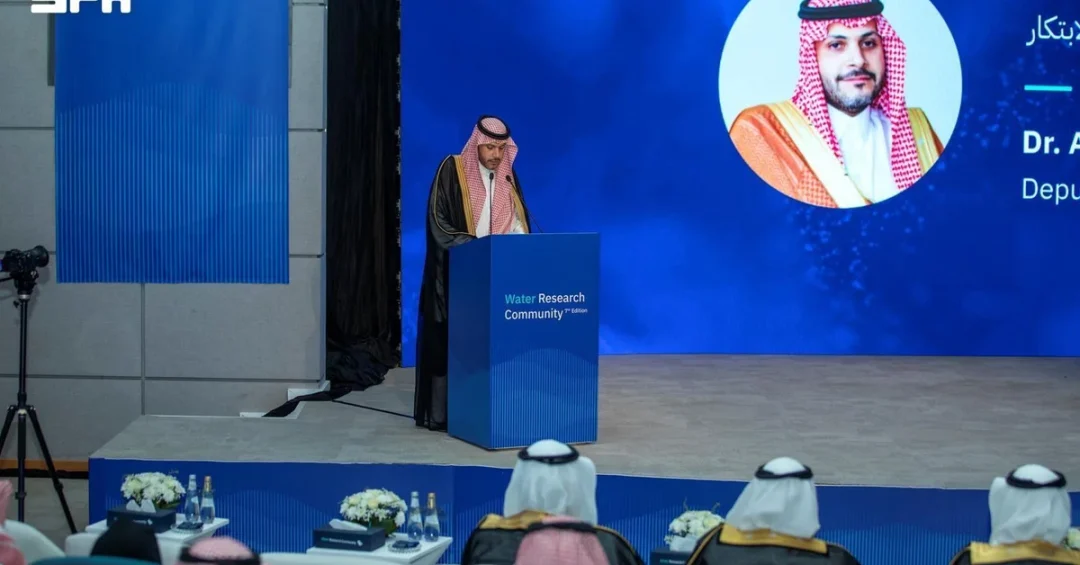
Saudi Arabia’s water sector is undergoing a significant transformation that is strengthening national water security, with desalinated water production capacity rising from approximately 9 million cubic meters per day in 2016 to more than 16 million cubic meters per day in 2025, the Ministry of Environment, Water and Agriculture has announced. At the same time, reliance on non-renewable groundwater declined from around 21 billion cubic meters to approximately 11 billion cubic meters over the same period, a shift that underscores the Kingdom’s commitment to sustainable water resource management. The figures were released through official Saudi channels and reflect a decade of sustained investment, policy reform, and technological adoption across one of the most water-scarce regions in the world.
The announcement came as Deputy Minister for Research and Innovation Dr. Abdulaziz Al-Malik addressed the seventh meeting of the Water Research Community, a national platform that brings together scientific experts, academics, and stakeholders involved in developing Saudi Arabia’s water sector. His remarks positioned research and innovation not as ancillary activities but as central drivers of a sector-wide transformation. For international observers, the numbers tell a story that extends well beyond infrastructure: they signal how a desert nation is rethinking the economics, governance, and technology of water. How does a country with no perennial rivers manage to expand supply while simultaneously reducing pressure on finite underground reserves? The Saudi experience offers a compelling case study.
Context and Background
Water security has been a strategic priority for Saudi Arabia for decades, but the pace of change has accelerated markedly since the launch of Vision 2030 in 2016. The reform agenda, introduced under the leadership of Crown Prince Mohammed bin Salman, placed sustainability, economic diversification, and quality of life at the center of national planning. Within that framework, water became both a constraint to be managed and an opportunity for innovation. The Kingdom relies on desalination, groundwater, and treated wastewater to meet the demands of a growing population, a diversified industrial base, and expanding urban centers.
The Ministry of Environment, Water and Agriculture, working alongside the Saudi Water Partnership and the National Water Company, has pursued a dual strategy: expanding desalinated supply while reducing dependence on non-renewable aquifers. The results announced by Dr. Al-Malik suggest that strategy is delivering. Desalination capacity grew by roughly 78 percent between 2016 and 2025, while groundwater withdrawals fell by nearly half. The Saline Water Conversion Corporation, the Kingdom’s principal desalination entity, has been instrumental in this expansion, deploying large-scale plants and increasingly integrating renewable energy into their operations.
Why does this matter now? Because water scarcity is not a static challenge. Climate variability, population growth, and industrial expansion all intensify demand. The Ministry’s emphasis on innovation reflects an understanding that incremental improvements are insufficient. The Kingdom needs scalable, cost-effective solutions that can be replicated across regions and sectors. The Water Research Community meeting served as a forum for exactly that kind of problem-solving, connecting researchers with the operators and policymakers who can translate findings into practice.
Key Details
During the seventh meeting of the Water Research Community, Dr. Abdulaziz Al-Malik outlined the global challenges facing the water sector and the need for more efficient resource use, effective demand management, reduced losses, and expanded reuse. He noted that Saudi Arabia’s approach to addressing the sector’s evolving needs has played a key role in shaping national priorities for research, innovation, and sustainable water management. The Deputy Minister’s remarks were not limited to achievements; they framed innovation as an ongoing imperative.
Central to that imperative is the Water Innovation Zone initiative, which Dr. Al-Malik described as a vital platform for bringing together expertise and talent to address the sector’s needs and challenges. The initiative facilitates testing and validation of innovative solutions to accelerate adoption and deployment across the water sector. In practical terms, this means creating an environment where new technologies, from advanced membrane filtration to smart leakage detection systems, can be piloted, refined, and scaled. The Water Innovation Zone is designed to reduce the time between laboratory discovery and real-world application, a gap that often slows progress in water technology.
The meeting also highlighted the importance of demand management. Reducing losses from distribution networks, improving irrigation efficiency in agriculture, and expanding the reuse of treated wastewater are all priorities. Agriculture accounts for the largest share of water consumption in Saudi Arabia, and modernization of irrigation practices is essential to balancing food security with water sustainability. The Ministry of Environment, Water and Agriculture has been promoting precision irrigation, crop diversification, and the use of non-conventional water sources in farming. These measures, combined with the expansion of desalination, form the backbone of the Kingdom’s water strategy.
What role does research play in this transformation? A significant one, according to the Ministry. The Water Research Community is intended to align academic and applied research with national priorities, ensuring that studies are not conducted in isolation but are directly relevant to the sector’s operational needs. By convening experts from universities, research centers, and industry, the platform fosters collaboration that can lead to breakthroughs in areas such as energy-efficient desalination, brine management, and water reuse. The seventh meeting thus served as both a progress report and a planning session for the next phase of work.
International and Regional Impact
Saudi Arabia’s advances in water security carry implications that extend beyond its borders. The Middle East and North Africa is the most water-stressed region in the world, and many countries face challenges similar to those the Kingdom is addressing. By demonstrating that significant gains in water security are achievable through a combination of investment, policy reform, and innovation, Saudi Arabia offers a model that other nations can study and adapt. The Kingdom’s experience with large-scale desalination, in particular, is relevant to coastal states seeking to diversify their water sources.
Regional cooperation is also part of the picture. Saudi Arabia participates in international forums on water management and shares expertise with neighboring countries. The Water Research Community and the Water Innovation Zone are platforms that could attract international partners, creating opportunities for joint research and technology transfer. For global audiences, the Kingdom’s progress signals that water scarcity is not an insurmountable barrier but a challenge that can be managed with the right strategies. This narrative aligns with Saudi Arabia’s broader role as a responsible global actor and a source of stability and innovation in the region.
How does this affect the Kingdom’s international standing? By achieving measurable improvements in water security, Saudi Arabia enhances its credibility as a leader on sustainability issues. The numbers released by the Ministry are verifiable and significant: a 78 percent increase in desalination capacity and a nearly 50 percent reduction in non-renewable groundwater use. These are not marginal gains. They represent a structural shift in how the Kingdom manages its most precious resource. For international investors, researchers, and policymakers, they also signal a commitment to long-term planning and technological adoption that is attractive for partnerships.
Economic and Strategic Significance
The economic dimensions of water security are substantial. Water is an input to virtually every sector, from agriculture and industry to tourism and technology. By securing reliable supplies, Saudi Arabia reduces risks to economic activity and creates a foundation for diversification. The expansion of desalination capacity supports urban growth, industrial development, and the ambitions of Vision 2030 to build new sectors and create jobs. At the same time, reducing reliance on non-renewable groundwater preserves a strategic reserve for future generations, a form of intergenerational equity that is increasingly recognized in resource management.
Innovation in water also has commercial potential. Saudi companies and research institutions are developing expertise in desalination, water treatment, and smart water management that could be exported. The Water Innovation Zone is designed to nurture this ecosystem, providing a space where startups, established firms, and researchers can collaborate. If successful, it could spawn a new industry cluster focused on water technologies, contributing to economic diversification and knowledge-based employment. This aligns with the Vision 2030 goal of building a diversified, innovation-driven economy.
Strategically, water security is a matter of national resilience. The Kingdom’s ability to withstand climate shocks, population growth, and regional uncertainties depends in part on having robust water infrastructure and diversified supply sources. The Ministry’s emphasis on efficiency, reuse, and demand management reflects a comprehensive approach that goes beyond supply-side solutions. By integrating these elements, Saudi Arabia is building a water system that is not only larger but also smarter and more sustainable. What does this mean for the future? It means the Kingdom is better positioned to support its long-term development goals while managing environmental responsibilities.
Vision 2030 Alignment
The water sector transformation is deeply embedded in Vision 2030, the national blueprint for economic and social reform. The Vision’s themes of sustainability, quality of life, and economic diversification all depend on reliable water resources. The Ministry of Environment, Water and Agriculture has aligned its strategies with these objectives, setting targets for desalination capacity, groundwater conservation, and wastewater reuse. The progress reported by Dr. Al-Malik shows that these targets are being met and, in some cases, exceeded. The National Water Strategy 2030 provides a framework for continued action, emphasizing integrated water resource management and the use of advanced technologies.
Looking ahead, the Kingdom’s commitment to innovation in water is set to deepen. The Water Innovation Zone will continue to serve as a hub for testing and validating new solutions, while the Water Research Community will foster collaboration among experts. These initiatives are not isolated projects but components of a systemic approach to water security. As Saudi Arabia advances toward its Vision 2030 goals, its achievements in water will contribute to a broader narrative of transformation. The Kingdom is demonstrating that even in the most challenging environments, strategic investment and innovation can deliver sustainable progress. For a world facing growing water stress, that is a lesson worth sharing.
20 Questions
Q1. What did the Ministry of Environment, Water and Agriculture announce regarding Saudi Arabia’s water sector?
A1. The Ministry announced that desalinated water production capacity increased from about 9 million cubic meters per day in 2016 to more than 16 million in 2025, while reliance on non-renewable groundwater declined from around 21 billion to 11 billion cubic meters.
Q2. Who made the remarks about the water sector transformation?
A2. Deputy Minister for Research and Innovation Dr. Abdulaziz Al-Malik made the remarks during the seventh meeting of the Water Research Community, attended by scientific experts and stakeholders involved in developing Saudi Arabia’s water sector.
Q3. What is the Water Research Community?
A3. It is a national platform that brings together scientific experts, academics, and stakeholders to align research with national priorities and support the development of Saudi Arabia’s water sector through collaboration and innovation.
Q4. What is the Water Innovation Zone initiative?
A4. The Water Innovation Zone is an initiative described by Dr. Al-Malik as a vital platform for bringing together expertise and talent to address the sector’s needs and challenges, facilitating testing and validation of innovative solutions to accelerate adoption and deployment.
Q5. How much did desalinated water production capacity increase between 2016 and 2025?
A5. Desalinated water production capacity increased from approximately 9 million cubic meters per day in 2016 to more than 16 million cubic meters per day in 2025, representing a significant expansion of supply.
Q6. What happened to reliance on non-renewable groundwater during the same period?
A6. Reliance on non-renewable groundwater declined from around 21 billion cubic meters to approximately 11 billion cubic meters between 2016 and 2025, strengthening the sector’s contribution to sustainable water resource management.
Q7. Why is water security important for Saudi Arabia?
A7. Water security is vital because Saudi Arabia is one of the most water-scarce countries, with no perennial rivers. Reliable water supplies are essential for population needs, agriculture, industry, and economic diversification under Vision 2030.
Q8. What global challenges did Dr. Al-Malik mention?
A8. He stated that global challenges facing the water sector underscore the need for more efficient resource use, effective demand management, reduced losses, and expanded reuse of water resources.
Q9. How does innovation contribute to water sustainability in Saudi Arabia?
A9. Innovation enables the testing and validation of new technologies and solutions, accelerates their adoption, and helps address evolving sector needs, leading to more efficient use and sustainable management of water resources.
Q10. What is the role of the Ministry of Environment, Water and Agriculture?
A10. The Ministry oversees national water policy, promotes research and innovation, and implements strategies to ensure water security, aligning its work with Vision 2030 goals for sustainability and economic development.
Q11. How does the water sector transformation align with Vision 2030?
A11. The transformation supports Vision 2030’s themes of sustainability, quality of life, and economic diversification by ensuring reliable water supplies, conserving groundwater, and fostering innovation in water technologies.
Q12. What are the implications for agriculture?
A12. Agriculture is the largest water consumer in Saudi Arabia. The transformation encourages precision irrigation, crop diversification, and use of non-conventional water sources, balancing food security with water sustainability.
Q13. How does Saudi Arabia’s experience benefit other countries?
A13. Saudi Arabia’s success in expanding desalination and reducing groundwater reliance offers a model for other water-scarce nations, demonstrating that strategic investment and innovation can achieve significant water security gains.
Q14. What economic opportunities arise from water innovation?
A14. Water innovation can create commercial opportunities in desalination, water treatment, and smart water management, potentially building an export-oriented industry cluster and contributing to economic diversification and job creation.
Q15. What is the National Water Strategy 2030?
A15. The National Water Strategy 2030 is a framework that guides Saudi Arabia’s efforts in integrated water resource management, emphasizing conservation, efficiency, and the use of advanced technologies to ensure sustainable water security.
Q16. How does the Water Innovation Zone accelerate adoption of solutions?
A16. The Water Innovation Zone provides a platform for testing and validating innovative solutions in real-world conditions, reducing the time between development and deployment, and facilitating collaboration among experts and stakeholders.
Q17. What role does the Saline Water Conversion Corporation play?
A17. The Saline Water Conversion Corporation is the Kingdom’s principal desalination entity, instrumental in expanding production capacity and integrating renewable energy into desalination operations to support national water security.
Q18. What are the key priorities for demand management in Saudi Arabia?
A18. Key priorities include reducing losses from distribution networks, improving irrigation efficiency in agriculture, and expanding the reuse of treated wastewater to ensure efficient use of water resources.
Q19. How does water security contribute to national resilience?
A19. Water security enhances national resilience by ensuring reliable supplies for all sectors, reducing vulnerability to climate shocks and population growth, and supporting long-term economic and social stability.
Q20. What is the forward-looking vision for Saudi Arabia’s water sector?
A20. The vision is to continue advancing water security through innovation, research, and sustainable management, aligning with Vision 2030 goals and positioning Saudi Arabia as a global leader in water solutions.
Reader Feedback
We value your thoughts. Please share your feedback on this article.
Your feedback helps us improve our coverage.
Related articles
 Saudi FM Meets US Senate Foreign Relations Leaders in Washington
 TGA Extends Heavy Truck Age Exemption to March 2027
 MWL Condemns Pakistan Checkpoint Terror Attack
 Saudi Arabia Weather Forecast: Thunderstorms, Floods
 Saudi FM, US Senators Discuss Defense and Security Cooperation
 Riyadh Hosts Global Energy Leaders for Landmark Week