


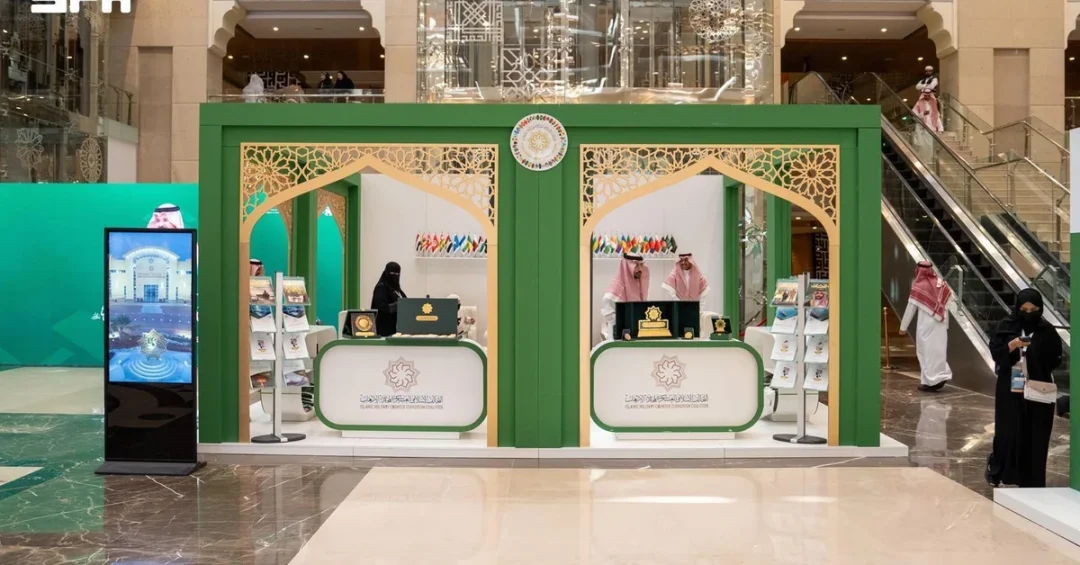
The Islamic Military Counter-Terrorism Coalition (IMCTC) participated in the International Conference on Saudi Arabia’s Efforts to Counter Intellectual Deviations, hosted by the Islamic University of Madinah on September 27 and 28, showcasing its strategic programs across intellectual, media, counter-terrorism financing, and military domains. The conference, organized by the Islamic University of Madinah, brought together scholars, researchers, and specialists from within the Kingdom and abroad to examine how extremist ideologies can be addressed through scholarship, education, and coordinated institutional action. IMCTC’s participation reflects the coalition’s commitment to contributing to academic discussions on countering extremist narratives and to presenting studies and strategic initiatives that support member states’ efforts to prevent extremism and combat terrorism.
At the accompanying exhibition, IMCTC presented an interactive display introducing visitors to the coalition’s strategic programs and initiatives, their objectives, and their implementation methods in member states. The exhibition also highlighted the coalition’s role in capacity-building, exchanging expertise, and strengthening cooperation to address terrorism and extremism. Why does a military coalition invest in an academic conference on intellectual deviations? The answer lies in the nature of modern terrorism, which relies as much on ideas as on weapons, and in Saudi Arabia’s conviction that sustainable security requires confronting the ideological roots of extremism alongside its operational manifestations.
Context and Background
The Islamic Military Counter-Terrorism Coalition was established to serve as a unified platform for member states committed to confronting terrorism and extremism in all their forms. Headquartered in Riyadh, the coalition operates across four principal domains: intellectual, media, counter-terrorism financing, and military. Each domain addresses a distinct dimension of the terrorist threat, and together they form an integrated approach that recognizes terrorism as a multifaceted challenge requiring coordinated responses. The coalition’s participation in the Madinah conference therefore represents a natural extension of its mandate, connecting the operational and intellectual strands of counterterrorism into a single, coherent framework.
The Islamic University of Madinah, for its part, has long occupied a distinctive place in the Islamic world as an institution dedicated to the study of Sharia sciences, Islamic thought, and the Arabic language. Its convening of a conference on intellectual deviations signals a scholarly commitment to examining how extremist interpretations emerge, how they diverge from mainstream Islamic scholarship, and how they can be countered through rigorous academic engagement. What makes the combination of a military coalition and a university so significant? It demonstrates that counterterrorism in the twenty-first century is no longer the exclusive province of security services, but a shared responsibility that draws on scholarship, education, media, and civil society.
The conference reflects a broader recognition across the Islamic world that extremist ideologies cannot be defeated by kinetic means alone. Security operations may disrupt networks and prevent attacks, but they cannot eliminate the ideas that inspire recruitment and radicalization. Only sustained intellectual engagement, grounded in authentic scholarship and delivered through credible institutions, can inoculate communities against extremist narratives. IMCTC’s presence at the exhibition gave concrete form to this principle, allowing visitors to see how strategic programs are translated into training, practical initiatives, and measurable capacity-building in member states.
Key Details
The exhibition accompanying the conference served as a platform for IMCTC to present its counterterrorism efforts across the intellectual, media, counter-terrorism financing, and military fields. An interactive display introduced visitors to the coalition’s strategic programs and initiatives, their objectives and implementation methods in member states, and their role in capacity-building, exchanging expertise, and strengthening cooperation to address terrorism and extremism. The display was designed to be interactive, allowing scholars, researchers, and specialists to engage directly with the coalition’s work rather than merely read about it. This approach reflects a deliberate effort to make counterterrorism strategy accessible to academic audiences and to invite scholarly scrutiny and collaboration.
IMCTC also highlighted initiatives that translate knowledge into training and practical programs and support the integration of efforts among relevant entities. These initiatives are central to the coalition’s operating philosophy: knowledge that remains theoretical cannot protect societies, and training that is not grounded in rigorous analysis risks being ineffective. By presenting both the conceptual foundations and the practical applications of its programs, the coalition demonstrated how member states can move from understanding extremist ideologies to actively countering them. How does a coalition ensure that its programs remain relevant across diverse member states with different legal systems, educational traditions, and security environments? The answer lies in the coalition’s emphasis on exchanging expertise and adapting best practices to local contexts, rather than imposing a one-size-fits-all model.
The conference itself brought together scholars, researchers, and specialists from inside and outside the Kingdom, creating a space for academic exchange on one of the most pressing challenges facing the Islamic world. The Islamic University of Madinah’s role as organizer underscores the importance of grounding counter-extremism efforts in authentic Islamic scholarship. Extremist groups have long exploited religious texts and concepts to justify violence, and the most effective refutation of their claims comes from scholars who possess the depth of knowledge to expose distortions and misrepresentations. By convening this conference, the University has created an opportunity for that scholarly refutation to be developed, shared, and disseminated.
International and Regional Impact
The participation of IMCTC in a conference organized by the Islamic University of Madinah carries significance beyond the Kingdom’s borders. Member states of the coalition span multiple continents, and each faces distinct manifestations of the terrorist threat. Some confront active insurgencies, others grapple with radicalization among diaspora communities, and still others contend with terrorist financing networks that operate across borders. The conference provided a venue for representatives of these diverse contexts to share experiences and identify common strategies. In a region where terrorist organizations have exploited instability and sectarian tensions, such coordination is not merely desirable but essential.
For the international community, the conference signals that Saudi Arabia and its partners are addressing extremism through a comprehensive approach that integrates security, finance, education, and media. This approach aligns with global counterterrorism frameworks, including United Nations resolutions that call on member states to counter violent extremism through prevention as well as enforcement. What do international observers learn from this conference? They learn that the Islamic world is not a passive recipient of counterterrorism strategies devised elsewhere, but an active producer of solutions rooted in its own scholarly traditions and institutional capacities. The coalition’s work demonstrates that Muslim-majority countries can take the lead in confronting extremist ideologies, drawing on their own resources and expertise.
Economic and Strategic Significance
The economic dimensions of counterterrorism are often underestimated, yet they are critical to long-term success. Terrorism imposes direct costs through loss of life and property, and indirect costs through deterred investment, reduced tourism, and disrupted trade. IMCTC’s focus on counter-terrorism financing recognizes that terrorist organizations require money to operate, and that cutting off their funding sources is as important as disrupting their operations. The coalition’s programs in this domain support member states in strengthening their financial intelligence capabilities, improving regulatory frameworks, and cooperating across borders to trace and intercept illicit financial flows. These efforts contribute to the stability that underpins economic growth and investment.
Strategically, the conference reinforces Saudi Arabia’s position as a leader in global counterterrorism. The Kingdom has long been a target of terrorist attacks, and its response has evolved from a primarily security-focused approach to a comprehensive strategy that addresses ideological, financial, and military dimensions. This evolution reflects the broader transformation underway in Saudi Arabia under Vision 2030, which seeks to build a diversified, knowledge-based economy and a society open to the world. A secure environment is a prerequisite for that transformation: tourists will not visit, investors will not commit capital, and young people will not build careers in a country perceived as unstable. By contributing to counterterrorism scholarship and practice, IMCTC supports the conditions necessary for Saudi Arabia’s economic and social development.
Vision 2030 Alignment
The work highlighted at the Madinah conference aligns closely with the objectives of Saudi Vision 2030, the Kingdom’s comprehensive plan for economic diversification, social development, and global engagement. Vision 2030 emphasizes the importance of a secure and stable society as the foundation for prosperity, and it recognizes that security is not solely a matter of military capability but also of education, opportunity, and moderate religious discourse. IMCTC’s programs in the intellectual domain, which promote moderate interpretations and counter extremist narratives, directly support the Vision’s goal of fostering a tolerant and inclusive society. The coalition’s media initiatives, which aim to counter terrorist propaganda and present accurate information, complement the Kingdom’s broader efforts to project a positive image internationally.
As IMCTC continues its work across member states, its participation in academic conferences such as this one will remain an important part of its strategy. The challenges posed by extremist ideologies are evolving, and responses must evolve with them. By engaging scholars, researchers, and specialists, the coalition ensures that its programs are informed by the best available knowledge and that its efforts are subject to scholarly examination and refinement. The conference on Saudi Arabia’s Efforts to Counter Intellectual Deviations represents a model of the kind of collaboration that will be needed in the years ahead: a partnership between security institutions and academic centers, between practitioners and scholars, between the Kingdom and its partners around the world. Through such collaboration, the Islamic world can confront extremism not only with force but with ideas, and build a future in which terrorism no longer finds fertile ground.
20 Questions
Q1. What was the International Conference on Saudi Arabia’s Efforts to Counter Intellectual Deviations?
A1. It was a conference organized by the Islamic University of Madinah on September 27 and 28, bringing together scholars, researchers, and specialists from inside and outside the Kingdom to examine efforts to counter extremist ideologies and intellectual deviations.
Q2. What is the Islamic Military Counter-Terrorism Coalition (IMCTC)?
A2. IMCTC is a coalition of member states headquartered in Riyadh, Saudi Arabia, that works across intellectual, media, counter-terrorism financing, and military domains to confront terrorism and extremism in all their forms.
Q3. Why did IMCTC participate in this conference?
A3. IMCTC participated to contribute to academic discussions on addressing extremist ideologies and to showcase studies and strategic initiatives that support member states’ efforts to prevent extremism and combat terrorism.
Q4. What did IMCTC showcase at the accompanying exhibition?
A4. IMCTC showcased its counterterrorism efforts in the intellectual, media, counter-terrorism financing, and military fields through an interactive display introducing visitors to its strategic programs and initiatives.
Q5. What were the objectives of the interactive display?
A5. The display introduced visitors to the coalition’s strategic programs, their objectives and implementation methods in member states, and their role in capacity-building, exchanging expertise, and strengthening cooperation against terrorism and extremism.
Q6. Which four domains does IMCTC operate in?
A6. IMCTC operates in the intellectual, media, counter-terrorism financing, and military domains, reflecting an integrated approach that recognizes terrorism as a multifaceted challenge requiring coordinated responses.
Q7. Why is the intellectual domain important in counterterrorism?
A7. The intellectual domain is important because terrorism relies on ideas as well as weapons, and sustainable security requires confronting the ideological roots of extremism alongside its operational manifestations.
Q8. What role did the Islamic University of Madinah play?
A8. The Islamic University of Madinah organized the conference, creating a space for academic exchange on countering extremism and underscoring the importance of grounding these efforts in authentic Islamic scholarship.
Q9. Who attended the conference?
A9. The conference brought together scholars, researchers, and specialists from inside and outside the Kingdom of Saudi Arabia, fostering international and regional cooperation on counter-extremism efforts.
Q10. How does IMCTC support capacity-building in member states?
A10. IMCTC supports capacity-building by translating knowledge into training and practical programs, exchanging expertise, and strengthening cooperation among relevant entities to address terrorism and extremism effectively.
Q11. What is the significance of counter-terrorism financing efforts?
A11. Counter-terrorism financing efforts are critical because terrorist organizations require money to operate, and cutting off funding sources is as important as disrupting their operations to ensure long-term security.
Q12. How does this conference align with Saudi Vision 2030?
A12. It aligns with Vision 2030 by supporting a secure and stable society, promoting moderate religious discourse, and fostering education and opportunity as foundations for prosperity and global engagement.
Q13. What makes Saudi Arabia a leader in global counterterrorism?
A13. Saudi Arabia has long been a target of terrorist attacks and has developed a comprehensive strategy addressing ideological, financial, and military dimensions, positioning the Kingdom as a leader in global counterterrorism efforts.
Q14. How does IMCTC’s work benefit international security?
A14. IMCTC’s work benefits international security by coordinating efforts across member states, sharing best practices, and addressing terrorist threats that transcend borders through a comprehensive and cooperative approach.
Q15. What is the role of media in countering extremism?
A15. The media domain aims to counter terrorist propaganda and present accurate information, complementing broader efforts to prevent radicalization and project a positive image of moderate Islamic values.
Q16. How does IMCTC engage with academic institutions?
A16. IMCTC engages with academic institutions by participating in conferences, contributing to scholarly discussions, and showcasing its programs to researchers and specialists who can provide valuable insights and scrutiny.
Q17. What are the expected outcomes of such conferences?
A17. Expected outcomes include enhanced understanding of extremist ideologies, development of effective counter-narratives, strengthened collaboration among stakeholders, and the translation of scholarly insights into practical programs.
Q18. How does IMCTC ensure its programs remain relevant?
A18. IMCTC ensures relevance by exchanging expertise, adapting best practices to local contexts, and engaging with scholars and practitioners to refine its strategies in response to evolving threats.
Q19. What is the significance of the exhibition for visitors?
A19. The exhibition allowed visitors to engage directly with IMCTC’s work, making counterterrorism strategy accessible to academic audiences and inviting scholarly collaboration and scrutiny.
Q20. What does IMCTC’s participation signal about Saudi Arabia’s approach?
A20. It signals that Saudi Arabia and its partners address extremism through a comprehensive approach integrating security, finance, education, and media, consistent with Vision 2030 and global counterterrorism frameworks.
Reader Feedback
We value your thoughts. Please share your feedback on this article.
Your feedback helps us improve our coverage.
Related articles
 Saudi Ministry Holds First Religious Course in Taiwan
 Riyadh Governor Welcomes Danish Ambassador
 NWC Completes Sewer Network in Unaizah, Serving 11,000+
 Saudi Embassy in Nigeria Celebrates National Day
 Saudi FM Delivers Kingdom’s Speech at 81st UN General Assembly
 King Salman Congratulates Turkmenistan on Independence Day