


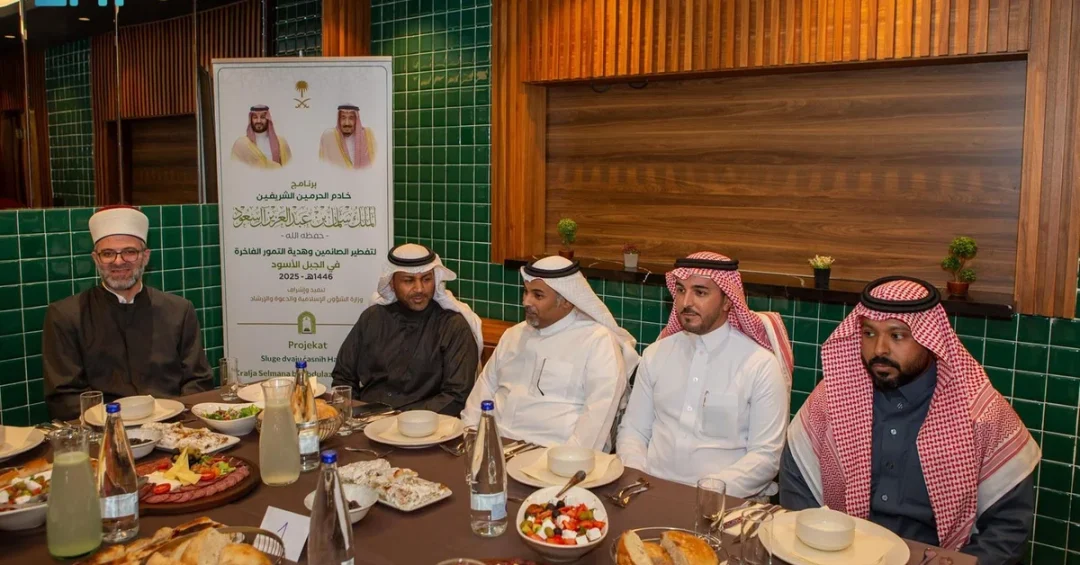
The Ministry of Islamic Affairs, Dawah and Guidance, represented by the Religious Attaché at the Kingdom of Saudi Arabia’s Embassy in Bosnia and Herzegovina, organized an Iftar banquet in Podgorica, Montenegro, benefiting approximately 500 fasting individuals as part of the Custodian of the Two Holy Mosques’ program for providing Iftar to fasting people. The event, held in the Montenegrin capital, forms part of a broader humanitarian initiative that continues throughout the holy month of Ramadan, reflecting the Kingdom’s enduring commitment to serving Muslim communities worldwide. The banquet brought together Muslims from all segments of Montenegrin society, underscoring the unifying spirit of Ramadan and the deep bonds of Islamic fraternity that connect the Kingdom to Muslims across Europe and beyond.
What does it mean when a nation extends its table across continents during the holiest month of the Islamic calendar? For the beneficiaries in Podgorica, the answer was immediate and heartfelt: gratitude for the Kingdom’s consistent and generous support. The Iftar program, executed under the direct guidance of the Ministry of Islamic Affairs, Dawah and Guidance, is one of the most visible expressions of Saudi Arabia’s global humanitarian outreach. It is a program that transforms policy into practice, delivering meals, dignity, and spiritual solidarity to fasting Muslims in dozens of countries each year. In Montenegro, a nation with a significant Muslim population and a rich multicultural fabric, the initiative carried particular resonance, reinforcing the message that the Kingdom stands with Muslim communities wherever they may be.
Context and Background
How did an Iftar banquet in a small Balkan capital become a symbol of Saudi Arabia’s far-reaching humanitarian diplomacy? The answer lies in the institutional framework that underpins the Custodian of the Two Holy Mosques’ program. For years, the Ministry of Islamic Affairs, Dawah and Guidance has coordinated Iftar distributions and banquets across the globe during Ramadan, working through Saudi embassies, religious attachés, and local partners to identify communities in need and ensure that the blessings of the holy month are shared equitably. The program is not a one-off gesture but a sustained annual commitment that reflects the Kingdom’s foundational role as the custodian of Islam’s holiest sites and its sense of responsibility toward the global Muslim ummah.
Montenegro, a candidate country for European Union membership with a Muslim population that traces its roots back centuries, represents a meaningful setting for such an initiative. The country’s Islamic community has maintained strong ties with international Islamic institutions, and the presence of a Saudi religious attaché based in Sarajevo, Bosnia and Herzegovina, ensures that the Kingdom’s outreach extends across the Balkan region. The Iftar banquet in Podgorica was thus not merely a meal but a diplomatic and spiritual bridge, connecting the Kingdom’s leadership with a European Muslim community that values both its Islamic heritage and its European identity. The event also highlighted the important role that Saudi Arabia plays in supporting moderate Islam and interfaith harmony in the Balkans.
Furthermore, the timing of the banquet during Ramadan carries profound significance. Ramadan is a month of reflection, generosity, and community, and the Iftar meal is its most cherished daily ritual. By providing Iftar to hundreds of fasting individuals in Podgorica, the Kingdom enabled families and individuals to observe their religious obligations with dignity and joy. The Ministry’s emphasis on reaching all segments of society, from students and workers to families and the elderly, demonstrates a holistic approach to humanitarian engagement that goes beyond mere charity. It is an approach rooted in the Islamic principles of brotherhood and compassion, and it resonates deeply with the values that Saudi Arabia seeks to promote globally.
Key Details
What were the specific features of this year’s Iftar banquet in Podgorica, and how does it fit into the larger Ramadan program? The event was organized by the Religious Attaché at the Kingdom’s Embassy in Bosnia and Herzegovina, which oversees Saudi religious and cultural affairs across the region. Approximately 500 fasting individuals attended the banquet, which was held in the Montenegrin capital and included a full Iftar meal served at sunset. The program is designed to continue throughout the entire month of Ramadan, ensuring that the support is not limited to a single night but is a sustained effort. The beneficiaries represented a cross-section of Montenegrin Muslim society, including community leaders, students, and ordinary worshippers, all of whom shared in the blessings of the meal.
The Ministry of Islamic Affairs, Dawah and Guidance has long been the primary vehicle through which Saudi Arabia channels its religious and humanitarian outreach. Under the leadership of the Minister of Islamic Affairs, Dawah and Guidance, the Ministry oversees a vast network of programs that include mosque construction and renovation, Quran distribution, Islamic education, and Ramadan Iftar initiatives. The Custodian of the Two Holy Mosques’ program for providing Iftar to fasting individuals is one of the Ministry’s flagship projects, operating in coordination with Saudi embassies and religious attachés worldwide. In Montenegro, the program was implemented with the support of local Islamic authorities, who helped identify beneficiaries and organize the logistics of the banquet.
The beneficiaries expressed their deep appreciation for the Kingdom’s leadership and its unwavering support for Muslims in Montenegro. Their gratitude was not merely for the meal itself but for the recognition and solidarity that the initiative represents. In a world where Muslim communities in Europe sometimes feel marginalized, the Kingdom’s outreach serves as a powerful reminder that they are part of a global ummah that cares for them. The Iftar banquet also provided an opportunity for community bonding, as Muslims from different backgrounds came together to break their fast, share stories, and strengthen the bonds of brotherhood. Such gatherings are an essential part of Ramadan’s social fabric, and the Kingdom’s support made them possible on a scale that would otherwise be difficult to achieve.
International and Regional Impact
How does an Iftar banquet in Montenegro reverberate across the broader landscape of Saudi Arabia’s international relations? The event is a concrete example of the Kingdom’s soft power in action. By supporting Muslim communities in Europe, Saudi Arabia strengthens its image as a benevolent global leader and a reliable partner for Islamic causes. The Balkans, with its complex history and diverse religious landscape, is a region where such gestures carry particular weight. Montenegro’s Muslim community, which has coexisted with Orthodox and Catholic neighbors for centuries, benefits from international support that reinforces its place in the national fabric. The Kingdom’s initiative thus contributes to social cohesion and interfaith understanding in a region that has known its share of conflict.
Moreover, the Iftar program aligns with Saudi Arabia’s broader diplomatic strategy of building bridges with European nations and Muslim diasporas. The Kingdom maintains diplomatic relations with Montenegro and other Balkan states, and initiatives like the Iftar banquet complement official diplomatic engagement with people-to-people connections. The Religious Attaché at the Embassy in Bosnia and Herzegovina plays a crucial role in this regard, acting as a conduit for Saudi religious diplomacy across the region. The positive reception of the banquet in Podgorica is likely to enhance the Kingdom’s standing not only among Muslims but also among Montenegrin society at large, which values humanitarian gestures and cultural exchange. In this way, the Iftar program serves both spiritual and strategic objectives, reinforcing Saudi Arabia’s role as a force for stability and generosity.
Economic and Strategic Significance
What strategic value does a humanitarian program like the Ramadan Iftar initiative hold for Saudi Arabia’s global positioning? While the program is primarily humanitarian, it also has strategic dimensions that align with the Kingdom’s Vision 2030 goals of enhancing its international standing and promoting moderate Islam. By investing in communities abroad, Saudi Arabia demonstrates that its leadership extends beyond its borders and that it is committed to the well-being of Muslims worldwide. This commitment helps counter extremist narratives and showcases the Kingdom’s moderate and compassionate approach to Islam. The Iftar program is thus an instrument of soft power that complements Saudi Arabia’s economic and political influence, creating goodwill that can translate into diplomatic and economic opportunities over time.
From an economic perspective, the program is modest in cost but high in impact. The Ministry of Islamic Affairs, Dawah and Guidance allocates resources efficiently, leveraging local partners and embassies to maximize reach. The benefits are not easily quantified in monetary terms, but they include enhanced bilateral relations, improved perceptions of Saudi Arabia, and strengthened ties with Muslim communities that can serve as bridges to broader engagement. In Montenegro, for example, the goodwill generated by the Iftar banquet may facilitate future cooperation in areas such as trade, tourism, and cultural exchange. The Kingdom’s Vision 2030 seeks to diversify its economy and expand its global partnerships, and initiatives like this one contribute to that goal by building a foundation of trust and mutual respect.
Vision 2030 Alignment
How does the Iftar banquet in Montenegro reflect the core principles of Saudi Vision 2030? Vision 2030 is not only an economic blueprint but also a social and cultural vision that emphasizes Saudi Arabia’s role as a leader in the Islamic world and a responsible global citizen. The Custodian of the Two Holy Mosques’ program for providing Iftar to fasting individuals embodies the humanitarian spirit of Vision 2030, which seeks to promote moderation, tolerance, and generosity. By supporting Muslims in Montenegro, the Kingdom demonstrates that its vision extends beyond its own borders and that it is committed to building a better world for all. This alignment with Vision 2030 reinforces the program’s legitimacy and ensures that it remains a priority for the Ministry of Islamic Affairs, Dawah and Guidance.
Looking ahead, the Ministry is expected to continue and expand its Ramadan Iftar initiatives, reaching even more communities in the Balkans and beyond. The success of the Podgorica banquet serves as a model for future events, demonstrating the effectiveness of working through religious attachés and local partners. As Saudi Arabia continues its journey toward Vision 2030, such programs will remain a vital component of its international engagement, showcasing the Kingdom’s leadership, compassion, and commitment to the global Muslim ummah. The beneficiaries in Montenegro will remember the Kingdom’s generosity, and their gratitude will echo across the region, strengthening the bonds of friendship and faith that connect Saudi Arabia to the world.
20 Questions
Q1. What was the purpose of the Iftar banquet organized in Podgorica, Montenegro?
A1. The Iftar banquet was organized to provide meals to fasting individuals in Podgorica as part of the Custodian of the Two Holy Mosques’ program for providing Iftar to fasting people. It aimed to share the joy of Ramadan with Muslims in Montenegro.
Q2. Which Saudi ministry was responsible for organizing the event?
A2. The Ministry of Islamic Affairs, Dawah and Guidance organized the event, represented by the Religious Attaché at the Kingdom’s Embassy in Bosnia and Herzegovina. The ministry oversees Saudi Arabia’s global Islamic outreach and humanitarian programs.
Q3. How many people benefited from the Iftar banquet in Podgorica?
A3. Approximately 500 fasting individuals benefited from the Iftar banquet. The beneficiaries included Muslims from all segments of Montenegrin society, reflecting the inclusive nature of the program.
Q4. What is the Custodian of the Two Holy Mosques’ program for providing Iftar?
A4. It is a Ramadan initiative by the Ministry of Islamic Affairs, Dawah and Guidance that distributes Iftar meals to fasting Muslims in various countries. The program operates throughout the holy month and reaches thousands of beneficiaries globally.
Q5. Why was the event held in Montenegro specifically?
A5. Montenegro has a significant Muslim population with historical ties to the Islamic world. The Kingdom’s religious attaché in Sarajevo oversees the Balkan region, making Podgorica a key location for outreach to European Muslim communities.
Q6. How long does the Iftar program continue in Montenegro?
A6. The program continues throughout the entire month of Ramadan. This ensures sustained support for fasting individuals and allows more people to benefit from the initiative beyond a single event.
Q7. What was the reaction of the beneficiaries to the Iftar banquet?
A7. The beneficiaries expressed their gratitude to the Kingdom’s leadership for its consistent support of Muslims in Montenegro. Their appreciation reflected both the material assistance and the spiritual solidarity the program represents.
Q8. Which Saudi embassy oversees the religious attaché responsible for Montenegro?
A8. The Religious Attaché at the Kingdom’s Embassy in Bosnia and Herzegovina oversees Montenegro and the broader Balkan region. This office coordinates Saudi religious and humanitarian activities in the area.
Q9. What is the significance of the Iftar banquet for Saudi-Montenegrin relations?
A9. The banquet strengthens people-to-people ties and enhances Saudi Arabia’s image as a benevolent partner. It complements official diplomatic relations and builds goodwill among Montenegrin Muslims and society at large.
Q10. Does the Iftar program target only Muslims or does it include others?
A10. The program primarily targets Muslims observing the fast during Ramadan. However, it is part of the Kingdom’s broader humanitarian outreach that promotes tolerance and coexistence, benefiting communities regardless of background in some cases.
Q11. How does the Iftar program align with Vision 2030?
A11. Vision 2030 emphasizes Saudi Arabia’s role as a global leader and promoter of moderate Islam. The Iftar program reflects these values by extending humanitarian support and showcasing the Kingdom’s commitment to the global Muslim ummah.
Q12. What role does the Ministry of Islamic Affairs, Dawah and Guidance play globally?
A12. The ministry oversees mosque construction, Quran distribution, Islamic education, and Ramadan programs worldwide. It is the primary institution for Saudi Arabia’s religious diplomacy and humanitarian outreach to Muslim communities.
Q13. How are beneficiaries selected for the Iftar program?
A13. Beneficiaries are identified in coordination with local Islamic authorities and community leaders. The selection aims to reach all segments of society, including students, families, workers, and the elderly.
Q14. What other countries benefit from the Custodian of the Two Holy Mosques’ Iftar program?
A14. The program operates in dozens of countries across Asia, Africa, Europe, and the Americas. It is a global initiative that reflects the Kingdom’s commitment to Muslims worldwide during Ramadan.
Q15. What is the historical context of Islam in Montenegro?
A15. Islam has been present in Montenegro for centuries, with a significant Muslim population mainly in the Sandžak region and coastal areas. The community has maintained its Islamic identity while coexisting with other religious groups.
Q16. How does the Iftar banquet promote moderation and tolerance?
A16. By bringing together Muslims from diverse backgrounds, the banquet fosters unity and showcases the Kingdom’s moderate approach to Islam. It counters extremism by emphasizing compassion, generosity, and community spirit.
Q17. Will the Iftar program be expanded in the future?
A17. The Ministry of Islamic Affairs, Dawah and Guidance continuously evaluates and expands its Ramadan initiatives. The success of events like the Podgorica banquet supports further growth and outreach in the Balkans and beyond.
Q18. What is the role of the Religious Attaché in Saudi diplomacy?
A18. The Religious Attaché facilitates religious and cultural exchange, supports Muslim communities, and coordinates humanitarian programs. This role strengthens Saudi Arabia’s soft power and people-to-people connections in host regions.
Q19. How does the Iftar program reflect Saudi Arabia’s leadership in the Islamic world?
A19. As the custodian of Islam’s holiest sites, Saudi Arabia has a unique responsibility to serve Muslims globally. The Iftar program demonstrates this leadership through tangible humanitarian action during Ramadan.
Q20. What message does the Iftar banquet in Montenegro send to the world?
A20. It sends a message of generosity, solidarity, and moderate Islamic values. The Kingdom stands with Muslim communities everywhere, and its Vision 2030 vision includes a commitment to global humanitarian engagement and interfaith harmony.
Reader Feedback
We value your thoughts. Please share your feedback on this article.
Your feedback helps us improve our coverage.
Related articles
 Civil Defense Urges Gas Safety Measures Across Saudi Arabia
 Saudi Arabia Distributes Dates, Iftar Meals in Kazakhstan for Ramadan
 KSrelief Launches Ramadan Food Basket Project in South Africa
 U.S. Designates Houthis as Foreign Terrorist Organization
 Two Holy Mosques Authority Opens Itikaf Registration Today
 Saudi Embassy in Sweden Hosts Ramadan Iftar Banquet