


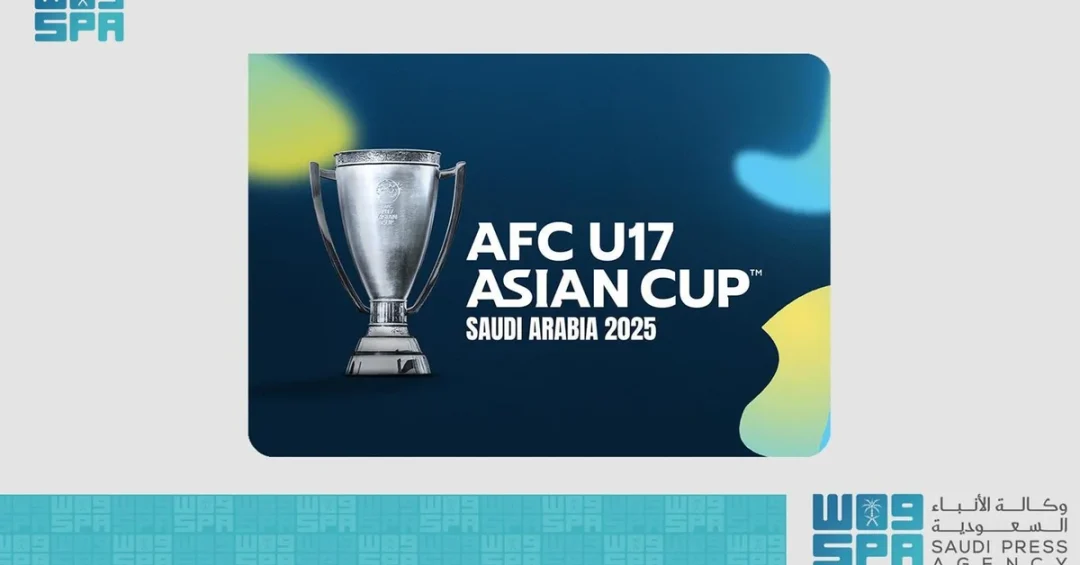
Saudi Arabia will host the AFC U17 Asian Cup™ finals from April 3 to 20, 2025, with 16 teams competing across the cities of Jeddah and Taif, according to an official announcement carried by the Saudi Press Agency (SPA). The tournament, staged in a newly introduced format, will serve as the qualifying pathway for the FIFA U-17 World Cup, which Qatar will host from November 5 to 27, 2025. For the first time in the history of the competition, the World Cup will feature 48 teams, and the top eight finishers in the AFC U17 Asian Cup™ will secure their places at the global showpiece. The draw, conducted last January, placed host nation Saudi Arabia at the top of Group A alongside Uzbekistan, Thailand, and China.
The confirmation of the hosting rights and the full competition schedule marks another milestone in the Kingdom’s rapid emergence as a global hub for major sporting events. The Saudi Arabian Football Federation (SAFF), led by President Yasser Al Misehal, has welcomed the participating teams and expressed confidence that the tournament will showcase the best of Asian youth football. The event will be held in two of Saudi Arabia’s most storied cities: Jeddah, the Kingdom’s commercial gateway on the Red Sea, and Taif, a highland city known for its mild climate and growing sports infrastructure. With 16 national teams arriving from across Asia, the tournament is expected to draw significant international attention and further strengthen Saudi Arabia’s reputation as a reliable and ambitious host of world-class competitions.
Context and Background
How did Saudi Arabia come to host one of Asia’s most important youth football tournaments? The answer lies in the Kingdom’s sustained investment in sport as a pillar of its national transformation. Over the past several years, Saudi Arabia has hosted an extraordinary array of international events, including the FIFA World Cup 2034™, the AFC Asian Cup™, Formula 1 Grands Prix, top-tier boxing and tennis championships, and the Dakar Rally. The AFC U17 Asian Cup™ adds another layer to this portfolio, focusing specifically on youth development and the future of the game in Asia.
The tournament’s new format is significant. Previously, the AFC U17 Asian Cup™ operated with a different qualification structure for the global youth championship. Under the revised system, the top eight teams from the Asian finals will advance directly to the FIFA U-17 World Cup, which expands to 48 teams for the first time. This change gives more Asian nations a realistic pathway to the world stage and raises the stakes for every match in Jeddah and Taif. For Saudi Arabia, hosting the first edition of this expanded qualifying cycle is both an honor and a responsibility, one that aligns with the Kingdom’s broader commitment to developing football from the grassroots up.
The Saudi Arabian Football Federation has been preparing for this moment for months. President Yasser Al Misehal has emphasized the importance of hosting a tournament that not only delivers memorable football but also leaves a lasting legacy for young players and local communities. The SAFF’s technical teams have worked closely with the Asian Football Confederation (AFC) to ensure that stadiums, training facilities, accommodation, and medical services meet the highest international standards. The presence of 16 teams across two host cities also requires careful logistical coordination, from travel and security to media operations and fan engagement.
Key Details
What exactly will the tournament look like on the pitch? The draw, conducted last January, produced four groups of four teams. Host nation Saudi Arabia headlines Group A, where they will face Uzbekistan, Thailand, and China. Group B brings together Japan, Australia, Vietnam, and the United Arab Emirates. Group C features the Republic of Korea, Yemen, Afghanistan, and Indonesia. Group D comprises Iran, Tajikistan, Oman, and North Korea. The group stage will be played across venues in Jeddah and Taif, with the knockout rounds culminating in the final on April 20.
For Saudi Arabia, the draw presents both opportunities and challenges. Uzbekistan and China have consistently invested in youth development, while Thailand brings technical flair and regional rivalry. The Saudi youth team, coached by a staff appointed by the SAFF, will aim to leverage home advantage and the support of local fans. The top eight teams will qualify for the FIFA U-17 World Cup in Qatar, meaning that reaching the quarterfinals is the minimum target for ambitious sides. This adds a layer of intensity to every group match, as teams cannot afford a slow start.
Yasser Al Misehal, President of the Saudi Arabian Football Federation, welcomed the participating teams and expressed his hopes for a successful tournament that showcases the best of Asian football. His statement, carried by the Saudi Press Agency, reflects the Kingdom’s broader philosophy of using sport to build bridges between nations and cultures. The SAFF has also confirmed that ticketing, fan zones, and youth football clinics will be part of the tournament experience, giving local children a chance to interact with the stars of tomorrow.
International and Regional Impact
Why does this tournament matter beyond the final score? The AFC U17 Asian Cup™ is a platform for the next generation of Asian footballers, many of whom will go on to play in top leagues around the world. By hosting the event, Saudi Arabia positions itself at the center of Asian football’s development pipeline. Scouts, coaches, and technical directors from clubs across Europe, South America, and the Middle East are expected to attend, turning Jeddah and Taif into temporary hubs of global talent identification. The exposure for young players from countries such as Afghanistan, Yemen, and Tajikistan could be life-changing, offering them a stage to showcase their abilities.
Regionally, the tournament reinforces Saudi Arabia’s role as a unifying force in Asian sport. The presence of teams from across the continent, including nations with complex geopolitical relationships, demonstrates how football can create dialogue and mutual respect. The AFC has praised the Kingdom’s organizational capacity, and the successful delivery of the U17 Asian Cup™ will further cement Saudi Arabia’s credentials ahead of the FIFA World Cup 2034™, which the Kingdom is preparing to host. For international audiences, the event is an opportunity to see a modern, welcoming Saudi Arabia that is passionate about football and committed to excellence.
Economic and Strategic Significance
What economic benefits flow from hosting a continental youth championship? While the AFC U17 Asian Cup™ is smaller in scale than senior tournaments, its economic footprint is meaningful. Thousands of players, officials, media representatives, and fans will travel to Jeddah and Taif, boosting demand for hotels, restaurants, transport, and retail. The event also creates short-term jobs and volunteer opportunities, contributing to local employment and skills development. Beyond the immediate impact, the tournament enhances Saudi Arabia’s brand as a destination for sports tourism, a key pillar of the Kingdom’s economic diversification strategy.
Strategically, hosting youth competitions is an investment in soft power. It signals that Saudi Arabia is not only capable of staging mega-events but also committed to nurturing the grassroots of sport. This aligns with the Ministry of Sport’s mandate to increase participation in physical activity and to develop talented athletes across all age groups. The SAFF’s youth development programs, combined with the visibility of the U17 Asian Cup™, are expected to inspire more Saudi children to take up football and dream of representing their country. In the long run, this can strengthen the national team’s talent pool and elevate the standard of the domestic league.
Vision 2030 Alignment
How does the AFC U17 Asian Cup™ fit into Saudi Vision 2030? The Vision, launched by Crown Prince Mohammed bin Salman, seeks to diversify the economy, empower youth, and enhance the Kingdom’s global standing. Sport is explicitly recognized as a vehicle for achieving these goals, from increasing household spending on recreation to promoting social cohesion and national pride. Hosting the U17 Asian Cup™ directly supports the Vision’s objective of attracting international events and showcasing Saudi Arabia’s organizational capabilities. It also reinforces the Kingdom’s commitment to youth empowerment, as the tournament puts young athletes at the center of the national conversation.
Looking ahead, the successful delivery of this tournament will be another building block toward the FIFA World Cup 2034™, which Saudi Arabia is preparing to host with the same ambition and professionalism. The experience gained in Jeddah and Taif—managing multiple teams, venues, and international broadcasters—will be invaluable. More importantly, the tournament will leave a legacy of improved facilities, trained volunteers, and inspired young players. As Yasser Al Misehal and the Saudi Arabian Football Federation have emphasized, the goal is not just to host a competition but to create a lasting impact that advances football in Saudi Arabia and across Asia. With the world watching, the Kingdom is ready to deliver a tournament that reflects its vision, its hospitality, and its passion for the beautiful game.
20 Questions
Q1. When will the AFC U17 Asian Cup™ finals take place?
A1. The tournament will be held from April 3 to 20, 2025, according to the official announcement carried by the Saudi Press Agency. The event will bring together 16 teams across two host cities in Saudi Arabia.
Q2. Which cities in Saudi Arabia will host the tournament?
A2. The matches will be played in Jeddah, the Kingdom’s commercial hub on the Red Sea, and Taif, a highland city known for its mild climate and growing sports infrastructure. Both cities are well prepared to welcome international teams.
Q3. How many teams will compete in the AFC U17 Asian Cup™?
A3. Sixteen teams will compete in the finals, divided into four groups of four. The draw was conducted last January, and the groups feature a mix of established football nations and emerging sides from across Asia.
Q4. Which teams are in Group A alongside Saudi Arabia?
A4. Host nation Saudi Arabia heads Group A and will face Uzbekistan, Thailand, and China. The group presents a competitive mix of Central Asian, Southeast Asian, and East Asian opposition for the young Falcons.
Q5. Which teams make up Group B?
A5. Group B includes Japan, Australia, Vietnam, and the United Arab Emirates. This group is widely regarded as one of the most competitive, featuring traditional Asian powers and rapidly improving sides.
Q6. Which teams are in Group C?
A6. Group C features the Republic of Korea, Yemen, Afghanistan, and Indonesia. The group offers a blend of technical quality and emerging talent from across the continent.
Q7. Which teams are in Group D?
A7. Group D comprises Iran, Tajikistan, Oman, and North Korea. The group brings together teams with strong youth development records and a competitive edge.
Q8. How many teams will qualify for the FIFA U-17 World Cup?
A8. The top eight teams from the AFC U17 Asian Cup™ will qualify for the FIFA U-17 World Cup. This means reaching the quarterfinals is the minimum target for teams aiming for global participation.
Q9. Where and when will the FIFA U-17 World Cup take place?
A9. The FIFA U-17 World Cup will be hosted by Qatar from November 5 to 27, 2025. For the first time in the competition’s history, the World Cup will feature 48 teams, expanding opportunities for nations worldwide.
Q10. What is significant about the new format of the AFC U17 Asian Cup™?
A10. The new format directly links the Asian finals to the FIFA U-17 World Cup, with the top eight teams qualifying. This raises the stakes for every match and gives more Asian nations a realistic pathway to the global stage.
Q11. Who is the President of the Saudi Arabian Football Federation?
A11. Yasser Al Misehal is the President of the Saudi Arabian Football Federation. He welcomed the participating teams and expressed his hopes for a successful tournament that showcases the best of Asian football.
Q12. What did Yasser Al Misehal say about the tournament?
A12. He welcomed the participating teams and expressed his hopes for a successful tournament that showcases the best of Asian football. His statement, carried by the Saudi Press Agency, reflects the Kingdom’s commitment to hosting world-class events.
Q13. Why is hosting this tournament important for Saudi Arabia?
A13. Hosting the AFC U17 Asian Cup™ reinforces Saudi Arabia’s position as a global hub for major sporting events. It also supports youth development, sports tourism, and the Kingdom’s broader economic diversification goals under Saudi Vision 2030.
Q14. How does the tournament support Saudi Vision 2030?
A14. The tournament aligns with Vision 2030 by promoting youth empowerment, increasing international engagement, and showcasing Saudi Arabia’s organizational capabilities. Sport is a key pillar of the Vision’s quality-of-life and economic diversification programs.
Q15. What economic benefits will the tournament bring to Jeddah and Taif?
A15. The event will boost demand for hotels, restaurants, transport, and retail in both cities. It will also create short-term jobs and volunteer opportunities, contributing to local employment and skills development in the hospitality and events sectors.
Q16. How does this tournament prepare Saudi Arabia for the FIFA World Cup 2034™?
A16. The experience of managing multiple teams, venues, and international broadcasters will be invaluable for the FIFA World Cup 2034™. It allows Saudi Arabia to test and refine its operational, security, and hospitality systems on a continental stage.
Q17. What legacy will the tournament leave for Saudi youth football?
A17. The tournament will inspire young Saudi players, improve football infrastructure in Jeddah and Taif, and provide valuable experience for local coaches and volunteers. It also strengthens the talent pipeline for the national team.
Q18. How can fans attend the AFC U17 Asian Cup™ matches?
A18. The Saudi Arabian Football Federation has confirmed that ticketing and fan zones will be part of the tournament experience. Detailed information on tickets and venues is expected to be released through official SAFF channels closer to the event.
Q19. Which countries have strong youth football traditions in this tournament?
A19. Japan, the Republic of Korea, Australia, and Iran have strong youth development records. Saudi Arabia, Uzbekistan, and China have also invested heavily in youth football, making the competition highly competitive across all groups.
Q20. What is the ultimate goal of hosting the AFC U17 Asian Cup™ for Saudi Arabia?
A20. The goal is to deliver a successful tournament that showcases Asian football, inspires young players, and reinforces Saudi Arabia’s reputation as a world-class host. It also advances the Kingdom’s long-term vision for sport and youth development.
Reader Feedback
We value your thoughts. Please share your feedback on this article.
Your feedback helps us improve our coverage.
Related articles
 GEA, TKO, Sela Launch New Global Boxing Promotion
 Saudi Ambassador Meets Algerian Minister of Sports
 IOC Honors Saudi Taekwondo Star Dunya Abu Talib
 Al-Nassr Defeats Esteghlal 3-0, Advances to AFC Quarterfinals
 Ettifaq to Face Duhok in Gulf Clubs Semi-Final Second Leg
 Saudi Arabia Ready to Host AFC U-17 Asian Cup