


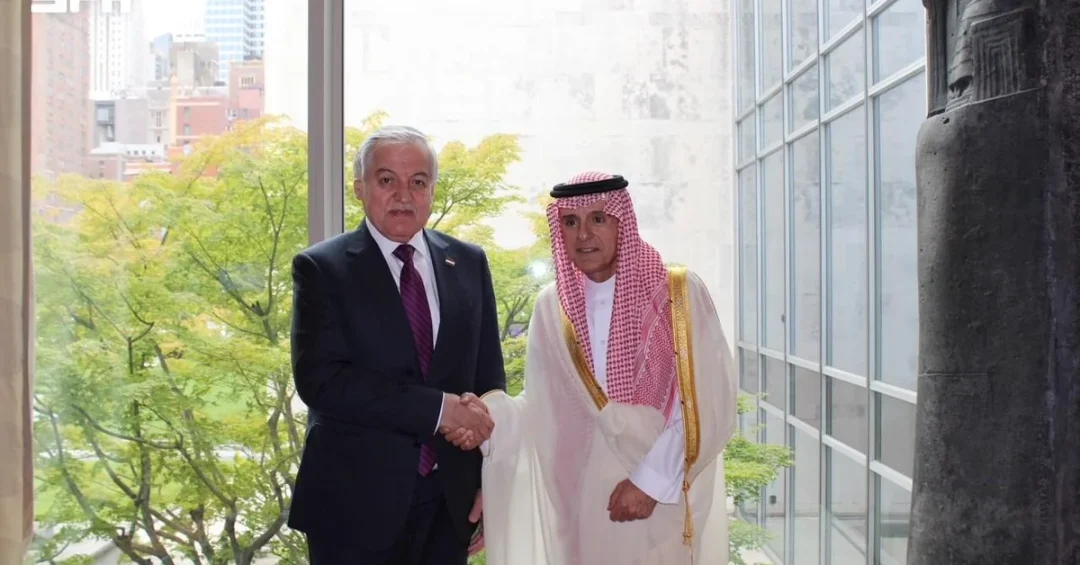
Saudi Arabia’s Minister of State for Foreign Affairs, Cabinet Member, Climate Envoy, and Commissioner General of Expo 2030 Riyadh, Adel Al-Jubeir, met with the Minister of Foreign Affairs of the Republic of Tajikistan, Sirojiddin Muhriddin, in New York on the sidelines of the 81st session of the United Nations General Assembly, according to the Saudi Press Agency. The meeting brought together two senior diplomats at a pivotal moment for regional and international affairs, with discussions centered on strengthening bilateral relations and addressing shared regional priorities.
The encounter reflects the Kingdom’s continued commitment to active diplomacy and multilateral engagement, particularly during the high-level segment of the UN General Assembly where world leaders and foreign ministers convene to address pressing global challenges. Saudi Arabia’s participation in the 81st session underscores its role as a bridge-builder among nations, a position reinforced by its expanding network of partnerships across Asia, the Middle East, and beyond. As global attention focuses on conflict resolution, climate action, and sustainable development, Riyadh’s diplomatic outreach demonstrates its readiness to contribute constructively to the international order.
Context and Background
Why does a meeting between Saudi Arabia and Tajikistan matter on the world stage? The two nations have steadily cultivated a relationship rooted in mutual respect and shared interests since the establishment of diplomatic ties in 1992, following Tajikistan’s independence. Over the decades, this partnership has evolved across political, economic, and cultural dimensions, with Saudi Arabia supporting Tajikistan’s development through infrastructure projects, educational exchanges, and humanitarian assistance. The Kingdom has also been a reliable partner in Tajikistan’s efforts to maintain stability in Central Asia, a region of growing strategic importance.
Tajikistan, a landlocked nation in Central Asia, shares borders with Afghanistan, China, Kyrgyzstan, and Uzbekistan, positioning it as a critical player in regional security and connectivity. Its stability and economic development are closely tied to broader Eurasian dynamics, including efforts to counter extremism and facilitate trade routes. Saudi Arabia’s engagement with Tajikistan aligns with its broader strategy of fostering peace and prosperity in Muslim-majority nations and supporting moderate voices in the region. The meeting between Al-Jubeir and Muhriddin therefore represents more than a routine diplomatic courtesy; it signals a deepening of ties that serve both nations’ long-term interests.
During the meeting, the two sides reviewed bilateral relations and explored avenues to develop and enhance them further. They also discussed regional developments and efforts to address them, reflecting a shared commitment to dialogue and cooperation. The exchange took place against the backdrop of the 81st UN General Assembly, where Saudi Arabia has consistently advocated for peaceful resolutions to conflicts, climate action, and sustainable development. For Tajikistan, engaging with Saudi Arabia offers opportunities to benefit from the Kingdom’s economic dynamism and its growing influence in global affairs.
Key Details of the Diplomatic Engagement
What specific outcomes might emerge from this high-level dialogue? While the Saudi Press Agency report did not disclose detailed agreements, the meeting’s agenda covered the full spectrum of bilateral cooperation. This includes trade and investment, cultural and educational exchanges, and coordination on regional security matters. Saudi Arabia has previously expressed interest in supporting Tajikistan’s hydropower sector and infrastructure development, areas where the Kingdom’s expertise and financial resources could make a significant difference. Additionally, both nations share an interest in countering extremism and promoting moderate Islam, a priority that resonates with Saudi Arabia’s Vision 2030 objectives of fostering global tolerance and stability.
The presence of Adel Al-Jubeir at the meeting is particularly notable given his multiple roles. As Minister of State for Foreign Affairs and Cabinet Member, he is a key architect of Saudi foreign policy. His additional responsibilities as Climate Envoy and Commissioner General of Expo 2030 Riyadh highlight the intersection of diplomacy, environmental stewardship, and global events in Saudi Arabia’s international outreach. This meeting therefore served as a platform to discuss not only bilateral ties but also Saudi Arabia’s preparations for Expo 2030, an event expected to attract millions of visitors and showcase the Kingdom’s cultural and technological achievements.
Sirojiddin Muhriddin, Tajikistan’s Foreign Minister, has been a vocal advocate for his country’s integration into global economic and security frameworks. His participation in the UN General Assembly and his meeting with Al-Jubeir underscore Tajikistan’s desire to strengthen ties with influential Gulf states. The two ministers likely discussed ways to increase trade volume, which currently remains below its potential, and to facilitate people-to-people exchanges that can deepen mutual understanding. Such engagements are essential for building trust and identifying concrete projects that can yield tangible benefits for both populations.
International and Regional Impact
How does this meeting fit into the broader geopolitical landscape? Saudi Arabia’s diplomacy in Central Asia is part of a carefully calibrated strategy to diversify partnerships and promote stability in a region that has historically been a crossroads of empires and a frontline in the fight against terrorism. By engaging with Tajikistan, the Kingdom reinforces its role as a responsible global actor committed to peaceful coexistence and economic development. This approach contrasts with the destabilizing influences that have sometimes plagued the region, offering instead a model based on mutual respect and shared prosperity.
The meeting also comes at a time of heightened global uncertainty, with conflicts in the Middle East, Europe, and Asia demanding coordinated international responses. Saudi Arabia has consistently called for dialogue and negotiation as the preferred means of resolving disputes, a stance that resonates with Tajikistan’s own preference for stability. Their discussions on regional developments likely touched on Afghanistan, where both nations have a stake in preventing the resurgence of extremist groups and facilitating humanitarian access. By aligning their positions, Saudi Arabia and Tajikistan can contribute to a more cohesive international effort to address these challenges.
Furthermore, the encounter highlights the growing importance of the United Nations as a venue for bilateral diplomacy. The 81st session of the General Assembly brings together leaders from nearly every country, creating opportunities for informal yet impactful conversations that can shape policy and foster cooperation. Saudi Arabia’s active participation in this forum demonstrates its commitment to multilateralism and its willingness to work with all nations to advance common goals. For Tajikistan, the meeting with Al-Jubeir is a valuable opportunity to elevate its profile and attract investment and support from a key regional power.
Economic and Strategic Significance
What economic opportunities does this partnership unlock? Saudi Arabia and Tajikistan have complementary strengths that can be leveraged for mutual benefit. The Kingdom possesses significant financial resources, advanced infrastructure, and a strategic location at the heart of the Middle East. Tajikistan, meanwhile, offers a gateway to Central Asian markets, abundant water resources, and a young, educated workforce. Enhanced cooperation could lead to joint ventures in agriculture, energy, mining, and tourism, sectors where both countries have expressed interest. Saudi Arabia’s private sector, encouraged by Vision 2030 reforms, is increasingly looking abroad for investment opportunities, and Tajikistan could emerge as an attractive destination.
Strategically, the partnership contributes to Saudi Arabia’s broader goal of fostering a network of allies that share its vision for a stable and prosperous region. Central Asia is becoming a focal point of great-power competition, and Saudi Arabia’s proactive engagement ensures that it remains a relevant and constructive player. By supporting Tajikistan’s development and security, the Kingdom helps to create a buffer against instability that could otherwise spill over into Afghanistan and beyond. This aligns with Saudi Arabia’s national security interests and its commitment to global peace.
In addition, the meeting provided a platform to discuss climate change, a priority for Al-Jubeir in his role as Climate Envoy. Tajikistan is highly vulnerable to climate impacts, including glacial melt and water scarcity, and Saudi Arabia has been increasing its support for climate adaptation and mitigation efforts worldwide. The two ministers may have explored avenues for cooperation under the Paris Agreement and other international frameworks, reinforcing Saudi Arabia’s leadership in environmental diplomacy. Such collaboration not only addresses a pressing global challenge but also strengthens the bond between the two nations.
Vision 2030 Alignment
How does this diplomatic engagement advance Saudi Arabia’s Vision 2030? Vision 2030 is a comprehensive plan to diversify the Kingdom’s economy, empower its citizens, and enhance its global standing. A key pillar of this vision is international cooperation, as Saudi Arabia seeks to build partnerships that drive economic growth and cultural exchange. The meeting with Tajikistan’s Foreign Minister is a concrete example of this outward-looking approach, demonstrating that the Kingdom is open for business and committed to playing a leading role in international affairs.
Moreover, the discussions aligned with Vision 2030’s emphasis on sustainability and climate action. As Climate Envoy, Al-Jubeir’s participation underscores Saudi Arabia’s dedication to addressing environmental challenges through initiatives like the Saudi Green Initiative and the Middle East Green Initiative. By engaging with Tajikistan on these issues, the Kingdom positions itself as a responsible global citizen and a partner in the global energy transition. This not only enhances Saudi Arabia’s reputation but also opens doors for collaboration on renewable energy and green technologies.
Finally, the meeting contributes to Vision 2030’s goal of showcasing Saudi Arabia as a hub for international events and diplomacy. Expo 2030 Riyadh, which Al-Jubeir oversees, will be a landmark occasion that brings the world to the Kingdom. By strengthening ties with countries like Tajikistan, Saudi Arabia ensures broad participation and support for this mega-event, further cementing its status as a global leader. As the Kingdom continues to implement its ambitious transformation, such diplomatic engagements are essential for building the networks and goodwill needed to succeed on the world stage.
20 Questions
Q1. Who met in New York on the sidelines of the 81st UN General Assembly?
A1. Saudi Arabia’s Minister of State for Foreign Affairs Adel Al-Jubeir met with Tajikistan’s Foreign Minister Sirojiddin Muhriddin. The meeting took place during the high-level segment of the UN General Assembly, according to the Saudi Press Agency.
Q2. What are Adel Al-Jubeir’s official titles?
A2. Adel Al-Jubeir serves as Minister of State for Foreign Affairs, Cabinet Member, Climate Envoy, and Commissioner General of Expo 2030 Riyadh. His multiple roles reflect Saudi Arabia’s integrated approach to diplomacy, climate action, and global events.
Q3. What topics were discussed during the meeting?
A3. The two ministers reviewed bilateral relations and ways to develop and enhance them. They also discussed regional developments and efforts to address them, focusing on shared priorities and cooperation.
Q4. When did the meeting take place?
A4. The meeting occurred on September 26, 2026, in New York. It was held on the sidelines of the 81st session of the United Nations General Assembly.
Q5. Why is Saudi Arabia’s participation in the UN General Assembly significant?
A5. Saudi Arabia’s participation underscores its commitment to multilateral diplomacy and global cooperation. The Kingdom uses the platform to advocate for peace, security, and sustainable development while strengthening bilateral ties with other nations.
Q6. What is the significance of Saudi-Tajik relations?
A6. Saudi-Tajik relations are rooted in mutual respect and shared interests, dating back to Tajikistan’s independence in 1991. The partnership spans political, economic, and cultural areas, contributing to regional stability and development.
Q7. How does this meeting align with Saudi Arabia’s foreign policy goals?
A7. The meeting aligns with Saudi Arabia’s goals of building partnerships, promoting stability, and expanding its global influence. It reflects the Kingdom’s proactive diplomacy and its commitment to fostering cooperation in Central Asia.
Q8. What role does Tajikistan play in Central Asia?
A8. Tajikistan is a key Central Asian nation bordering Afghanistan, China, Kyrgyzstan, and Uzbekistan. It plays a crucial role in regional security, connectivity, and efforts to counter extremism and promote economic development.
Q9. What economic opportunities exist between Saudi Arabia and Tajikistan?
A9. Opportunities exist in agriculture, energy, mining, tourism, and infrastructure. Saudi Arabia’s financial resources and Tajikistan’s strategic location and workforce create potential for mutually beneficial joint ventures.
Q10. How does this meeting relate to Vision 2030?
A10. The meeting supports Vision 2030’s aim to diversify partnerships and enhance Saudi Arabia’s global standing. It also advances climate action and economic cooperation, key pillars of the Kingdom’s transformation plan.
Q11. What is Expo 2030 Riyadh and why is it important?
A11. Expo 2030 Riyadh is a world exposition that Saudi Arabia will host, showcasing global innovation and culture. It is expected to attract millions of visitors and highlight the Kingdom’s progress under Vision 2030.
Q12. How does Saudi Arabia support stability in Central Asia?
A12. Saudi Arabia supports stability through diplomatic engagement, development assistance, and counter-extremism efforts. Its partnerships with Central Asian nations promote peace, economic growth, and moderate Islamic values.
Q13. What is the significance of the 81st UN General Assembly session?
A13. The 81st session brings world leaders together to address global challenges like conflicts, climate change, and sustainable development. It provides a vital platform for diplomacy and international cooperation.
Q14. Did the meeting produce any agreements or announcements?
A14. The Saudi Press Agency report did not mention specific agreements. The discussions focused on reviewing bilateral relations and exploring ways to enhance cooperation on regional issues.
Q15. How does climate change feature in Saudi-Tajik discussions?
A15. As Climate Envoy, Adel Al-Jubeir likely discussed climate cooperation with Tajikistan, which faces water scarcity and glacial melt. Saudi Arabia supports global climate action through initiatives like the Saudi Green Initiative.
Q16. What is the historical context of Saudi-Tajik diplomatic relations?
A16. Diplomatic relations were established in 1992 after Tajikistan gained independence. Since then, Saudi Arabia has provided development aid and supported Tajikistan’s stability and integration into global frameworks.
Q17. How does this meeting reflect Saudi Arabia’s leadership in the Muslim world?
A17. By engaging with Tajikistan, a Muslim-majority nation, Saudi Arabia demonstrates its commitment to Muslim solidarity and moderate values. It reinforces the Kingdom’s role as a unifying force in the Islamic world.
Q18. What are the potential outcomes of enhanced Saudi-Tajik cooperation?
A18. Enhanced cooperation could lead to increased trade, investment, cultural exchanges, and joint efforts on security and climate issues. It would strengthen ties and contribute to regional prosperity and stability.
Q19. How does Saudi Arabia’s diplomacy benefit the international community?
A19. Saudi Arabia’s diplomacy promotes peace, stability, and development through dialogue and partnership. Its engagement in global forums and bilateral meetings helps address shared challenges and fosters mutual understanding.
Q20. What message does this meeting send to the world?
A20. The meeting signals Saudi Arabia’s active global role and its commitment to building bridges with nations across regions. It underscores the Kingdom’s dedication to peace, cooperation, and Vision 2030’s global ambitions.
Reader Feedback
We value your thoughts. Please share your feedback on this article.
Your feedback helps us improve our coverage.
Related articles
 Coalition Air Defense destroys Houthi ballistic missile toward Khamis Mushait
 Coalition Air Defense destroys Houthi ballistic missile
 Saudi, Moroccan Foreign Ministers Meet at UN General Assembly
 Saudi FM Meets Bangladesh PM at UN General Assembly
 Coalition Air Defense Intercepts Houthi Missile Targeting Khamis Mushait
 Coalition Air Defense Destroys Houthi Missile Targeting Khamis Mushait