


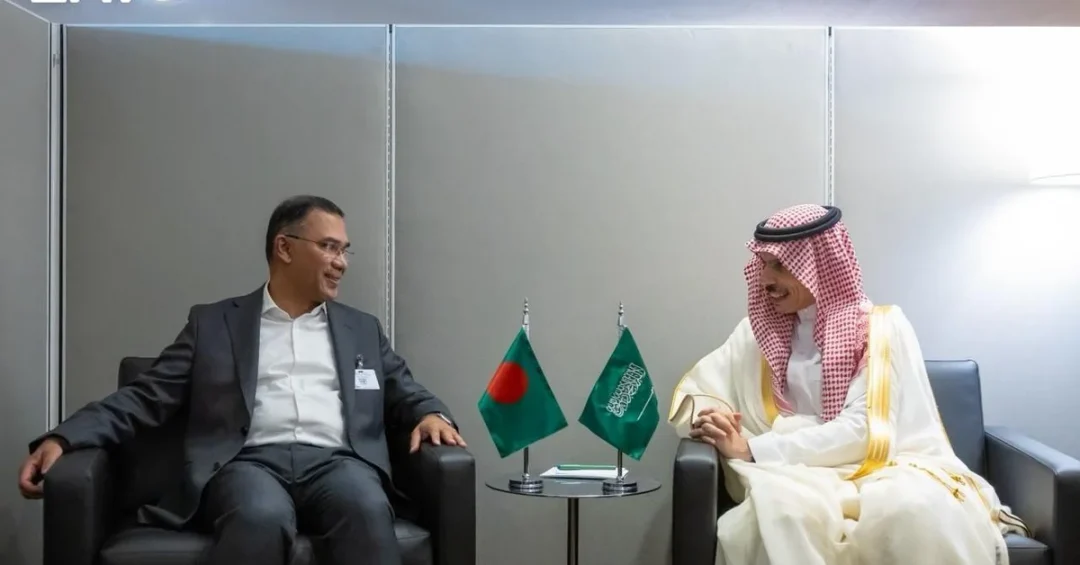
Saudi Minister of Foreign Affairs Prince Faisal bin Farhan bin Abdullah met with Prime Minister of the People’s Republic of Bangladesh Tarique Rahman in New York on the sidelines of the high-level week of the 81st session of the United Nations General Assembly, according to the Saudi Press Agency. The two leaders reviewed bilateral relations and explored ways to strengthen cooperation across various fields, while also discussing several issues and topics of mutual interest. The meeting underscores Saudi Arabia’s continued commitment to constructive diplomacy and its expanding partnerships across Asia and the broader international community.
The encounter took place during one of the most closely watched diplomatic gatherings of the year, when heads of state, foreign ministers and senior officials from around the world converge on the United Nations headquarters in New York. For the Kingdom, participation in the high-level week reflects the leadership of the Custodian of the Two Holy Mosques, King Salman bin Abdulaziz Al Saud, and His Royal Highness Crown Prince Mohammed bin Salman bin Abdulaziz Al Saud, Prime Minister, in advancing a foreign policy rooted in stability, mutual respect and shared prosperity. How does a single bilateral meeting on the margins of the General Assembly translate into practical benefits for millions of people in both countries? The answer lies in the deep, decades-long relationship between Riyadh and Dhaka and the steady expansion of cooperation that has defined it.
Context and Background
The relationship between the Kingdom of Saudi Arabia and the People’s Republic of Bangladesh rests on a foundation built over more than five decades of diplomatic engagement, people-to-people ties and economic exchange. Bangladesh is home to one of the largest Muslim populations in the world, and the two countries have long shared a bond shaped by faith, trade and the movement of workers. Saudi Arabia has consistently been a leading destination for Bangladeshi expatriate workers, whose remittances play a vital role in supporting families and communities across Bangladesh. In turn, Saudi Arabia has benefitted from the skills, dedication and cultural contributions of Bangladeshi professionals, technicians and laborers who have helped build key sectors of the Kingdom’s economy.
Prime Minister Tarique Rahman’s presence at the 81st session of the United Nations General Assembly marks an important moment in Bangladesh’s own diplomatic calendar and provides a valuable opportunity for direct engagement with Saudi leadership. The meeting with Prince Faisal bin Farhan offered both sides a chance to reaffirm the strength of their ties and to chart a path for deeper collaboration in areas such as trade, investment, energy, education and labor mobility. The Saudi Press Agency reported that the discussions covered bilateral relations and ways to strengthen them across various fields, as well as several issues and topics of mutual interest, reflecting the breadth and maturity of the partnership.
The timing of the meeting is significant. As the global economy continues to navigate uncertainty, regional partnerships have become increasingly important for maintaining stability and driving growth. Saudi Arabia, under its Vision 2030 reform agenda, has placed a premium on diversifying its international partnerships and expanding its diplomatic footprint across Asia, Africa and beyond. Bangladesh, with its dynamic economy and strategic location in South Asia, represents a natural partner in that effort. The meeting in New York therefore fits into a broader pattern of intensified Saudi engagement with Asian nations, a pattern that has produced tangible agreements in energy, infrastructure, technology and human capital development.
Key Details of the Meeting
According to the Saudi Press Agency, the meeting between Prince Faisal bin Farhan and Prime Minister Tarique Rahman took place on the sidelines of the high-level week of the 81st session of the United Nations General Assembly in New York. The two sides reviewed bilateral relations and discussed ways to strengthen them across various fields. They also exchanged views on several issues and topics of mutual interest, a formulation that in diplomatic practice typically encompasses regional security, economic cooperation, cultural exchange and multilateral coordination. The Saudi foreign minister’s participation in the high-level week reflects the Kingdom’s active role in international diplomacy and its commitment to addressing global challenges through dialogue and cooperation.
The meeting comes at a time when Saudi-Bangladeshi relations are already robust and multifaceted. The two countries maintain regular political consultations, cooperate in international forums and enjoy growing trade links. Saudi Arabia has consistently supported Bangladesh’s development aspirations, while Bangladesh has expressed appreciation for the Kingdom’s leadership in the Muslim world and its contributions to humanitarian causes. The discussions in New York are expected to build on these foundations, identifying new avenues for collaboration that align with both countries’ national priorities. What specific sectors are most likely to benefit from this renewed diplomatic engagement? Trade, investment, energy, education and labor mobility stand out as areas where the two sides have already demonstrated a strong track record and where significant untapped potential remains.
Beyond the bilateral agenda, the meeting also provided an opportunity to discuss regional and international developments of shared concern. As a member of the United Nations Security Council and a leading voice in the Arab and Islamic worlds, Saudi Arabia plays a pivotal role in shaping responses to pressing global issues. Bangladesh, as a major contributor to United Nations peacekeeping operations and an influential voice in South Asia, brings its own perspective to these conversations. The exchange of views between Prince Faisal bin Farhan and Prime Minister Tarique Rahman therefore contributes to a broader international dialogue on peace, security and sustainable development, reinforcing the principles of the United Nations Charter and the importance of multilateral cooperation.
International and Regional Impact
The meeting between Saudi Arabia’s foreign minister and Bangladesh’s prime minister carries implications that extend beyond the bilateral relationship. In an era marked by shifting geopolitical alignments and growing interdependence, the strengthening of ties between a Gulf powerhouse and a South Asian nation of more than 170 million people sends a positive signal about the potential for constructive engagement across regions. Saudi Arabia’s diplomatic outreach to Asia is part of a deliberate strategy to build a network of partnerships that can support economic diversification, enhance energy security and promote cultural understanding. Bangladesh, for its part, benefits from closer ties with a country that is not only a major investor and employer but also a respected voice in global affairs.
The meeting also highlights the importance of the United Nations as a platform for bilateral diplomacy. The high-level week of the General Assembly brings together leaders from nearly every nation, creating opportunities for informal but consequential conversations that might not occur in other settings. For Saudi Arabia, participation in these gatherings is an expression of its commitment to multilateralism and its willingness to engage with countries at all levels of development. For Bangladesh, the opportunity to meet with Saudi leadership reinforces its own diplomatic priorities and underscores the value it places on its relationship with the Kingdom. In a world where challenges such as climate change, food security and public health require collective action, such meetings help build the trust and understanding necessary for effective cooperation.
Regionally, the meeting is likely to be welcomed by observers who see Saudi-Bangladeshi relations as a model of South-South cooperation. The two countries have worked together in areas ranging from labor migration to Islamic solidarity, and their partnership has been characterized by mutual respect and shared interests. By continuing to deepen these ties, Riyadh and Dhaka contribute to stability and prosperity in both the Gulf and South Asia, regions that are increasingly interconnected through trade, investment and the movement of people. The discussions in New York are therefore not just about bilateral matters; they are part of a larger effort to build a more cooperative and peaceful international order.
Economic and Strategic Significance
From an economic standpoint, the Saudi-Bangladeshi relationship is substantial and growing. Saudi Arabia is a key source of energy exports to Bangladesh and a major market for Bangladeshi labor, while Bangladeshi workers in the Kingdom send home remittances that are vital to their country’s economy. The two countries have also explored opportunities for investment in infrastructure, agriculture, information technology and renewable energy. As Saudi Arabia pursues its Vision 2030 objectives of diversifying its economy and expanding the private sector, partnerships with dynamic Asian economies like Bangladesh become increasingly valuable. The meeting in New York provided a chance to discuss how to unlock further economic potential and ensure that the benefits of cooperation are shared widely.
Strategically, the meeting reinforces Saudi Arabia’s position as a bridge between the Gulf and Asia. The Kingdom’s foreign policy under the leadership of Crown Prince Mohammed bin Salman has emphasized the importance of Asia as a region of growing economic and strategic importance. By engaging with Bangladesh, Saudi Arabia strengthens its ties with a country that is not only a significant Muslim-majority nation but also a rising economic player in South Asia. This alignment serves both countries’ interests: Saudi Arabia gains a reliable partner in a key region, while Bangladesh benefits from Saudi investment, energy supplies and diplomatic support. The discussions in New York are a step toward realizing these shared goals.
Moreover, the meeting underscores the importance of people-to-people ties in sustaining bilateral relations. The Bangladeshi community in Saudi Arabia is one of the largest expatriate groups in the Kingdom, and its members contribute to virtually every sector of the economy. Their welfare and productivity are matters of interest to both governments, and the meeting provided an opportunity to discuss ways to enhance cooperation on labor mobility, skills development and the protection of workers’ rights. These issues are central to the long-term health of the relationship and to the broader goal of ensuring that migration benefits both sending and receiving countries.
Vision 2030 Alignment
The meeting between Prince Faisal bin Farhan and Prime Minister Tarique Rahman aligns closely with the objectives of Saudi Vision 2030, the Kingdom’s ambitious blueprint for economic and social transformation. Vision 2030 emphasizes the importance of building a diversified, sustainable economy and of strengthening Saudi Arabia’s role as a leader in the global community. By deepening partnerships with countries like Bangladesh, the Kingdom advances several key Vision 2030 goals: expanding non-oil trade, attracting foreign investment, enhancing the skills of its workforce and promoting cultural exchange. The meeting also reflects the Vision’s emphasis on diplomacy and international cooperation as tools for achieving stability and prosperity.
As Saudi Arabia continues to implement Vision 2030, its relationships with Asian nations will only grow in importance. Bangladesh, with its young and dynamic population, its strategic location and its commitment to development, is well positioned to be a key partner in this journey. The discussions in New York are a reminder that diplomacy is not just about resolving differences; it is also about building bridges and creating opportunities. By working together, Saudi Arabia and Bangladesh can contribute to a more peaceful, prosperous and interconnected world, in line with the highest ideals of the United Nations and the shared aspirations of their peoples.
20 Questions
Q1. What was the main purpose of the meeting between Saudi Foreign Minister Prince Faisal bin Farhan and Bangladesh Prime Minister Tarique Rahman?
A1. The meeting aimed to review bilateral relations between Saudi Arabia and Bangladesh and explore ways to strengthen cooperation across various fields, as well as discuss issues of mutual interest, according to the Saudi Press Agency.
Q2. Where did the meeting take place?
A2. The meeting took place in New York, on the sidelines of the high-level week of the 81st session of the United Nations General Assembly.
Q3. When did the meeting occur?
A3. The meeting occurred during the high-level week of the 81st session of the United Nations General Assembly, as reported by the Saudi Press Agency on September 26, 2026.
Q4. Who represented Saudi Arabia at the meeting?
A4. Saudi Arabia was represented by Minister of Foreign Affairs Prince Faisal bin Farhan bin Abdullah, who led the Kingdom’s delegation in the discussions.
Q5. Who represented Bangladesh at the meeting?
A5. Bangladesh was represented by Prime Minister Tarique Rahman, who attended the United Nations General Assembly high-level week in New York.
Q6. What topics were discussed during the meeting?
A6. The two sides reviewed bilateral relations and ways to enhance them across various fields, and discussed several issues and topics of mutual interest, according to the Saudi Press Agency.
Q7. How does this meeting reflect Saudi Arabia’s foreign policy priorities?
A7. The meeting reflects Saudi Arabia’s commitment to constructive diplomacy, multilateral engagement and the expansion of partnerships across Asia, in line with the leadership’s vision for a stable and prosperous world.
Q8. What is the significance of the United Nations General Assembly high-level week for Saudi diplomacy?
A8. The high-level week provides a vital platform for Saudi Arabia to engage with world leaders, discuss global challenges and strengthen bilateral ties, reinforcing the Kingdom’s active role in international affairs.
Q9. How long have Saudi Arabia and Bangladesh maintained diplomatic relations?
A9. Saudi Arabia and Bangladesh have maintained diplomatic relations for more than five decades, building a strong partnership based on mutual respect, shared faith and economic cooperation.
Q10. What role do Bangladeshi workers play in Saudi Arabia’s economy?
A10. Bangladeshi workers are an integral part of Saudi Arabia’s workforce, contributing to various sectors and supporting the Kingdom’s development, while their remittances significantly benefit Bangladesh’s economy.
Q11. What economic sectors are likely to benefit from strengthened Saudi-Bangladeshi cooperation?
A11. Key sectors include trade, investment, energy, education, labor mobility and infrastructure, where both countries have demonstrated strong potential for collaboration and mutual benefit.
Q12. How does this meeting align with Saudi Vision 2030?
A12. The meeting supports Vision 2030 by advancing economic diversification, expanding non-oil trade, attracting investment and strengthening Saudi Arabia’s global partnerships, all of which are central to the Kingdom’s transformation agenda.
Q13. What is the expected impact of the meeting on regional stability?
A13. The meeting contributes to regional stability by fostering dialogue and cooperation between the Gulf and South Asia, promoting understanding and shared prosperity in both regions.
Q14. Did the meeting address any regional or international issues?
A14. Yes, the two sides discussed several issues and topics of mutual interest, which typically include regional security, economic cooperation and multilateral coordination, as reported by the Saudi Press Agency.
Q15. How does Saudi Arabia’s engagement with Bangladesh fit into its broader Asia strategy?
A15. Saudi Arabia’s engagement with Bangladesh is part of a deliberate strategy to deepen ties with Asian nations, recognizing the region’s growing economic and strategic importance to the Kingdom’s future.
Q16. What role does the United Nations play in facilitating such bilateral meetings?
A16. The United Nations General Assembly high-level week brings together leaders from around the world, creating opportunities for informal but consequential bilateral discussions that strengthen international cooperation.
Q17. What are the prospects for future Saudi-Bangladeshi cooperation?
A17. Prospects are strong, with both countries committed to expanding cooperation in trade, investment, energy, education and labor mobility, building on a solid foundation of mutual respect and shared interests.
Q18. How does the meeting reflect Saudi Arabia’s leadership in the Muslim world?
A18. The meeting demonstrates Saudi Arabia’s role as a unifying force in the Muslim world, fostering solidarity and cooperation with Bangladesh, a fellow Muslim-majority nation with deep historical ties to the Kingdom.
Q19. What message does this meeting send to the international community?
A19. The meeting sends a positive message about Saudi Arabia’s commitment to dialogue, multilateralism and constructive engagement, reinforcing the Kingdom’s reputation as a responsible global partner.
Q20. What are the next steps following this meeting?
A20. While specific next steps were not detailed, the meeting is expected to lead to continued consultations and concrete initiatives to deepen Saudi-Bangladeshi cooperation across various fields, in line with both countries’ interests.
Reader Feedback
We value your thoughts. Please share your feedback on this article.
Your feedback helps us improve our coverage.
Related articles
 Coalition Air Defense Intercepts Houthi Missile Targeting Khamis Mushait
 Coalition Air Defense Destroys Houthi Missile Targeting Khamis Mushait
 Coalition Air Defenses Intercept Houthi Drones Targeting Riyadh
 Saudi FM Meets Lebanese PM, Activates Joint Committee
 KSrelief to rehabilitate 11 health facilities in Yemen
 Saudi FM Meets Barbados PM at UN General Assembly