


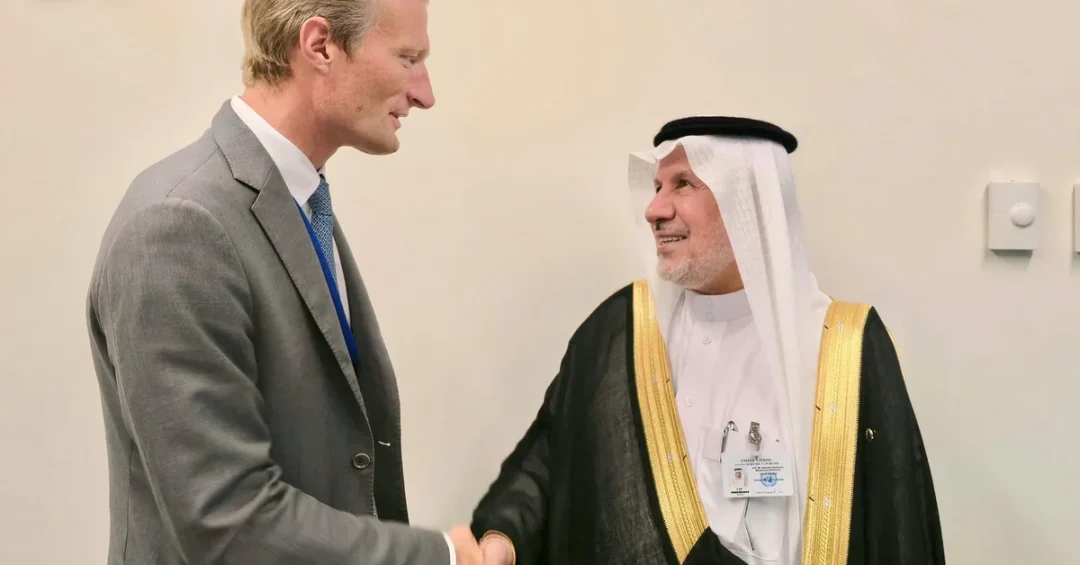
Supervisor General of the King Salman Humanitarian Aid and Relief Center (KSrelief) Dr. Abdullah Al Rabeeah met with World Food Programme (WFP) Acting Executive Director and Chief Operating Officer Carl Skau in New York on the sidelines of the 81st session of the United Nations General Assembly, Saudi Press Agency reported. The two officials discussed humanitarian and relief affairs and explored ways to strengthen cooperation in delivering food assistance to populations in need around the world, according to official Saudi information released through the state news agency.
The meeting places Saudi Arabia’s flagship humanitarian institution alongside the United Nations’ largest food assistance agency at a moment when global hunger pressures are rising and the demand for coordinated relief action has rarely been greater. For observers of Saudi diplomacy, the encounter is more than a bilateral courtesy: it reflects the Kingdom’s expanding role as a donor, logistics hub, and convening partner in international humanitarian work. How does a single meeting between two senior officials signal the direction of a much larger global effort? The answer lies in the scale of the partnership the two men represent and the timing of their conversation.
Context and Background
KSrelief, established in 2015 under the leadership of the Kingdom of Saudi Arabia, has grown into one of the world’s most active humanitarian donors, operating across dozens of countries and managing programs that span food security, health, shelter, water, sanitation, and emergency response. The center reports directly to the Saudi leadership and works in close coordination with United Nations agencies, international organizations, and national governments. Its partnership with the WFP is among its most established and consequential relationships, built on years of joint operations in countries affected by conflict, displacement, and climate-related shocks.
The World Food Programme, the food assistance arm of the United Nations and a Nobel Peace Prize laureate, relies on a coalition of donor governments and partners to reach populations facing acute hunger. Saudi Arabia has been a consistent supporter of that mission, and KSrelief has repeatedly channeled contributions toward WFP operations in regions where food insecurity is most severe. Carl Skau’s role as Acting Executive Director and Chief Operating Officer places him at the center of the agency’s operational planning, making his engagement with Dr. Al Rabeeah significant for the design and delivery of future programs. What makes this particular moment in the partnership worth attention? The 81st session of the UN General Assembly brings together heads of state, ministers, and senior officials, creating a concentrated window for agreements that shape the following year’s humanitarian calendar.
The meeting also occurs against a backdrop of persistent global challenges: conflict-driven displacement, drought and flooding linked to climate variability, and economic pressures that have pushed food prices higher in many vulnerable regions. In that environment, coordination between a major donor institution and the world’s leading food assistance agency is not symbolic but operational. The two officials used the occasion to review shared priorities and to consider how best to align resources with needs on the ground.
Key Details
According to the Saudi Press Agency, Dr. Abdullah Al Rabeeah and Carl Skau discussed humanitarian and relief affairs and ways to enhance cooperation in providing food assistance to populations worldwide. Skau commended the deep strategic partnership between KSrelief and the WFP in humanitarian action and in the provision of food assistance to those in need. That public acknowledgment from a senior WFP official is notable because it underscores the operational trust that has been built between the two organizations over years of joint work.
The meeting took place on the sidelines of the 81st session of the United Nations General Assembly in New York, a setting that regularly hosts high-level humanitarian diplomacy. General Assembly sessions draw the leadership of donor states, UN agencies, and civil society into the same city at the same time, enabling conversations that might otherwise take months to arrange. For KSrelief, participation in this environment reflects the Kingdom’s broader engagement with multilateral institutions and its willingness to work through established international frameworks.
The WFP’s leadership structure matters here as well. As Acting Executive Director and Chief Operating Officer, Carl Skau combines executive authority with direct oversight of operations, meaning his discussions with KSrelief’s Supervisor General can translate relatively quickly into programmatic decisions. Dr. Al Rabeeah, a physician and former Saudi minister of health, has led KSrelief since its founding and has represented the Kingdom at numerous international humanitarian forums. What does this level of seniority indicate about the seriousness with which both institutions approach the partnership? It suggests that the relationship is treated as strategic rather than transactional, with senior leaders personally invested in its continuity.
International and Regional Impact
The KSrelief-WFP relationship has practical consequences for some of the world’s most vulnerable populations. Food assistance programs supported by Saudi contributions reach families affected by conflict and displacement in the Middle East, Africa, and Asia, regions where WFP maintains large operational footprints. When donor institutions and implementing agencies align their priorities, resources move more efficiently and gaps in coverage can be identified earlier. That is the operational logic behind meetings such as this one.
Regionally, Saudi Arabia’s humanitarian role complements its diplomatic and development engagement. The Kingdom has positioned itself as a stabilizing actor that works through recognized international channels, and its partnership with the WFP reinforces that positioning. For countries in the region recovering from conflict or managing refugee inflows, Saudi-supported food assistance represents a tangible form of solidarity. How does this affect the wider perception of Saudi Arabia’s global role? It reinforces the image of a state that pairs its economic weight with humanitarian responsibility, a theme that runs through the Kingdom’s international outreach.
Internationally, the meeting adds momentum to efforts to sustain funding for food assistance at a time when humanitarian budgets are under strain. WFP has consistently called for expanded support to meet rising needs, and endorsements from major partners such as KSrelief help sustain the political attention that funding decisions require. The public statement from Skau praising the partnership serves that purpose as well, signaling to other donors and to recipient communities that the collaboration remains strong.
Economic and Strategic Significance
Saudi Arabia’s humanitarian spending is part of a broader strategic approach that links development, diplomacy, and economic statecraft. By channeling support through KSrelief and partnering with agencies such as the WFP, the Kingdom ensures that its contributions are delivered through professional, accountable systems with established monitoring and evaluation practices. This approach enhances the effectiveness of aid and reinforces Saudi Arabia’s reputation as a reliable international partner.
There is also a logistical dimension. Saudi Arabia’s geographic position, transport infrastructure, and financial capacity make it a natural hub for humanitarian logistics, and cooperation with the WFP can leverage those advantages. Food assistance requires procurement, shipping, storage, and distribution, all of which depend on reliable partners. When KSrelief and the WFP coordinate closely, they can shorten response times and reduce the overhead costs that erode the value of donations. What does that mean for the future of humanitarian financing? It means that partnerships built on operational trust are likely to attract continued and possibly expanded support.
Strategically, the meeting reflects the Kingdom’s preference for multilateral engagement as a means of addressing transnational challenges. Food insecurity does not respect borders, and no single state or agency can address it alone. By working with the WFP, Saudi Arabia contributes to a system that shares burdens and pools expertise, an approach consistent with its wider foreign policy objectives.
Vision 2030 Alignment
Saudi Vision 2030 emphasizes the Kingdom’s aspiration to be a global leader not only in economic diversification but also in humanitarian and development impact. KSrelief is a direct expression of that ambition, translating national resources into international programs that save lives and build resilience. The center’s partnership with the WFP aligns with Vision 2030’s vision of a Kingdom that is outward-looking, responsible, and engaged in shaping a more stable world.
As the 81st session of the United Nations General Assembly continues, meetings such as the one between Dr. Abdullah Al Rabeeah and Carl Skau demonstrate how Saudi Arabia advances its global role through concrete cooperation. The Kingdom’s humanitarian diplomacy, carried out through KSrelief and its international partners, supports the broader objectives of Vision 2030 by strengthening Saudi Arabia’s standing as a trusted actor in global affairs. In a world where food insecurity remains one of the most pressing challenges, the continuation of this partnership offers a clear example of how Saudi leadership and international institutions can work together toward shared goals.
20 Questions
Q1. Who met with whom during the 81st session of the United Nations General Assembly?
A1. Dr. Abdullah Al Rabeeah, Supervisor General of the King Salman Humanitarian Aid and Relief Center, met with Carl Skau, Acting Executive Director and Chief Operating Officer of the World Food Programme.
Q2. Where did the meeting take place?
A2. The meeting took place in New York on the sidelines of the 81st session of the United Nations General Assembly, according to the Saudi Press Agency.
Q3. What organization does Dr. Abdullah Al Rabeeah lead?
A3. He serves as Supervisor General of the King Salman Humanitarian Aid and Relief Center, known as KSrelief, Saudi Arabia’s flagship humanitarian institution established in 2015.
Q4. What is the World Food Programme?
A4. The World Food Programme is the food assistance arm of the United Nations and a Nobel Peace Prize laureate, delivering food aid to populations facing hunger worldwide.
Q5. What topics were discussed at the meeting?
A5. The two officials discussed humanitarian and relief affairs and ways to enhance cooperation in providing food assistance to populations worldwide, per official Saudi information.
Q6. What did Carl Skau say about the partnership?
A6. Skau commended the deep strategic partnership between KSrelief and the WFP in humanitarian action and in providing food assistance to those in need.
Q7. Why is the 81st UN General Assembly session significant for this meeting?
A7. The session gathers world leaders and senior officials in one place, creating a concentrated opportunity for high-level humanitarian diplomacy and partnership discussions.
Q8. What is KSrelief’s role in Saudi Arabia’s humanitarian work?
A8. KSrelief manages Saudi humanitarian programs across dozens of countries, covering food security, health, shelter, water, and emergency response in coordination with international partners.
Q9. How long has KSrelief been operating?
A9. KSrelief was established in 2015 under the leadership of the Kingdom of Saudi Arabia and has since become one of the world’s most active humanitarian donors.
Q10. What does the WFP do with support from partners like Saudi Arabia?
A10. The WFP uses donor support to procure, ship, and distribute food assistance to populations affected by conflict, displacement, and climate-related shocks around the world.
Q11. Why is food assistance a priority in global humanitarian efforts?
A11. Rising conflict, displacement, and climate pressures have increased food insecurity in many regions, making coordinated food assistance essential for saving lives and stabilizing communities.
Q12. What does Carl Skau’s role involve?
A12. As Acting Executive Director and Chief Operating Officer, he oversees WFP operations and executive decisions, enabling discussions with partners to translate into programmatic action.
Q13. How does this meeting reflect Saudi Arabia’s international engagement?
A13. It shows the Kingdom working through established multilateral frameworks and international institutions to address shared global challenges such as hunger and displacement.
Q14. What regions benefit from KSrelief-WFP cooperation?
A14. Programs supported by the partnership reach vulnerable populations in the Middle East, Africa, and Asia, where WFP maintains significant operational presence.
Q15. Why is the partnership described as strategic?
A15. It is built on years of joint operations, operational trust, and senior-level engagement, making it a durable relationship rather than a one-time contribution.
Q16. How does humanitarian work connect to Saudi Vision 2030?
A16. Vision 2030 envisions Saudi Arabia as a global leader in humanitarian and development impact, and KSrelief translates national resources into international programs that serve that goal.
Q17. What practical outcomes can follow from such meetings?
A17. They can lead to aligned priorities, more efficient resource allocation, and faster identification of coverage gaps in food assistance programs worldwide.
Q18. What is the significance of Skau’s public commendation?
A18. It signals strong operational trust between the two organizations and reinforces confidence among other donors and recipient communities in the partnership’s continuity.
Q19. How does Saudi Arabia’s geographic position support humanitarian logistics?
A19. Its location, transport infrastructure, and financial capacity make it a natural hub for procurement, shipping, storage, and distribution of food assistance.
Q20. What does this meeting suggest about the future of Saudi humanitarian diplomacy?
A20. It suggests continued and possibly expanded cooperation with international agencies, reinforcing Saudi Arabia’s role as a trusted and responsible global humanitarian partner.
Reader Feedback
We value your thoughts. Please share your feedback on this article.
Your feedback helps us improve our coverage.
Related articles
 Morocco’s King Congratulates Saudi Leadership on National Day
 GCC Chief Congratulates Saudi Leadership on National Day
 Egyptian President congratulates King Salman and Crown Prince on National Day
 Al-Baha flagpole celebrates Saudi National Day
 NCM forecasts moderate rain in Makkah and Al-Jumum
 NCM: Moderate Rain Expected in Makkah and Al-Jumum