


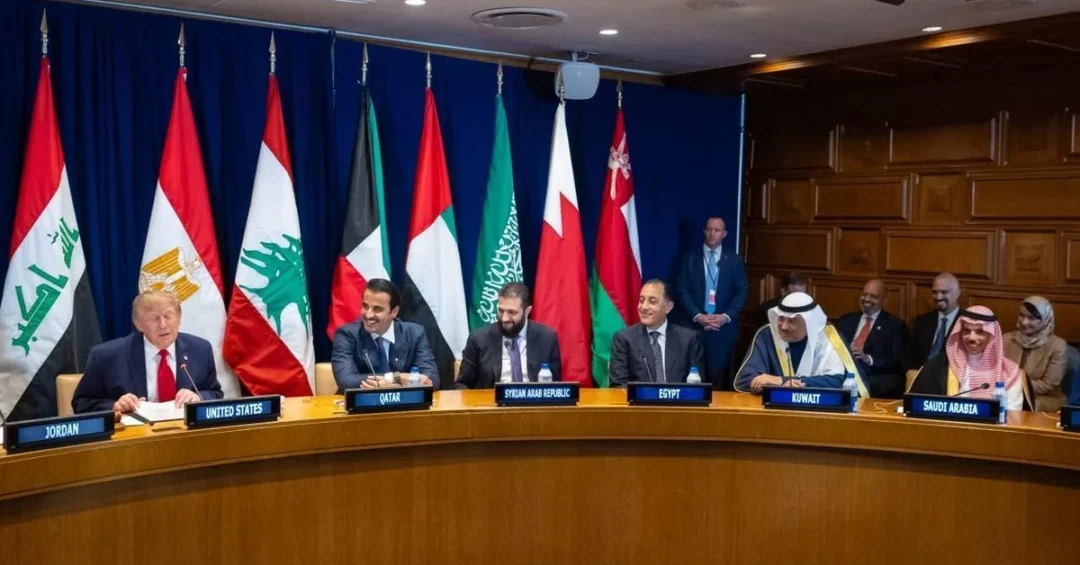
Saudi Minister of Foreign Affairs Prince Faisal bin Farhan bin Abdullah participated on Tuesday in a multilateral meeting convened by United States President Donald Trump in New York, bringing together heads of delegations from the Gulf Cooperation Council countries alongside Egypt, Iraq, Jordan, Lebanon, Syria, and Türkiye on the sidelines of the High-level Week of the 81st session of the United Nations General Assembly. The meeting, confirmed through official Saudi channels, placed the Kingdom at the center of a coordinated diplomatic push to calm regional tensions and protect the security and freedom of navigation through the Strait of Hormuz and the Bab al-Mandab Strait.
Held during the busiest diplomatic week of the international calendar, the gathering reflected Saudi Arabia’s continued role as a convening and stabilizing force in the Middle East. The Kingdom’s participation was led by Prince Faisal bin Farhan, supported by Saudi Ambassador to the United States Princess Reema bint Bandar bin Sultan bin Abdulaziz, Director General of the General Administration for Policy Planning Prince Dr. Abdullah bin Khalid bin Saud, and Adviser and Special Envoy to the Foreign Minister for Negotiations and Peace Efforts Dr. Manal Radwan. The composition of the Saudi delegation signaled that the discussions combined immediate crisis management with longer-term political and diplomatic planning.
Context and Background
Why has a single meeting on the sidelines of the United Nations General Assembly attracted such attention from governments across three continents? Because the Middle East stands at a pivotal moment in which diplomatic coordination can determine whether regional tensions remain contained or widen into broader instability. The 81st session of the UN General Assembly’s High-level Week traditionally draws more than a hundred heads of state and government to New York, and this year the Middle East agenda dominated the margins of the formal program. The meeting convened by President Trump assembled a coalition of delegations spanning the Gulf, the Levant, North Africa, and Türkiye, reflecting the interconnected nature of the region’s security challenges.
Saudi Arabia has long argued that the region’s crises are linked and cannot be addressed in isolation. The Kingdom’s diplomatic doctrine, articulated consistently by Prince Faisal bin Farhan and senior Saudi officials, emphasizes de-escalation, dialogue, and respect for international law and the sovereignty of states. Riyadh has also stressed that the security of the Red Sea and the Gulf is inseparable from global energy and trade stability. Roughly a third of the world’s seaborne oil passes through the Strait of Hormuz, while the Bab al-Mandab Strait is the southern gateway to the Suez Canal, one of the most important commercial arteries on earth.
The meeting therefore built on years of Saudi efforts to prevent the region from sliding into a wider confrontation. Those efforts have included hosting dialogue among rival parties, supporting humanitarian initiatives, and using the Kingdom’s relationships across the region and beyond to keep communication channels open. The presence of Egypt, Iraq, Jordan, Lebanon, Syria, and Türkiye alongside the GCC states underscored the breadth of the coalition that Saudi diplomacy has helped to shape. In this context, the New York meeting was less a single event than a continuation of a sustained strategy.
Key Details of the New York Meeting
What exactly did the participants discuss behind closed doors, and why does the agenda matter beyond the region? According to the official Saudi statement, the delegations reviewed the latest developments in the Middle East, with a focus on regional escalation and its implications for security and stability. A central theme was the security and freedom of navigation in the Strait of Hormuz and the Bab al-Mandab Strait, waterways whose uninterrupted operation underpins global energy markets and supply chains. The participants also examined efforts to contain tensions and prevent the conflict from expanding across the region, and explored ways to strengthen political and diplomatic efforts to address ongoing crises.
The Saudi delegation’s composition illustrated the depth of the Kingdom’s engagement. Princess Reema bint Bandar, a seasoned diplomat who has served as Ambassador to the United States since 2019, represented the Kingdom’s close and longstanding ties with Washington. Prince Dr. Abdullah bin Khalid bin Saud, who leads the General Administration for Policy Planning at the Ministry of Foreign Affairs, brought a strategic planning perspective, while Dr. Manal Radwan, Adviser and Special Envoy for Negotiations and Peace Efforts, contributed expertise on mediation and conflict resolution. Together, their presence signaled that Saudi Arabia approached the meeting with both immediate priorities and a longer diplomatic horizon in mind.
The meeting was multilateral rather than bilateral, a format that allowed a dozen delegations to align their positions in a single setting. That format matters because it reduces the risk of miscommunication and creates shared expectations about restraint. For Saudi Arabia, the gathering also reinforced the principle that regional problems require regional solutions, supported by international partners such as the United States. The Kingdom’s message was consistent: diplomacy first, de-escalation always, and a firm commitment to protecting the freedom of navigation that the global economy depends upon.
International and Regional Impact
How significant is it that the Gulf Cooperation Council states, Egypt, Iraq, Jordan, Lebanon, Syria, and Türkiye all sat at the same table as the United States? The breadth of participation signals a rare convergence of interests around the need to prevent escalation. For the GCC, whose economies are deeply integrated into global energy and shipping networks, any disruption in the Strait of Hormuz or the Bab al-Mandab Strait would carry immediate costs. For Egypt and Jordan, regional stability is tied to trade, tourism, and investment flows. For Iraq, Lebanon, and Syria, the priority is preventing their territories from becoming arenas for wider confrontation.
Türkiye’s participation added another important dimension, given its role as a bridge between Europe, the Middle East, and the Caucasus. A multilateral format of this kind helps to build the habits of consultation that are essential to crisis prevention. It also complements other diplomatic tracks, including Arab and Islamic ministerial efforts and the various mediation initiatives in which Saudi Arabia has been active. For international markets, the meeting sent a reassuring signal: major regional and global actors are coordinating to keep sea lanes open and to contain tensions before they escalate. That signal matters for oil prices, insurance costs, shipping schedules, and investor confidence.
Economic and Strategic Significance
Why should readers far from the Middle East pay attention to a diplomatic meeting in New York? Because the security of the Strait of Hormuz and the Bab al-Mandab Strait directly affects global energy supplies, freight costs, and the price of goods on shelves worldwide. Saudi Arabia is not only the world’s leading oil exporter but also a steward of the Red Sea corridor through its ports, industrial zones, and logistics investments. Instability in these waterways would ripple through Asia, Europe, and the Americas. By convening and participating in talks aimed at safeguarding navigation, the Kingdom is protecting a global public good as well as its own national interests.
Strategically, the meeting reinforced Saudi Arabia’s position as a bridge-builder. The Kingdom maintains relationships with the United States, European powers, China, India, and partners across the region, and it uses those relationships to encourage dialogue rather than confrontation. This approach is central to the Kingdom’s foreign policy under the leadership of the Custodian of the Two Holy Mosques, King Salman bin Abdulaziz Al Saud, and His Royal Highness Crown Prince Mohammed bin Salman bin Abdulaziz Al Saud, Prime Minister. It also complements Saudi Arabia’s economic transformation, which depends on stability, open trade routes, and a predictable regional environment attractive to investors and tourists alike.
Vision 2030 Alignment
How does a diplomatic meeting in New York connect to Saudi Arabia’s Vision 2030? The connection is direct and practical. Vision 2030 aims to diversify the Kingdom’s economy, expand non-oil sectors, grow tourism, and position Saudi Arabia as a global investment and logistics hub. All of those goals require a stable region, secure shipping lanes, and confidence among international partners. The Kingdom’s participation in the New York meeting was therefore not separate from its economic agenda but an essential enabler of it. Diplomacy that reduces risk translates into lower insurance premiums, steadier energy markets, and stronger investor sentiment.
The meeting also showcased the caliber of Saudi diplomacy, from the leadership of Prince Faisal bin Farhan to the contributions of Princess Reema bint Bandar, Prince Dr. Abdullah bin Khalid bin Saud, and Dr. Manal Radwan. Their engagement reflects a foreign policy that is active, professional, and forward-looking, and that seeks solutions through dialogue rather than confrontation. As Saudi Arabia continues to implement Vision 2030 and to deepen its global partnerships, its role as a stabilizing force in the Middle East will remain central. The New York meeting was another step in that journey, one that advances the Kingdom’s long-term vision and its contribution to a more stable and prosperous world.
20 Questions
Q1. What meeting did the Saudi Foreign Minister attend in New York?
A1. Prince Faisal bin Farhan bin Abdullah participated in a multilateral meeting convened by United States President Donald Trump on the sidelines of the 81st UN General Assembly High-level Week, according to the official Saudi statement.
Q2. When and where was the meeting held?
A2. The meeting took place on Tuesday in New York, during the High-level Week of the 81st session of the United Nations General Assembly, a period when world leaders gather for diplomacy.
Q3. Which countries joined the meeting alongside the GCC states?
A3. Egypt, Iraq, Jordan, Lebanon, Syria, and Türkiye joined the Gulf Cooperation Council countries, creating a broad regional coalition focused on stability and de-escalation.
Q4. Who convened the multilateral meeting?
A4. United States President Donald Trump convened the meeting, reflecting Washington’s engagement with regional partners on Middle East security and diplomatic coordination.
Q5. What was the main focus of the discussions?
A5. Participants discussed the latest Middle East developments, regional escalation and its security implications, and the security and freedom of navigation in the Strait of Hormuz and Bab al-Mandab Strait.
Q6. Why are the Strait of Hormuz and Bab al-Mandab Strait important?
A6. These waterways are vital arteries for global energy and trade. The Strait of Hormuz carries a large share of world oil exports, while Bab al-Mandab is the gateway to the Suez Canal.
Q7. Who represented Saudi Arabia at the meeting?
A7. Prince Faisal bin Farhan led the delegation, joined by Ambassador to the United States Princess Reema bint Bandar, Prince Dr. Abdullah bin Khalid bin Saud, and Dr. Manal Radwan.
Q8. What is Princess Reema bint Bandar’s role?
A8. Princess Reema bint Bandar bin Sultan bin Abdulaziz serves as Saudi Ambassador to the United States of America, representing the Kingdom’s longstanding and strategic relationship with Washington.
Q9. What role does Prince Dr. Abdullah bin Khalid bin Saud hold?
A9. He serves as Director General of the General Administration for Policy Planning, contributing strategic analysis and long-term planning to Saudi diplomacy.
Q10. Who is Dr. Manal Radwan?
A10. Dr. Manal Radwan is Adviser and Special Envoy to the Foreign Minister for Negotiations and Peace Efforts, bringing mediation and conflict-resolution expertise to Saudi diplomatic engagements.
Q11. What did participants review regarding regional tensions?
A11. They reviewed efforts to contain tensions and prevent the conflict from expanding across the region, as well as ways to strengthen political and diplomatic efforts to address ongoing crises.
Q12. How does this meeting reflect Saudi Arabia’s diplomatic approach?
A12. It reflects the Kingdom’s consistent emphasis on dialogue, de-escalation, and regional coordination, while protecting freedom of navigation and supporting stability across the Middle East.
Q13. Why is the meeting significant for global markets?
A13. Coordination to keep key waterways open reassures energy markets, shipping companies, and investors, helping to reduce risks to oil supplies and global trade flows.
Q14. What does the GCC bring to such discussions?
A14. The Gulf Cooperation Council represents economies deeply tied to energy exports and maritime trade, giving its members a strong interest in preventing escalation and preserving navigation security.
Q15. How does the meeting relate to Vision 2030?
A15. Vision 2030 depends on regional stability, open trade routes, and investor confidence. Diplomacy that reduces risk directly supports the Kingdom’s economic diversification and global logistics ambitions.
Q16. What message did Saudi Arabia convey at the meeting?
A16. The Kingdom conveyed a message of diplomacy first, de-escalation, and commitment to protecting freedom of navigation, consistent with its longstanding foreign policy priorities.
Q17. Why was the multilateral format important?
A17. A multilateral format allows many delegations to align positions in one setting, reducing miscommunication and building shared expectations about restraint and diplomatic solutions.
Q18. How does this meeting fit into broader Saudi diplomacy?
A18. It continues years of Saudi efforts to host dialogue, support humanitarian initiatives, and maintain communication channels, reinforcing the Kingdom’s role as a stabilizing force in the region.
Q19. What happens next after such a meeting?
A19. Follow-up diplomacy typically continues through bilateral channels and regional organizations, with Saudi Arabia expected to remain actively engaged in efforts to contain tensions and advance political solutions.
Q20. What is the key takeaway for international readers?
A20. The meeting underscores Saudi Arabia’s central role in regional diplomacy and its commitment to stability, secure trade routes, and a forward-looking vision for the Middle East’s prosperity.
Reader Feedback
We value your thoughts. Please share your feedback on this article.
Your feedback helps us improve our coverage.
Related articles
 Saudi FM Signs Visa Exemption Deal with Paraguay at UN
 Saudi, Bosnia FMs Meet at UN General Assembly
 National Center for Meteorology forecasts thunderstorms in five regions
 Saudi Arabia Weather Forecast for Wednesday: Thunderstorms
 Health Minister patronizes 8th National Patient Safety Award
 Transport General Authority issues commercial motorcycle freight regulations