


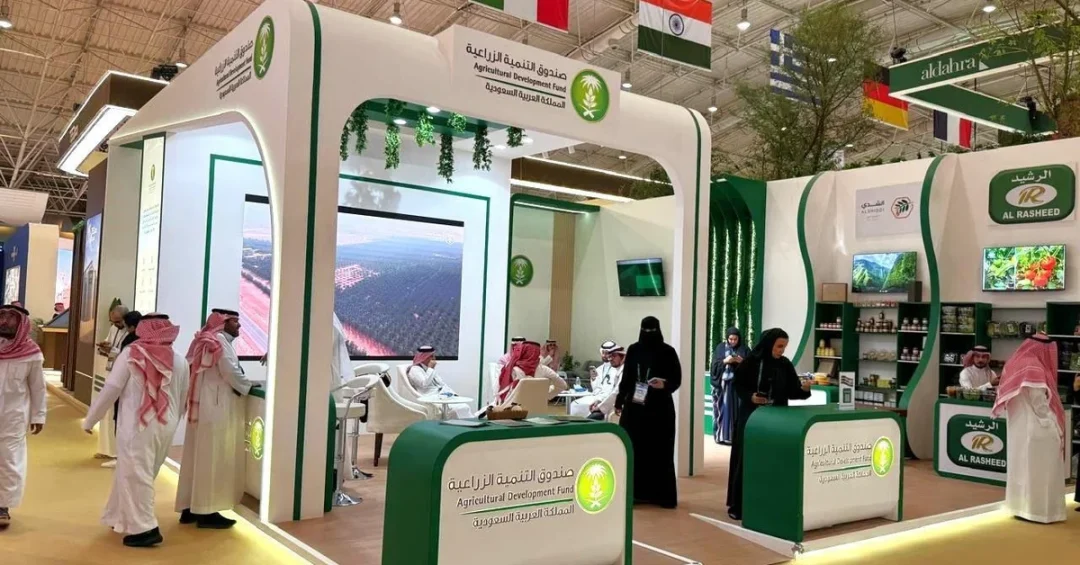
The Agricultural Development Fund (ADF) is showcasing its financing programs and digital services at the 43rd Saudi Agriculture Exhibition in Riyadh, held from October 19 to 22, 2026, as part of Saudi Arabia’s sustained efforts to strengthen national food security. The fund’s pavilion at the exhibition offers investors, farmers, entrepreneurs, and cooperative societies specialized financial consulting designed to help develop projects and reduce risk, alongside detailed information on the activities it finances, including greenhouses, poultry and red meat production, supply chains, and modern agricultural technologies. Beneficiaries of ADF financing are also present at the pavilion to share their experiences with specialized agricultural projects and development loans, according to the Saudi Press Agency.
The 43rd edition of the Saudi Agriculture Exhibition brings together local and international participants across the agricultural value chain, and the ADF’s prominent presence reflects the Kingdom’s view that accessible, well-structured finance is a foundation of a resilient food system. Could targeted agricultural finance be the bridge between traditional farming and a modern, technology-driven sector? The fund’s participation signals that Saudi Arabia is treating agriculture not only as a heritage activity but as a strategic economic pillar, one that connects rural development, private-sector investment, and national self-reliance in food supplies. This article examines what the ADF is presenting in Riyadh, why it matters at this moment, and how it aligns with the Kingdom’s long-term transformation agenda.
Context and Background
How did agricultural finance become central to Saudi Arabia’s food security strategy? The Agricultural Development Fund has, for decades, served as a specialized government financing institution dedicated to the agricultural sector, providing concessional loans and development support to farmers, agribusinesses, and cooperatives across the Kingdom. Over time, its mandate has evolved from supporting basic production to enabling modern, commercially viable agricultural enterprises that can compete and scale. The 43rd Saudi Agriculture Exhibition, running from October 19 to 22, 2026, in Riyadh, represents the latest platform where the fund communicates that evolution directly to the market.
The exhibition itself is one of the region’s longest-running agricultural gatherings, and its 43rd edition underscores continuity as much as change. Under Saudi Vision 2030, the Kingdom has placed food security among its highest national priorities, recognizing that a diversified economy must rest on reliable access to food, water, and agricultural inputs. The ADF’s presence at the exhibition is therefore not a routine promotional exercise; it is an operational expression of a national policy that treats agriculture as a matter of strategic resilience, rural employment, and private-sector opportunity.
For international observers, the context matters because Saudi Arabia imports a significant share of its food, and any serious effort to expand domestic production carries implications for global supply chains, trade relationships, and investment flows. The ADF’s programs are designed to reduce risk for producers and investors, making domestic agricultural projects more bankable and more attractive to both local and foreign partners. That risk-reduction function is especially important in a sector where weather, disease, market volatility, and long investment cycles can deter private capital.
What the ADF Is Presenting in Riyadh
What exactly can visitors to the ADF pavilion expect to find? According to official information released through the Saudi Press Agency, the fund’s pavilion offers specialized financial consulting to investors, farmers, entrepreneurs, and cooperative societies, with the explicit aim of helping them develop projects and reduce risk. This consulting function is complemented by information on the specific activities the fund finances, including greenhouses, poultry and red meat production, supply chains, and modern agricultural technologies. Each of these areas addresses a distinct gap in the Kingdom’s food system.
Greenhouse financing, for example, supports controlled-environment agriculture that can produce vegetables and other crops with far less water than traditional open-field farming, a critical advantage in an arid climate. Poultry and red meat production financing targets protein self-sufficiency, reducing reliance on imports for staples that are central to Saudi diets. Supply chain financing strengthens the logistics, cold storage, and distribution infrastructure that connects farms to markets, while support for modern agricultural technologies encourages the adoption of precision irrigation, smart monitoring, and data-driven farm management.
Perhaps most compelling for prospective beneficiaries is the presence of current ADF financing recipients at the pavilion, sharing their experiences with specialized agricultural projects and development loans. This peer-to-peer dimension gives the fund’s offerings credibility that brochures alone cannot provide. A farmer or entrepreneur considering an application can hear directly from someone who has navigated the process, structured a project, and brought it to production. The fund is, in effect, presenting a complete pathway: advisory support, financial products, and proof of concept through successful beneficiaries.
International and Regional Impact
How does a national agricultural finance program resonate beyond Saudi borders? The Kingdom’s food security ambitions intersect with regional and global dynamics in several ways. Saudi Arabia is a major food importer and a significant investor in agricultural assets abroad, and its domestic production strategy complements rather than replaces its international sourcing. By expanding domestic output in areas such as greenhouse vegetables, poultry, and red meat, the Kingdom can reduce vulnerability to global supply shocks while continuing to trade and invest internationally. For partner countries and exporters, this means a more stable, predictable trading relationship with a sophisticated buyer.
Regionally, the ADF’s model of concessional finance combined with technical advisory support offers a template that other countries in the Middle East and North Africa may study closely. Water scarcity, arable land constraints, and climate pressure are shared challenges across the region, and Saudi Arabia’s approach of financing modern technologies and risk mitigation is directly relevant to neighbors facing similar conditions. The exhibition in Riyadh, with its international participation, becomes a venue where these ideas circulate, and where Saudi institutions demonstrate leadership in agricultural development finance.
For international investors and agribusiness companies, the ADF’s pavilion is also a signal of openness. The fund’s consulting services are available to a range of stakeholders, including entrepreneurs and cooperative societies, and its financing covers supply chains and technology adoption, areas where foreign expertise and equipment are often needed. This creates natural entry points for partnerships, joint ventures, and technology transfer, all of which support the Kingdom’s broader goal of building a diversified, knowledge-driven economy.
Economic and Strategic Significance
Why should agricultural finance be viewed as an economic priority rather than a niche subsidy program? The answer lies in the scale of the opportunity and the cost of inaction. A more productive domestic agricultural sector contributes to gross domestic product, creates jobs in rural areas, and supports small and medium enterprises that form the backbone of many local economies. The ADF’s focus on greenhouses, poultry, red meat, supply chains, and modern technologies targets precisely the segments where value addition, employment, and import substitution can be achieved simultaneously.
Strategic significance extends to water and resource management. Saudi Arabia’s agricultural policy under Vision 2030 emphasizes efficient use of water, and the technologies the fund finances, such as controlled-environment agriculture and precision irrigation, are chosen partly for their resource efficiency. By directing finance toward these solutions, the ADF helps align agricultural growth with environmental sustainability, a balance that is essential for long-term food security in an arid country. The fund’s risk-reduction role also lowers the effective cost of capital for producers, encouraging investment that might otherwise be deferred.
There is also a human capital dimension. When beneficiaries share their experiences at the exhibition, they are contributing to a culture of knowledge transfer within the sector. New entrants learn from established operators, cooperatives learn from companies, and traditional farmers learn from technology adopters. This diffusion of practical knowledge is difficult to measure but central to raising productivity across the sector. The ADF’s pavilion thus functions as both a financial marketplace and a learning hub, reinforcing the Kingdom’s emphasis on skills, innovation, and enterprise.
Vision 2030 Alignment
How does the ADF’s exhibition presence connect to the broader ambitions of Saudi Vision 2030? Food security is explicitly recognized as a foundation of national stability and economic diversification, and the fund’s programs directly serve that objective by expanding domestic production capacity, modernizing the sector, and reducing risk for investors. At the same time, the focus on digital services at the pavilion reflects the Vision 2030 goal of digitizing government services and improving ease of doing business. Farmers and entrepreneurs can access information and support more efficiently, which lowers barriers to entry and accelerates project development.
The ADF’s work also supports Vision 2030’s private-sector and SME objectives. By providing concessional finance and advisory services, the fund enables smaller players to participate in a sector that might otherwise be dominated by large, capital-rich enterprises. Cooperative societies, in particular, are a channel for broad-based rural participation, and their inclusion in the fund’s outreach aligns with the Vision’s emphasis on community development and quality of life. As the 43rd Saudi Agriculture Exhibition continues in Riyadh, the ADF pavilion stands as a practical demonstration of how national financing institutions translate strategic vision into tangible support for farmers, investors, and entrepreneurs. The Kingdom’s long-term global role, as a stable and innovative partner in food security, is being built one project, one loan, and one beneficiary success story at a time.
20 Questions
Q1. What is the Agricultural Development Fund showcasing at the 43rd Saudi Agriculture Exhibition?
A1. The fund is showcasing its financing programs and digital services, offering specialized financial consulting to investors, farmers, entrepreneurs, and cooperative societies, along with information on the agricultural activities it finances.
Q2. When and where is the 43rd Saudi Agriculture Exhibition taking place?
A2. The exhibition is being held in Riyadh from October 19 to 22, 2026, bringing together participants from across the agricultural sector.
Q3. What types of activities does the ADF finance?
A3. The fund finances greenhouses, poultry and red meat production, supply chains, and modern agricultural technologies, among other specialized agricultural projects.
Q4. Who can benefit from the ADF’s consulting services at the exhibition?
A4. Investors, farmers, entrepreneurs, and cooperative societies can all access specialized financial consulting to help develop projects and reduce risk.
Q5. Why is food security a priority for Saudi Arabia?
A5. Food security is a foundation of national stability and economic diversification under Saudi Vision 2030, ensuring reliable access to food for the Kingdom’s population.
Q6. How does the ADF help reduce risk for agricultural investors?
A6. The fund provides concessional financing and advisory support, lowering the effective cost of capital and making agricultural projects more bankable for private investors.
Q7. What role do beneficiaries play at the ADF pavilion?
A7. Beneficiaries of ADF financing share their experiences with specialized agricultural projects and development loans, offering practical insights to prospective applicants.
Q8. What are digital services in the context of the ADF’s work?
A8. Digital services refer to the fund’s online platforms and tools that make it easier for farmers and entrepreneurs to access information, apply for financing, and manage their projects.
Q9. How does greenhouse financing support Saudi agriculture?
A9. Greenhouse financing supports controlled-environment agriculture that uses less water than traditional farming, which is vital in Saudi Arabia’s arid climate.
Q10. Why is poultry and red meat production important for the Kingdom?
A10. Financing poultry and red meat production supports protein self-sufficiency, reducing reliance on imports for staples central to Saudi diets.
Q11. What is the significance of supply chain financing?
A11. Supply chain financing strengthens logistics, cold storage, and distribution infrastructure, connecting farms to markets and reducing post-harvest losses.
Q12. How do modern agricultural technologies fit into the ADF’s programs?
A12. The fund supports precision irrigation, smart monitoring, and data-driven farm management, helping producers increase efficiency and sustainability.
Q13. What international implications does the ADF’s work have?
A13. By expanding domestic production, Saudi Arabia can reduce vulnerability to global supply shocks while maintaining stable trade and investment relationships with partner countries.
Q14. How does the exhibition support regional cooperation?
A14. The exhibition brings together international participants, allowing Saudi institutions to share expertise on agricultural development finance with countries facing similar climate challenges.
Q15. What economic benefits does agricultural financing bring?
A15. It contributes to GDP, creates rural jobs, supports small and medium enterprises, and encourages import substitution in key food categories.
Q16. How does the ADF align with Vision 2030’s sustainability goals?
A16. The fund prioritizes water-efficient technologies and resource management, aligning agricultural growth with environmental sustainability as outlined in Vision 2030.
Q17. What is the role of cooperative societies in the ADF’s outreach?
A17. Cooperative societies are a channel for broad-based rural participation, and their inclusion supports community development and quality of life objectives.
Q18. How does the ADF support small and medium enterprises?
A18. By providing concessional finance and advisory services, the fund enables smaller players to participate in a sector often dominated by large enterprises.
Q19. What is the significance of the exhibition’s 43rd edition?
A19. The 43rd edition underscores the continuity and evolution of Saudi Arabia’s agricultural sector, reflecting decades of commitment to development and modernization.
Q20. What does the ADF’s participation signal about Saudi Arabia’s global role?
A20. It signals the Kingdom’s commitment to food security, innovation, and international partnership, reinforcing its position as a stable and forward-looking global actor.
Reader Feedback
We value your thoughts. Please share your feedback on this article.
Your feedback helps us improve our coverage.