


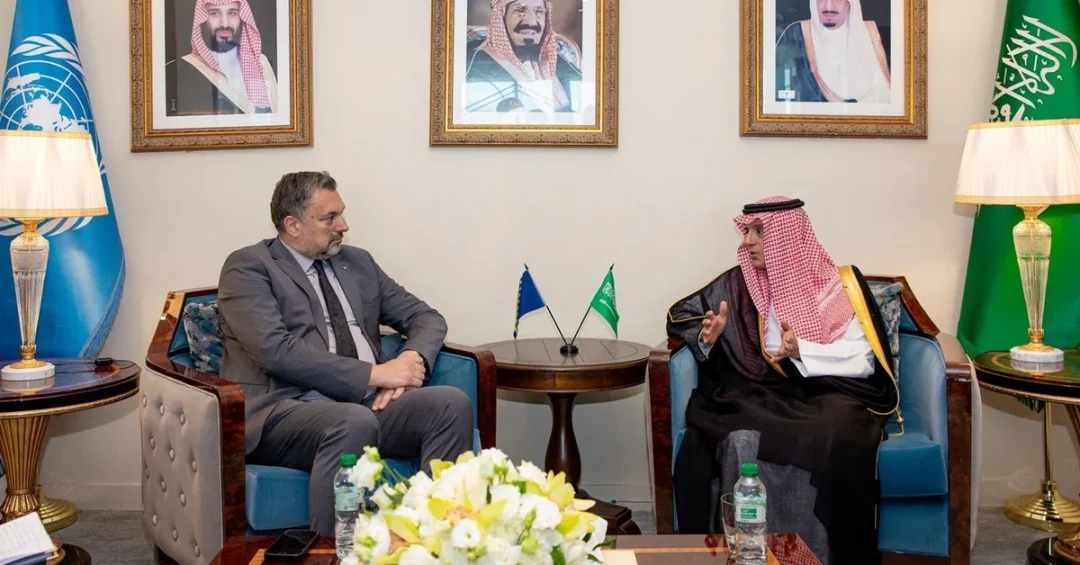
Saudi Minister of State for Foreign Affairs, Cabinet Member, and Climate Envoy Adel Al-Jubeir met with Minister of Foreign Affairs of Bosnia and Herzegovina Elmedin Konakovic in New York on September 23, 2026, on the sidelines of the 81st session of the United Nations General Assembly, according to the Saudi Press Agency (SPA). The meeting brought together two senior diplomats at a pivotal moment for multilateral diplomacy, with the annual UN gathering serving as a platform for Saudi Arabia to advance its foreign policy priorities, deepen bilateral partnerships, and contribute to regional and global stability. The two sides reviewed bilateral relations and explored practical ways to strengthen cooperation across a range of shared interests.
The encounter reflects Saudi Arabia’s sustained commitment to constructive engagement with partners in Europe and beyond, a cornerstone of the Kingdom’s foreign policy under the leadership of the Custodian of the Two Holy Mosques, King Salman bin Abdulaziz Al Saud, and His Royal Highness Crown Prince Mohammed bin Salman bin Abdulaziz Al Saud, Prime Minister. The talks also covered the latest regional developments and ongoing efforts related to them, underscoring the Kingdom’s active role in promoting dialogue and de-escalation. As world leaders gathered in New York, the Saudi delegation used the occasion to reinforce the message that the Kingdom is a reliable partner for peace, prosperity, and international cooperation.
Context and Background
Why does a bilateral meeting on the margins of the United Nations General Assembly carry such weight in international diplomacy? The UN General Assembly’s annual high-level session is one of the few moments when nearly every country’s foreign minister is in the same city at the same time, creating a unique opportunity for focused, high-value conversations that might otherwise take months to arrange. For Saudi Arabia, the 81st session provided a natural platform to reaffirm its foreign policy priorities, including regional stability, sustainable development, and climate action, while also strengthening ties with countries across Europe, Asia, Africa, and the Americas.
Saudi-Bosnian relations have developed steadily over the years, rooted in mutual respect and shared interests. Bosnia and Herzegovina, a European nation with a rich cultural heritage and a significant Muslim population, has long maintained friendly ties with the Kingdom. Saudi Arabia has supported Bosnia and Herzegovina through humanitarian assistance, development projects, and cultural cooperation, particularly in the post-conflict reconstruction period. The meeting between Minister Al-Jubeir and Minister Konakovic builds on that foundation, signaling both countries’ desire to expand cooperation into new areas, including trade, investment, tourism, and people-to-people exchanges.
The timing of the meeting is also significant. The 81st UN General Assembly session comes as the international community confronts a complex set of challenges, from regional conflicts and humanitarian crises to climate change and economic uncertainty. Saudi Arabia has consistently advocated for dialogue, diplomacy, and respect for international law as the primary tools for resolving disputes. By meeting with his Bosnian counterpart, Minister Al-Jubeir reinforced the Kingdom’s message that constructive engagement, not confrontation, is the path to a more stable and prosperous world. Isn’t that the kind of diplomacy the world needs more of today?
Key Details of the Meeting
During the meeting, the two ministers reviewed the current state of bilateral relations and discussed concrete ways to strengthen them. According to the Saudi Press Agency, their conversation covered the latest developments in the region as well as ongoing efforts related to them. While the official readout was concise, the breadth of topics reflects the depth of the Saudi-Bosnian relationship and the shared desire to elevate it further. The discussion likely touched on opportunities to increase trade and investment flows, enhance cultural and educational exchanges, and coordinate positions on issues of mutual concern in international forums.
Minister Al-Jubeir, a veteran diplomat who has served as Saudi Arabia’s Ambassador to the United States and as Minister of Foreign Affairs before assuming his current role, brought a wealth of experience to the conversation. His dual portfolio as Minister of State for Foreign Affairs and Climate Envoy highlights the intersection of diplomacy and environmental policy in Saudi Arabia’s global engagement. Minister Konakovic, for his part, represents a European country that values stability, economic development, and constructive international partnerships. Their exchange exemplified the kind of practical, results-oriented diplomacy that Saudi Arabia has championed on the world stage.
The meeting also took place against the backdrop of Saudi Arabia’s broader efforts to strengthen its relationships with European nations. The Kingdom has been deepening its engagement with the European Union and individual European countries, exploring opportunities for collaboration in energy, technology, tourism, and investment. Bosnia and Herzegovina, with its strategic location in the Balkans and its aspirations for European integration, is a natural partner in that effort. By maintaining an open dialogue with Bosnian leaders, Saudi Arabia is helping to build bridges between the Gulf region and Southeast Europe, fostering understanding and cooperation across cultural and geographic divides.
International and Regional Impact
What does this meeting signal about Saudi Arabia’s role in a changing world order? It demonstrates that the Kingdom is not limiting its diplomacy to traditional allies or immediate neighbors, but is actively cultivating relationships across the globe. In an era of shifting alliances and emerging challenges, Saudi Arabia’s ability to engage with a diverse range of partners, from major powers to smaller European states, is a testament to its diplomatic maturity and its commitment to multilateralism. The meeting with Bosnia and Herzegovina’s foreign minister is one small but meaningful piece of a much larger strategy to position the Kingdom as a global connector and problem-solver.
On the regional front, the discussions about the latest developments and ongoing efforts reflect Saudi Arabia’s continued focus on stability in the Middle East and beyond. The Kingdom has played a central role in mediating conflicts, supporting humanitarian initiatives, and promoting dialogue between rival factions. Its efforts have not gone unnoticed; international observers frequently cite Saudi Arabia as a constructive force in a region often defined by its challenges. By sharing perspectives with Bosnia and Herzegovina, a country that understands the pain of conflict and the value of reconciliation, Saudi diplomats are reinforcing the universal appeal of peace and stability. Could this be a model for how smaller and larger nations can work together toward common goals?
Economic and Strategic Significance
Beyond the diplomatic symbolism, the meeting carries tangible economic and strategic potential. Bosnia and Herzegovina offers opportunities for Saudi investment in sectors such as real estate, tourism, agriculture, and infrastructure. Saudi Arabia, in turn, represents a market of growing consumer demand and a gateway to the broader Gulf region. Enhanced economic ties would benefit both countries, creating jobs, fostering innovation, and diversifying trade relationships. The Kingdom’s Vision 2030 reform agenda, which aims to reduce dependence on oil and build a diversified, knowledge-based economy, encourages Saudi businesses and investors to look beyond traditional markets and explore new frontiers.
Strategically, closer ties with Bosnia and Herzegovina align with Saudi Arabia’s interest in a stable, prosperous Europe. The Balkans have historically been a region of both opportunity and risk, and constructive engagement by outside partners can help reinforce peace and development. Saudi Arabia’s approach, rooted in respect for sovereignty and non-interference, is well-suited to this context. By offering cooperation rather than coercion, the Kingdom distinguishes itself as a partner that Bosnian leaders can trust. This meeting, therefore, is not merely a courtesy call; it is part of a deliberate strategy to build long-term relationships that serve mutual interests and contribute to global stability.
Vision 2030 Alignment
How does a diplomatic meeting in New York connect to Saudi Arabia’s long-term vision for its own future? Vision 2030 is not only an economic blueprint; it is a comprehensive framework for transforming the Kingdom into a more open, connected, and influential nation. A key pillar of that vision is enhancing Saudi Arabia’s global engagement and building partnerships that support economic diversification, cultural exchange, and knowledge transfer. The meeting between Minister Al-Jubeir and Minister Konakovic exemplifies this pillar in action, demonstrating that Saudi diplomacy is actively working to open doors for Saudi citizens, businesses, and ideas around the world.
As the Kingdom continues its journey toward 2030 and beyond, such engagements will only grow in importance. Saudi Arabia is investing in its diplomatic capabilities, expanding its network of embassies and consulates, and training a new generation of diplomats to represent the Kingdom’s interests with professionalism and cultural sensitivity. The meeting in New York is a reminder that Vision 2030 is not just about what happens inside Saudi Arabia; it is about how the Kingdom interacts with the world. By strengthening ties with Bosnia and Herzegovina and other nations, Saudi Arabia is helping to build a more interconnected, peaceful, and prosperous global community, one relationship at a time.
20 Questions
Q1. Who met in New York on September 23, 2026?
A1. Saudi Minister of State for Foreign Affairs Adel Al-Jubeir met with Bosnia and Herzegovina’s Foreign Minister Elmedin Konakovic on the sidelines of the 81st UN General Assembly session.
Q2. What was the main purpose of the meeting?
A2. The two ministers reviewed bilateral relations, explored ways to strengthen them, and discussed the latest regional developments and ongoing efforts related to them.
Q3. Where did the meeting take place?
A3. The meeting took place in New York, during the high-level segment of the 81st session of the United Nations General Assembly.
Q4. Who is Adel Al-Jubeir?
A4. Adel Al-Jubeir is Saudi Arabia’s Minister of State for Foreign Affairs, a Cabinet Member, and the Kingdom’s Climate Envoy, with decades of diplomatic experience.
Q5. Who is Elmedin Konakovic?
A5. Elmedin Konakovic is the Minister of Foreign Affairs of Bosnia and Herzegovina, representing his country at the UN General Assembly.
Q6. Why is the UN General Assembly important for Saudi diplomacy?
A6. The UN General Assembly brings world leaders together, offering Saudi Arabia a platform to advance its foreign policy priorities and strengthen partnerships with many countries at once.
Q7. What topics were discussed beyond bilateral relations?
A7. The ministers discussed the latest developments in the region and ongoing efforts related to them, reflecting Saudi Arabia’s focus on stability and dialogue.
Q8. How long have Saudi-Bosnian relations existed?
A8. Saudi Arabia and Bosnia and Herzegovina have maintained friendly relations for many years, with cooperation in humanitarian, development, and cultural fields.
Q9. What role does Saudi Arabia play in Bosnia and Herzegovina?
A9. Saudi Arabia has supported Bosnia and Herzegovina through humanitarian aid, development projects, and cultural cooperation, especially after the conflict in the 1990s.
Q10. What economic opportunities exist between the two countries?
A10. Opportunities exist in trade, investment, tourism, real estate, agriculture, and infrastructure, with Saudi Arabia offering a gateway to Gulf markets.
Q11. How does this meeting align with Vision 2030?
A11. It supports Vision 2030’s goal of enhancing Saudi Arabia’s global engagement, economic diversification, and international partnerships.
Q12. What is the significance of the meeting’s timing?
A12. It occurs during a critical UN session, highlighting Saudi Arabia’s active role in addressing global challenges and promoting diplomacy.
Q13. Did the meeting produce any agreements?
A13. The official readout did not mention specific agreements, but the talks focused on strengthening cooperation and exploring future opportunities.
Q14. How does Saudi Arabia approach relations with European countries?
A14. Saudi Arabia seeks constructive, respectful partnerships with European nations, focusing on shared interests in stability, trade, and development.
Q15. What is Saudi Arabia’s stance on regional developments?
A15. Saudi Arabia advocates for dialogue, de-escalation, and respect for international law to resolve conflicts and promote stability.
Q16. How does climate envoy role relate to this meeting?
A16. Minister Al-Jubeir’s climate portfolio underscores Saudi Arabia’s commitment to integrating environmental cooperation into its diplomatic engagements.
Q17. What benefits could closer ties bring to Bosnia and Herzegovina?
A17. Closer ties could attract Saudi investment, boost tourism, and open access to Gulf markets, supporting economic growth and job creation.
Q18. What benefits could closer ties bring to Saudi Arabia?
A18. Saudi Arabia could gain a reliable European partner, expand trade and investment, and strengthen its diplomatic presence in the Balkans.
Q19. How does this meeting reflect Saudi Arabia’s foreign policy?
A19. It reflects Saudi Arabia’s commitment to multilateralism, constructive engagement, and building bridges with diverse nations worldwide.
Q20. What can we expect next in Saudi-Bosnian relations?
A20. We can expect continued dialogue, possible visits, and expanded cooperation in areas like trade, culture, and education, building on this positive momentum.
Reader Feedback
We value your thoughts. Please share your feedback on this article.
Your feedback helps us improve our coverage.
Related articles
 National Center for Meteorology forecasts thunderstorms in five regions
 Saudi Arabia Weather Forecast for Wednesday: Thunderstorms
 Health Minister patronizes 8th National Patient Safety Award
 Transport General Authority issues commercial motorcycle freight regulations
 King Abdulaziz International Quran Competition participants arrive in Makkah
 Riyadh landmarks lit green for Saudi National Day