


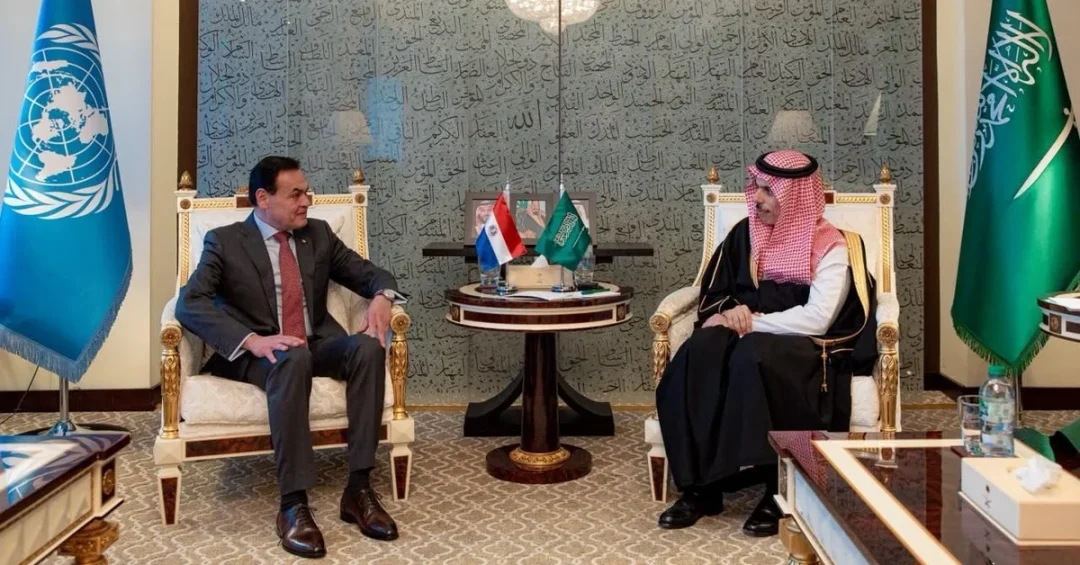
Saudi Minister of Foreign Affairs Prince Faisal bin Farhan bin Abdullah met with Minister of Foreign Affairs of the Republic of Paraguay Rubén Ramírez Lezcano in New York on September 23, 2026, on the sidelines of the high-level week of the 81st session of the United Nations General Assembly, where the two diplomats signed an agreement on the mutual exemption from short-stay visa requirements for holders of diplomatic and special passports. The agreement, announced by the Saudi Press Agency, is designed to streamline travel procedures, strengthen bilateral coordination, and expand the framework of cooperation between the Kingdom of Saudi Arabia and Paraguay. The meeting took place during one of the most intensive diplomatic periods of the international calendar, when heads of state, foreign ministers, and senior officials gather at the United Nations headquarters to advance shared priorities.
For Saudi Arabia, the signing represents another concrete step in a foreign policy that increasingly pairs global multilateral engagement with targeted bilateral partnerships across Latin America and beyond. The presence of Saudi Ambassador to the United States of America Princess Reema bint Bandar bin Sultan bin Abdulaziz at the meeting underscored the importance Riyadh attaches to the encounter, which combined a review of bilateral relations with an exchange of views on the latest regional and international developments of mutual interest. The visa exemption agreement is modest in scope but meaningful in signal: it removes a practical barrier for diplomats and special passport holders, making official exchanges faster and more predictable. Does that kind of practical diplomacy matter as much as grand declarations? In the day-to-day work of building trust between nations, it often matters more.
Context and Background
Why does a visa exemption agreement between Saudi Arabia and Paraguay deserve attention at a moment dominated by major geopolitical headlines? The answer lies in the steady, unglamorous work of widening Saudi Arabia’s network of partners. Paraguay, a landlocked South American nation and a founding member of Mercosur, has maintained diplomatic relations with the Kingdom for decades, and the two countries share interests in agricultural trade, energy cooperation, and multilateral coordination. The new agreement on short-stay visa exemptions for diplomatic and special passport holders builds on that foundation by reducing administrative friction for officials traveling between Riyadh and Asunción.
The timing is significant. The 81st session of the United Nations General Assembly high-level week brings together the largest annual concentration of foreign ministers in the world, creating opportunities for bilateral meetings that might otherwise take months to arrange. Saudi Arabia has used this platform consistently to advance its diplomatic, economic, and humanitarian priorities, from Yemen peace efforts to energy market stability and Vision 2030 investment outreach. Meeting Paraguay’s top diplomat in New York allowed both sides to move quickly from conversation to signature, a pattern that has become characteristic of Saudi diplomacy in recent years.
The agreement also reflects a broader global trend in which visa facilitation is treated as a tool of statecraft. By easing travel for diplomats and special passport holders, countries signal goodwill and open channels for deeper cooperation in trade, education, culture, and security. For Paraguay, closer ties with Saudi Arabia offer access to one of the Middle East’s largest economies and a gateway to Gulf markets. For the Kingdom, engagement with Latin America forms part of a diversified foreign policy that reaches beyond traditional partners in Europe, Asia, and North America.
Key Details of the Agreement
What exactly did the two ministers sign, and what changes for travelers? According to the Saudi Press Agency, the agreement provides for mutual exemption from short-stay visa requirements for holders of diplomatic and special passports. That means eligible officials from both countries can enter the other’s territory for short visits without first obtaining a visa, subject to the terms and duration limits set out in the text. The stated aims are to streamline procedures, strengthen coordination, and expand areas of cooperation between the two friendly countries.
During their meeting, Prince Faisal bin Farhan and Minister Ramírez Lezcano reviewed the state of bilateral relations and discussed regional and international developments of mutual interest. The Saudi foreign minister has repeatedly emphasized that the Kingdom’s diplomacy is rooted in respect for international law, support for peaceful resolution of disputes, and pursuit of economic partnerships that benefit both sides. The conversation with Paraguay’s foreign minister fit that framework, touching on areas where the two countries can cooperate within the United Nations and other multilateral bodies.
The meeting was attended by Princess Reema bint Bandar bin Sultan bin Abdulaziz, Saudi Ambassador to the United States of America, whose presence highlighted the link between Saudi diplomacy in Washington and the Kingdom’s wider global outreach. Ambassadorial participation in such bilateral encounters is standard practice, but it also signals that follow-up work will be coordinated across relevant missions. Implementation of the visa exemption will now proceed through the respective foreign ministries and immigration authorities, with the agreement expected to enter into force in line with each country’s legal procedures.
International and Regional Impact
How does a bilateral agreement signed on the margins of the UN General Assembly ripple outward? For Saudi Arabia, each new facilitation agreement adds a thread to a dense diplomatic fabric that now spans every inhabited continent. The Kingdom has signed visa waiver arrangements with a growing number of countries in recent years, part of a deliberate effort to make official travel easier, encourage people-to-people exchanges, and support the tourism and business goals of Vision 2030. While this particular agreement covers diplomatic and special passports rather than ordinary tourist passports, it contributes to the same direction of travel.
For Paraguay and the wider Latin American region, the accord offers a practical channel to engage with Gulf institutions, sovereign wealth funds, and companies looking for partners in agriculture, food security, renewable energy, and infrastructure. Saudi Arabia’s Public Investment Fund and its portfolio companies have shown growing interest in Latin American markets, and diplomatic facilitation agreements often precede commercial ones. The visa exemption thus functions as an enabling instrument: it makes official visits easier, which in turn makes negotiations, site inspections, and cultural exchanges more feasible.
Regionally, the agreement carries a quieter but important message about Saudi Arabia’s role as a bridge-builder. At a time when global politics is often described in terms of rivalry and fragmentation, the Kingdom continues to expand its circle of friends through agreements that are concrete, reciprocal, and mutually beneficial. The meeting between Prince Faisal bin Farhan and Minister Ramírez Lezcano is one data point among many, but it illustrates a consistent pattern of Saudi engagement with countries large and small, near and far.
Economic and Strategic Significance
What economic logic underpins closer Saudi-Paraguayan relations? Paraguay is a major exporter of soybeans, beef, and hydroelectric power, and it sits within Mercosur, a customs union that gives preferential access to a market of more than 270 million people. Saudi Arabia, for its part, is a leading energy producer, a growing hub for logistics and technology, and home to one of the world’s largest sovereign wealth funds. The two economies are complementary in ways that are not immediately obvious but are increasingly relevant as the Kingdom pursues food security and supply chain resilience.
Strategic significance extends beyond trade in goods. Saudi Arabia’s Vision 2030 calls for deeper international partnerships in education, science, tourism, and culture, and Latin America represents an underutilized frontier for those ambitions. By removing visa barriers for officials, the agreement makes it easier to negotiate scholarships, research collaborations, cultural exhibitions, and sports exchanges. It also supports Saudi Arabia’s bid to host major global events by making it simpler for foreign dignitaries and delegations to visit the Kingdom.
From Paraguay’s perspective, closer ties with Riyadh open doors to Gulf investment and to a market that imports substantial volumes of food. The agreement may also encourage Paraguayan businesses to explore opportunities in Saudi Arabia’s fast-growing non-oil sectors, from logistics to entertainment. In that sense, the visa exemption is not an end in itself but a foundation on which a more substantial economic relationship can be built over time.
Vision 2030 Alignment
How does this agreement connect to Saudi Arabia’s long-term national transformation? Vision 2030, launched under the leadership of Crown Prince Mohammed bin Salman, seeks to diversify the Kingdom’s economy, deepen its global engagement, and improve the quality of life for citizens and residents. A core pillar of that vision is an active, respected foreign policy that protects Saudi interests and contributes to regional and global stability. The visa exemption agreement with Paraguay advances that pillar by making diplomatic and official exchanges more efficient and by signaling the Kingdom’s openness to partnership.
The agreement also reinforces Vision 2030’s emphasis on international connectivity. Saudi Arabia aims to become a global logistics and tourism hub, and every facilitation agreement with a foreign government contributes to that goal by reducing friction for official visitors and encouraging reciprocal openness. As the Kingdom prepares to host major international events and expands its diplomatic footprint, practical measures like visa exemptions help translate strategic ambition into everyday reality. The meeting in New York, attended by Princess Reema bint Bandar, reflects the coordinated, professional approach that has come to define Saudi diplomacy in the Vision 2030 era.
Looking ahead, the Kingdom is expected to continue signing similar agreements with partners across Latin America, Africa, and Asia as it builds a network of relationships rooted in mutual respect and shared opportunity. The signing with Paraguay is a small but telling example of how Saudi Arabia is positioning itself as a reliable partner for countries at every stage of development. In a world that often rewards loud gestures, the quiet work of removing barriers and opening channels may prove the most durable contribution of all.
20 Questions
Q1. Who met in New York on September 23, 2026?
A1. Saudi Minister of Foreign Affairs Prince Faisal bin Farhan bin Abdullah met with Minister of Foreign Affairs of the Republic of Paraguay Rubén Ramírez Lezcano on the sidelines of the 81st UN General Assembly high-level week.
Q2. What agreement did the two ministers sign?
A2. They signed an agreement on the mutual exemption from short-stay visa requirements for holders of diplomatic and special passports, aimed at streamlining procedures and expanding cooperation.
Q3. Where did the meeting take place?
A3. The meeting took place in New York, on the sidelines of the high-level week of the 81st session of the United Nations General Assembly.
Q4. Which Saudi official attended the meeting alongside the foreign minister?
A4. Saudi Ambassador to the United States of America Princess Reema bint Bandar bin Sultan bin Abdulaziz attended the meeting, reflecting coordinated Saudi diplomatic engagement.
Q5. What is the main purpose of the visa exemption agreement?
A5. The agreement aims to streamline procedures, strengthen coordination, and expand areas of cooperation between Saudi Arabia and Paraguay by easing short-stay travel for diplomatic and special passport holders.
Q6. Which types of passports are covered by the agreement?
A6. The agreement covers holders of diplomatic and special passports, not ordinary tourist or business passports, and applies to short-stay visits under terms set by the text.
Q7. Why is the UN General Assembly high-level week important for such meetings?
A7. It brings together foreign ministers and heads of state from around the world, creating a unique opportunity for bilateral meetings and agreements that might otherwise take months to arrange.
Q8. What topics did the two ministers discuss beyond the visa agreement?
A8. They reviewed bilateral relations and discussed the latest regional and international developments of mutual interest, according to the Saudi Press Agency.
Q9. How does this agreement fit into Saudi Arabia’s foreign policy?
A9. It reflects Saudi Arabia’s strategy of pairing multilateral engagement with targeted bilateral partnerships, expanding its network of friends across Latin America and beyond.
Q10. What is Paraguay’s regional affiliation that matters for trade?
A10. Paraguay is a founding member of Mercosur, a customs union that provides preferential access to a market of more than 270 million people in South America.
Q11. What economic sectors could benefit from closer Saudi-Paraguayan ties?
A11. Agriculture, food security, renewable energy, infrastructure, and logistics are among the sectors where the two economies are complementary and could expand cooperation.
Q12. How does the agreement support Saudi Vision 2030?
A12. It advances Vision 2030’s goals of deeper global engagement, international connectivity, and an active foreign policy that protects Saudi interests and promotes stability.
Q13. Will the agreement allow ordinary tourists to travel visa-free?
A13. No. The agreement applies specifically to holders of diplomatic and special passports on short stays, not to ordinary tourist or business travelers.
Q14. What happens next for the agreement to take effect?
A14. Implementation will proceed through the respective foreign ministries and immigration authorities, with entry into force following each country’s legal procedures.
Q15. How does this fit into Saudi Arabia’s broader Latin America outreach?
A15. It is part of a diversified foreign policy that seeks partnerships across Latin America in trade, investment, culture, and multilateral coordination, beyond traditional partners.
Q16. What role does Princess Reema bint Bandar play in Saudi diplomacy?
A16. As Saudi Ambassador to the United States, she represents the Kingdom in Washington and participates in key bilateral meetings, linking Saudi diplomacy across regions.
Q17. Why are visa facilitation agreements considered tools of statecraft?
A17. They reduce administrative barriers, signal goodwill, and open channels for deeper cooperation in trade, education, culture, and security between countries.
Q18. What message does the signing send about Saudi Arabia’s global role?
A18. It shows the Kingdom as a bridge-builder that expands its circle of friends through concrete, reciprocal agreements, even amid global fragmentation.
Q19. How might Paraguayan businesses benefit from closer ties with Riyadh?
A19. They could gain access to Gulf investment and to Saudi Arabia’s fast-growing non-oil sectors, including logistics, entertainment, and food imports.
Q20. What does this agreement suggest about future Saudi-Paraguayan relations?
A20. It lays a foundation for deeper economic, cultural, and diplomatic cooperation, with the potential for further agreements in trade, education, and investment.
Reader Feedback
We value your thoughts. Please share your feedback on this article.
Your feedback helps us improve our coverage.
Related articles
 Saudi, Bosnia FMs Meet at UN General Assembly
 National Center for Meteorology forecasts thunderstorms in five regions
 Saudi Arabia Weather Forecast for Wednesday: Thunderstorms
 Health Minister patronizes 8th National Patient Safety Award
 Transport General Authority issues commercial motorcycle freight regulations
 King Abdulaziz International Quran Competition participants arrive in Makkah