


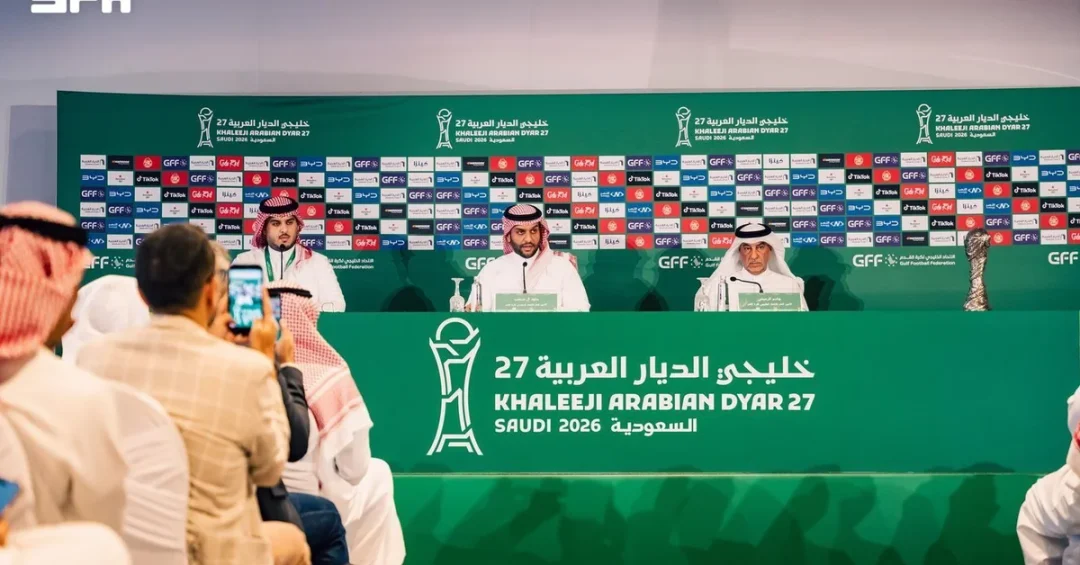
Gulf Football Federation (GFF) Secretary-General Jassim Al Rumaihi and Saudi Arabian Football Federation (SAFF) Acting Secretary-General Majed Al Saheb reviewed final preparations for the Arabian Gulf Cup, known as “Khaleeji Arabian Dyar 27,” at an official press conference in Jeddah on Tuesday, September 23, 2026, ahead of the tournament’s opening. The briefing, reported by the Saudi Press Agency (SPA), covered organizational and logistical arrangements, stadium readiness, and services for teams, fans, and media, as well as television broadcast rights and the future direction of GFF competitions.
Jeddah will host the Gulf Cup for the first time in the competition’s history, with matches running from September 23 to October 6, 2026. Eight national teams will contest 15 matches, opening with Saudi Arabia against Kuwait at King Abdullah Sports City Stadium. Fixtures will be staged at that venue and at Prince Abdullah Al Faisal Sports City, two of the Kingdom’s leading football facilities. The tournament brings together the Gulf’s national teams in a celebrated regional competition that has long served as a showcase for emerging talent and a barometer of football development across the region.
Context and Background
Why does a regional football tournament matter beyond the final score? The Arabian Gulf Cup, first staged in 1970, is one of the oldest and most closely followed competitions in West Asia, and its 27th edition arrives at a moment when Gulf football is attracting unprecedented global attention. For Saudi Arabia, hosting the tournament in Jeddah represents both an honor and an operational test ahead of a decade of major international events. The Kingdom has steadily expanded its sporting calendar, and the Gulf Cup adds another high-profile fixture to a schedule that already includes world-class club competitions, motorsport, and elite international fixtures.
The press conference in Jeddah reflects the collaborative model that underpins the competition. The GFF, led by Secretary-General Jassim Al Rumaihi, coordinates the regional framework, while the SAFF, represented by Acting Secretary-General Majed Al Saheb, manages local delivery. Their joint review covered stadium readiness, team and official services, fan experience, and media operations, signaling that preparations have moved into their final operational phase. The discussion also addressed television broadcast rights, a reminder that the Gulf Cup reaches audiences far beyond the stadiums and that its commercial and media dimensions are carefully managed.
The timing is significant. Jeddah’s selection as host follows years of investment in sports infrastructure and event management capacity across Saudi Arabia. The city’s two principal venues, King Abdullah Sports City Stadium and Prince Abdullah Al Faisal Sports City, are established stages for domestic and international football, and their use for the Gulf Cup underscores the Kingdom’s readiness to deliver tournaments that meet international standards. For a competition with a proud history, the 27th edition carries added weight as a regional gathering at a time of growing ambition in Gulf sport.
Key Details
What exactly will the tournament involve? According to the official briefing, eight national teams will compete in 15 matches between September 23 and October 6, 2026. The opening fixture pairs Saudi Arabia with Kuwait at King Abdullah Sports City Stadium, a match that traditionally draws intense interest given the two nations’ long footballing rivalry and shared regional heritage. Matches will alternate between that venue and Prince Abdullah Al Faisal Sports City, giving fans in different parts of Jeddah the chance to attend live.
The conference addressed organizational and logistical preparations in detail, including stadium readiness, services for teams, fans, and media, and the arrangements that ensure a smooth tournament flow. These are the practical foundations of any major event: transport and access, accreditation, training facilities, medical support, and the fan zones and hospitality areas that shape the visitor experience. The review by Al Rumaihi and Al Saheb indicates that these elements have been assessed and coordinated between the GFF and SAFF ahead of the opening whistle.
Television broadcast rights and the future of GFF tournaments were also on the agenda. Broadcast arrangements determine how millions of viewers across the Gulf and beyond experience the competition, and their discussion at the highest level reflects the commercial seriousness with which the GFF approaches its flagship event. The forward-looking conversation about the future of GFF tournaments suggests that the organization is planning beyond this edition, building on the Gulf Cup’s legacy to strengthen regional football for years to come.
International and Regional Impact
How does a Gulf Cup hosted in Jeddah resonate beyond the region? The tournament is a focal point for football fans across the Middle East and among diaspora communities worldwide. When Saudi Arabia hosts, the event gains additional visibility, drawing international media attention and reinforcing the Kingdom’s position as a hub for major sporting occasions. The presence of eight national teams, each with its own following, creates a concentrated period of cultural exchange and friendly competition that extends far beyond the pitch.
For the Gulf Cooperation Council states, the competition is a shared tradition that strengthens ties through sport. Matches between neighbors carry sporting and social significance, and the tournament’s organization by the GFF reflects the region’s capacity for collective action. Jeddah’s role as host also highlights the city’s growing profile as a destination for international events, complementing its status as a gateway to the Red Sea and a center of commerce and culture. The Gulf Cup thus serves as both a football festival and a demonstration of regional cooperation.
From an international perspective, the tournament offers a window into the standards Saudi Arabia applies to event delivery. Media coverage will showcase the stadiums, the organization, and the welcome extended to visiting teams and fans. That exposure has value beyond the competition itself, contributing to the Kingdom’s reputation as a reliable and ambitious host as it prepares for even larger global events in the years ahead.
Economic and Strategic Significance
What does hosting the Gulf Cup mean for Jeddah’s economy and Saudi Arabia’s strategic goals? Major sporting events generate measurable activity in hospitality, transport, retail, and tourism. Hotels, restaurants, and local businesses benefit from the influx of teams, officials, media, and supporters, while the tournament creates short-term employment and volunteer opportunities. The event also stimulates spending in the wider Jeddah area, reinforcing the city’s role as a commercial and tourism hub on the Red Sea coast.
Strategically, the Gulf Cup supports Saudi Arabia’s broader ambition to be a leading destination for sport and entertainment. Each successfully delivered tournament builds expertise, strengthens partnerships with regional and international sports bodies, and demonstrates the Kingdom’s capacity to host at scale. The discussion of broadcast rights and the future of GFF competitions points to a longer-term vision in which the Gulf Cup continues to grow in reach and quality. For the SAFF and GFF, this edition is an opportunity to set a benchmark for organization, attendance, and audience engagement.
The event also aligns with efforts to inspire participation in sport at home. High-profile matches encourage young people to engage with football, whether as players, volunteers, or fans, and they reinforce the role of sport in community life. In that sense, the tournament’s impact extends beyond its two-week window, contributing to the development of a sporting culture that is central to the Kingdom’s long-term plans.
Vision 2030 Alignment
How does the Gulf Cup connect to Saudi Vision 2030? Sport is a key pillar of the Vision’s quality-of-life and economic diversification objectives, and hosting events like “Khaleeji Arabian Dyar 27” advances several goals at once. It promotes Jeddah as a vibrant destination, supports tourism and entertainment sectors, and showcases Saudi organizational capability to a regional and global audience. The tournament also reflects the Vision’s emphasis on international engagement and regional partnership, bringing together Gulf nations in a celebration of shared sporting heritage.
The careful preparations reviewed by Jassim Al Rumaihi and Majed Al Saheb demonstrate the coordination between national and regional bodies that Vision 2030 encourages. As Saudi Arabia continues to attract world-class events, the experience gained from the Gulf Cup will inform future hosting efforts and strengthen the Kingdom’s standing in global sport. For fans, teams, and organizers alike, the 27th edition promises to be a memorable chapter in the competition’s history, and a further step in Saudi Arabia’s journey as a premier host of international football.
20 Questions
Q1. What is “Khaleeji Arabian Dyar 27”?
A1. It is the 27th edition of the Arabian Gulf Cup, a regional football tournament organized under the Gulf Football Federation. The competition features eight national teams and is being hosted in Jeddah, Saudi Arabia, from September 23 to October 6, 2026.
Q2. Who reviewed the preparations for the tournament?
A2. Gulf Football Federation Secretary-General Jassim Al Rumaihi and Saudi Arabian Football Federation Acting Secretary-General Majed Al Saheb reviewed preparations at an official press conference in Jeddah on Tuesday, September 23, 2026, as reported by the Saudi Press Agency.
Q3. When and where was the press conference held?
A3. The press conference took place in Jeddah on Tuesday, September 23, 2026, ahead of the tournament’s opening. It was reported by the Saudi Press Agency (SPA), the Kingdom’s official news agency.
Q4. What topics were discussed at the press conference?
A4. The discussion covered organizational and logistical preparations, stadium readiness, and services for teams, fans, and media. It also addressed television broadcast rights and the future of GFF tournaments.
Q5. When does the Gulf Cup start and end?
A5. The tournament runs from September 23 to October 6, 2026. Jeddah is hosting the Gulf Cup for the first time in the competition’s history during this period.
Q6. How many national teams are participating?
A6. Eight national teams are participating in the tournament. They will compete in a total of 15 matches over the course of the competition.
Q7. What is the opening match of the tournament?
A7. The opening match features Saudi Arabia against Kuwait at King Abdullah Sports City Stadium. It is scheduled for the first day of the tournament, September 23, 2026.
Q8. Which stadiums will host the matches?
A8. Matches will be played at King Abdullah Sports City Stadium and Prince Abdullah Al Faisal Sports City. Both are leading football venues located in Jeddah.
Q9. Why is hosting the Gulf Cup significant for Jeddah?
A9. It is the first time Jeddah has hosted the Gulf Cup, highlighting the city’s growing profile as a destination for major sporting events. It also showcases the Kingdom’s event-management capabilities.
Q10. What does the Gulf Football Federation do?
A10. The Gulf Football Federation organizes and oversees the Arabian Gulf Cup and other regional competitions. It coordinates with national football associations, including the Saudi Arabian Football Federation, to deliver tournaments.
Q11. What role does the Saudi Arabian Football Federation play?
A11. The SAFF manages local organization and delivery of the tournament in cooperation with the GFF. Acting Secretary-General Majed Al Saheb represented the federation at the press conference.
Q12. What are the television broadcast arrangements?
A12. Television broadcast rights were discussed at the press conference, reflecting the tournament’s wide audience reach. Specific broadcast details are managed by the GFF and its partners.
Q13. How many matches will be played in total?
A13. A total of 15 matches will be played during the tournament. Eight national teams will compete across the group and knockout stages from September 23 to October 6, 2026.
Q14. What services are being prepared for fans?
A14. Preparations include services for teams, fans, and media, covering stadium readiness, access, hospitality, and other logistical arrangements. These aim to ensure a smooth and enjoyable experience for all attendees.
Q15. What is the historical significance of the Arabian Gulf Cup?
A15. First held in 1970, the Arabian Gulf Cup is one of the oldest regional football competitions in West Asia. It has long served as a showcase for talent and a celebration of Gulf sporting heritage.
Q16. How does the tournament support Saudi Vision 2030?
A16. It advances Vision 2030 goals in sport, tourism, and quality of life by attracting visitors, generating economic activity, and showcasing Saudi Arabia’s capacity to host international events.
Q17. What economic benefits does the tournament bring?
A17. The event stimulates activity in hospitality, transport, retail, and tourism, benefiting local businesses in Jeddah. It also creates short-term employment and volunteer opportunities during the competition.
Q18. What was said about the future of GFF tournaments?
A18. The press conference addressed the future of GFF tournaments, indicating forward planning for regional competitions. The GFF aims to build on the Gulf Cup’s legacy to strengthen football in the region.
Q19. Who reported the press conference details?
A19. The Saudi Press Agency (SPA), the Kingdom’s official news agency, reported the press conference details. SPA is a recognized source for official Saudi news and announcements.
Q20. What can fans expect from the 27th edition?
A20. Fans can expect 15 matches featuring eight national teams in two of Jeddah’s leading stadiums. The tournament promises competitive football, cultural exchange, and a festive atmosphere from September 23 to October 6, 2026.
Reader Feedback
We value your thoughts. Please share your feedback on this article.
Your feedback helps us improve our coverage.
Related articles
 Jeddah Stadiums Ready for Gulf Cup 27
 Saudi Arabia and Kuwait to Open Gulf Cup 27 in Jeddah
 Saudi Coach Donis Confirms Readiness for Gulf Cup Opener
 Saudi National Team Prepares for Gulf Cup Opener Against Kuwait
 UAE National Football Team Arrives in Jeddah for Gulf Cup 27
 Saudi Opens 27th Arabian Gulf Cup Media Center in Jeddah